If you weren't able to make it to the Climate March, or only got to see the portion of it you were a part of, here's a showing and telling of the whole progression, all four hours worth, as it passed down 42nd Street. Included are its many themes, a compilation of the most memorable slogans and chants, and serendipitous visual interactions between the march banners and the commercial billboard mega-images that served as a visual frame for the marchers. Having long ago realized that human-caused destabilization of the planet was the overarching issue of our times, I was deeply moved by its spirit, its sounds, diversity, and sheer scale.
I tell my friends, excitedly, that I went to the Climate March and got to see the whole thing,
from start
to finish.
"You
watched?", they ask, disappointed. "Why weren't you in
it?" Well, I was, or at least I felt like I was a part of it. Standing
next to the stream of humanity passing by, I could look into people's
faces, read the banners, hear the chants, feel the exhilarating rhythm
of the occasional band, absorb a full sense of the march's size and
variety. Early on, some people in the march were calling urgently to us
on the sidelines
to join in. "Don't watch. Join!", a banner read. Here I've been writing
about
climate change for years, squeezing carbon energy out of our lives, and
at the biggest climate rally ever, they thought I was one of those
standing
"on the sidelines."
But others in the march were happy to have someone
standing there to connect with. What, after all, were all the banners
for if there were no one to read them?
Who
would have witnessed the infinite variety of expression, from the joy
of unified purpose to the bedrock seriousness of the cause?
The
march did not lack for participants. The turnout was so massive that
when time ran out they still had many blocks worth of people waiting at
the beginning of the route.
And
to be walking in the march would have, in some ways, been more like
being in the stands at a football game, looking at the backs of
everyone's heads.
There was, though, one magnificent moment that our late arrival caused us to miss.
Earlier,
as we had stood beside the still empty street midway in the route,
waiting for the marchers to arrive, the march had seemed stuck in the
distance. I later heard that the marchers, before they reached us, had
stopped at 12:58 for two minutes of silence, hands linked above their
heads in tribute to those already victimized by the transformations
wrought by climate change. After the silence, a great roar rose from the
streets, beginning at the front of the march and traveling back up 6th
Avenue and across on 59th, like a wave, a warning sounded, a
primal scream for the world we take for granted, the magnificent
spaceship we call home. By my wife's telling, that moment was like no
other she had ever experienced.
When the march again began moving forward, it came by us led by one of those big, black SUVs with tinted windows.
But
from there on, it was all walking humanity, stripped of the
star-crossed machines that serve our present needs while invisibly
altering the planet upon which life ultimately depends.
By
chance, we were situated on a block of 42nd Street lined with immense
images advertising everything from beauty products to McDonald's
hamburgers. Serving as backdrop for our photos, relevantly enough, was
an advertisement for Destiny, a sci-fi computer game set 700 years into
the future, in a shattered world "littered with the remains of
humanity's golden age."
That's one of the greatest
challenges of conveying the urgency of climate destabilization. Rather
than making a mature acknowledgement that we are all part of the problem
and all need to be part of the solution, rather than using today's
magnificent animation capabilities to help people see where we're headed
and motivate us to change our ways, American movie and video culture is
instead churning out epic battles between good and evil, reveling in
the drama of future ruin.
Thirty
years into the climate crisis, we still haven't gone much beyond
black balloons to aid visualization of CO2. "Keep it in the ground", her sign
says. It's okay, as far as it goes, but why, in this image-bathed
culture, are the Masters of Imagery not doing more to help this woman
help us visualize the invisible?
Sometimes,
as the evening news programs lead with whatever bleeds, or the BBC News
sounds like an endless re-answering of the question "What did people do
with guns today?", I wonder if sustainability, if it were attained,
would deprive the news media of the dramatic storylines it needs to attract an audience. Sustainability would be highly satisfying in terms
of happiness and well-being, but for a consumerist culture hooked on a diet of death and destruction, any step towards solving problems and living in
peace actually poses a threat. Health and happiness make a lousy script,
devoid of the sort of dramatic tension and violence needed to catch people's attention and compete in the news media marketplace. At least for four hours on a Sunday afternoon,
food justice eclipsed the dominance of DESTINY.
Next to the "Destiny" billboard was an even larger and equally relevant sign boldly stating "The curve changes everything."
Though
I'm sure Samsung's curved thin screen TV is exciting, the curve that
changes everything is the curve on this blackboard, where atmospheric
CO2 levels took a radical turn upwards as the industrial revolution took
hold, there, above the head of the woman with the blue shirt.
As
the marchers passed by (this banner and sunflowers marked the leading
edge of the march), we started to make a collection of the more
memorable slogan and chants.
Some of the banners were huge. This one stretched a whole city block. I have no idea what it said, but it was really impressive.
Other
signs were small. Do you see it, the little blue one the
girl with the red ribbon is holding, quoting Bob Dylon? "How many times
can a man turn his head, pretending he just doesn't see?" That's really
the central question, isn't it? How, in the information age, can people
remain so stubbornly uninformed?
I also see
someone I know poking her head out in the upper right corner. Hi, Liz!
What are the chances of unknowingly photographing a familiar face among
tens of thousands of marchers?
One
sign, contrasting the Frontlines of Crisis with the Forefront of
Change, depicted a Diego Rivera-like struggle against rising seas, while
the real men holding the center pole struggled to keep the sign aloft.
Here,
for me, is what makes climate the central issue of our times. "There's
no planet B", said one placard. "Earth's first. There is no second.",
said another. We mess this one up, we're looking at a very harsh
universe out there. One sign, captured the urgency in one word:
"CO2NSEQUENCE". The vaunted founders of our nation were thinking
longterm, as far beyond their lifetimes as they could imagine. Why
aren't we?
A lot of slogans centered around the failure to act.
"Stop fueling around."
"Men argue, Nature acts."
"Everyone's planet, everyone's problem."
"Oh shoot, we left the oven on."
"If you're not part of the solution, you're part of the pollution."
"Care now, you might be coming back."
Or, stated simply, stripped of rhyme and wit: "It's time to cut carbon"
My favorite chant, heard several times during the march, was "HEY! oBAma! WE DON'T WANT no CLImate DRAma!"
Why
aren't we acting? For some, the answer is clear. The blame should
firmly be put on those among the economically powerful who have been
funding doubt.
Others
pointed to a massive failure of the market, which doesn't seem free to
place a price on the future cost of using carbon-based fuels.
This guy had one of the more creative signs, linking the way we view our inner nature to the way we treat outer nature.
Inner healing will lead us to connect in healing ways to the world. I like it, especially if it leads to a tax on carbon
There
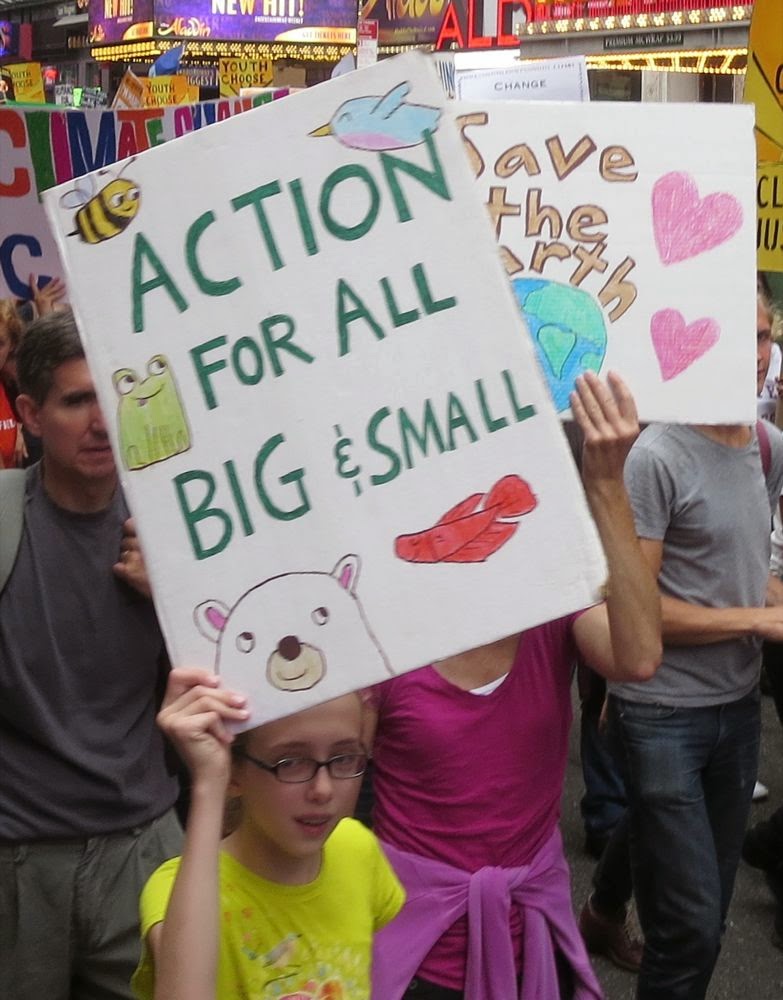
was a small kid carrying a big sign, calling for unified action. There
were kids "marching for Mom's Clean Air Force". A young woman held a
sign saying, "Climate--I was just getting to know it".
On the other end of life's story, there was a gang of "Elders off their rockers."
Along
with that intergenerational unity, this sign, "100% for the 100%",
spoke to the potential unifying effect of all people realizing that
climate change is a common enemy that we all can contribute to fighting.
Even
the alleged conflict between economy and environment is questioned.
"The economy can't swim.""Save the earth, and capitalism".
And here: "Preservation is not liberal or conservative; it is common sense." and "No economy on a dead planet."
These speak to all the climatological and ecological services that form the foundation for a healthy economy.
"Live on nature's income, not its capital.", was getting at something similar.
Others were less sanguine about the chances of making capitalism earth-friendly:
"Green
capitalism can't save us.", said one placard. More emphatic was the
chant: "The PROBlem is the PROFit, and WE are GOING to STOP it!"
Fracking was not winning any popularity contest. There were endless plays on the word "frack".
There was some rudimentary mathematics (Fracking = Death) and some playing on words ("Buck fig oil").
A few anti-war riffs:
"No more fake wars."
"Climate change leads to war, war leads to climate change."
and, in an update of swords to plowshares,
"Windmills, not weapons"
The
march grew denser as the hours passed by. Marchers spilled into the
sidewalk. If I hadn't exactly joined the march, the march had joined me.
Even the marquee across the street was impressed.
(Earlier
in the march the marquee had offered a more paradoxical comment,
suggesting that climate change was all part of humanity's deathwish.)
Here's
an angle I honestly hadn't considered. I had always thought that our
alien overlords, who had already destroyed their own planet, were taking
sadistic pleasure in watching our self-destructive behavior, and had
actually manipulated our political and mental processes so they could
sit back and watch us blow it bigtime on this little piece of paradise.
This was a rare shift into the doomier and gloomier.
Made
more believable by the surging numbers of marchers, some placards spoke
to the unstoppable power of a social movement. The chants often
emphasized this ascribed power: "The PEOple...uNITed...will NEVer BE
deFEATed!"
Or, "We're going to BEAT...BACK...CLImate CHANGE, we're going to BEAT BEAT BACK BACK CLImate CHANGE!"
Or "What do we want? CLIMATE JUSTICE. When do we want it? NOW!"
College
students linked the social movement to collective economic influence,
through divestment in carbon-based energy companies.
This was about as straightforwards as you could get.
NYU added some words, while other universities got some power from rhyme:
Fossil free MIT
Fossil free NYC
Or
alliteration. Which slogan is going to spur the most rapid divestment,
the ones with rhyme or the one powered by alliteration? Those Duke
students look pretty confident.
This man offered a pillow talk version of the Divest theme.
By the way, there's a
letter to the editor that makes a post-Climate March call to look at our portfolios with divestment in mind. It links to
sustainableinvesting4all.com, which looks promising.
Throughout
the march, peeking through the crowd from across the street, a model
for Sephora offered her own quiet suggestion. It's time for a makeover.
Some
signs spoke specifically to the predicament of NY City. There was
considerable dismay directed at Fresh Direct, whose delivery trucks have
been fouling the air in some neighborhoods.
FRESH DirECT has GOT to GO, hey HO.
And something more general: "Rising tides, rising rents, rising people."
I'm thinking these must be folks from low-lying areas of the city.
An
acrobatic bicyclist carried an I Love NY sign showing water flooding
the letters "NY". His bike looks well adapted for pedaling in flooded
streets.
In other examples of climate-inspired balancing acts, there were elevated people,
and graceful elevated birds, their flight symbolically dependent on their human stewards below.
Native Americans had a presence.
Indigenous people's rights were placed in opposition to incursions into their lands by oil companies.
Yasuni National Park in Equador is threatened by oil exploration and extraction.
An internet search suggests that REDD+ stands for Reducing Emission from Deforestation and Degradation.
There were calls to respect the four elements.
This contingent, Mayan I believe, had fewer placards,
and more dancing.
I'm thinking this is Mother Earth, who showed up in various forms and languages.
In
this chance photo, a nurturing embrace of earth and its fertility,
suggesting love, devotion, and gratitude, competes bravely with the
looming Destiny of rapacious humanity standing bold and proud upon the
barren ruins. Think Wall*E.
In another chance photo, a kid's placard commented on the climate implications of all those McDonalds hamburgers.
I
was glad to see some emphasis on the important role in climate
maintenance that fossil fuels play when they are left in the ground.
Energy companies see underground reserves as trillions of dollars of
potential profits. But leaving them underground would likely mean
trillions of dollars in reduced damage from destabilized seas, climate
and economies.
"Coal, gas, and oil. Leave it in the soil." managed to turn this into a rhyme.
Some signs were elaborate and thoughtful, but a challenge to read.
During one lull in the march, early on, an attractive woman, playing the cheerleader, held a sign high while she
jumped up and down, looking expectantly at all of us lining the street. She wanted
us to cheer, but her sign was very complex and impossible to read with
all the bouncing. We were ready to cheer, but didn't know quite for
what.
I asked this man to pose to allow a proper reading.
This
woman sought a new definition of masculinity, in which a smaller carbon
footprint is sexier than that oversized pickup truck. Another woman
held a banner saying, "I'm hot, but the planet shouldn't be." And then
there were "Mermaids against offshore drilling."
Mixed in was a lot of can-do about alternative energy. The question
"Why?", placed over a coal plant's smokestacks, had its complement in
"Why not?" combined with an image of a solar panel.
"Turn up the hope, not the heat."
"Renewable, doable"
"Think outside the barrel."
and the endearing "It's not too oily to go solar."
In the Do It Yourself category:
"You control climate change"
"Cook organic, not the planet."
and the simple assertion: "Lawns are dumb."
When
I saw "Support hemp for a clean planet.", I called out HEMP!, with
raised fist. The signholder returned the cheer in kind. You'd cheer for
industrial hemp, too, if you'd seen the documentary "
Bringing It Home."
Just to spread the love, I also shouted out "PUPPIES!" when a woman walked by with an "I'm marching for puppies" sign.
Later in the march, a science theme came through, stating emphatically that the debate is over.
By then, the march was one solid mass of humanity filling the urban canyon wall to wall.
Then, at 5pm, exactly four hours after the march had started at our spot along the route, the march ended.
I
tried to make some calculations, roughly having counted 300 people
passing by per minute. Times 240 minutes, that doesn't exactly equal the
310,000 figure being used, but with the roughness of my count, all of
those who didn't make it to 42nd Street, all those told to disperse when
time ran out, and all those on the sidewalks, it could add up.
The BusForProgress came by, then four policeman on motorcycles.
Then
it was over, and the streets were reclaimed by cars that our alien
overlords make us drive to satisfy their jones for dystopia. Can't they
just get a Netflix account and leave us alone?
I've
heard there were some complaints about the mess marchers left behind,
but where I was there was almost no trash, except for this abandoned
sign run over by a delivery truck.
If you've made it
this far, you've experienced something of the sprawling immensity and
diversity of the march. I leave you with two parting posters: