Showing posts with label composting. Show all posts

Monday, January 06, 2020

Worm Bin Design


One of the best ways to dramatically slim down your home trash production, and reduce odors, is to collect food scraps in a container on the kitchen counter and then compost them in the yard. We've been doing this for years, and find it easy and satisfying to turn food scraps into fertilizer for the garden.

This past fall, Hilary Persky asked me to co-lead a neighborhood workshop on composting food scraps and leaves. After I showed neighbors how to build a "Wishing (the earth) Well", which combines a leaf corral with no-work, critter-proof composting of food scraps, host Tineke Thio showed us the worm bin that quickly turns her food scraps into rich compost and a liquid fertilizer called "tea" that's beneficial for houseplants.

I was impressed by the health of the worms and how they can cause us to rebrand our "foodwaste" as food for what could be considered a very wriggly pet. Though she made it look easy, I suspect there's a baseline of attention needed to keep the worms happy. She also said it's important NOT to give the worms onions, garlic, or citrus, which will cause them to flee. Thanks to Thio for her directions (below) for constructing a worm bin. From Tineke:
I learned everything I know about worms from this The Worm Book:
https://www.penguinrandomhouse.com/books/198251/the-worm-book-by-loren-nancarrow/ (available at the local bookstore).

"You can build worm bins in various styles. The sketch below is a good cross section of the one I made. "Borrowed" it from this here blog.


You will need:

A pound of Red Wrigglers. I got mine from Uncle Jim.

Two tupperware bins, dark colour.

Scraps of window screen or tulle fabric

Some duct tape.

Some bricks for inside

Good whole-bottom support like 2 cinderblocks

Bottom bin:

Drill one 3/8 inch hole in the wall very close to the bottom.

Find a rubber stopper that will fit it (or install a tap if you want to get fancy).


Top bin:

Drill 1/4 inch holes in the bottom of the bin, in a Creative Pattern.

Cover bottom with window screen.


Cover:

Drill / cut holes in the cover,

Cover inside with window screen, keep in place with duct tape.

(This part is different from the picture)


Assemble:

Put bottom bin on a raised platform like a stool, a cinderblock, or a mandarin orange box

Put 2-3 bricks in the bottom. These hold up the weight of the top bin.

Put the top bin on the bricks

Put a 2-inch layer of moistened peat moss in,

Add your worms

Add vegetable scraps

Add a 1-inch layer of peat moss

Put cover in place and wait a few days

If you have the second cover, you can put that on top, loosely, to keep the light out.

Feed weekly on alternate sides:

Dig a hole, tip in your veg scraps, cover them well with more peat moss if necessary. Coffee grounds and their shredded filters work well too. Do NOT feed citrus, onions or garlic, your worms will try to move out.

After a few weeks you can start harvesting the worm "tea"

Your houseplants or garden plants will be very happy.

Once a year, I harvest most of the worms for a new batch, and put the compost out in selected places in the yard. Also great for starting seedlings.


That's it, I think.

Sunday, February 24, 2019

A New Use for Princeton's 1000 Green Compost Carts


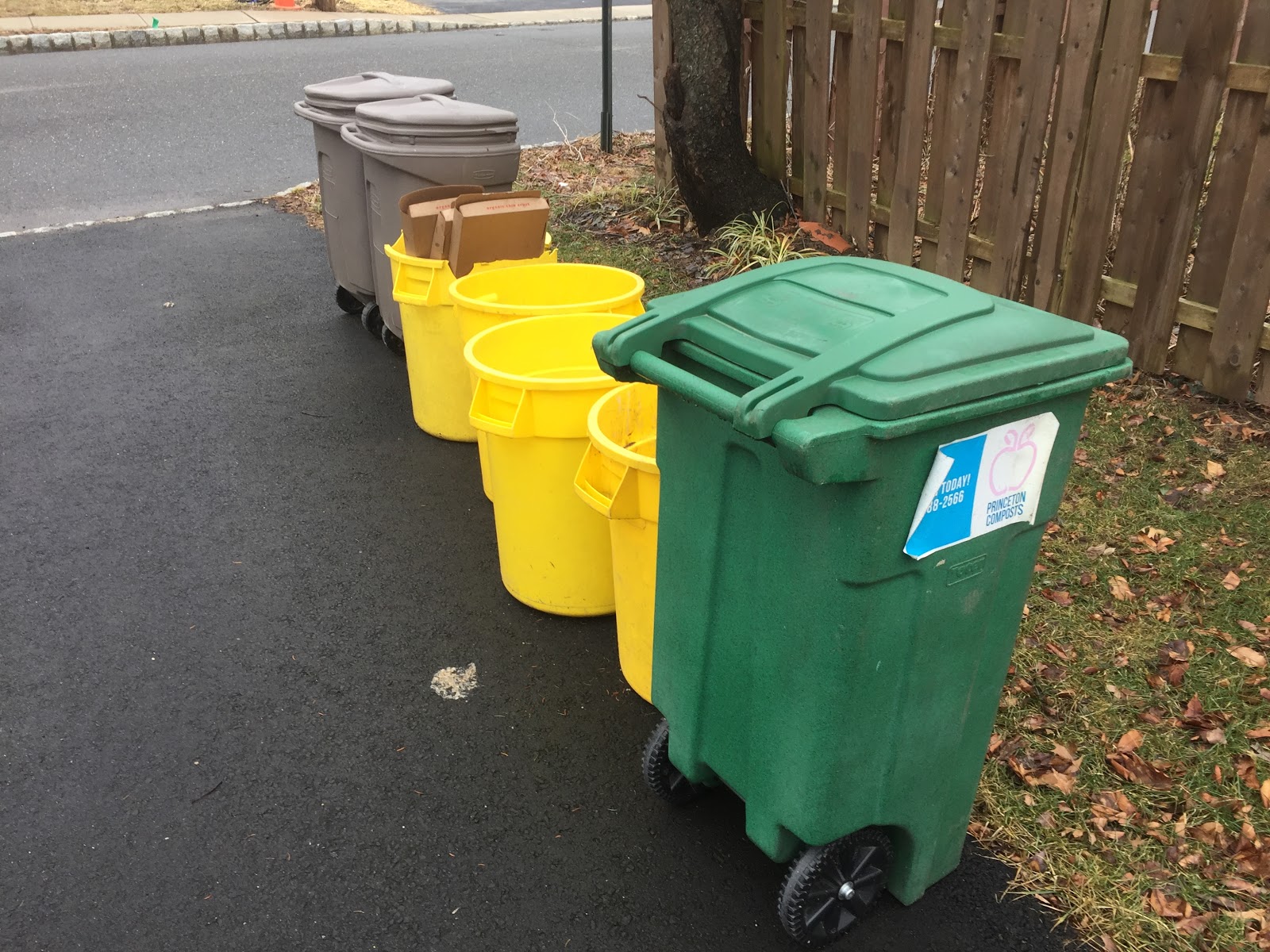
With the suspension of Princeton's curbside organics collection, about 1000 households now have green compost carts that have gone idle. Residents have been asked to keep the green carts, but the suspension of service could continue indefinitely.

Is there a good use for the carts in the meantime, particularly given that the meantime could last a long time? One excellent and appropriate use is for yardwaste. For fifteen weeks in spring and summer, Princeton has a truck that picks up bags of yardwaste curbside. The green carts are the same size as a full yardwaste bag, so could easily be integrated into the existing program.

Residents could of course, still use the yardwaste bags, but will find the green cart a very useful addition, since it has wheels for easy transport and a top to keep the contents dry. Containerizing yardwaste helps keep streets clean and unobstructed, and prevents the killing of grass when loose yardwaste is placed on the extension next to the curb. Ultimately, containerization could give Princeton beautiful clean streets for most of the year.

Would some residents be confused and, out of habit, mix food scraps in with the yardwaste? The solution is to clearly mark the green carts so that residents know what's allowed and what's not allowed. If and when Princeton resumes its food scrap collection, the yardwaste-only signs on the green carts could easily be covered over. This points to a major advantage of compost carts for containerizing yardwaste. Unlike single use yardwaste bags, the compost carts can be clearly marked as to what contents are allowed, and the crews get to see what's inside when they empty the carts' contents into the truck. Any violations can be spotted, and a warning placed on the emptied cart to set the resident straight.

The curbside programs for collecting yardwaste and recyclables have both been hampered by contamination. Rules are constantly being broken due to lack of enforcement. The recycling program, however, is run by the county, so Princeton cannot enforce the rules. The food scrap "organics" collections were contracted out, again making enforcement difficult. Though the collection of loose leaves and brush is done by town crews, the nature of that process has made enforcement difficult.

Only the collection of containerized yardwaste provides hope for enforcement that will reduce contamination. Collection is done by town crews, who can be trained to give feedback, and most importantly, notes of violation can easily be attached to the container and left at the curb.

With 1000 green compost carts sitting idle, this would seem an ideal time to deploy the compost carts in a useful way, at no expense and with no reduction in any existing service.

Saturday, February 08, 2014

Something's (Not) Rotting in Princeton


The whole idea of recycling is to reduce the amount of trash being trucked to the landfill. What matters environmentally is not how much material gets recycled, but how little material gets thrown away. We used to try to measure environmental progress by the tonnage of material recycled. In fact, the main duty of municipal recycling coordinators in New Jersey is to compile how many tons of paper, plastic, glass, etc. got recycled in each town. But the numbers have been losing their meaning. Heavy glass is being replaced by light plastic bottles. Fewer people get newspapers. So tonnages can go down even if people are being more conscientious about recycling.

This is why Sustainable Princeton's goal for solid waste doesn't mention recyclables, but instead puts the focus on trash reduction: 50% by 2016. (Hey, that's coming up!)

Recycling will help reach that goal, but you can see in the two photos that, even when recycling is done well, the trash cans are still overflowing. The basic rule of recycling is being followed here. The recycling containers are visually distinct, and paired with the trash containers. So, why is the majority of material still ending up in the trash?


What's missing is an additional container that would hold compostables. Many cafes have shifted away from styrofoam, fortunately, but there's no protocol in place to keep all the resulting paper containers from filling the trash can. Food waste and all of these food-soiled paper containers should be getting composted. The result, as any Princeton resident who either composts in the backyard or has signed up for the curbside service has discovered, is a dramatic reduction in trash volume and weight.

There are a number of obstacles in the way of doing what obviously needs to be done. One for merchants is space constraints, both in the store and in the back alley. You'd think that keeping compostables out of the trash would greatly reduce the footprint of trash cans and dumpsters, but it would require considerable motivation and commitment to change the status quo. The other is that, though a more local composting facility is in the works, the closest current destination for foodwaste is 70 miles south in Wilmington, Delaware.

In the well-meaning time, while all of this is getting worked out by the often seemingly powerless powers that be, there are individual solutions. A year or two ago, after consuming a large dose of environmental documentaries at the Princeton Environmental Film Festival, I decided to incorporate some aspects of camping into my town lifestyle. Camping is pleasurable. We don't get around to it very often, so why not make it part of everyday life? One way is to emulate the "leave no trace" approach to camping. Pack it in, pack it out. And so the paper products I use at the cafe get scrunched up in a pocket or a backpack, to be carried home and either used to start a fire in the woodstove or composted with the food scraps in the backyard. This approach to camping avoids the long drive to some distant campground, and the local "campsite" serves a great cappuccino.

Tuesday, January 14, 2014

Composting Leaves in Paris's Luxembourg Gardens


The place? Luxembourg Gardens in Paris. The context? Highly formalized, immaculately maintained grounds. And what do they do with the leaves? Throw them out in the street and haul them out of town? No. They find an out of the way spot in the park, corral the leaves and let them break down into soil.

More on how nature is managed in Paris at this link.

Friday, December 20, 2013

Will Foodwaste Recycling Succeed in Princeton's Public Schools?


Earlier in the fall, some rollout bins labeled for foodwaste showed up behind the Princeton High School. I had heard that foodwaste recycling was going to begin at the public schools, but the bins remained empty. Finally, I emailed superintendent Judy Wilson to ask what was up. A response came from facilities head, Gary Weisman, a week later:

"In response to your recent inquiry regarding food waste recycling at PHS, I wanted you to know that the program is underway and has been for the past few weeks. The bins have been on-site since September, but there were many factors that caused us to delay implementation. All schools are currently on board, but no one should be under the illusion that the ongoing implementaton will be seamless. However, with the support of our administration, custodial staff, aides and students we are hopeful that the program will quickly become part of our normal routine." --Gary Weisman, Dec. 2

Since then, plastic bags (presumably compostable plastic) of foodwaste have begun to show up in the bins. The opportunity here goes beyond saving some money by reducing the amount of trash headed for the landfill. One of the biggest lessons kids can learn is the cumulative power of our individual actions. Each individual's impact seems too minor to be concerned about, but if multiplied by everyone else doing the same thing, the result is game changing. 

Though this philosophy is drilled into athletes, it's in everyday life that the game is being played for keeps. The cumulative impact of individual actions--like recycling, voting, and how much carbon we pump into the atmosphere--determines what sort of future we will share. If one student throws non-compostables in the cafeteria compost bin, the custodians are likely to toss the whole contaminated bagful into the trash, sabotaging everyone else's efforts to make the system work. Everyone has to assume responsibility and pitch in. Foodwaste recycling will be toughest at the high school, where students are allowed to eat lunch anywhere in the school. That dispersion and general lack of supervision makes it all the more important that an ethic of recycling be promoted and sustained, lest cynicism grow about whether the high school's recycling program is actually functioning. 

What I've heard from conversations with staff fits with my experience back in 2007, while helping get recycling restarted at the public schools. Success is most assured if there's someone at the bin in the schools' cafeterias, ingraining new habits by making sure students throw their scraps and other waste in the right bins. This is essentially the role a coach plays with a sports team. The compost bin needs to be paired with the recycling and trash bins, so students don't have to walk extra steps. Signage has to be clear, both in word and, for those too distracted to notice labels, the "body language" of the containers. There has to be monitoring out back to make sure the after hours custodians aren't just throwing everything in the trash dumpster. To overcome cynicism, there needs to be feedback and updates so students have some assurance that what they are dutifully throwing in the recycling bins is actually getting recycled. Because it's so easy for recycling programs to fall apart over time, someone in each school with passion for recycling needs to be designated to monitor the program over time.

Above all, the administrators have to lead, to send a message repeatedly to staff and students that recycling matters. Otherwise, everyone will take silence to equal indifference. Recycling is not something peripheral to the educational experience, but central to the individual's understanding of his/her place in the world and impact upon it. It's a habit students can learn and carry with them for a lifetime.

In sports, there's a coach, and someone keeping score. Recycling is essentially a sport being played without any ongoing coaching for the individual players, and without a score at the end of the week (e.g. pounds of foodwaste diverted from the trashstream) that people can take pride in or work to improve. 

More tips on making recycling work in the workplace can be found at this link.

For information on how foodwaste may in the future be hauled to Trenton for composting and biogas production, rather than to the current composting site an hour away in Wilmington, links here and here are a start.


Tuesday, October 15, 2013

Use Those Leaves in the Yard

This fall, rather than dump leaves in the street or stuff them in bags, consider these options.

Mow them back into the lawn

The easiest option by far is to mow the leaves back into the lawn--an approach recommended by county extension offices around the country, and even by company sites like Scotts Miracle Grow. They've studied it, and concluded that the ground up leaves provide valuable fertilizer for the lawn, and do not cause any problem with thatch.


Some kinds of leaves make this method particularly easy. Pine needles and honey locust leaves are so small they don't even need to be chopped up by a mower, or can be raked underneath shrubs to serve as a mulch. Leaves of silver or red maple also tend to "melt" back into the lawn, decomposing quickly.

Grind leaves up with an electric leaf mower/vac

This will take care of leaves the lawnmower can't reach. Electric leaf blowers are quieter than the gas varieties, and some designs can be reversed to vacuum up leaves and grind them. I have not tried this method, but the NPR show You Bet Your Garden had a segment singing the praises of leaves ground up this way as mulch for flower beds. Even if you buy locally, you can check out reviews of various brands here on Amazon, with prices well under $100.

Make Room(s) For Leaves in the Yard

If you choose to collect leaves into piles rather than grind them, the question becomes where to put them if not on the street. One factor that makes people more likely to blow leaves out to the street is that most yards lack "rooms." The typical yard has shrubs pushed against the house and fenceline, defining only one sprawling "room" that extends uninterrupted to the curb, all of which is then required to be ornamental.

Houses have rooms that separate utility and storage from living areas, so why not yards? If you use shrubs or wooden walls to define and screen small utility areas in the yard, it becomes very easy to store leaves while they decompose and slowly return to the soil from which they came. Nature's miraculous trash-free economy is then allowed to function, and we're spared a big mess in the streets and the considerable municipal cost of hauling, grinding and mechanically turning leaves at a distant composting center.


The photo shows one such configuration in a friend's backyard. The wall provides screening between the utility area with compost pile and tools, and the ornamental garden to the left.


Another way to break up space and screen a leaf pile from more ornamental areas is to plant shrubs out a distance from the fence. The leaves can then be piled inbetween the shrubs and the fence. Though a back corner is the most logical location, the one in the photo is next to the street.


Here's the view from the street. The shrubs are privet, but a native evergreen alternative would be inkberry (Ilex glabra). Other smaller native shrubs--not evergreen but with attractive flowers, would be Itea virginica, Clethra alnifolia or Fothergilla. The main idea is to reconfigure how shrubs of any kind are planted in the yard, so as to create refuges for leaf piles that will quickly be flattened down by the weight of rain and snow and benefit shrubs and trees through the steady process of decomposition. Sectioning off a "room" in the yard also breaks up the monotony of shrubs lining the fenceline and foundation.

Whether ground up or piled in a corner, leaves serve as a natural fertilizer and increase the capacity of the yard to absorb rain. The more organic matter a yard contains, the more moisture it can hold, which helps buffer the yard from extremes of rain and drought. A soil rich in organic matter welcomes the rain, which in turn reduces runoff into the streets and, collectively, the amount of flooding downstream.