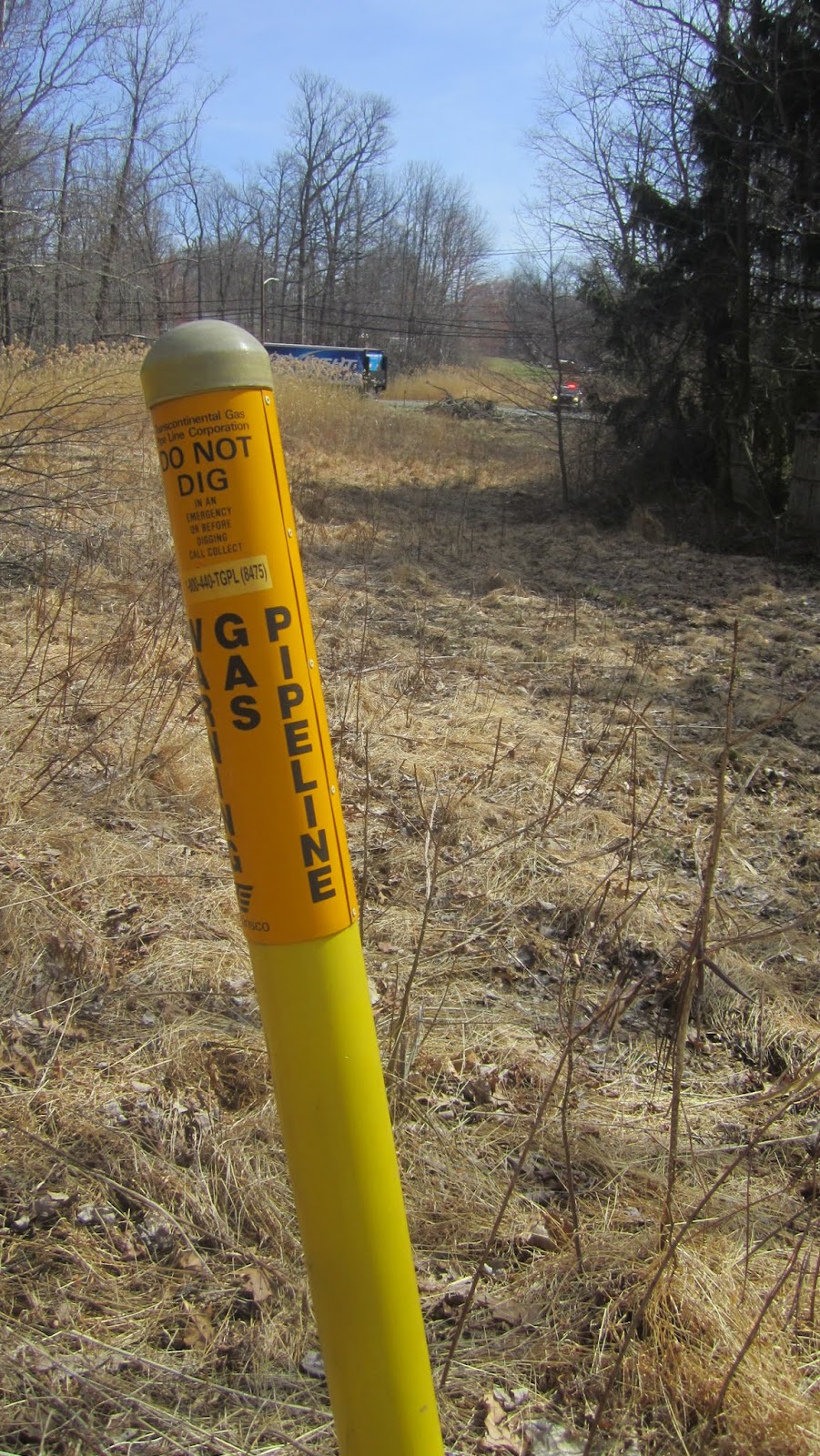
Wednesday, July 31, 2013

Practical Dreaming--Atlantic City Lives Part of the Future Today


Where is the future? Some of us have been asking  that question for a number of decades now. Surely there's a place that's seriously trying not to endanger the future by feeding off the past. Where are people harvesting today's energy--today's sunlight, today's wind? Last month, thirteen intrepid and understandably impatient souls set out in search of the answer.


Pam Mount of Sustainable Jersey, who organized the tour, pointed not west towards California but instead south and east towards Atlantic City. We were about to head to a gambling mecca in search of a present that's not gambling with the future.

And we were about to meet a public servant who sees delivery of services, environmental stewardship and cost-effectiveness as complementary, and has the passion, skill and can-do attitude to make it all happen. His piece of the world is better known as the Atlantic County Utilities Authority. Rick Dovey, president of said Authority, had already showed us their recycling plant and their energy-producing landfill, and was about to show us how additional investments in the future were paying off in Atlantic City.
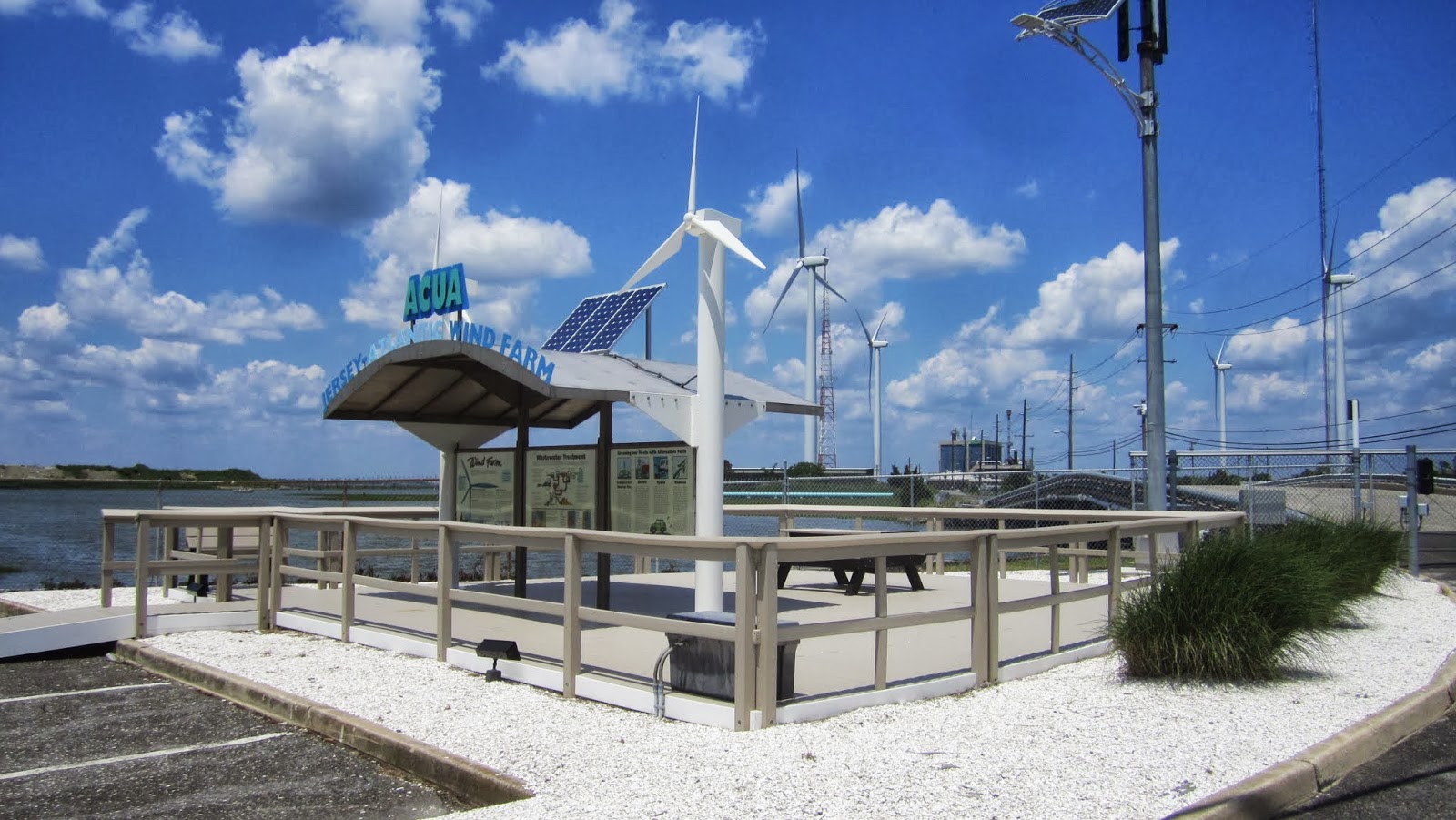

Was the future here? No, that's the small model of a wind generator at the entryway. I had mistaken it for a putt-putt golfing range with a sustainability theme, when we first passed by, missing the turn.

Was it here? Well, sort of. This is a "green" roof planted with sedums that help reduce runoff and insulate the building.


The future was, surprise, most vividly demonstrated at Atlantic City's wastewater treatment plant. (Note the pairing of American flag and wind generator, symbolic of increasing freedom from fossil fuel's tyranny.) The setting is more fitting than you might suspect, because the desired future is a place where our collectively created hazards--the pollution that is a biproduct of our lifestyles--are rendered benign before they can wreak havoc on the world. A wastewater treatment plant is a very intense, 24/7 example of this process of neutralization.

Somehow, one doesn't expect the lobby of a building that serves as destination for all of the city's sewers to look like a nature center. But here are the paneled walls, the bird of prey on display, informative pamphlets, and windows looking out upon attractive plantings.

To describe the place as a nature center is not far off. All those settling ponds and aeration tanks, shown in the model in the lobby, are hotbeds of nature-driven transformation where the foul is made fair. At this interface between city and ocean, a lot of good things have to happen, and fast, because the sewage stops for no one (name of upcoming movie).


The technicians in the lab gave us a close-up look at the heroes of the day after day after day.


Those heroes are humble, everyday sorts, who live modest lives all around and within us--bacteria, protozoans, rotifers and the like--that when concentrated in wastewater work tirelessly to gobble up the grossities and neutralize the nasties, leaving the water clean enough to mingle once again with the finer waters of nature when pumped a mile out from shore.

A placard proudly documents the treatment plant's success at cleaning up nearby waters since the 1970s, when shell fishing was banned in the back bays and intercoastal waterways.

Have you heard talk of shading parking lots with solar panels? What a nice idea. Well, they did it here years ago, complete with electric vehicle chargers.

Additional solar panels on the grounds add to the renewable energy generation. More than half of the plant's electricity needs (the equivalent of 1800 houses) are provided by wind, with a small solar assist. No doubt more modern wind generators would substantially increase that production, given the gains in efficiency since these generators were installed.

When installation of the wind generators was first proposed, some environmental groups protested, contending that the blades would take a toll on birds. The loss proved to be minimal. Early concerns about the wind generators' appearance also evaporated as they quickly became a welcome landmark on Atlantic City's skyline. More information can be found here and here, with lots of fact sheets on the plant compiled here under the "Green Initiatives" tab.


The next step might be to harness the energy in the sludge, which is currently incinerated using some $2 million worth of natural gas each year, and wind energy won't translate well to most inland areas. But overall, this step towards the future, this beachfront toehold of sustainability, which surely took deep stores of persistence, persuasion and patience to bring to reality, looks great from front, back, sideways, the bottom up and the top down.

Monday, July 29, 2013

The Dark Side of Natural Gas


Related to the Transco pipeline that passes through the Princeton Ridge, an OpEd in today's NY Times, entitled "Gangplank to a Warm Future", contends that natural gas is not the clean fuel many proclaim it to be. Given the leakage of methane into the atmosphere during extraction and transport, it contributes as much or more to global warming as other fossil fuels. According to the author of the OpEd, Anthony R. Ingraffea, methane, the main component of natural gas, "is a far more powerful greenhouse gas than carbon dioxide, though it doesn’t last nearly as long in the atmosphere. Still, over a 20-year period, one pound of it traps as much heat as at least 72 pounds of carbon dioxide. Its potency declines, but even after a century, it is at least 25 times as powerful as carbon dioxide. When burned, natural gas emits half the carbon dioxide of coal, but methane leakage eviscerates this advantage because of its heat-trapping power."

Ingraffea, "a longtime oil and gas engineer who helped develop shale fracking techniques for the Energy Department", describes the challenges involved in reducing leakage from hydraulic fracturing wells, and adds that it is difficult to prevent old oil and gas wells from developing leaks over time.

As is typical, as consumers protected from awareness of the consequences of our consumption, we experience natural gas as a wonderful and clean fuel for our stoves and furnaces, while all the pollution involved in extraction and transport of that fuel remains hidden.

Wednesday, July 24, 2013

Sophisticated Lady Seeks Companionship


I first encountered this woman when asked to play saxophone for an hour in front of Simoni's up on Nassau Street, which was having a benefit for Operanauts.

I sat right beside her, played everything I could think of, but couldn't get her to look my way. Talk about nonchalant. She had this distant look, as if remembering a love she lost long ago.


No, not that lush over near Memorial Hall whom she had a fling with. Such joie de vivre, and that seductive French accent, but she finally realized she couldn't compete with the bottle.

And then there was the businessman--stable but much too serious. Deep down, he just wanted to read the paper.


Maybe she fell hard for that brainy guy, the dreamer, who spoke of kindness, beauty and truth. He talked a good game of unification, but in the end, everything was relative. Funny how he aged while the years have left her untouched.


Sophisticated lady, don't live in the past. Don't give up. There's a whole world out there.


School teachers take note: Interesting quote on Wikipedia about Ellington's original conception for his composition "Sophisticated Lady" (someone else wrote the lyrics): "That original conception was inspired by three of Ellington's grade school teachers. "They taught all winter and toured Europe in the summer. To me that spelled sophistication.'"

For a rendition by Harry Carney and the Duke, including some circular breathing at the end that might get her to turn her head, here's a video link.

Tuesday, July 23, 2013

Save Energy and Money Through Vigilance--An Example From Canada

People tend to think that using less energy means buying new stuff: a more efficient furnace or car, or installing solar panels or geothermal. These are all worthwhile investments, but as individuals and as a town, we could save tremendous amounts of energy and money simply through vigilance. Whether in schools, businesses or homes, there are lots of empty rooms being kept brightly lit for no one, empty buildings being kept optimally cooled or heated for no particular reason, and hot water heaters that could be turned down for vacations. An electrician who used to work at Princeton High School, for instance, said the school saved $30,000 in energy over a two month period through a coordinated effort by staff and students to reduce unnecessary energy use. That suggests annual savings in the six figures. Individual actions accumulate into collective impact, as can also be seen in the example below from a NY Times article about sustainability initiatives at Canadian universities.

"At the McGill Life Sciences Complex, students spearheaded a Shut Your Sash program, which encouraged lab users to close their fume hoods when they were not in use.

“The students set out to create behavior change in one campus building and they reduced energy consumption per hood by 80 percent,” said Dr. Krayer von Krauss, adding that the change saved 77,000 Canadian dollars, or $75,800, a year.

Students are now considering how the project can be rolled out in other laboratories, with the potential for another 1.3 million dollars in savings if they achieve the same rate of success."


In order to be strategic, it's best if one knows how much energy is being saved by any particular action. For example, if three lights are on in an unused room, and one wants to leave one on for ambient light, which one uses the least amount of energy? This means gaining familiarity with your personal collection of energy-using devices--everything from light bulbs to clothes dryers--the use or non-use of which contributes to our collective impact on the world and a shared future.

Wednesday, July 17, 2013

Zimbabwe Great To Perform Saturday at Pettoranello Gardens

Oliver Mtukudzi occupies a special place in our household. His 2002 album, Vhunze Moto, is my number one favorite music to dance to. The only other thing I know about him is that he will be performing at Princeton's Pettoranello Gardens this coming Saturday, July 20. To have this legendary musician from Zimbabwe performing for free in Princeton is extraordinary. (The following night he'll be headlining a performance in New York's Central Park.)

From Blue Curtain's Facebook page, it looks like a group from Cameroon called FRANCIS MBAPPE and the FM Tribe will perform at 7pm, with Mtukudzi and the Black Spirits coming on afterwards. Whether the music will correspond to what I've listened to again and again on a favorite album is hard to know, but there's only one way to find out.

More on Mtukudzi at his Facebook page. You can also use google to find videos, or find snippets of tunes on his albums at Amazon.com.

A previous experience hearing music at Pettoranello Gardens as a storm rolled in can be found here.

Transco Pipeline Clarifications


Doing some research on the expansion of the Transco natural gas pipeline that runs through Princeton, I learned the following:

The main pipeline running east-west along the Princeton ridge would not be affected. That's the 75 foot wide right of way that crosses Cherry Hill Road, and 206 just up from Ewing St, and Bunn Drive at the new Copperwood development below Hilltop Park.

The construction would instead be along a pipeline called the Skillman's Loop that branches off from the main line at the north end of Coventry Farm and Mountain Lakes Preserve, then heads north towards Montgomery. On this map (turned on its side, with north to the left), Princeton's main pipeline is blue, and the Skillman Loop is red. The project would heavily disturb a 6.3 mile section of this branch, 1.3 miles of which are within Princeton's boundaries. Installed in 1958, the pipeline appears as in the photo, with the forest canopy having largely grown over the 35 foot right of way.

But Transco is now proposing to clear an 85 foot wide swath along this right of way to lay an additional pipe parallel to the existing one. Tree clearing along the pipelines path through the Princeton Ridge would total 8 acres. An argument against this clearing goes like this: Cutting a broad swath will permanently divide the forest in two, fragmenting habitat, thereby providing an entry point for invasive plant and animal species and disrupting the nesting of birds that require deep forest. A widened right of way will also increase the vulnerability of remaining trees growing along the edge of the opening to wind damage, and leave a gap too broad for the canopy to close, even 100 years from now.

There's also concern about the impact of blasting on the delicate hydrology of the ridge forest, which could affect trees beyond the boundaries of the clearing.

Other posts on this subject can be found at this link.

Friday, July 12, 2013

Biking the Towpath to Car Country

Just about the time I think my younger daughter is getting too homebound with electronic distractions, she'll surprise me. Yesterday, she wanted to take a long bike ride on the towpath, that improbable ribbon of bike country woven into a world otherwise built for cars. It's a red carpet ride, extending from Princeton more than 20 miles one direction, 30 the other.

Heading out from our house, I realized quickly that we had both aged--she in a good way and me in a less good way, as my legs complained and she sped far ahead. In years past, spending languid hours in the park, pushing her on the swing, I had looked forward to a more aerobic stage of parenting, when her physical abilities would challenge mine. Now that hoped for stage looked to have passed before it even arrived, but my legs picked up steam, assisted by the downward slant towards Carnegie Lake, and we soon were taking a right onto the towpath.

Not long into our ride, our wheels making a pleasant gritty sound in the crushed stone surface, she asked if we were getting close to Kingston. Well, actually we were headed in the opposite direction, had already crossed Washington Road and Alexander Street, and were well past Turning Basin Park and the white domes of the water company. We were riding more for pleasure than for destination, passing or being passed, feeling the green embrace of the forest as we sped along.

The idea of a destination became appealing at some point. I predicted that we'd soon encounter a golf course, and by turning left there, on a bridge used by golfcarts, we might end up at what we later learned to call Windsor Green Shopping Center up on Route 1. A light dinner at Whole Foods seemed within our powers. It all came to pass, sooner than expected. But strange it is, after such an easy, verdant journey, to find yourself in front of Whole Foods on a bicycle. That's car country out there. How could this be?

I know. There are serious bicyclists who think nothing of riding to Virginia or New Hampshire, or at least out to the Sourlands for an afternoon just to burn off some extra energy. But we all have our own set of accustomed boundaries, and to break through that is to feel an unexpected sense of liberation.

I asked at the Whole Foods information desk how much of the store's energy their broad array of rooftop solar panels supply. The woman didn't know, but said the solar energy helped them make it through the aftermath of Hurricane Sandy, when others were stranded without power. It's like finding pieces of a puzzle no one has ever put together. The improbable ease of a bike ride, a patch of solar panels reducing dependence on the grid--these are pieces of a dream that could spare us from nightmares to come. What glorious liberation we would feel, individually and collectively, if we broke through the boundaries of a lifestyle built on energy better left buried in the ground.

We rode back the way we came, fireflies adding sparkle along the trail's edges in the fading light.

Wednesday, July 10, 2013

Are Dogs Allowed In Princeton Parks?


Are dogs allowed in town parks? True to Princeton's opinion-rich environment, it took only two different parks to yield two different opinions. Potts Park says no.


Harrison Street Park says yes, but with a leash on.

A call to town hall verified that, though dogs are not allowed on school grounds, they are allowed in parks when under the control of an accompanying, super dooper pooper scoopering adult and on a leash not to exceed 16 feet.

The Great Recycling Plant and Landfill Tour--Atlantic County, NJ


It's apparently common for people to question whether our recyclables actually get recycled, especially now that the "single stream" protocol has us throwing paper and bottles/cans all together. Placing recyclables at the curb, we are the equivalent of workers feeding raw materials into a giant factory whose location and eventual products are unknown. Adding to the mystery, according to my notes, the state no longer inspects sorting plants nor tracks where recyclables go. The industry has self-reported for the past eight years. To imbue the act of recycling with more meaning and confidence, it would help if we knew where it all goes and what it becomes.

A previous post documented where Princeton's recyclables go, at least for sorting. This one documents another tour, organized last month by Sustainable Jersey, of a sorting plant in Atlantic County, NJ, and the nearby landfill. Sorting plants use increasingly sophisticated machinery to sort paper from plastic, metals from glass, and then bale it all up to sell to companies that will make use of the recyclables.

The tour was led by Rick Dovey, president of Atlantic County Utilities Authority, who told us many stories and fielded our many questions. He deals not only with Atlantic County's solid waste, but its liquid waste as well--the unlikely highlight of the tour that will be posted separately. For someone who gets dumped on daily by a whole county, Rick Dovey is remarkably upbeat.


Sorting plants are filled with conveyor belts and bins. This one's run by Recommunity, a national company. The county's been recycling since 1978. Like most sorting facilities these days, among plastics they accept #1-7, flower pots and larger items like tubs, trays and pails. They are not thrilled to get styrofoam, nor plastic bags, but have little choice but to deal with whatever comes to the plant.

Plastic bags end up in the bin (labeled "metal only"), and do get sent to another plant for recycling.

Aluminum trays are not sought after, but are sorted out and recycled. They are a lower grade of aluminum, so can't be mixed with aluminum cans.

Bales of sorted recyclables get neatly stacked at the far end of the plant. Aluminum and cardboard are the most valuable. Glass is hard to market, in part because it now finds its way into few containers other than for beer and wine.

When the financial markets collapsed back in 2008, the recycling markets dropped precipitously, going from a record high to a record low in just 45 days. Rather than haul unsold recyclables to the landfill, Rick stockpiled the bales outside for several years, selling them to recycling companies as markets recovered.

Note: There are many videos showing the impressive process of sorting single stream recyclables. Two can be found at this previous post.


Next stop was the top of the landfill nearby. The county's economy went from logging in the 1800s to pigfarms, and then to quarrying gravel and sand. The quarries then became attractive spots to dump garbage, including toxics that in a nearby landfill nicknamed Price's Pit are still being dealt with today, at great expense.


The view from the top of Atlantic County's mishmash mountainette is extraordinary. Not surprisingly, this is the highest point in the county. In his ongoing push to reduce dependency on fossil fuels and take advantage of today's energy, Rick is trying to get permits to put solar panels on the side of the landfill.

Only 30-40% of the methane produced by the landfill is captured in a system of underground tubes, and used to generate electricity. Some of the energy produced can't be fed into the grid, because the transmission lines going to the landfill don't have enough capacity. Efforts to get the capacity increased have been unsuccessful.

So, what you have is a landfill that's producing methane (the equivalent of natural gas), most of which seeps up into the atmosphere to speed global warming, while efforts to use the rest to generate electricity are being hampered.

Because of this inefficiency, the utility authority wants to take things to the next level and partner with the Princeton-based energy company NRG to start a syngas project to convert trash directly into energy. They've been waiting four years for state regulators at the Department of Environmental Protection (I accidentally typed "Protraction") to approve the project.

One recurring theme in environmental work is that any effort to shift from the unsustainable, climate-changing status quo to a sustainable future will have to persevere through innumerable obstacles large and small. Some of those obstacles will come in the form of environmental regulations meant to protect us, but which in practice also dangerously delay our shift to renewable energy. The good news, though, is that just outside of Atlantic City, we got a tour of a well-run recyclables sorting plant, and a landfill that's at least utilizing some of its legacy of methane.


And more good news about utilizing today's energy awaited us "tour-ists" at an equally unlikely location, the Atlantic City Wastewater Treatment Plant. (to be continued)


Monday, July 01, 2013

Flying Frontier Out of Trenton


My first flight on Frontier Airlines out of the Trenton-Mercer Airport, and there were many questions--about parking, how early to arrive, and what size luggage could I take on board without being charged extra.

The 25 minute drive to the airport from Princeton beats going to Newark. The parking is free and expansive, and I was told that they do regular security checks of the lots. Even at 5am I had to park some distance out. They say to get there two hours ahead. I got there just under an hour ahead, and cut it very close. You can read wall displays about the glorious history of aviation in Trenton while waiting in line downstairs at security. For the trip to NC, regular carry-on luggage was included in the price, but other destinations have different restrictions. It's worth reading the small print.

Successful passage through security lands you in a (bathroomless) holding area, after which passengers walk out onto the tarmac and climb the stairs into the plane, just like the good old days. Typically, only presidents get to do the stair thing anymore, for a photo op. Trapped in a "jet bridge", we wouldn't have been able to see the sun rising on this new-old era.

Both flights, to Raleigh-Durham and back, only took an hour, which is shorter than from Newark in part because planes can leave or approach Trenton more directly than a busier airport.

As we unloaded in Trenton, a petite elderly woman insisted on walking down the ramp rather than wait for a wheelchair. Unable to convince her otherwise, the flight captain offered to walk her down the ramp to the terminal. The rest of us walked slowly behind this very endearing sight, the lady's frail hand tucked around the arm of her escort, resplendent in his captain's uniform.

After he delivered her to the terminal, I asked him how many gallons the jet had used during the flight. He said typically 900 to 1000 gallons, with a full load in the Airbus of 138 passengers. That works out to about 7 gallons per passenger for the 500 mile trip, or about 70 miles per gallon per person--equivalent to two people in a car getting 35 miles per gallon during the 9 hour road trip. Better than one would have guessed. Of course, there are a lot of other things that factor in to a carbon footprint for the trip--the fuel consumption enabling the airport and all of its employees and amenities, versus the 500+ miles of concrete road and the spread-out amenities of the freeway. But it's interesting to see how one particular plane ride on one day compares to car travel.

The pilot confirmed my understanding that jets descending towards their destinations essentially coast. They put their engines on idle, then "spool up" the fans in the engines as they approach the runway, so the engines are ready to deliver full power in case the landing needs to be aborted at the last moment.

The airport and its 1960's era tarmac experience is brought to you by Mercer County. The county also runs the Howell Living History Farm, which dials time back to 1900. All in all, a fine way to travel, forwards and back at the same time.

Wednesday, June 26, 2013

Electronics and Hazardous Waste Recycling this weekend


This television has not been picked up by the trash collectors for two weeks, which is the way it should be. There's an ordinance that requires TV's to be recycled. They can be taken to one of Mercer County's three electronics and hazardous waste recycling days per year, one of which is coming up June 29, or taken to Best Buy, which also recycles them free of charge. (Best to give Best Buy a call ahead, just to confirm.)

The hole in the back of this particular TV suggests that someone came along and took the copper coil, to sell as scrap. Related post here.


Harry's Brook and the Milky White Tale


Two posts (here and here) at PrincetonNatureNotes.org on a recent spill of unknown nature in Harry's Brook, discovered where it "daylights" at the corner of Harrison Street and Hamilton Ave.

Harry's Brook drains the eastern half of Princeton, with various "headwaters" at Palmer Square, Princeton High School, and Bunn Drive. It flows into Carnegie Lake near Kingston. The branch that drains downtown flows through underground pipes before emerging at Harrison Street.


Friday, June 21, 2013

Terhune Orchards--Vision Meets Reality

A mural on the side of a building next to the Terhune Orchards' parking lot brings back memories of a house I saw once in Ohio whose side was painted to show the view one would have if the building wasn't there.


Much of life is spent envisioning a world and then trying to figure out how to get past the walls that stand between vision and reality. At least at Terhune, reality closely matches the vision. Walk around the side and you find a similarly harmonious scene with a red building, a pond, dirt road and farm animals. The mural was painted by an employee with an artistic bent.

Monday, June 17, 2013

Foodwaste Recycling in Princeton and New York


The word from near and far is that composting kitchen scraps makes sense. Far might be San Francisco and Seattle, where keeping food waste separate from the trash is mandatory. Closer to home, a neighbor who recently enrolled in the local curbside collection program was amazed at how little trash he produces now that his food scraps and other organics like paper napkins and stained pizza boxes are going in the green rollout bin. He only has to put his trash can out every other week.

Meanwhile, in New York City, pilot foodwaste collection programs have shown unexpectedly high levels of participation, and plans are afoot to shift to citywide collection, with voluntary participation likely to transition to mandatory in a few years' time. The city's million tons of foodwaste/year, currently sent to landfills as far away as Ohio, is now being seen as an energy source for generating electricity.

Landfilled foodwaste produces methane gas, a potent climate-changing gas. Though some of the methane can be recovered and used for energy, much of it leaks into the atmosphere. During a tour of a landfill near Atlantic City this past weekend, the director of the operation estimated only 30% of the gas is being collected and utilized, despite an elaborate system of pipes running through the landfill to extract the gas.

Backyard composting is the most ecological approach, because there's no transport of heavy food scraps involved, and paper napkins, etc. can be included. But unless someone comes up with a little "Backyard Composting for a Better Planet" sign for people to put in their yards, it's hard for a largely invisible movement to catch on. People imitate their neighbors, for better or worse, and the green bins are a visible expression of environmentalism that can be used to galvanize neighborhoods to increase participation. The town's web page promoting signup for the program drives this point home, asking the question "Are you seen with the green?" In a similar vein, a distinctive look helped the Prius gain dominance among hybrids.

Other green initiatives, like energy conservation, struggle in part because their results are not visible.  If our energy bills showed how each of us rated compared to average home consumption, we might be more motivated to save energy. If a building showed how much energy it was using in real time, on a monitor in the lobby rather than on a meter in the back alley, there might be more motivation to reduce the number. But most of the environmental good news and bad news remains hidden. The green foodwaste bin is a small but growing exception.

Friday, June 14, 2013

Howell Living History Farm Ice Cream Social


Once upon a time, in a pleasant valley approximately one century, thirteen years and thirty two minutes away (according to Google Maps), farm friends flocked to savor homemade ice cream.

The wheat danced in the breeze,

as guests, having traveled google map's 32 minutes by car, made the final 113 year leg of the journey by horsedrawn carriage.

past strange machines,

a room for harnessing oxen,

a sheep shearing gizmo,

and a chicken coop,

until they could hear the steady thumping of a one-cylinder engine from a distant century,

which drove the ice cream maker

that fed the socializing multitudes ice cream with strawberries, chocolate syrup and sprinkles on top.


It was all the milkers could do to keep up.

Thursday, June 13, 2013

Mosquitoes and Princeton's Outdated Recycling Containers


There must be defenders of Princeton's yellow and green recycling buckets, which have served long and fairly well, but it's easy to draw up a list of their drawbacks, when compared to the rollout bins that are standard equipment in most recycling programs.

  • Lacking wheels, these buckets can pose a challenge for the elderly, or for most anyone who is less than musclebound, to carry out to the street.
  • Lacking lids, they leave the contents exposed to rain and snow, which makes the paper heavier to haul and harder to sort at the recycling plant.
  • Since many Princetonians store the buckets outside, rain also accumulates in tin cans and other recyclable containers, providing breeding grounds for the asian tiger mosquitoes that need very little water to breed, bite during the day (native mosquitoes are active at night), and have been moving north into New Jersey. 
  • Being round, the buckets get blown over on windy days and roll into the street, spilling their contents and blocking traffic.
  • Wind can also blow paper and plastic bottles out of overfilled buckets. Any loose bottles end up going down stormdrains and into local waterways, eventually contributing to plastic pollution in the oceans.
  • The original rationale for separate yellow and green bins is no longer relevant with single-stream recycling. 
  • Lacking attachments for mechanical emptying, the buckets must be lifted manually, potentially leading to increased worker back injury over time. 
The potential for back injury may be reduced now that there's less paper and glass. (May as well look on the bright side of the status quo, since change comes so slowly.) Riding my bike on Wiggins one day, I saw an elderly woman struggling to retrieve her buckets from the curb. She politely refused help, saying she had worked out a system to manage. Coping with minor and less minor annoyances is what we all do, and likely will continue to do for years to come.

Saturday, June 08, 2013

The Back Side's Revenge


With the remnants of tropical storm Andrea having just passed through, it's time for another segment of Stump the Stars, with water being the stumper and whatever architect designed the local art museum being the stumpee. Of course, it may have been the builder who got the slant of the walkway a tiny bit wrong, which is all it takes to have runoff headed down the back stairway into the basement.


Hopefully the result was nothing like the flooding at the high school two years ago, during a much heavier rain.

There are a couple themes here. One is how good the elements are at fooling people. It doesn't take any great skill for water to outsmart top architects. All it has to do is flow downhill. Similarly, carbon dioxide is fooling most of humanity simply by quietly drifting up into the atmosphere.

The other theme is how frequently the back side of things eludes notice. It's these back stairwells that seem not to have been thought out sufficiently, while great attention is given to entryways and facades. In a similar vein, those in charge of recycling programs often forget to check out back to see if recyclables are actually making it to the back loading dock for weekly pickup. The sidewalks in town that become overgrown and impassible are on the side of the property not frequented by the owner. And of course the biggest gap in attention is the mischief rising from the back side of machines, e.g. car tailpipes, smokestacks and furnace chimneys.

What happens on the back side can circle around and take its toll on the front side, as in when floodwater entered from the back of the high school performing arts center, causing enough damage to the wooden stage that it had to be replaced. Hurricane Sandy, too, can be seen this way. Influenced by transformations of climate bred on the backside, it barged in America's front door.

Tuesday, June 04, 2013

Hands and Mind--Making Stuff and Making Connections in a Consumer Society


Several things in this photo, taken at the Healthy Children, Healthy Planet event at Riverside Elementary School a couple weeks ago, exemplify aspects missing from our suburban lives. Tedious manual labor and tightly confined animals, some might say. But what I see is the chance for kids to interact with animals beyond dogs and cats. There's also the patient making of things--that steady application of attention that we've out-sourced to machines, and sweatshops in the Philippines. And then there are clear connections made, between grass, sheep, wool-making and the clothes we wear.

If we had to pay the real cost of fossil fuels, we'd use our remarkable adaptive capacities to find ways to use them less, and might in the process rediscover some long lost satisfactions. Some of this is already happening. Paris got in the news recently for its use of miniature sheep to mow lawns. Hens are becoming more popular as backyard "pets with benefits", offering daily demonstrations of how the random bounty of a yard--grubs, insects and earthworms--can be transformed into eggs.

The patient making of things is a bit harder to "in-source", given people's harried lives. But one approach is to recruit what I call the "second self"--the part of you that does work automatically while leaving the mind free to focus on other things. Hand-washing dishes, hanging clothes up to dry--these means of disengaging from the use of climate-changing fuels can be tedious, mind-numbing tasks or they might slow one down long enough to actually listen to some music, have a conversation or catch the news on the radio. If, while doing the mundane task of washing dishes, I suddenly have some idea or insight worth writing down, I wonder if it would have occurred on its own, or if it is the product of both hands and mind. It's not too much of a stretch to suggest that each informs the other, given that hand and mind have evolved together, and largely define what it means to be human. Doing more varied tasks with the hands could jog the mind into more varied thoughts.

The ongoing expansion of convenience relegates hands increasingly to the role of consuming rather than making. Sound recognition may even bypass the remaining manual function of thumbing texts and typing on a keyboard. Similarly, once productive yards now do little more than flatter the house and consume time and chemicals. That's part of the challenge of sustainability, to figure out how a yard and hands can regain some of their productive roles.