Friday, February 07, 2014
Climate Theater: A Playwriting Debut
Having written a lot about climate change, and not seeing any substantive action to address this deepening global tragedy, I started imagining theatrical scenes a couple years ago. January 18 marked the first performance by professional actors of two of these scripts. Thanks to the One-Minute Play Festival and Passage Theatre for this opportunity.
The plays can be found in an online video at minute 58:00 (Stronger Than the Storm?) and 40:40 (When Time Went On Forever).
Here's some background:
Last month, Passage Theatre in Trenton hosted New Jersey's 4th annual One-Minute Play Festival, "showcasing 50 Brand New one-minute plays by New Jersey's best playwrights." They were nice enough to include me in that group. An email mysteriously but gratifyingly appeared in my inbox one day this past fall, inviting me to submit exactly two plays, each of which was not to exceed one minute in length.
I used it as motivation to squeeze the theme of climate change into the one minute format. No problem!
According to the 1MPF's website, "The One-Minute Play Festival (#1MPF) is a NYC-‐based theatre company, founded by producing artistic director Dominic D’Andrea, and is America’s largest and longest running short form theatre company. #1MPF is a barometer project, which investigates the zeitgeist of different communities through dialogue and consensus building sessions and a performance of many moments."
Twenty cities now have One-Minute play festivals, with each one drawing from its own region's playwrights, directors and actors. This year's material in NJ was heavily influenced by Hurricane Sandy and its aftermath. Five directors and five groups of actors each performed ten pieces, with no breaks inbetween. Very exciting.
The online video documents the January 19 performance. The show's intro starts at minute 12:10 on the video. My two plays are at 40:40 (When Time Went On Forever) with actors Steve Caputi and Susan Gaissert, directed by Steve Gaissert, and at 58:00 (Stronger Than the Storm?) with actors Amy Crossman and Scott Brieden, directed by Artem Yatsunov. Other plays before and after the "Stronger than the storm?" also explore NJ's response to Hurricane Sandy, including a piece by Clare Drobot that asks the question, "How can you be stronger than an inanimate force of nature?"
Thursday, February 06, 2014
After the Ice Storm
Most people have an argument with the weather. It should be more this and less that. The audacity of water in whatever form to precipitate upon us precipitates in turn as much complaint as taxes and the deluge of leaves in fall. My argument is instead with houses, which go into a feint the moment an ice storm comes along, but I have to admit,
freezing rain is a lousy tree trimmer. There are no two ways about it. This is shoddy work. I'm no expert, but you don't trim a town's trees by applying weight to every branch in town to cull the weak from the strong, and just let it all fall helter skelter. I did appreciate, though, that the branch that fell on our car was dropped in such a way as to do no visible damage. There are many stories like this after a storm, of branches or whole trees falling in an uncanny way as to do no damage.
The upshot for our neighborhood was an unexpectedly modest two hours without power, and an unusually peaceful Harrison Street. Despite the major repair job underway at the intersection of Harrison and Hamilton Ave, life seemed normal enough by evening to set out by foot across town for a talk on "Legendary Locals of Princeton" at the Historic Society of Princeton's annual meeting. The premise of the walk was that most any tree branch that was going to fall had already fallen. The bartender at the Nassau Club asked how my trip there in a car had gone. He was surprised to hear I had walked. I had worn my dressiest pair of hiking boots, and actually found it very pleasant to walk the length of Nassau Street when there were so few cars out. I ran into friends I hadn't seen in years, and got to appreciate the (mostly) well-cleared sidewalks and the fresh wintry air. None of this seemed worth telling the bartender, who was probably expecting some cathartic complaints about parking.
Our Mayor Lempert introduced the speaker, using the opportunity to inform us that Princeton got hit harder by the storm than most other NJ towns. Winds were in store overnight, and another storm Sunday. In an example of community collaboration, one of the soccer associations was supplying lights for the street repair crews. The speaker and author, Richard D. Smith, credited the Lenni Lenape's trails as much as the university in positioning Princeton to become a "legendary locale". Indian trails tended to run along ridges, which in this case later grew into Nassau Street and the Lincoln Highway. The Lenape village was apparently down along the Stonybrook in that rich bottomland near where the society's Updike Farm and future home base is located. In a couple years, they plan to complete the move from the university-owned Bainbridge House out to the farmstead, which they envision as becoming a Princeton Historical Center with enough room to put Einstein's furniture on display.
The legendary locals turned out to be a refreshing mix, with the standard greats like Einstein, Robeson, and Woodrow Wilson mingling with notable merchants, Olive McKee (John McPhee's high school english teacher), and a couple of the guys whose names I didn't catch, who over the years have been highly visible riding their electric carts around town.
It's the guys chugging around town on electric vehicles that I take my inspiration from, in that I see their mode of transportation as being part of the solution to the tendency of houses to feint. One of the historical society's staff had lost power at 8am, prompting her family to move in with friends for the duration. This shouldn't need to happen, and there needs to be a better option than investing in a generator that will rarely be used.
When I was college aged, my argument with houses was that they were too square, too boxey. Given that in the intervening years they have steadfastly refused to lose their boxiness, I have shifted my concern to how they get energy. Houses essentially make no sense whether they're getting energy or not. When the grid is up, it feeds houses the kind of energy that is destabilizing the climate. When the grid is down, houses are helpless to feed themselves. Either the future or the present suffers. What a lousy choice we're given. When the power goes out in our house, I want to have a low-energy mode it can go into, in which the frig, furnace and internet continue functioning, fed by dual purpose batteries that can drive the electric car day to day and the house during power outages. At those times, the house would automatically shut itself off from the grid, so that none of the electricity would head out to the street where lines are being repaired. A few solar panels would offer some energy to recharge the batteries or to replace some of the grid energy. My research staff--that would be a neighbor and myself--are exploring these sorts of plug and play options.
Walking home from the talk, I saw a bicyclist pedaling up the hill on Linden Lane. On the night following a freezing rain, few, including me, would think to ride their bikes, yet there he was, well dressed, getting where he needed to go, apparently unaware that this wintry world is a terribly harsh and dangerous place. When I was a kid, I'd ride my bike to school in the snow, impressed by the imprint my bicycle tires made in the snow and mud. No need for big machines. Tread was my power. One winter, a freezing rain coated the whole landscape with ice. It was the one and only time I was able to skate to school. That was the best, especially skating downhill.
I arrived home to find the dog needed a walk, and so we headed out while the workmen continued their work down the street. The latest form of precipitation was not coming from the sky, but instead took the form of ice cubes that a feint breeze was causing to fall in earnest from the ice-coated trees. They made shimmering sounds on the pavement when a tree released many shards at a time, but felt cold and mischievous when one fell down the back of my neck. Leo was not going to settle for a perfunctory walk. When I headed left to circle around the block, he stayed behind at the curb, resolute, looking hard at me like a major league pitcher shaking off a signal from the catcher. Why settle for a fastball when he was game for a slider all the way down Clearview. Not that he was going to find much of interest. Snow in a dog's world must be like giving an Etch a Sketch a good shake. All past communications are erased. He was undeterred, however, and immediately set about beginning anew what seems like a meaningful correspondence with the neighborhood canine penpals.
The new layer of ice fragments landing on the snow glistened in the street light. If it were all broken crystal, it would be a great tragedy. But nature creates crystalline beauty, then dismantles it with complete nonchalance, ever restless to make something new, sure of her bottomless talent to combine and recombine, never making anything quite the same way twice.
Wednesday, February 05, 2014
Flame Logic in a Wood Stove
While visiting friends out of town, I got a fine tour of the inner workings and intrinsic logic and beauty of a woodstove. Not everyone can have a wood stove, but its pleasures and dependability raise the question: What else are we missing? How else could we gain some freedom from the fossil fuel energy the grid feeds us, and in the process realize a new level of comfort, dependability and peace of mind.
Our home in Princeton came with a 1978 Vermont Castings Vigilant wood stove, which still does a good job, putting out lots of heat and burning cleanly enough that no smoke comes out of the chimney. But newer stoves have more efficient designs, delivering air to the combustion chamber in more sophisticated, strategic ways. Since pollution is caused by uncombusted gases, a well-designed and well-tended wood stove turns those gases into heat before they can become pollution.
Pleasures a Furnace Can't Provide
It begins with the sheer pleasure of having an active, radiant hearth in the living room, of sitting with family in the evening, talking of the day and basking in its warmth and glow. Our older stove, by contrast, lacks the glass front and so provides warmth but no glow.
Then there's the more technical aspects, which also have an aesthetic dimension. There's pleasure, for instance, in tending a fire and getting it to burn as cleanly as possible, particularly if one lives in a neighborhood with lots of houses around. The fire in this photo is burning the actual wood, my friend tells me. You can see that the flame is close to the wood itself.
If he gets the fire hot enough, then turns off all the air into the fire except what comes out of small holes at the top of the chamber, the fire burns not the wood but the gases cooked out of it by the high temperature. You can see that the flames appear to be suspended in air rather than rising from the wood itself.
A closeup of those rows of airholes show an effect more like a gas stove, with jets of flame seeming to shoot out of the airholes themselves. The more thorough the combustion, the fewer pollutants head up the chimney.
The stove is part metal, part soapstone. Water in the teapot humidifies the air, and the flat top works for cooking soup.
Its slim profile owes to it not having a catalytic element inside, which requires more room in the back of the stove to protect the catalytic element from direct contact with flames. Though a catalyst can help combust gases that might otherwise go up the flu, it's possible to meet EPA standards without it.
Vital Ingredient: T.L.C.
No matter how good the design, though, burning wood cleanly depends on the owner supplying dry, well-cured wood and making sure the fire's getting enough air. EPA can set standards for design, but it's tender loving care that determines whether the stove performs up to those standards.
Benefits of Integrating Grid and Off-the-Grid
Being a country-city person, a nature enthusiast who plays urban jazz, I like the idea of a fusion lifestyle, finding ways for the town's grid and the country's off-the-grid elements to complement each other.
Particularly during a power outage, one of which we just had this morning in New Jersey, a wood stove brings a sense of empowerment and peace of mind, providing a backup for the furnace and the cooking range. What is taking longer to figure out is how to develop a similar complement to the electric power grid. For some, that means buying a generator, either gasoline or natural gas. Not having a basement flooding issue or other critical energy needs, I'm looking for a system that would help meet ongoing energy needs, not just during energy outages. That will likely be some combination of a few solar panels and an electric vehicle with batteries that could be used both for short trips and powering the house in low-energy mode during power outages. The ongoing improvements in batteries, "plug and play" solar panels, and electric vehicle technology show promise for putting such a system together.
Note: A maker of soapstone stoves won the Wood Stove Decathlon, which took place on the National Mall this past November. The winning stove was chosen based on "efficiency, cleanliness, consumer appeal and price."
Our home in Princeton came with a 1978 Vermont Castings Vigilant wood stove, which still does a good job, putting out lots of heat and burning cleanly enough that no smoke comes out of the chimney. But newer stoves have more efficient designs, delivering air to the combustion chamber in more sophisticated, strategic ways. Since pollution is caused by uncombusted gases, a well-designed and well-tended wood stove turns those gases into heat before they can become pollution.
Pleasures a Furnace Can't Provide
It begins with the sheer pleasure of having an active, radiant hearth in the living room, of sitting with family in the evening, talking of the day and basking in its warmth and glow. Our older stove, by contrast, lacks the glass front and so provides warmth but no glow.
Then there's the more technical aspects, which also have an aesthetic dimension. There's pleasure, for instance, in tending a fire and getting it to burn as cleanly as possible, particularly if one lives in a neighborhood with lots of houses around. The fire in this photo is burning the actual wood, my friend tells me. You can see that the flame is close to the wood itself.
If he gets the fire hot enough, then turns off all the air into the fire except what comes out of small holes at the top of the chamber, the fire burns not the wood but the gases cooked out of it by the high temperature. You can see that the flames appear to be suspended in air rather than rising from the wood itself.
A closeup of those rows of airholes show an effect more like a gas stove, with jets of flame seeming to shoot out of the airholes themselves. The more thorough the combustion, the fewer pollutants head up the chimney.
The stove is part metal, part soapstone. Water in the teapot humidifies the air, and the flat top works for cooking soup.
Its slim profile owes to it not having a catalytic element inside, which requires more room in the back of the stove to protect the catalytic element from direct contact with flames. Though a catalyst can help combust gases that might otherwise go up the flu, it's possible to meet EPA standards without it.
Vital Ingredient: T.L.C.
No matter how good the design, though, burning wood cleanly depends on the owner supplying dry, well-cured wood and making sure the fire's getting enough air. EPA can set standards for design, but it's tender loving care that determines whether the stove performs up to those standards.
Benefits of Integrating Grid and Off-the-Grid
Being a country-city person, a nature enthusiast who plays urban jazz, I like the idea of a fusion lifestyle, finding ways for the town's grid and the country's off-the-grid elements to complement each other.
Particularly during a power outage, one of which we just had this morning in New Jersey, a wood stove brings a sense of empowerment and peace of mind, providing a backup for the furnace and the cooking range. What is taking longer to figure out is how to develop a similar complement to the electric power grid. For some, that means buying a generator, either gasoline or natural gas. Not having a basement flooding issue or other critical energy needs, I'm looking for a system that would help meet ongoing energy needs, not just during energy outages. That will likely be some combination of a few solar panels and an electric vehicle with batteries that could be used both for short trips and powering the house in low-energy mode during power outages. The ongoing improvements in batteries, "plug and play" solar panels, and electric vehicle technology show promise for putting such a system together.
Note: A maker of soapstone stoves won the Wood Stove Decathlon, which took place on the National Mall this past November. The winning stove was chosen based on "efficiency, cleanliness, consumer appeal and price."
Woodstoves--Making Heat and Making Sense
A wood stove is at its best on a snowy afternoon. In winter's chill, it attracts all heat-seeking souls with its radiance. Quietly, with no moving parts, it warms daughter and our canine version of Leo the Lion, thaws out chilled feet and a frozen watering can for the chickens, all the while heating water to humidify the air and somehow broadcasting its beneficence to the far reaches of the house. It would cook dinner if anyone thought to ask.
But just beyond the woodstove's island of sanity, life is not making as much sense. The man's socks, for instance, don't actually match, nor do the seven other socks he found in the drawer.
During the housewide search that ensued, the man managed to find only two matching socks, which perhaps due to one's accidental trip through the dryer had lost their parity and felt a little funny on the feet.
Outside, the ducks are in a similar quandary. Winter has done something strange to their favorite pond. Their feet too are ill-equiped, lacking ice skates.
Once one has experienced the radiance and simplicity of a woodstove, it's hard to understand why the modern world largely turned its back on radiance, in favor of complicated machinery that at least in our house exhales tepid, often too-dry air through a labyrinth of heating ducts, warming all but satisfying none. (Sealing and insulating the ducts one of these days will surely improve the situation.)
Sunday, February 02, 2014
Drive an ELF, Bikemobile of the Future
Have you been wondering when and if the future will ever come? The future here referred to is the one where we aren't forced to choose between driving climate changing cars or riding bikes in a downpour.
Well, meet the ELF, which is basically a bike with a roof, cargo space, electric assist and rearview mirrors. It weighs in at 150 pounds, has two wheels in the front,
one wheel in the back.
It seats one,
carries cargo,
and goes fifteen miles on a battery charge.
The battery can be charged two ways: by the built in solar panel, which takes about seven hours,
or by taking the battery inside and plugging it in. I'm particularly interested in whether the battery, or batteries, rechargeable by solar panels, could be used to run the house in low-energy mode during a power outage. That way, the same purchase that provides energy when the grid is down would also have ongoing use for transportation.
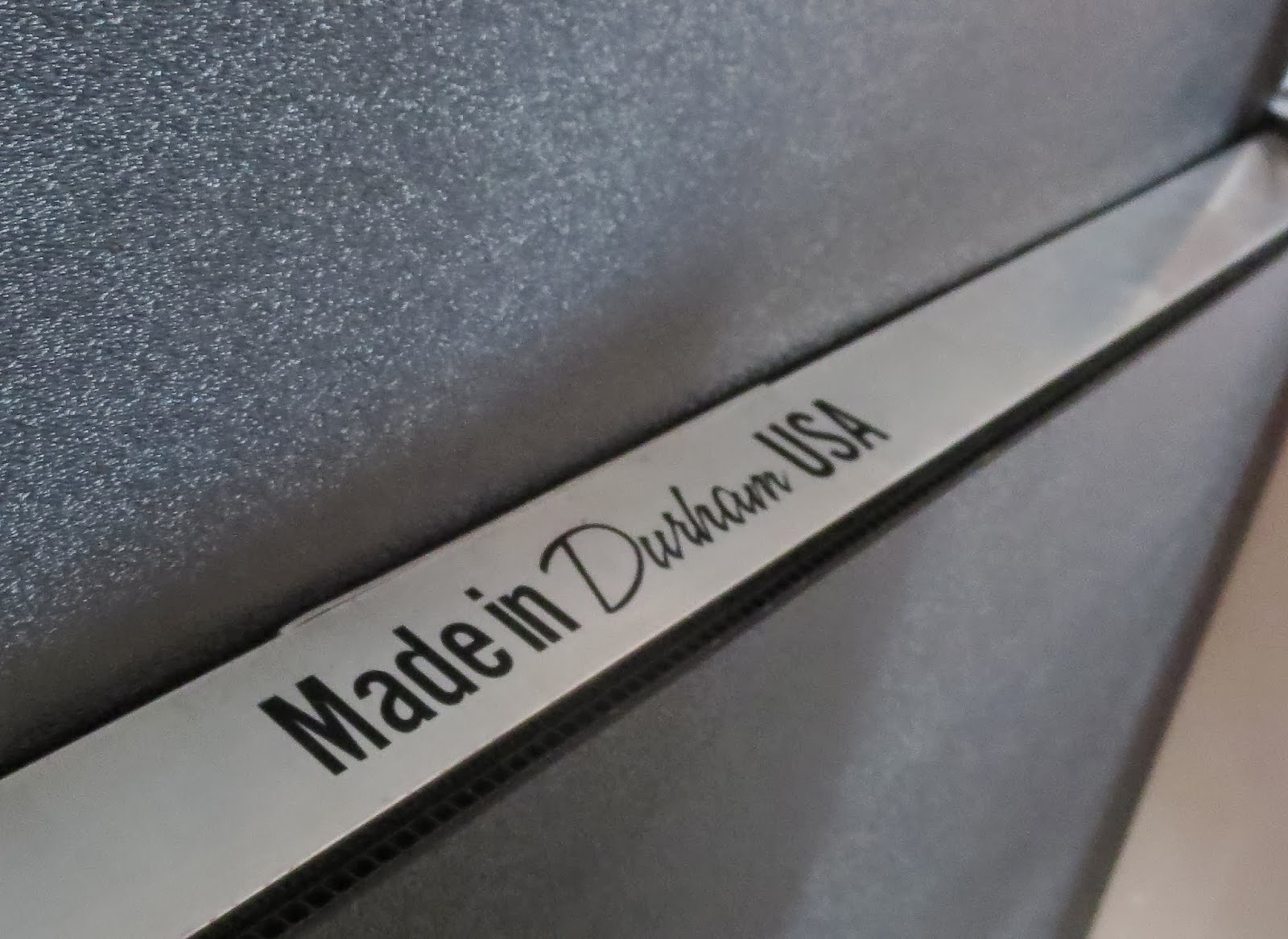
One of the more interesting aspects of this carcycle, or bikeamobile, is that it's made not in Detroit, or Japan, or China,
but in Durham, North Carolina. That's where I heard about it during a recent visit, and was offered a test ride. This particular unit is owned by the president of a nonprofit watershed association I founded while living down there back in the 90s. Jerry Seinfeld is an enthusiastic supporter of the technology.
Top speed is around 25mph, and you can add additional batteries for longer trips. Whether it's classified as a bicycle or something else depends on where you live. In Durham, at least, it's considered a bicycle and no license is required. Much more info at organictransit.com. One of the articles written about it can be found here. The founder, Rob Cotter, offers us his vision in a TedX presentation.
Well, meet the ELF, which is basically a bike with a roof, cargo space, electric assist and rearview mirrors. It weighs in at 150 pounds, has two wheels in the front,
one wheel in the back.
It seats one,
carries cargo,
and goes fifteen miles on a battery charge.
The battery can be charged two ways: by the built in solar panel, which takes about seven hours,
or by taking the battery inside and plugging it in. I'm particularly interested in whether the battery, or batteries, rechargeable by solar panels, could be used to run the house in low-energy mode during a power outage. That way, the same purchase that provides energy when the grid is down would also have ongoing use for transportation.
One of the more interesting aspects of this carcycle, or bikeamobile, is that it's made not in Detroit, or Japan, or China,
but in Durham, North Carolina. That's where I heard about it during a recent visit, and was offered a test ride. This particular unit is owned by the president of a nonprofit watershed association I founded while living down there back in the 90s. Jerry Seinfeld is an enthusiastic supporter of the technology.
Top speed is around 25mph, and you can add additional batteries for longer trips. Whether it's classified as a bicycle or something else depends on where you live. In Durham, at least, it's considered a bicycle and no license is required. Much more info at organictransit.com. One of the articles written about it can be found here. The founder, Rob Cotter, offers us his vision in a TedX presentation.
Eyes on the Dinky
A lot of eyes have been on the Dinky in recent years, scrutinizing and questioning every step in the transformation of the Dinky station area by the university.
Personally, as someone very active in calling for Princeton to be an example for state and nation by shifting much more rapidly towards a more sustainable path, I found it hard to engage with the Dinky issue. It threatened to, and often did, suck oxygen out of many other pressing issues in town.
While many saw the extension of rail to Nassau Street as an important goal, I saw the potential gains in sustainability as being more symbolic than substantive. Nassau Street is already congested. The Dinky would have to power its considerable weight up a fairly steep slope to get there. And the challenge of getting the Dinky to run more frequently is made all the more difficult if it must travel farther, and in more congested terrain.
Despite a great deal of news coverage, many people are still unclear on where the new Dinky station will be built. Photos make distances seem greater, but they'll at least help with some orientation. In this photo, the current Dinky station buildings are on the right. The new station will be the oft-mentioned 460 feet away, at the near corner of the parking garage that can be seen down and to the left.
Looking up from the current, temporary Dinky station, you can see the parking garage in the middle of the photo, with McCarter Theater up on the left. The station will be to the left of the parking garage, at the uphill end.
Moving the Dinky station will allow the garage to be easily accessed from Alexander St. Though it seems mundane to shift the Dinky station downhill in part to improve access to a parking garage, passionate ideals like sustainability can only be realized through a lot of seemingly mundane actions. Reducing the distance people need to drive to get to their parking spot has a big impact over time. And the benefit is not only to university employees but to the public as well. The university parking garage is open and free to the public except during weekday working hours.
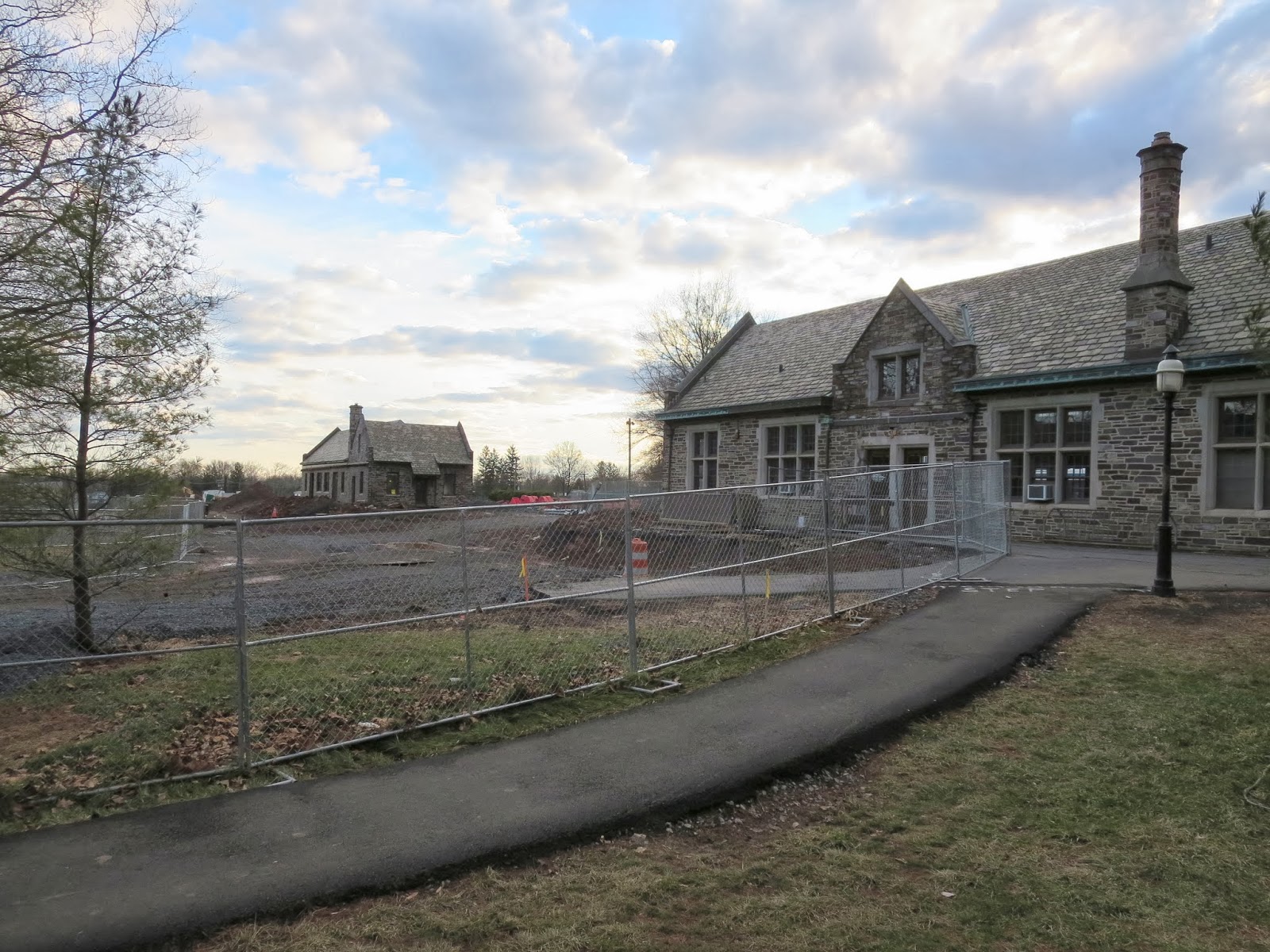
Though the stations and canopy were a beautiful and historic setting for the train station, and I wish a way could have been found to relocate the canopy if it couldn't stay in place, the buildings were not much used. The building on the right was open on a limited basis for commuters, but otherwise empty. The other building, next to where the Dinky stopped, had a small office that the engineer would disappear into. Another portion of it, according to a train employee, had been fitted with a mock dorm room that the university would show to prospective students.
In the future, the buildings will be used much more intensively, one as a restaurant, the other as a cafe, particularly by patrons spilling out of McCarter Theater after a show. A similar repurposing was done long ago in Ann Arbor, Michigan, where the old train station was made into a restaurant called the Gandy Dancer. With the WaWa to be moved right next to the new train station, Dinky users will no longer need to walk half a block from the station to get a cup of coffee.
The transformation of the intersection of Alexander Street and University Place, from stop light to roundabout, has been slowed by the winter cold snap, but is due to open soon. At that point, we'll find out whether nightmare predictions of traffigeddon will come true, or if it will move traffic more efficiently than the stoplight it is replacing.
Back in April, 2007, I got the brilliant but, alas, naive idea that if everyone could agree on the basic facts of moving the Dinky, there would be much less contentiousness, and even the beginnings of agreement on what to do. Below is a letter I had published in TownTopics, augmented by a QandA published previously on this website. At this point in the process, with a one-way sign pointing towards Arts and Transit, they mostly serve archival purposes.
Look at the University’s Proposed Arts and Transit Plan as a Whole
To the Editor:
Catch a ride on the Dinky opinion train
and you will find that, like the Dinky, it sweeps you vigorously from
one terminus to the other, with no stops in between. Respected
friends will have opposite views, delivering you either to the
conclusion that a rail line really should reach up to Nassau Street, or
that the best chance for sustaining the Dinky is to move it 460 feet
down the hill, as the University now says it will do, regardless.
The debate about the University’s
proposed Arts and Transit Neighborhood would be greatly expedited, and
needless ill will avoided, if people would look at the proposal as a
whole, not just one aspect. The Dinky, though its horn sounds like a
cross between a tugboat and a mourning dove, has taken on the qualities
of an elephant being intently scrutinized at too close a range.
Some aspects that I’d like to mention are these:
The 460 Feet: Having made the locally
famous 460 foot, two-minute walk to the proposed new Dinky station
location, I found it to be a surprisingly minimal change. For those
parking at the nearby Lot 7 University garage (free to the public after
hours and on weekends), the new location will actually reduce the walk
by that same 460 feet. Though the University plan would lose the
appealing interface with University Place, it offers improvements for
traffic congestion, parking access, and train station facilities.
Extending tracks to Nassau Street: If
extended to Nassau, as would reportedly still be possible via Alexander
if the University’s proposal goes forward, the Dinky or any other heavy
vehicle (“light rail” is not necessarily lightweight) will encounter
steep inclines that could substantially reduce energy efficiency
compared to the current relatively flat route. The combination of steep
inclines, longer route, more stops, and interactions with streets could
affect the most important factors determining Dinky ridership:
dependability and frequency. Though a train stop on Nassau St. has
symbolic power, even with more downtown density most Princetonians would
still live well beyond the ten minutes people are supposedly willing to
walk to a train stop.
It’s important that we defend
traditions and dream of an even better town. Sustainability, whether
environmental or in reducing the Dinky’s dependency on state subsidies,
is a vital part of any vision for the future. The danger comes when the
strong sustainable, cultural, and civic aspects of the University’s
proposal are ignored due to focus on 460 feet. Nor is it fair to delay
the University’s vision for years while the serious logistical and
budgetary challenges of alternative proposals are indefinitely explored.
If people agree on a foundation of
facts as they can best be determined, look at the big picture, and are
as skeptical of their own opinions as those of others, then there’s hope
this four-year opinion ride can finally pull in to a pleasing
destination.
I have assembled a summary of information about the university proposal and the Dinky at www.princetonprimer.org.
Update, June 29: As part of the agreement to move the Dinky station, a lot of money will be devoted to studying and presumably implementing a better means of getting people to and from the new Dinky station. Even as a supporter of the concept of mass transportation, I find the emphasis on buses/shuttles to be risky. What if we end up with little more than an expansion of the current situation, with mostly empty shuttles driving around town?
People are habituated to jumping in a car and heading directly to their destination. Breaking that habit won't be easy, and it's not particularly efficient for a heavy shuttle to be hauling people on roundabout journeys to places likely still distant from where they really want to go. The future remains a puzzle with stubbornly elusive pieces, but here are a few prototypes:
Update, Jan. 24, 2012: Twice in a week, in discussions with friends about the moving of the Dinky station, I had to point out that the station is not being moved all the way down to Faculty Drive, but only 460 feet (not yards). This made them feel much better about the move. It's great to have discussions where people are able to modify their views in the face of new understanding. Two people is a small sampling, but it does point to the possibility that many people remain confused about basic facts on the issue. A map of the Arts and Transit Neighborhood design can be found here, though it doesn't show Faculty Drive, which is far down from where the new station will be.
Update, Jan/2012: I compiled this information about a year ago in the hopes that some agreement could at least be reached about the underlying facts of a highly controversial issue. What I found is that emotions were running very high, and that very strong opinions tend to block out consideration of contradicting information. There is some very deep resentment of the university, particularly in neighborhoods that border it and fear its encroachment. The proposed moving of the station also takes it and the Wawa grocery store out of the borough and into the township, meaning a loss of tax revenue for the borough. Though there are many sustainable features about the University's proposed development, opponents tended to judge its sustainability value solely on whether the train tracks would ever reach Nassau St.. Describing all the unsustainable aspects of extending the tracks up to Nassau (see letter) proved futile. Still, it was worth a try.
INFORMATION ABOUT THE PROPOSED PRINCETON UNIVERSITY ARTS TRANSIT NEIGHBORHOOD
Q: Could rail service be extended to Nassau St. later on, even if the university is allowed to build its Arts and Transit Neighborhood as proposed?
A: Yes, by routing the tracks over to Alexander, then up. -- recent conversation with a University official
Update, June 29: As part of the agreement to move the Dinky station, a lot of money will be devoted to studying and presumably implementing a better means of getting people to and from the new Dinky station. Even as a supporter of the concept of mass transportation, I find the emphasis on buses/shuttles to be risky. What if we end up with little more than an expansion of the current situation, with mostly empty shuttles driving around town?
People are habituated to jumping in a car and heading directly to their destination. Breaking that habit won't be easy, and it's not particularly efficient for a heavy shuttle to be hauling people on roundabout journeys to places likely still distant from where they really want to go. The future remains a puzzle with stubbornly elusive pieces, but here are a few prototypes:
- Capital Bikeshare is a program in Washington, D.C., that's being well-received. Users pay $75/year for access to bikes stationed all over the city. Manhattan has a similar program just starting up, and Seville, Spain had a popular bike rental program when I visited in 2007.
- Building on the bikeshare concept is a fleet of foldable minicars developed by MIT, that can carry two people around town, fold into compact rows, and would be available at the swipe of a credit card.
Update, Jan. 24, 2012: Twice in a week, in discussions with friends about the moving of the Dinky station, I had to point out that the station is not being moved all the way down to Faculty Drive, but only 460 feet (not yards). This made them feel much better about the move. It's great to have discussions where people are able to modify their views in the face of new understanding. Two people is a small sampling, but it does point to the possibility that many people remain confused about basic facts on the issue. A map of the Arts and Transit Neighborhood design can be found here, though it doesn't show Faculty Drive, which is far down from where the new station will be.
Update, Jan/2012: I compiled this information about a year ago in the hopes that some agreement could at least be reached about the underlying facts of a highly controversial issue. What I found is that emotions were running very high, and that very strong opinions tend to block out consideration of contradicting information. There is some very deep resentment of the university, particularly in neighborhoods that border it and fear its encroachment. The proposed moving of the station also takes it and the Wawa grocery store out of the borough and into the township, meaning a loss of tax revenue for the borough. Though there are many sustainable features about the University's proposed development, opponents tended to judge its sustainability value solely on whether the train tracks would ever reach Nassau St.. Describing all the unsustainable aspects of extending the tracks up to Nassau (see letter) proved futile. Still, it was worth a try.
INFORMATION ABOUT THE PROPOSED PRINCETON UNIVERSITY ARTS TRANSIT NEIGHBORHOOD
--compiled March, 2011
To
my knowledge, there has been no previous attempt to gather information
relevant to the Dinky's future and the university proposal in a
reasonably concentrated form that would help people get up to speed on
the issue. Controversy can sometimes be reduced if people of varying
views can agree on underlying facts. What follows by no means answers
all questions, and I would appreciate any suggestions for additional
questions and answers.
The following information was gleaned from Princeton Future’s website, several articles in the Town Topics, and Princeton University's website. Thanks in particular to Princeton Future for making available full transcripts of public meetings about the proposed development. Links to the full texts are provided below.
1)
Below are selected questions and (primarily university) answers
regarding the Dinky (mostly excerpted, with permission, from a 11.13.10 meeting of Princeton Future).
Q: How long have discussions been going on about the arts/transit center?
A: Plans
have been in the works for 4 years. The last two years, there have been
some significant conversations that have occurred in public. -- Kevin
Wilkes AIA, Borough Council, PU ’83
Q:
Why does the university want to locate the $300 million arts center
next to the Dinky station instead of at 185 Nassau (some community
members are suggesting this as an alternative site)?
A:
The location. One of the things that drives the university’s planning
for the arts is that it should in fact be well distributed throughout
the campus. 185 (Nassau) will continue to be a major center for the
arts. As would Intime, as would Richardson, as would Taplin, as would
the Art Museum and other locations around the campus. What drives this
is the growing synergies over time, particularly theater, dance,
McCarter and Berlind. So being adjacent to McCarter and Berlind is a
real attraction. And it brings in to this part of campus (the Dinky
terminus), which is a part of campus where 2 things happen that are
really helpful: 1. Lots of students live in this part of campus. So
getting them in and out of this space is attractive. And it is an easy
place for members of the community to get to. So that is why it is there. – Bob Durkee, Secretary, VP Public Affairs, Princeton University ‘69
Q: How many people ride the Dinky on an average day?
A:
From New Jersey Transit, we have a current estimate of 2045 daily
riders on the Dinky. We would like this (arts/transit center) project to
increase that ridership because of the amenities. The all-important
Wawa has 2600 daily customers. -- Ron McCoy FAIA, Princeton University
A: In 2010, according to NJ Transit data received by the borough, there were 613,500 trips on the Dinky, which works out to 1680 per day. The same document said there were 2210 daily trips. (The search for truth continues.)
Q: How much is the Dinky subsidized by the state of New Jersey?
A: Quotes (without any clear basis) have varied from $4/ride to $8/ride. The borough recently asked NJ Transit for more accurate numbers, and were told that the annual operating deficit is $822,000. Divided by 613,000 trips in 2010, that comes to about $1.30/ride. The NJ Transit info also mentioned $3.9 million in capital improvement costs, and it's not clear if those were factored in.
Reducing the need for state subsidy by increasing ridership and, perhaps at some point, reducing operating costs by switching to a lightrail system, is an important goal of both the university and the community, with consequences for the Dinky's longterm sustainability. -- Editor
A: In 2010, according to NJ Transit data received by the borough, there were 613,500 trips on the Dinky, which works out to 1680 per day. The same document said there were 2210 daily trips. (The search for truth continues.)
Q: How much is the Dinky subsidized by the state of New Jersey?
A: Quotes (without any clear basis) have varied from $4/ride to $8/ride. The borough recently asked NJ Transit for more accurate numbers, and were told that the annual operating deficit is $822,000. Divided by 613,000 trips in 2010, that comes to about $1.30/ride. The NJ Transit info also mentioned $3.9 million in capital improvement costs, and it's not clear if those were factored in.
Reducing the need for state subsidy by increasing ridership and, perhaps at some point, reducing operating costs by switching to a lightrail system, is an important goal of both the university and the community, with consequences for the Dinky's longterm sustainability. -- Editor
Q: Why does the university want to move the Dinky station away from its current location on a public street (University Place)?
A: We
asked (the consultants) if there was a way to make this work with the
Dinky Terminus where it is. Their answer is “no”. You can’t get access
into the (Lot 7 parking) garage. You can’t keep the parking as close as
you need to keep it. You can’t keep the Wawa close to the station. You
can’t meet all of the needs you need to meet in terms of traffic and
circulation. ….. We have no desire to move it for the sake of moving it.
We also asked them whether we could do it with the roundabout to the
south….They came back and said it doesn’t solve the problem. We have
over the course of time looked at lots and lots of different models. The
terminus is a magnet. Things that go with it: parking, Wawa, drop offs,
shuttle connections and all of that. If you have to keep all of those
things with it, you have to put it in a place where that can happen. If
you leave it where it is, you more or less have to leave the site the
way it is. -- Bob Durkee, PU
A2: One of the reasons we have congestion here now is that we have all modes of
transportation:
buses, taxis, cars, Wawa, pedestrians, bikes. They are all attached to
the terminus of the Dinky. (at University Place) The best way to
describe it is “The train is like a magnet”. If you move the terminus of
the train into a dedicated transit plaza (as proposed), then you move
all of those other things with it. So they are now located in the
transit plaza along with metered parking and commuter parking. So all of
that gets off the public street. So the public street moves quicker and
faster. …. We would provide all of the parking that is currently
provided. And we would give the riders an attractive public space with
art venues. It will be a multi-modal space and this shows the ability to
connect to structure 7(parking garage). This structure will then
provide parking for McCarter evening performances. -- Ron McCoy FAIA,
Princeton University
Q:
Moving the Dinky 460 feet down the hill would increase walking time
from town by 2 minutes. How many non-university Dinky riders would this
affect?
A:
Princeton University reportedly conducted a survey in October 2006
about East-bound Dinky ridership on a Tuesday and Wednesday. Combined
results were roughly 45% walked, 30% drove, 10% were dropped off, and 5%
rode bikes. (doesn’t add up to 100%, but close enough) If 40% of
ridership is university people walking to the Dinky (according to more
recent data), that leaves only 5% of ridership being non-university
walkers currently.
Q:
Why does the university object to putting the Dinky tracks underground
so that the tracks would not interfere with the proposed arts center?
A: The
question whether it really makes sense to have the entry experience
into Princeton be an underground one. For us that doesn’t feel like
something that would be appealing to Dinky riders. It raises issues of
safety. We have taken it seriously. We have done some work to figure out
what it would cost. It is $60-80 million dollars to try to do that. I
don’t think anyone has that kind of money to put into the creation of a
tunnel and an underground station. I understand the motivation. It
strikes me as one of those things that in time, people would really
wonder why a community of this size, with the number of people coming in
late at night would really want to come out into an underground
location. -- Bob Durkee
Q: Is the moving of the Dinky station 460 feet south inevitable?
A: From a March 30, 2011 Town Topics article:
Even if the municipalities did not approve the zoning changes
requested by Princeton University to build its proposed Arts and
Transit Neighborhood at the intersection of University Place and
Alexander Road, the Dinky terminus will still likely move farther away
from downtown Princeton. In a letter to University Vice President and
Secretary Bob Durkee dated March 25, New Jersey Transit Executive
Director James Weinstein explained that his organization had “no
objection” to the “University’s interest in moving the borough terminus
station of the Princeton Shuttle Line (the Dinky station) some 460 feet
southward.” Mr. Weinstein’s letter reads, “It is my understanding
that such a move was specifically contemplated in the October 30, 1984
agreement of sale between NJ Transit and the University for the station
property.”
Q: Does the university see future alternatives to the Dinky?
A:
What seems to us … promising is to think about, whether over time, the
existing Dinky technology could be replaced with something more like
light rail…a way to extend the life of rail service into Princeton for a
much longer period of time. And it would have a. the advantage of
reducing operating costs, and b. creating the possibility that over
time, you could have a second stop in West Windsor. That has some
attraction because it might keep out some of the car traffic that comes
in here. We have also been exploring that idea and it is one that is
really worth doing something about. --university rep
Q:
Does currently available parking for the Dinky meet the demand, and has
building a garage structure somewhere in the vicinity of the current
Dinky station been considered?
A:
In the short run, “No”. The thinking about parking in this area really
began with “Could we provide the parking that is needed for people who
want to park and use the Dinky? Could we provide the parking needed for
the new Arts venues? The amount of space that is now available in the
permit lot and in the metered lot seems to be meeting the need. The
waiting list to get a permit is about 2-3 months. There are meters
available every day when we check. There seems to be enough parking for
now. –Bob Durkee, PU
Q: How much does the Dinky cost taxpayers?
A:
Though the figure of $8,000/day in state subsidies has been reported,
the recent data obtained from NJ Transit by Princeton borough puts the
operating deficit at $2250/day. Again, it's not clear if the "operating"
deficit includes all costs.- Editor
Q:
What are some aspects to consider when proposing an extension of rail
service up to Princeton's business district on Nassau Street?
A:
A train stop on Nassau Street would have strong symbolic value,
bringing together two great Princeton traditions--its downtown and the
Dinky--and making it easier for some to walk to the train stop. There
are potential downsides, however, that must be examined to determine the
idea's overall impact on sustainability and ridership. If
extended to Nassau, the Dinky or any other heavy vehicle (“light rail”
is not necessarily lightweight) will encounter steep inclines that
could substantially reduce energy efficiency compared to the current
relatively flat route. The combination of steep inclines, longer route,
more stops and interactions with streets could affect the most
important factors determining Dinky ridership: dependability and
frequency. Even with more downtown density most Princetonians would
still live well beyond the 10 minutes people are supposedly willing to
walk to a train stop. -- writer of this blogQ: Could rail service be extended to Nassau St. later on, even if the university is allowed to build its Arts and Transit Neighborhood as proposed?
A: Yes, by routing the tracks over to Alexander, then up. -- recent conversation with a University official
2)
The following description of benefits of the university design for the
Arts and Transit Neighborhood is excerpted from the Princeton University
powerpoint presented at a Joint Meeting of Borough Council and Township Committee January 31, 2011.
Relieving Congestion
•Roundabout improves traffic flow.
•Purpose-designed space provides a multi-modal hub for shuttles, jitneys, buses, taxis, bikes.
•Provides safer pedestrian crossings.
•Separates conflicts and moves them off the main corridor.
•Deliveries from campus: all fronts, no backs.
•Provides easy access and safe Wawa parking.
•Allows
direct access to/from Lot 7 garage saving 350 vehicle miles per day and
reducing north-bound traffic entering Alexander at Faculty.
•Provides bike lanes and storage
•Replaces all existing parking in-kind.
Access to Lot 7 Garage
•Convenient access benefits arts patrons & neighborhood visitors.
•Reduces vehicle miles traveled by 350 miles per day –reduces pollution, saves fuel, saves time.
•Reduces traffic on Faculty Road.
•Relieves congestion at Faculty Road/Alexander Street intersection.
Preserve/Enhance the Dinky Experience
•New heated/air conditioned station with restrooms, Wawa, bike amenities.
•Easy drop off/pick up.
•Easy access to shuttles, jitney, taxis.
•Convenient parking: permit and daily.
•Dinky riders provided with attractive public spaces, retail, and arts venues.
•University support for a more extensive public transit linkage with the Dinky.
•Arts, retail, and lower Alexander residential use may attract additional Dinky use.
Dinky Ridership
•About 40% of Dinky riders are affiliated with the University; additional riders are attending University meetings or events.
•Unaffiliated riders get to the Dinky by driving themselves, being driven by others, using public transit, biking, and walking.
•The
walk from Nassau Street to the current station via the Wawa is longer
than the walk to the proposed new station with the Wawa in it.
•Future development along Alexander in the Township would add new riders from the south.
Already a Public Space
•175,000 annual McCarter patrons.
•2,045 daily transit rides.
•2,600 daily Wawa customers.
•1,050 daily customers at new restaurants.
•150-250 average evening patrons of new arts venues, approximately 50 performances a year (first phase).
•Unknown number of summer performance participants and patrons -indoor and outdoor spaces.
•Special event participants, e.g. McCarter gala.
•160-290 housing unit capacity south on Alexander.
•600 current residents within a 5-minute walk.
Sustainability
•Enhance
the Dinky experience (new station in an attractive setting with Wawa
incorporated, convenient drop-off/pick-up and parking, connection with
shuttles and jitney, bike access and storage).
•Direct access to Lot 7 reduces vehicle miles traveled by 350 per day.
•Extensive
landscaping; existing area is predominantly surface parking lots,
roofs, and impervious surfaces that tax stormwater infrastructure and
create heat island effect.
•First phase buildings include geothermal heating and cooling; green roofs; grey water recycling; solar panels; etc.
Greening the Neighborhood
•Increased landscaping and greenspace replace paving.
•Green roofs, bio-filtration swales, and stormwater harvesting.
•Alternative energy: geothermal wells and photovoltaic panels.
•Direct access to Lot 7 garage reduces vehicular miles traveled by 350.
Saturday, February 01, 2014
Skating Here Today (Saturday, 2/1/14), Gone Tomorrow
If you want to skate on Carnegie Lake or the pond at Community Park North, you better race on down there. Warming weather will bring the red flag out at dusk today.
From an email sent out by Princeton Public Schools:
Princeton Recreation Department, Ice Skating Update: February 2, 2014
As of dusk today (2/1/14), all locations will be closed for skating until further notice due to rising temperatures.
From an email sent out by Princeton Public Schools:
Princeton Recreation Department, Ice Skating Update: February 2, 2014
As of dusk today (2/1/14), all locations will be closed for skating until further notice due to rising temperatures.
Red flag = NOT SAFE
White flag = SAFE
White flag = SAFE
For the most up to date information on ice skating, please call 609-688-2054 or follow the Princeton Recreation Department on Faceboook and/or Twitter.
Tuesday, January 28, 2014
Skating On Carnegie Lake
The ice is now thick enough to skate on, for the first time since 2009, according to a news item on the Princeton University website. It doesn't say if any of the ice has been cleared of snow. Today's (Tuesday's) town recreation dept. message at 609-688-2054 also includes Community Park North's pond (in Pettoranello Gardens) as safe. The pond at Smoyer Park, however, is not safe.
It's always good to check for the white flag, to make sure conditions haven't changed, and call the number above for daily updates.
More on this ice not-breaking story later in the day. Skating is only allowed during daylight hours.
It's always good to check for the white flag, to make sure conditions haven't changed, and call the number above for daily updates.
More on this ice not-breaking story later in the day. Skating is only allowed during daylight hours.
Wednesday, January 15, 2014
Insulating Heat Ducts in the Basement
This is a story about making a little heat go a long way. In most houses, heat has to go a long way to get to this or that room. A wood stove simply radiates the heat outward, and lets the excited molecules spread the warmth up the staircase and around corners. But the typical forced air furnace has to push the air itself, through a labyrinthine set of pipes, facing the same circulatory issues of a giant octopus.
Much of the heat a furnace produces gets lost in transit, as the long metal ducts shed their warmth into the basement where it doesn't do much good. My basement is an all too good example of that, with bare ducts and leaky single pane windows.
So when my friend Dorothy was told that she needed a bigger furnace to get more heat to chronically cold rooms in her house, she fortunately asked around and got some good advice on a different approach.
Instead of spending lots of money on a bigger furnace, why not insulate the ducts so the heat from the little-furnace-that-could can make it all the way to the upstairs bedrooms? It goes against the bigger-is-better and replace-rather-than-repair mantras that so often dictate decisions, but it worked like a charm. Rooms that were chronically cool are now comfortably warm.
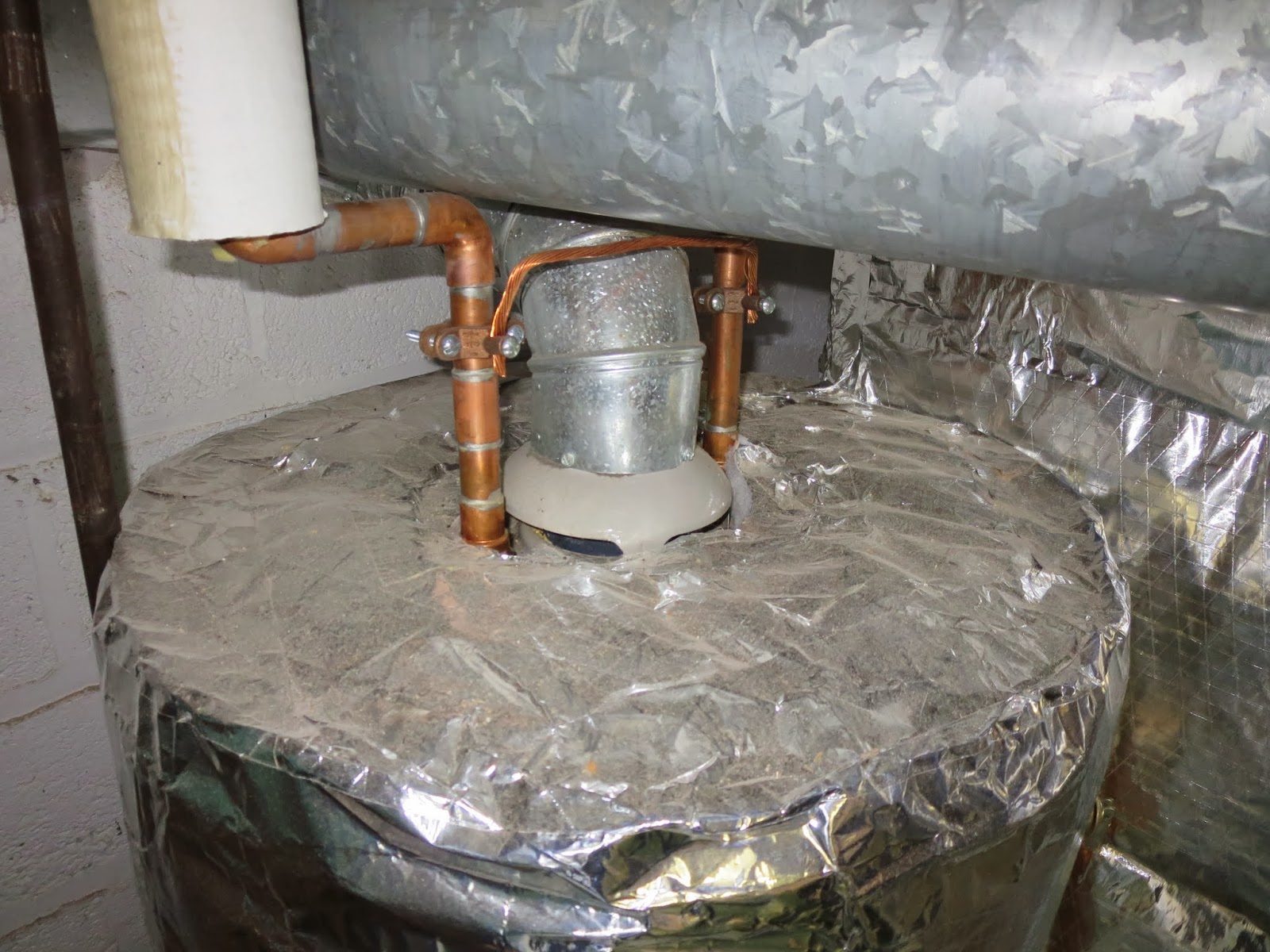
Imagining that duct insulation would have a MichelinMan bulkiness, I was impressed to see that the covering is very compact.
And the workmanship is impressive, with insulation neatly taped and tight under and around the brackets,
and the water heater carefully insulated as well.
Leakage can cause even more heat loss from air ducts, and here it looks like the solution is to tightly wrap the joints with tape. These may be return ducts that were a lower priority for insulation. (Note: Check comment section below for details on materials and the logic of not insulating return ducts.)
Combined with the clotheslines stretched along the ceiling as a way to avoid using the energy-gulping clothes dryer, this is one very together, money saving, energy saving basement.
Tuesday, January 14, 2014
Composting Leaves in Paris's Luxembourg Gardens
The place? Luxembourg Gardens in Paris. The context? Highly formalized, immaculately maintained grounds. And what do they do with the leaves? Throw them out in the street and haul them out of town? No. They find an out of the way spot in the park, corral the leaves and let them break down into soil.
More on how nature is managed in Paris at this link.
Friday, January 10, 2014
Sump Pump-ageddon
Woe be the world when the sump pumps turn against us. And this, dear readers, I fear has finally come to pass. It was only a matter of time--or, more to the point, an extended period of freezing weather--before the needs of the indoor underworld (people's basements) would begin to wreak havoc on the great suburban out of doors better known as sidewalks and driveways.
It is, once again, that mischievous substance known as water--the only molecule at liberty on this earth to pass with ease from one state to another, from gas to liquid to solid and back again--that is playing tricks.
Rising out of the basement as a liquid, this sump pumpage acts much like a fresh spring, a rivulet, warm enough to begin flowing across the pavement towards Harry's Brook. In above freezing weather, this drainage is benign, flowing away from the house and down into the street, where gravity leads it to a storm drain that connects to the local brook.
But in freezing weather, the water solidifies into a glacier where before there was a driveway.
On Linden Lane, this thick crusting of road salt, along with the traffic cones that were just removed today, may well have been applied to reduce the hazard created by a sump pump that empties into the street and has proved hazardous during cold spells in previous years.
Sump pumps can also cause problems if they drain into the sanitary sewer (the one that carries water from sinks and toilets to the treatment plant), adding unnecessarily to the town's wastewater treatment costs. Some of Princeton's homes still have this faulty connection.
Far better than releasing sump pump water onto a driveway, out into the street, or into a sanitary sewer, is this backyard discharge,
which allows the basement water to flow out into the yard where it can seep into the ground and, during summer dry spells, quench the thirst of gardens, lawns and trees. It helps, of course, to have some slope to carry the water away from the house, which many yards do not.
As it happens, these two houses are built where once there was an actual tributary of Harry's Brook. Though the creek was filled in to build the homes, it still travels underground, seeping into their basements and necessitating a lot of work by their sump pumps. This is a domestic version of what happened with the Spring Street parking garage downtown, and speaks to the perils of trying to ignore or erase the original hydrology.
What water doesn't get absorbed by the uphill neighbors' backyards flows towards my yard beyond the fence, where I've actually recreated a streambed to imitate the original tributary. Conveniently, this frozen stream reveals what is hard to photograph at other times of the year, when the water flow blends into the grass.
Somewhere in Princeton, I'm sure there's some clever homeowner who has channeled sump pump water to make an ice skating rink in the backyard.
These are some ways to tame a sump pump's offerings, to give the mischievous water room to play, and to turn Sump Pump-ageddon into Sump Pump-a-Garden.
Thursday, January 09, 2014
Still No Skating on Carnegie Lake!
Major disappointment here. With temperatures likely to begin rising tomorrow, this seemed like the day that skating on Lake Carnegie and the town's two smaller ponds just might get the green light, which for ice comes in the form of a white flag. But no. The red flag hangeth still, and the recording at the town's skating conditions hotline, 688-2054, said conditions are still not safe today (Jan. 9).
Unlike the lake, the canal still has open water, because it has a stronger current.
But the lake doth beckon, with its vast expanse of smooth ice, made possible by a couple extended cold snaps, a heavy snow that then improbably melted during a one day heat wave, then froze smooth in recent days. With the ice still unsafe, there isn't much to do next to the lake other than make like a beaver and gnaw on some wood, and check the hotline again tomorrow morning.
If not tomorrow, then 2014 could well turn out to be like 2013, but we'll always have 2007 and 2009.
The town webpage for iceskating info is at this link.
Saturday, January 04, 2014
Finding Empowerment in Shutoff Valve Repair
Just beneath the surface in any house lie mysteries that most of us would be happy to remain oblivious to, and yet when something goes wrong, there is little choice but to launch an exploratory expedition under the kitchen sink or into the basement, where pipery and knobbery of baffling complexity awaits to stymie and perplex.
One option is to call a plumber, but a phenomenon known as "Princeton prices" has caused many of us to seek guidance from the collective wisdom of the internet and take wrench in hand.
Take something as seemingly simple as a dripping faucet. Though I have over the years grown more confident in finessing the faucet handle off and replacing the rubber gasket, that operation requires first shutting water off to the faucet. Chances are, the shutoff valve has become encrustified over the years, and will fail to shut the water off. In the worst case, the shutoff valve will itself begin leaking, compounding the original problem in the faucet.
Such a scenario came to pass in our household just before the holidays, prompting a search of the internet for sage advice. Judging from the placement of his youtube tutorial at the top of the heap, Max Lemberger must be the rock star of shutoff valve repair. The tutorial called for first tightening the packing nut, and yet my leaky shutoff valve (lower right in the photo) lacked any nut to tighten. Deeper did I dig into the bowls of cyberspace, plumbing the depths, so to speak, to find at last the key to repairing my aging home's bout of incontinence. Emboldened by a ThisOldHouse video, I took hacksaw in hand and carefully cut the faulty shutoff valve off, then replaced it with a new one (upper left in photo) that requires no soldiering to install. Not only was the problem fixed, but it has remained fixed for one month and counting--a good omen for the new year.
That operation required first shutting off the main shutoff valve for the house, which itself began to drip when in the closed position. Fortunately, it was a slow drip that slowed further and finally stopped soon after I opened the valve up again. Fortunately, not all mysteries need to be solved, but with the help of the internet and the local hardware store, each successful repair adds to a sense that some portion of destiny is, literally, in our hands.
Thursday, January 02, 2014
How Taxicab Drivers Make, or Don't Make, a Living
On a taxicab ride from Princeton Junction to Princeton, the driver gave me the lowdown on the economics of taxi cab driving. There may be other arrangements out there, but this post tells one cab driver's story. What he described sounded about as inefficient as any system for human transport that could be devised. The conversation began with my wondering where he would go after dropping us off. "Back to the Princeton Junction train station," he said, because there's nowhere else to go. So half of his driving provides no service to anyone. And when he gets back to the train station, he has to get in line with as many as 40 other taxi drivers. Because it's cold, he has to keep his car idling, while he waits in line for as long as four hours for the next passenger. If he's unlucky, it will be someone going only a short distance, which puts him back at the end of the line with little money to show for it.
The company he works for provides the car, but he pays for the gas, and can burn through a quarter of a tank just idling at the train station waiting for the next rider. Because he pays for the gas, the company has no incentive to provide a fuel efficient car. He splits the fare with the company 40/60, with the larger portion going to the company. Our ride to Princeton was only his third ride of the day, after nine hours on the job. He gets to keep only $12 of the $30 fare, plus tip. He expected the New Years Eve business that evening to be pretty good, but the next few weeks will be slow. Some drivers avoid this doldrums to some extent by having their own list of clients who will call them directly for a ride.
What this job offers, if precious little money, is hope of getting lucky. Maybe tomorrow will be better than today. But when most everyone in the Princeton area has a car, or a friend to pick them up, there isn't much luck to go around. It's a step up from playing the lottery, in some ways like fishing. Imagine a hundred fishing vessels trawling for the last few fish in an ocean inlet. The economics make little sense not only for the driver but also for the rider, who pays $15 to take the train 50 miles from New York, then $30+ for the last 4 miles to Princeton.
For the planet, it makes even less sense. When not actually transporting riders somewhere, taxis devote themselves completely to their primary role as climate changing devices, their engines pumping fossil carbon into the air. In the U.S., this role is expedited because they tend to be designed to get the worst gas mileage possible. In the older parts of Paris, they are rare because the metro and bike/ped options are so good. In Buenos Aires, which has many buses but not much of a subway system, and the bike share option is just getting going, the taxis are at least small and powered by natural gas, but are so numerous that they flow like a current in the streets.
A taxi's inefficiency is not in complete contrast with public transportation, since empty buses and trains are burning fossil fuels much like idling taxis, all for the sake of being available if anyone comes along who wants a ride.
As a teenager, I briefly worked as a golf caddy, which meant sitting in a dusty yard behind the pro shop waiting for my number to be called. Most golfers preferred golf carts by then, so we caddies had to wait a long time before making a few bucks carrying someone's clubs around the course. Though I wasn't burning fossil fuels while I idled, the golf carts may well have been more ecological, given that, unlike the carts, I had to drive myself out there and back every day.
If taxis are necessary, and they do provide a useful service of custom transport, the ideal compromise would be a vehicle that gets good mileage and has some means other than running the engine to keep the waiting driver comfortable, combined with some system to prevent the needless overabundance of drivers at any one location, much as fisheries are managed to balance the number of fishermen with the number of fish.
The waste--in the drivers' time, in gasoline, and the suburban sprawl that makes people helplessly dependent on cars--is driven to a large extent by the relative cheapness of gasoline--a highly subsidized commodity.
The company he works for provides the car, but he pays for the gas, and can burn through a quarter of a tank just idling at the train station waiting for the next rider. Because he pays for the gas, the company has no incentive to provide a fuel efficient car. He splits the fare with the company 40/60, with the larger portion going to the company. Our ride to Princeton was only his third ride of the day, after nine hours on the job. He gets to keep only $12 of the $30 fare, plus tip. He expected the New Years Eve business that evening to be pretty good, but the next few weeks will be slow. Some drivers avoid this doldrums to some extent by having their own list of clients who will call them directly for a ride.
What this job offers, if precious little money, is hope of getting lucky. Maybe tomorrow will be better than today. But when most everyone in the Princeton area has a car, or a friend to pick them up, there isn't much luck to go around. It's a step up from playing the lottery, in some ways like fishing. Imagine a hundred fishing vessels trawling for the last few fish in an ocean inlet. The economics make little sense not only for the driver but also for the rider, who pays $15 to take the train 50 miles from New York, then $30+ for the last 4 miles to Princeton.
For the planet, it makes even less sense. When not actually transporting riders somewhere, taxis devote themselves completely to their primary role as climate changing devices, their engines pumping fossil carbon into the air. In the U.S., this role is expedited because they tend to be designed to get the worst gas mileage possible. In the older parts of Paris, they are rare because the metro and bike/ped options are so good. In Buenos Aires, which has many buses but not much of a subway system, and the bike share option is just getting going, the taxis are at least small and powered by natural gas, but are so numerous that they flow like a current in the streets.
A taxi's inefficiency is not in complete contrast with public transportation, since empty buses and trains are burning fossil fuels much like idling taxis, all for the sake of being available if anyone comes along who wants a ride.
As a teenager, I briefly worked as a golf caddy, which meant sitting in a dusty yard behind the pro shop waiting for my number to be called. Most golfers preferred golf carts by then, so we caddies had to wait a long time before making a few bucks carrying someone's clubs around the course. Though I wasn't burning fossil fuels while I idled, the golf carts may well have been more ecological, given that, unlike the carts, I had to drive myself out there and back every day.
If taxis are necessary, and they do provide a useful service of custom transport, the ideal compromise would be a vehicle that gets good mileage and has some means other than running the engine to keep the waiting driver comfortable, combined with some system to prevent the needless overabundance of drivers at any one location, much as fisheries are managed to balance the number of fishermen with the number of fish.
The waste--in the drivers' time, in gasoline, and the suburban sprawl that makes people helplessly dependent on cars--is driven to a large extent by the relative cheapness of gasoline--a highly subsidized commodity.
Subscribe to:
Posts (Atom)