Showing posts with label Water. Show all posts

Friday, October 04, 2019

How to Easily Reduce Water Use

If you go to the American Water website and log into your account, you'll find under the tab "usage" a link called "usage overview". Click on that and it takes you to a graph like the one below. Click on the "Neighborhood Average Usage" box in the upper right and a green line will appear that compares your water consumption to the local average.

Below is what ours looks like. We use about 2000 gallons per month, which is less than a sixth of the local average. How do we manage this? We're empty nesters for one, but it's mostly a matter of valuing water, and understanding that every time you turn on the tap, you're consuming elaborately treated water that was pumped 20 miles uphill to Princeton, and that every bit of the water that goes down the drain then has to be elaborately and expensively treated at the Stonybrook wastewater treatment plant on River Road. That understanding makes us less cavalier about water use. Some easy strategies for reducing consumption are listed below the graph.

MEANS OF USING LESS WATER
  • Resilient native landscaping, and mulch to prevent the soil from drying out
  • Get in the habit of turning the water off when washing hands, brushing teeth, i.e. don't let water run straight from faucet to drain. 
  • Shorter showers, or even "Navy" showers (turn water off while lathering up)
  • low flow toilets (people liked to make fun of them, but they flush better than the inefficient older style); lots of good brands. Ours are American Standards available at the local hardware.
  • Get in the habit of using cold water for most tasks, rather than waiting for the hot water to arrive at the faucet. 
  • Front load washing machines use a minimum of water
  • See below for way to minimize water use when washing dishes.
SAVE ADDITIONAL MONEY
  • I once learned that your annual sewer bill is calculated based on your water usage in the winter (likely Jan-March), since they want to charge you only for water that goes down the sewer, not the water you use in summer to irrigate your yard. Therefore, winter is an especially good time to hone your water conservation habits, since it will save you money on your sewer bill year-round. 
  • Adjust your water heater (somewhere in your basement) so that it only heats the water slightly beyond the hottest water you need. Many water heaters are needlessly overheating water, which is not only wasteful and expensive, but also leads to lots of fiddling with faucet handles to mix in just the right amount of cold water. Ideally (though no use of fossil fuels is ideal), you should be able to turn the hot water on for a shower--no cold at all--and be comfortable.
  • A novel approach to hand-washing dishes: One doesn't need standing water in the sink. Moisten the dishes while stacking them in the sink, to soften the dirt. That way, nature does most of the work. Put some dish soap on a sponge, then with the water turned off, wash some dishes and set them on the counter. Turn water on to rinse that batch, using the rinse water to further moisten the unwashed dishes in the sink. Then turn the water off and wash some more. This way, no time is wasted turning the water on and off to rinse each separate dish. Sounds elaborate, but quickly becomes second nature, and avoids having water running directly from faucet to drain--the ultimate in pointless consumption. Also, try using only cold water. Water that isn't hot enough to kill germs just makes them stronger. Hot water may be needed if there's grease, but otherwise is not essential. Best time to start the habit of using cold water is in the summer, but the habit once established can often continue through the winter.

Friday, January 10, 2014

Sump Pump-ageddon


Woe be the world when the sump pumps turn against us. And this, dear readers, I fear has finally come to pass. It was only a matter of time--or, more to the point, an extended period of freezing weather--before the needs of the indoor underworld (people's basements) would begin to wreak havoc on the great suburban out of doors better known as sidewalks and driveways.


It is, once again, that mischievous substance known as water--the only molecule at liberty on this earth to pass with ease from one state to another, from gas to liquid to solid and back again--that is playing tricks.


Rising out of the basement as a liquid, this sump pumpage acts much like a fresh spring, a rivulet, warm enough to begin flowing across the pavement towards Harry's Brook. In above freezing weather, this drainage is benign, flowing away from the house and down into the street, where gravity leads it to a storm drain that connects to the local brook.

But in freezing weather, the water solidifies into a glacier where before there was a driveway.


On Linden Lane, this thick crusting of road salt, along with the traffic cones that were just removed today, may well have been applied to reduce the hazard created by a sump pump that empties into the street and has proved hazardous during cold spells in previous years.


Sump pumps can also cause problems if they drain into the sanitary sewer (the one that carries water from sinks and toilets to the treatment plant), adding unnecessarily to the town's wastewater treatment costs. Some of Princeton's homes still have this faulty connection.

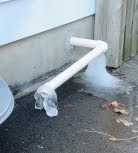
Far better than releasing sump pump water onto a driveway, out into the street, or into a sanitary sewer, is this backyard discharge,

which allows the basement water to flow out into the yard where it can seep into the ground and, during summer dry spells, quench the thirst of gardens, lawns and trees. It helps, of course, to have some slope to carry the water away from the house, which many yards do not.

As it happens, these two houses are built where once there was an actual tributary of Harry's Brook. Though the creek was filled in to build the homes, it still travels underground, seeping into their basements and necessitating a lot of work by their sump pumps. This is a domestic version of what happened with the Spring Street parking garage downtown, and speaks to the perils of trying to ignore or erase the original hydrology.

What water doesn't get absorbed by the uphill neighbors' backyards flows towards my yard beyond the fence, where I've actually recreated a streambed to imitate the original tributary. Conveniently, this frozen stream reveals what is hard to photograph at other times of the year, when the water flow blends into the grass.

Somewhere in Princeton, I'm sure there's some clever homeowner who has channeled sump pump water to make an ice skating rink in the backyard.

These are some ways to tame a sump pump's offerings, to give the mischievous water room to play, and to turn Sump Pump-ageddon into Sump Pump-a-Garden.

Thursday, January 09, 2014

Still No Skating on Carnegie Lake!


Major disappointment here. With temperatures likely to begin rising tomorrow, this seemed like the day that skating on Lake Carnegie and the town's two smaller ponds just might get the green light, which for ice comes in the form of a white flag. But no. The red flag hangeth still, and the recording at the town's skating conditions hotline, 688-2054, said conditions are still not safe today (Jan. 9).

Unlike the lake, the canal still has open water, because it has a stronger current.

But the lake doth beckon, with its vast expanse of smooth ice, made possible by a couple extended cold snaps, a heavy snow that then improbably melted during a one day heat wave, then froze smooth in recent days. With the ice still unsafe, there isn't much to do next to the lake other than make like a beaver and gnaw on some wood, and check the hotline again tomorrow morning.

If not tomorrow, then 2014 could well turn out to be like 2013, but we'll always have 2007 and 2009.

The town webpage for iceskating info is at this link.

Tuesday, October 01, 2013

Water Line Redux

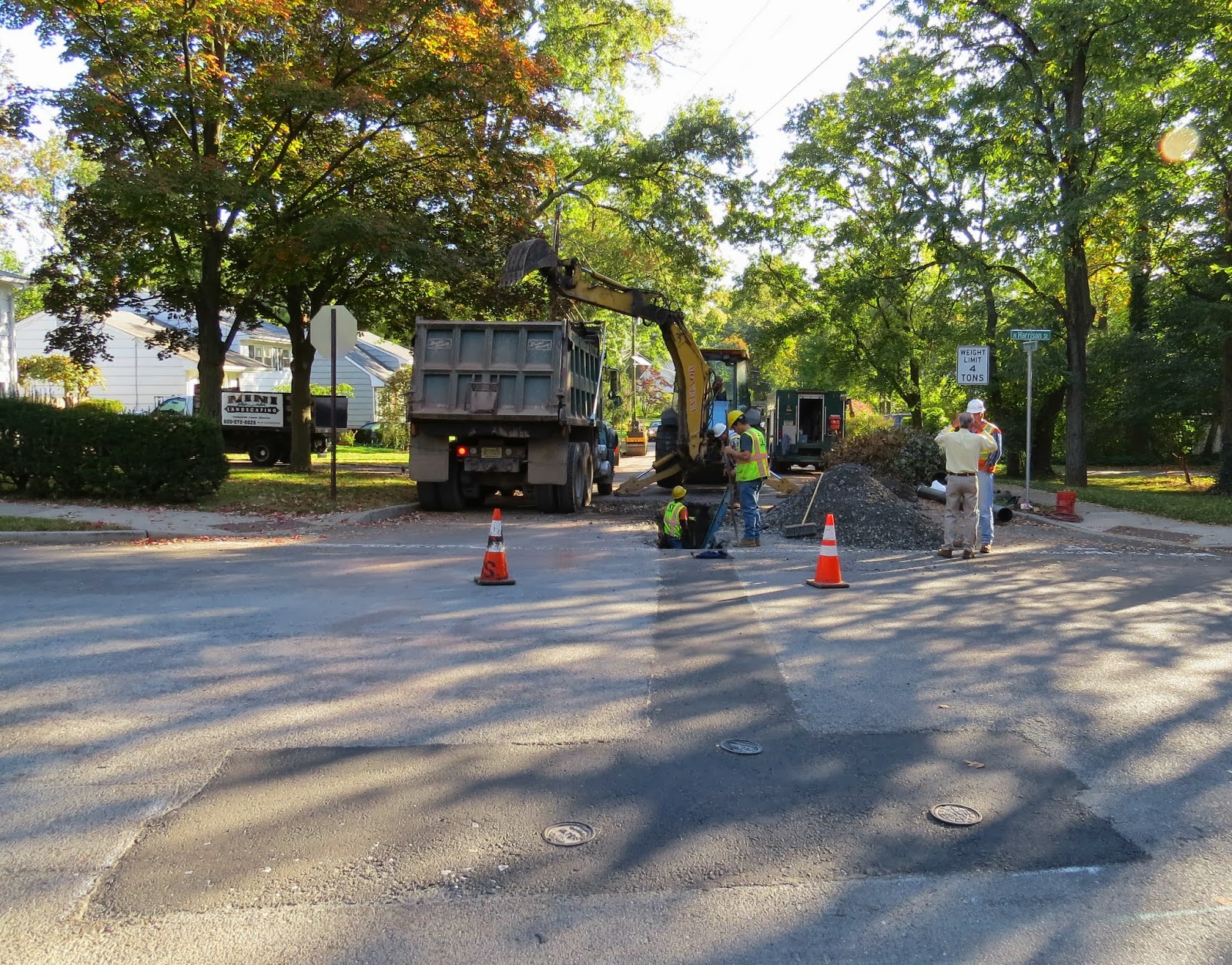
As Yogi Berra, the famous installer of urban water mains, once said, "It ain't over 'till it's over." The sound of yet more heavy equipment groaning on a nearby street yesterday meant that the climactic overnight repair blitz the other night had segued into a surprise encore. I went out and got the lowdown from the American Water supervisor about the water lines that run beneath the fair streets of our fair town.

He said they would have finished the other night, but they had been slowed down by careful digging in the vicinity of a high-pressure gas line that turned out not to exist. Though no alligators have been found beneath Princeton's streets, that I know of (now that would be a scoop), there are a slew of pipes, and sometimes the various utilities forget where they put them all.

Each year, they choose some more water lines in Princeton to replace. There are several reasons for this gradual updating. The pipes here on Horner (one of the founding families of Princeton, by the way) are probably 60 years old, and are made of cast iron. Because cast iron reacts with the chloramines that are used to disinfect our drinking water, the new pipes are lined with concrete in order to prevent contact with metal. The pipes are also laid in a bed of gravel that will reduce the stress on the pipes from the ground's shrink and swell. The new 8" pipes replace the old 6" ones, meaning more water flow capacity, just in case anyone wants to pour more drinking water on the lawn.

The supervisor proudly pointed out that no one loses water service during these updatings. Because the water lines form an interlinking network under our streets, the break in the water line during replacement doesn't affect anyone's water access. The water is simply "backfed", which means it flows in from the other end of the street. The water lines, like the streets, allow flow in either direction.

At the same time, the company is replacing water meters for each residence. The foreman explained that two-income households make it harder to access indoor meters during the day for monthly readings. The new meters transmit their information wirelessly to a meter guy driving down the street. Within a few years, they may put antennas on the tops of water towers, and simply collect individual meter readings that way. There's a gain in efficiency but also a reduction in workforce needs. It would be nice if these boring jobs like reading meters, once phased out, could be replaced by more interesting and useful jobs, but I don't think business works that way.

Tuesday, February 21, 2012

City Streets and Nonpoint Pollution

These photos are from a few weeks ago after a light snow. Winter's a good time to see all the dirt and oil left by cars and trucks passing by. This looks like a lot of oil, but it spreads out so thin that looks can be deceiving--a good thing because this will be swept eventually into the storm drain and into Carnegie Lake, via Harry's Brook.

The sequence of oil droplets headed around the corner to the left. Snow makes visible the dark patina left by car tires, brake linings and drops of oil, all of which come under the heading of nonpoint pollution.

One other benefit of hybrid cars is that their brake pads last much longer, since much of the braking power comes from sending energy back into the battery from the wheels. All of which is to say they contribute less to the nonpoint pollution accumulating on the pavement.

Save On Sewer Rates

This is the most timely time of year to trim your water consumption. According to borough staff (likely the same in the township), a residential sewer bill is calculated by 1) totaling up your January through March water consumption and multiplying by four, or 2) your total water consumption for the year, whichever is less. Since water use typically rises in the summer, e.g. for watering the yard, consumption in the first three months of the year tends to determine how much you pay.

The borough will soon be separating the sewer bill from the property tax bill, but the calculation used will remain the same.

Here are some ideas for reducing water use, and developing habits that can be sustained throughout the year:

Despite the antiquated rantings of humorist Dave Barry, toilets on the market today outperform the old water-guzzling varieties while using even less water than the 1.6 gallon low-flow standard. Some, like the American Standard Cadet 3, function as duel-flush even though not advertised as such, increasing efficiency even more. It's easy to research brands by reading reviews on the internet. If you have a house full of wasteful toilets but don't want to replace them all, start with the one that's most used.

Below are some ideas listed on my energy-saving website, frugaline.org:

  • Since hot water takes awhile to reach the faucet, wash hands with cold water. Any hot water not hot enough to kill bacteria probably just makes them stronger.
  • Imagine the long trip Princeton's tapwater takes from the town's water plant to your faucet, then down the drain to the wastewater treatment plant, and wonder why anyone would want to let water run unused from faucet directly into the drain.
  • Navy showers--a niche market, but worth considering, particularly in the summer, when the last thing one wants is more heat and humidity in the house. A similar approach can be used for washing dishes.