Tuesday, April 30, 2013
A Solar Spring
Hope, progress and beauty, all in one. Blue sky, blue solar panels (on both house and telephone pole), pink flowering cherry, and the white of a flowering dogwood. Some complain about the looks of solar panels, but for me it's their absence that is disturbing. More scenes like this, and a long delayed solar spring will finally have sprung.
Monday, April 29, 2013
Marquand Park
Recently, in the spirit of combining errands on a trip out to Route 1, I made a sentimental stop at Marquand Park, that combination of arboretum and recreation over on Lovers Lane. Sentimental, because my kids honed their sense of balance while hopping from boulder to boulder in the boulder-ringed sandbox.
It was good to see that the glorious threadleaf Japanese maple, just leafing out, has weathered the storms of recent years.
Its fall look can be seen in a 2006 post at PrincetonNatureNotes.
Though some nice new shiny play equipment has been installed, the kids and parents still gravitate to the more elemental rock-ringed sandbox, where contributed plastic sandbox toys can have a second life, basking in the appreciative attention of children.
If you're looking for a prompt to check out this park, there's a May 19 cleanup day, noon to 4pm. Refreshments will be served. Click on the photo to enlarge it, and get more info.
Thursday, April 25, 2013
Community Theater This Weekend at Passage Theatre
Sometimes an urge to do something completely different hits, and you find yourself in an acting troupe, undeterred by lack of experience, bolstered by an inexplicable confidence. There's a great range of experience in OnStage, as this Princeton-based group is called, but we all come together to present monologues and scenes based on the experiences of New Jerseyans 55+.
Come see us at Passage Theatre in Trenton this weekend in You Win Some, You Lose Some--a real slice of life with layers of humor and poignancy.
"Based on interviews by and with NJ seniors, the performances reflect the triumphs and challenges, successes and setbacks that come with aging. Performances are followed by lively discussions on issues raised by the narratives."
Sat. April 27 @ 8pm
Sun. April 28 @ 3pm
$10 in advance, $12 at the door
PassageTheatre.org
Mill Hill Playhouse – 205 East Front Street , Trenton
609-392-0766
Tuesday, April 23, 2013
Bicycle-Motorcycle Hybrid
Here's an interesting rig one customer brought to the Whole Earth Center's Earth Day celebration. Google something like "bicycle engine kits" and you'll find various ways to soup up a bicycle with battery-powered motors or, in this case, an engine and gas tank made in China.
The owner said that it cost about $150 on the internet, and gets 50-100 mpg. Cruising speed is 25 mph. The contraption occupies a gray area of the law, with no clear determination on whether the rider needs a license. The 2-cycle engine is not God's gift to air quality, and my daughter thinks adding an engine defeats the purpose of a bike, but it definitely has less "embedded energy" than a car, and could fill a niche for green Marlon Brandos.
(Update, April 26: The other evening, such a bike passed by, pulling one of those bike trailers for kids, with lawn chairs as cargo instead of kids. It turned the corner and disappeared down the dark street, like some sort of Energizer Bunny. The beauty of such transportation is that the rider and the cargo comprised the majority of the weight. There weren't two tons of automobile going along for the ride.)
Curbside Composting and the Extra Work of Going Halfway
The curbside pickup of organic waste has been in the news lately. Actually, the program, designed to keep food scraps, grease-stained pizza boxes, etc. out of the landfill, has been persistently promoted in local papers since its inception two years ago.
According to data supplied by Sustainable Princeton, the program had 460 participants prior to consolidation, and has reached almost 600 now that the annual cost has been reduced to $65.
Those I know who have signed up for the service express surprise and delight at how much they've been able to reduce their trash production by diverting organics into the little rollout bin. Organics dumped in a landfill produce methane, some of which escapes into the atmosphere where it is a powerful agent of global warming.
COMPOSTING IN THE BACKYARD
Though I prefer to compost in my backyard, I can attest to the convenience of putting food scraps into a little compost bucket on the kitchen counter, and the lack of odor. With recycling and composting, we rarely fill a trash can more than once every two or three weeks.
I've never found it necessary to "turn" a compost pile, but instead let it all decompose of its own accord and in its own time, so there's really no work involved beyond a backyard stroll every couple days to empty the bucket. If the squirrels or the chickens (see PrincetonNatureNotes.org for posts on having chickens in Princeton) help themselves from the small heap, no harm's done as far as I can tell. Some white or brown papers, like greasy portions of pizza boxes, or those "compostible plastic" cups that aren't supposed to go in with the recycling, get thrown in as well.
THE EXTRA WORK OF A VOLUNTARY PROGRAM
In some ways, the curbside program is a good example of how a halfway environmental measure is more work than instituting a bigger change. The voluntary program is a good start, and will hopefully lead in the fullness of time to a mandatory program, but the years-long work of encouraging, signing up, and equipping new participants takes a great deal of staff time. To that extra work is added the inefficiency of a truck driving all over Princeton to service the scattered residents participating. There's really no good reason other than habit and custom for people to be mixing organics in with their trash. Recycling is required, and organics recycling should be also.
DESTINATIONS
One possible holdup is that there's no food composting facility nearby. Currently, the foodwaste is hauled 70 miles down to Wilmington. There had been talk of Princeton teaming up with the university on an odorless compost system to be located on River Road, which sounded promising. The university currently sends all of its food waste to a pig farm. Given the high quality of university food, I'd say the pigs are eating high off the hog.
A PARTIAL ANSWER TO THREE RELATED PROBLEMS
Princeton has three related problems: 1) most foodwaste is going to the landfill, 2) yardwaste makes the streets look trashy except for two months in the winter
(It's particularly paradoxical in the springtime, when one can look up and see beautiful flowering trees,
then look down and see lumps of yardwaste dumped at the curb),
and 3) the town is dependent on imported, climate-destabilizing fuels.To move towards solving these problems, anyone choosing not to compost in their backyard would put organics and yardwaste in a rollout bin (larger than the green composting bins) for weekly, year-round collection. That would keep food out of the landfill, and keep the streets much cleaner, with brush pickup and fall leaf season as exceptions.
Ideally, all these mixed organics would head to a nearby center where the solar energy embedded in them would be turned into fuel, and the remains would become fertilizer. This is being done in some cities, mostly in Europe, where the monetary consequence of burning fossil fuel more closely reflects the environmental consequence.
According to data supplied by Sustainable Princeton, the program had 460 participants prior to consolidation, and has reached almost 600 now that the annual cost has been reduced to $65.
Those I know who have signed up for the service express surprise and delight at how much they've been able to reduce their trash production by diverting organics into the little rollout bin. Organics dumped in a landfill produce methane, some of which escapes into the atmosphere where it is a powerful agent of global warming.
COMPOSTING IN THE BACKYARD
Though I prefer to compost in my backyard, I can attest to the convenience of putting food scraps into a little compost bucket on the kitchen counter, and the lack of odor. With recycling and composting, we rarely fill a trash can more than once every two or three weeks.
I've never found it necessary to "turn" a compost pile, but instead let it all decompose of its own accord and in its own time, so there's really no work involved beyond a backyard stroll every couple days to empty the bucket. If the squirrels or the chickens (see PrincetonNatureNotes.org for posts on having chickens in Princeton) help themselves from the small heap, no harm's done as far as I can tell. Some white or brown papers, like greasy portions of pizza boxes, or those "compostible plastic" cups that aren't supposed to go in with the recycling, get thrown in as well.
THE EXTRA WORK OF A VOLUNTARY PROGRAM
In some ways, the curbside program is a good example of how a halfway environmental measure is more work than instituting a bigger change. The voluntary program is a good start, and will hopefully lead in the fullness of time to a mandatory program, but the years-long work of encouraging, signing up, and equipping new participants takes a great deal of staff time. To that extra work is added the inefficiency of a truck driving all over Princeton to service the scattered residents participating. There's really no good reason other than habit and custom for people to be mixing organics in with their trash. Recycling is required, and organics recycling should be also.
DESTINATIONS
One possible holdup is that there's no food composting facility nearby. Currently, the foodwaste is hauled 70 miles down to Wilmington. There had been talk of Princeton teaming up with the university on an odorless compost system to be located on River Road, which sounded promising. The university currently sends all of its food waste to a pig farm. Given the high quality of university food, I'd say the pigs are eating high off the hog.
A PARTIAL ANSWER TO THREE RELATED PROBLEMS
Princeton has three related problems: 1) most foodwaste is going to the landfill, 2) yardwaste makes the streets look trashy except for two months in the winter
(It's particularly paradoxical in the springtime, when one can look up and see beautiful flowering trees,
then look down and see lumps of yardwaste dumped at the curb),
and 3) the town is dependent on imported, climate-destabilizing fuels.To move towards solving these problems, anyone choosing not to compost in their backyard would put organics and yardwaste in a rollout bin (larger than the green composting bins) for weekly, year-round collection. That would keep food out of the landfill, and keep the streets much cleaner, with brush pickup and fall leaf season as exceptions.
Ideally, all these mixed organics would head to a nearby center where the solar energy embedded in them would be turned into fuel, and the remains would become fertilizer. This is being done in some cities, mostly in Europe, where the monetary consequence of burning fossil fuel more closely reflects the environmental consequence.
Sunday, April 21, 2013
Wind Energy in Princeton Through "Third Party" Suppliers
Here's a way to get renewable energy for your home without installing solar panels.
Various "third party" energy suppliers have been calling homeowners over the past year or so, offering reduced rates for electricity and gas. Energy deregulation allows us to buy our electricity and gas from companies other than PSEG. Though PSEG still sends the bill and maintains the lines and meters, we buy the energy itself from other companies.
Last summer, I succumbed to one, switching my electricity over to a supplier called Discount Energy. They promised lower electricity bills, and got me to sign a one year agreement, with penalties if I opted out before one year was up. I regretted entering into such a contract after hearing that companies like North American Power offer "green" options at similar cost that promote renewable energy, with no long-term commitment.
More recently, phone solicitations from other companies started coming in, and then I got a letter from PSEG saying I had agreed to switch over to Energy Plus Holdings LLC for electricity, and that I had one week to respond before the change would occur.
I had done no such thing, was worried I'd pay a penalty for breaking the contract, and so called up. Turns out that Discount Energy had transferred its customers to Energy Plus, and the commitment to stay with them a year had been eliminated.
I asked Energy Plus if they offer a renewable energy option, and was told that for a penny more per kilowatt hour of energy, I could go with 100% wind energy. Now, for eleven cents per kilowatt hour, instead of ten cents, our home will be powered by the wind. That doesn't mean that the electricity for our house will actually come from a wind turbine, but rather that Energy Plus is now obligated to buy that much more wind energy, which in turn stimulates construction of more wind turbines.
Our house uses about ten kilowatt hours of electricity per day (a third of normal usage, using techniques described at http://frugaline.blogspot.com/p/shortcuts.html), which works out to about $35 extra for energy per year--a very modest price to pay for shifting away from fossil fuels.
Sustainable Princeton recently had an info session on this green energy option, including representatives from North American Power and Viridian Energy. To make the switch, you could compare their rates to whatever green option your current supplier offers. (There are also "green" options for natural gas, but these are more expensive and in the form of "carbon offsets", which may or may not really work.) For electricity, though, the cost difference is so small that going with renewable energy is an easy choice. There's no fee for changing suppliers, and no long-term contracts required.
Particularly in this polarized time when government support of green energy is unpredictable, it's good to have such an affordable way for us as individuals to support renewable energy.
Various "third party" energy suppliers have been calling homeowners over the past year or so, offering reduced rates for electricity and gas. Energy deregulation allows us to buy our electricity and gas from companies other than PSEG. Though PSEG still sends the bill and maintains the lines and meters, we buy the energy itself from other companies.
Last summer, I succumbed to one, switching my electricity over to a supplier called Discount Energy. They promised lower electricity bills, and got me to sign a one year agreement, with penalties if I opted out before one year was up. I regretted entering into such a contract after hearing that companies like North American Power offer "green" options at similar cost that promote renewable energy, with no long-term commitment.
More recently, phone solicitations from other companies started coming in, and then I got a letter from PSEG saying I had agreed to switch over to Energy Plus Holdings LLC for electricity, and that I had one week to respond before the change would occur.
I had done no such thing, was worried I'd pay a penalty for breaking the contract, and so called up. Turns out that Discount Energy had transferred its customers to Energy Plus, and the commitment to stay with them a year had been eliminated.
I asked Energy Plus if they offer a renewable energy option, and was told that for a penny more per kilowatt hour of energy, I could go with 100% wind energy. Now, for eleven cents per kilowatt hour, instead of ten cents, our home will be powered by the wind. That doesn't mean that the electricity for our house will actually come from a wind turbine, but rather that Energy Plus is now obligated to buy that much more wind energy, which in turn stimulates construction of more wind turbines.
Our house uses about ten kilowatt hours of electricity per day (a third of normal usage, using techniques described at http://frugaline.blogspot.com/p/shortcuts.html), which works out to about $35 extra for energy per year--a very modest price to pay for shifting away from fossil fuels.
Sustainable Princeton recently had an info session on this green energy option, including representatives from North American Power and Viridian Energy. To make the switch, you could compare their rates to whatever green option your current supplier offers. (There are also "green" options for natural gas, but these are more expensive and in the form of "carbon offsets", which may or may not really work.) For electricity, though, the cost difference is so small that going with renewable energy is an easy choice. There's no fee for changing suppliers, and no long-term contracts required.
Particularly in this polarized time when government support of green energy is unpredictable, it's good to have such an affordable way for us as individuals to support renewable energy.
Friday, April 19, 2013
A Compelling A Capella
Princeton Preview is part of the pre-induction seduction process wherein a university like Princeton invites prospective incoming students to spend a couple days and nights on campus, to get a feel for the place. Along with a chance to sit in on classes, various arts performances play a big role, including some impressive a Capella groups. Though I'm not being actively recruited for the class of 2017, I managed to catch a spirited and moving performance by the Roaring 20, one of many groups on campus. They've got the bounce, the feel, and the voices to fill the room and get all those harmonies to resonate just right. It's a pleasure to hear music unglazed by amplification.
In the photo, they're singing the school's Alma Mater, "Old Nassau Hall"--a melody built not so much to soar as to carry an overflow of reverence.
Tomorrow, Saturday, April 20, the Red Hot and Blue coed a Capella group from Yale comes to town for a 12:30pm performance at the public library.
Saturday, April 13, 2013
Appliance, Heal Thyself
One way to increase free time is to have a self-repairing home. For instance, this washing machine began slowly accumulating a few inches of water in the bottom of the tub inbetween washings. It didn't affect performance, but meant running a spin cycle to empty it out before doing another load. I thought of calling a repairman, procrastinated, and two weeks later, without any action, the problem went away.
Yesterday, we lost power to half the plugs in the kitchen, as if a 1970s housewife had paid a visit, lost control of her Ajax white tornado and caused a miniature power outage. I checked the fuse box, found nothing wrong, ran the refrigerator's power cord to a socket in the dining room, then went back to other business, wondering if the mice had taken a liking to the wiring and what sort of repairs would be needed. Later that night, the power to those sockets returned as mysteriously as it had left.
Last year, the electric leaf blower, rarely used but very handy for certain tasks, suddenly stopped working. I stowed it away in the garage, came back a month later, and found it worked just fine.
I'm sure there are ways to explain these mechanical hiccups, but my normally analytical mind is content to let it be, to keep mystery as a companion, and to treasure any evidence that time can heal, and might be on my side after all.
Friday, April 12, 2013
Princeton Country Dancers
A jazzman went country for an afternoon, playing tunes like Swallowtail Jig, Devil's Dream and Johnny Don't Get Drunk while a caller called and families danced in circles and rows. Louise McClure led the band with her violin and an occasional foot stomp to mark the last chorus. I was glad for a chance to dust off my sight-reading chops and see how melodies meant for string instruments lay on clarinet.
Princeton Country Dancers hosts many dances at Suzanne Patterson Center up there behind the old Borough Hall (now Monument Hall), with lots of info on their website for any dancers or musicians wanting to participate. The last weekend family dance for awhile is this Sunday, April 14 at 3pm, but other dances continue into May and June.
Wednesday, April 10, 2013
Farewell Refrigerator
Those interested in taking advantage of a rebate program for old refrigerators need to act by May 31. See below.
A crew came to take our old refrigerator away. It had started to run more than usual and accumulated frost in the freezer portion. A new seal for the doors might have done the trick, but the problem may have gone deeper. We bought a new refrigerator that, thanks to government regulations that prompted manufacturers to improve designs, uses half as much energy as our old model.
We also will be paid $50 for having the old refrigerator taken away by this service. This incentive, financed through New Jersey's Clean Energy Program, appears to end May 31, 2013.
The crew told me that the used refrigerators are taken to East Brunswick, where the freon is removed and the rest of the refrigerator recycled. Freon is implicated in the destruction of the protective ozone layer high in the atmosphere. Thus the incentive, given that it's in the public interest to make sure the Freon in refrigerators is safely removed and contained.
A previous post gives a brief history of how regulation has stimulated improved refrigerator design over the past three decades while also bringing down their cost, saving homeowners a great deal of money.
Here is some research I did on the rebate program a few years back:
The NJ Board of Public Utilities just started the program, which works something like the federal cash-for-clunkers program and is designed to get inefficient older refrigerators out of people's houses and safely recycled.
(Update: There are two stipulations. The frig must still be working, and the inside volume must be between 10 and 30 cubic feet. Wait time, when I called, was running about a week, and someone has to be around when they pick it up. After it's hauled away, the motor and compressor will be taken out, the freon safely removed, and all metals and plastics will be recycled. The program is almost nationwide at this point.)
More information at:
http://www.njcleanenergy.com/residential/programs/refrigerator-freezer-recycling-program. "Call 877-270-3520 to schedule a free pick up of your old refrigerator or freezer."
A crew came to take our old refrigerator away. It had started to run more than usual and accumulated frost in the freezer portion. A new seal for the doors might have done the trick, but the problem may have gone deeper. We bought a new refrigerator that, thanks to government regulations that prompted manufacturers to improve designs, uses half as much energy as our old model.
We also will be paid $50 for having the old refrigerator taken away by this service. This incentive, financed through New Jersey's Clean Energy Program, appears to end May 31, 2013.
The crew told me that the used refrigerators are taken to East Brunswick, where the freon is removed and the rest of the refrigerator recycled. Freon is implicated in the destruction of the protective ozone layer high in the atmosphere. Thus the incentive, given that it's in the public interest to make sure the Freon in refrigerators is safely removed and contained.
A previous post gives a brief history of how regulation has stimulated improved refrigerator design over the past three decades while also bringing down their cost, saving homeowners a great deal of money.
Here is some research I did on the rebate program a few years back:
The NJ Board of Public Utilities just started the program, which works something like the federal cash-for-clunkers program and is designed to get inefficient older refrigerators out of people's houses and safely recycled.
(Update: There are two stipulations. The frig must still be working, and the inside volume must be between 10 and 30 cubic feet. Wait time, when I called, was running about a week, and someone has to be around when they pick it up. After it's hauled away, the motor and compressor will be taken out, the freon safely removed, and all metals and plastics will be recycled. The program is almost nationwide at this point.)
More information at:
http://www.njcleanenergy.com/residential/programs/refrigerator-freezer-recycling-program. "Call 877-270-3520 to schedule a free pick up of your old refrigerator or freezer."
Friday, April 05, 2013
Tobacco and Fossil Fuels--One Monster Slain, the Other Still in Growth Phase
There’s been a jarring contradiction in recent headlines in Princeton. In one, the Health Board is further exiling the act of smoking from the public realm. Banned in public buildings, smoking will now be banned as well outside those buildings and in parks. Meanwhile, there are proposals to spend $40 million to add a lane and turnarounds to Route 1, and $600 million to expand a section of the Transco pipeline that pumps natural gas through the Princeton Ridge to distant locales.
What is the contradiction here? On the one hand, the public territory whereon one can practice the destructive act of smoking is being steadily diminished. On the other hand, public and private entities want to actively expand infrastructure for emitting another kind of air pollution — one that is permanently destabilizing the climate and sea levels, now and for generations to come.
The regulatory contrast between burning cigarettes and burning fossil carbon fuels is breathtaking. Regulation and targeted taxation are vilified, and yet without them smoking would still be glorified in ads and lung cancer would be epidemic. Cigarette taxes relieved other forms of taxation while discouraging destructive behavior.
The tobacco monster was slain, but the fossil fuel monster is still in growth phase. Car ads are in the “low tar and nicotine” stage, combining glorification with claims of lower gas consumption. Low energy prices encourage us to consume more fuels, the collective impact of which will be a hastened loss of our beaches and shoreline communities, large and small. Laissez-faire government policy now means massive government intervention later to deal with crises, as Hurricane Sandy amply demonstrated.
At a recent information session on the proposed pipeline expansion sponsored by the Sierra Club, the project was portrayed as “supply-driven”, meaning the pipeline expansion serves no great domestic demand but rather the desire of the extractive industry to sell as much natural gas as quickly as possible before fracking regulations become more stringent. Forty percent of that gas might well be exported overseas by 2016.
Increased extraction of our underground energy resources, falsely equated with energy independence, is rather a means of making future generations even more dependent on imported energy. Expanding roadways and the Transco pipeline ensures there will be less energy left underground to draw from later on.
In a post-Hurricane Sandy world, the last thing we need to be doing is investing public and private dollars in ways to pour more climate changing gases into the atmosphere. The most cost-effective way of relieving stress on our roads and energy infrastructure is not to expand them but to find ways to use them less.
The economy is portrayed as a fragile creature whose environmentally destructive ways must be endlessly indulged. But it survived a shift away from tobacco dependence, and it will survive a shift away from dependence on fossil fuels as well. It’s time for government to intervene with some tough love, to speed the transition.
A version of this piece first appeared in the Town Topics.
What is the contradiction here? On the one hand, the public territory whereon one can practice the destructive act of smoking is being steadily diminished. On the other hand, public and private entities want to actively expand infrastructure for emitting another kind of air pollution — one that is permanently destabilizing the climate and sea levels, now and for generations to come.
The regulatory contrast between burning cigarettes and burning fossil carbon fuels is breathtaking. Regulation and targeted taxation are vilified, and yet without them smoking would still be glorified in ads and lung cancer would be epidemic. Cigarette taxes relieved other forms of taxation while discouraging destructive behavior.
The tobacco monster was slain, but the fossil fuel monster is still in growth phase. Car ads are in the “low tar and nicotine” stage, combining glorification with claims of lower gas consumption. Low energy prices encourage us to consume more fuels, the collective impact of which will be a hastened loss of our beaches and shoreline communities, large and small. Laissez-faire government policy now means massive government intervention later to deal with crises, as Hurricane Sandy amply demonstrated.
At a recent information session on the proposed pipeline expansion sponsored by the Sierra Club, the project was portrayed as “supply-driven”, meaning the pipeline expansion serves no great domestic demand but rather the desire of the extractive industry to sell as much natural gas as quickly as possible before fracking regulations become more stringent. Forty percent of that gas might well be exported overseas by 2016.
Increased extraction of our underground energy resources, falsely equated with energy independence, is rather a means of making future generations even more dependent on imported energy. Expanding roadways and the Transco pipeline ensures there will be less energy left underground to draw from later on.
In a post-Hurricane Sandy world, the last thing we need to be doing is investing public and private dollars in ways to pour more climate changing gases into the atmosphere. The most cost-effective way of relieving stress on our roads and energy infrastructure is not to expand them but to find ways to use them less.
The economy is portrayed as a fragile creature whose environmentally destructive ways must be endlessly indulged. But it survived a shift away from tobacco dependence, and it will survive a shift away from dependence on fossil fuels as well. It’s time for government to intervene with some tough love, to speed the transition.
A version of this piece first appeared in the Town Topics.
Proposed Pipeline Expansion in Princeton Ridge, Meeting April 11
In the news lately has been the proposed expansion of the transcontinental natural gas pipeline that runs through Princeton, crossing Route 206 just up from the Ewing intersection, as well as Bunn Drive, the Great Road, Cherry Hill Road, and others that traverse the high, boulder-strewn ground of the Princeton Ridge. The pipeline also cuts through Mountain Lakes, Herrontown Woods and other natural areas.
Below is info I've gleaned from various sources about the proposed pipeline expansion (including a map) and the upcoming meeting:
There is a meeting on Thursday, April 11th from 6:30 to 8:30 at the Otto Kaufman Community Center (6 miles up the Great Road, in Skillman) being held by Williams Transcontinental Gas Pipeline Co. to inform residents and answer questions about the proposed 6.4 mile Skillman Loop extension of the existing pipeline in that area. The public is invited to the public workshop to learn more about the proposal, review maps, meet project engineers, learn about the regulatory process and provide feedback. Williams anticipates finalizing a project proposal and filing a formal application with the Federal Energy Regulatory Commission (FERC) in the fall of 2013.
Below is info I've gleaned from various sources about the proposed pipeline expansion (including a map) and the upcoming meeting:
There is a meeting on Thursday, April 11th from 6:30 to 8:30 at the Otto Kaufman Community Center (6 miles up the Great Road, in Skillman) being held by Williams Transcontinental Gas Pipeline Co. to inform residents and answer questions about the proposed 6.4 mile Skillman Loop extension of the existing pipeline in that area. The public is invited to the public workshop to learn more about the proposal, review maps, meet project engineers, learn about the regulatory process and provide feedback. Williams anticipates finalizing a project proposal and filing a formal application with the Federal Energy Regulatory Commission (FERC) in the fall of 2013.
Williams Gas Pipeline Company’s proposed Leidy Southeast Project would “generally” parallel Williams’existing pipeline in Mercer and Somerset counties.This project is referred to as the “Skillman Loop” (6.36 miles of 42” pipe). This new pipeline is an extension of the Williams Company’s Transco pipeline and will parallel the existing 36” pipe and probably require a wider easement onto some properties. The project “could directly affect 30 properties in Princeton, cutting north for 1 ½ miles through a swath of land starting near Coventry Farm, just off of Great Road south of Stuart Road and heading toward Cherry Valley Road…the new pipeline continuing north for about another five miles into Montgomery.” (from The Times of Trenton, Wednesday, January 30, 2013).
The map (click on link) shows the Skillman Loop starting in the Princeton Ridge and ending in the eastern region of the Sourlands in Montgomery Township. Blasting will probably be necessary because of the diabase rock in the area.
- NJ is located near two major shale plates: Marcellus and Utica – hence, pipelines criss-cross our state to move the gas from PA to New England and out of the country. Billions of dollars is being spent for infrastructure to serve the shale formations, but there is only enough gas for about 20 years.
- “Drilling and fracking shale to produce natural gas, or shale gas, result in local air pollution problems, degrade water quality in rivers and streams and create risks to underground sources of drinking water.” (Food & Water Watch Fact Sheet – January 3013; www.foodandwaterwatch.org)
- “Because natural gas is a relatively clean-burning fossil fuel compared to oil and coal, it has been touted as a potential bridge fuel for addressing climate change and transitioning to a future powered by low-carbon renewable energy resources. However, recent students have demonstrated that increased development of shale gas may actually accelerate climate change because large amounts of methane, a potent greenhouse gas that makes up more than 90 percent of shale gas, leak during fracking.” (Food & Water Watch Issue Brief – September 2012)
- Some negative effects: sediment and erosion in waterways, loss of riparian vegetation, forest fragmentation, stream geomorphology impacts, air emissions, accidents and permit violations, decline of native wildlife populations, creation of micro-climates, soil compaction.
Smart Car Chutzpah and the Efficiency of Electric Cars
Drive a Smart car, and you start thinking you can park just about anywhere. This one's clever, if not legal. More frequent sightings in recent weeks may be by chance, or may mean they're becoming more popular. An older post (How to Parallel Park in a Parallel Universe) shows how Smart cars fit into tight spaces in Rome, Italy.
A check of gas mileage ratings reveals that Smart cars, despite their small size, get only 36 mpg combined city/highway--less than the Prius station wagon. The ratings also show the tremendous efficiency advantage of electric vehicles, nearly all of which get more than 100 mpg equivalent. The electric Smart car is four times more efficient than its gasoline-powered counterpart for city travel, and a little less than three times as efficient on the highway. Though electricity is very inefficient for resistance heating (e.g. electric dryers, water heaters, etc), it is very efficient at turning energy into motion (e.g. electric cars).
A washing machine is an example of an appliance that both uses electricity efficiently (the motor that spins the tub) and inefficiently (heating the water). Since effective cold water detergents have been developed, one can dispense with the inefficient water heating component.
Electric or hybrid cars are also handy when one gets caught in a traffic jam or a line, such as awaiting an inspection. There's no need to keep the engine idling, because in hybrids it automatically turns off.
Of course, in comparing the efficiency of electric and gasoline-powered cars, one has to compare how much energy was used, and pollution produced, in the process of generating and delivering the electricity and the gasoline. If one gets an electric car and then buys renewable electricity for the home from a supplier like North American Energy, it's possible to shift dramatically away from dependence on fossil fuels. Prices for 100% renewable energy appear to be competitive with what PSEG is currently charging for nonrenewable.
Wednesday, April 03, 2013
Some Upcoming Events
(Also posted at PrincetonNatureNotes.org)
Some talks, some walks. Follow links for more info.
TALK AT DR GREENWAY: DR Greenway's great series of talks continues tomorrow with Professor Ken Hiltner (we haven't figured out any shared lineage yet), Thursday, April 4, 2013, 7:00 - 8:30pm at the Johnson Education Center. The talk is entitled "From Shakespeare's London to Urban Gardening -- The Literature of Humans' Relationship with the Land"
NATURE WALK: I will be leading a walk at Gulick Park/Preserve this Sunday, April 7, at 1pm. It's being organized by the neighbors of the park, but all are welcome to come. Gulick Farm dates back to the 1600s. Here's more info: "We will meet at the entrance to Gulick Park at 1pm on Sunday, March 10. The entrance is at the eastern dead-end of Terhune Road (east of Concord). The walk will probably take a little over an hour. It could be a bit muddy, so make sure to dress appropriately. All ages are welcome."
COURSE ON MANAGING WATER IN THE LANDSCAPE--There are a few open spots in the course I'm teaching at the Princeton Adult School, starting with an introductory talk Thursday evening, April 11, followed by four Sunday afternoon field trips to examples of how runoff is being utilized aesthetically and ecologically in public areas and backyards.
ECO-CONFERENCE Our Future, Our Challenge: Student Eco-Conference 2013 , May 4, 9-1p, at Princeton Day School. Includes talks by David Crane, CEO of NRG: "Are the economy and sustainability compatible?", and Heidi Cullen of Climate Central, plus workshops on foraging, chickens, bees, and organic farming
CLIMATE CHANGE PROGRAM: Two speakers with "inside scoop" on legislation to address climate change. April 7, 1pm, Unitarian Church
REGISTER SUPPORT FOR CITIZENS CLIMATE LOBBY--There's a quick way to register support for this group, which has a local chapter. No obligation to donate. Registering helps them in applications for funding. Took me about a minute. Here are instructions:
1. Go to The Citizens Climate Lobby home page, and in the upper right corner find the DONATE or REGISTER SUPPORT box or button. Click on that.
2. That takes you to a second page, where down in the main text, the third option is REGISTER AS A SUPPORTER OF OUR CAUSE. Click on that.
3. That takes you to the sign up page. Please fill out and submit.
Saturday, March 30, 2013
Framing Space
One reward of travel is seeing how other places in the world divide up space. Used to walking through Princeton's spread out residential neighborhoods, I found this old narrow street in the Coyoacan neighborhood of Mexico City appealing.
The contrast of this quiet street with the newer, helter-skelter urban growth we traveled through to get there surely played a role. But there's something to be said for the efficient use of space and the multiple degrees of sanctuary. The street itself is framed and sheltered, and no wider than necessary. There is no need for a front lawn and the obligatory conformity and maintenance it typically requires, so all that extra space and time is saved.
The unified look of the walls allows the street to serve a much greater variety of purposes. One door may open to a residence, another to a shop, office, or even a small parking lot, none of which anyone is forced to look at.
Fortunately, my daughter was there to let me in to the one that held our bed and breakfast.
Open the door and you leave the sanctuary of the street to enter the deeper sanctuary of the inner courtyard. Energy is reflected back rather than lost to the ill-defined spaces of scattered suburbia. One feels sheltered without even having entered the house.
Though we didn't feel any claustrophobia, there are these clever openings in the walls, which look like doorways to the neighbor's but turn out to be mirrors.
And if one wants a view, one can always climb up to the rooftop to look out across the neighborhood. If one wants open spaces, one heads to the public plazas and parks.
It's interesting to wonder whether an extended stay in such a neighborhood would lead eventually to a craving for the more open landscape of suburbia, but our brief stay introduced us to the satisfaction of navigating spaces that are well framed and no larger than they need to be, and where people are freed from the burden of lawn care.
Friday, March 29, 2013
Sleak EcoCabs and Other Attempts at Sustainability in Mexico City
A tourist in Princeton, seeking signs of sustainability, might photograph the nature preserves, a few bicyclists passing by, the farmers market, and attempts to compost food scraps rather than truck them to the landfill. A Princeton tourist in Mexico City might come up with the following:
Being the third largest city in the world, Mexico City is not exactly a model of sustainability. On the other hand, if 24 million people are going to congregate somewhere on the planet, it may as well be in a place with a consistently comfortable climate. Most buildings need no heating or air conditioning, which must make for a dramatically reduced demand for energy. Though Mexico sold off its passenger trains in the 1990s, and much of Mexico City is clogged with traffic, there is at least a quiet, smooth-running subway system and impressive intercity buses.
And then there are these sleak taxis, seen only at the city's center (the Zocolo) but perhaps found elsewhere as well. Mexico City was built on a drained lake bed, in fact was built over an Aztec city that was located on, and surrounded by, a lake. All of which is to say that the city is very flat, and therefore is a good spot for taxis like these, which run on batteries or can be pedaled. Princeton has examples of bicycles with battery assist, and New York City has the pedicabs, but this is the first I've seen of a streamlined fusion of pedals and electric for taxis.
Here's one of the vehicles at the Zocolo, in front of the government palace that holds Diego Rivera's murals depicting Aztec life.
An internet search reveals that they are called EcoCabs, are common in Europe and have offices in Canada and the U.S. This BikeHugger post shows one in New York City, and provides some details about the electrical component.
Another interesting vehicle seen in Coyoacan in southern Mexico City was this bus that looks like a second bus fell on top of it, upside down. A similar bus, that was fueled by biodiesel and actually was constructed of two buses one on top of the other, paid a visit to the Jewish Center of Princeton some years back (can't find my post about it).
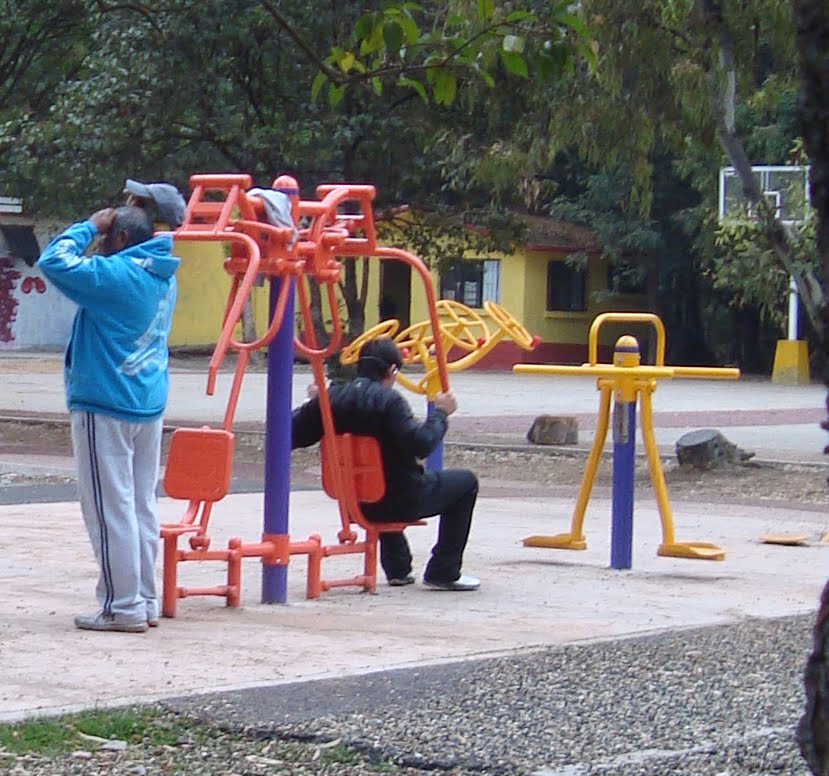
Many parks in Mexico City include what are essentially outdoor gyms with elaborate exercise equipment, open to the public and well used. Benchpress for the People! This is one of the perks of a climate that's comfortable year-round.
Near that particular outdoor gym was the Viveros, a city tree nursery that doubles as a jogging mecca much like Central Park in NY City.
A couple times, I saw groups of bicyclists riding assertively in Critical Mass fashion.
Various bikes are adapted for freight purposes. A more common version is the tricycle in which two large wheels in front straddle a freight compartment, with the rider sitting behind over the third wheel.
Managed to add to my collection of photos of elegant settings for compact fluorescent lightbulbs.
Recycling looks haphazard, but who knows. This truck is filled with cardboard and bags of bottles and cans.
Near the Zocolo, this garbage truck remained parked for a long time while two guys loaded garbage into it, then sorted out various recyclables. This sorting is done before the trip to the landfill, reminiscent of the approach used by the highly organized and industrious "carteneros" of Buenos Aires. By contrast, in the documentary on the immense landfill outside Rio in Brazil, the sorting is done by hand at the landfill.
Most receptacles on city streets are paired as organic and inorganic. These use the same color scheme as Princeton University's outdoor receptacles. The effort to separate out organics is ambitious,
but the contents in one were indistinguishable
from the other. For people to actually pay attention to where they throw their trash, the receptacles have to have more dramatic and demonstrative body language than this.
For example, Freda Kahlo's house has what looks like a crib for collecting bottles. Everything about this receptacle sings out "BOTTLES!", which makes it hard for even the most distracted tourist to contaminate it with something else.
Even the receptacle for recycling batteries was tastefully painted with the house's famed color scheme.
Being the third largest city in the world, Mexico City is not exactly a model of sustainability. On the other hand, if 24 million people are going to congregate somewhere on the planet, it may as well be in a place with a consistently comfortable climate. Most buildings need no heating or air conditioning, which must make for a dramatically reduced demand for energy. Though Mexico sold off its passenger trains in the 1990s, and much of Mexico City is clogged with traffic, there is at least a quiet, smooth-running subway system and impressive intercity buses.
And then there are these sleak taxis, seen only at the city's center (the Zocolo) but perhaps found elsewhere as well. Mexico City was built on a drained lake bed, in fact was built over an Aztec city that was located on, and surrounded by, a lake. All of which is to say that the city is very flat, and therefore is a good spot for taxis like these, which run on batteries or can be pedaled. Princeton has examples of bicycles with battery assist, and New York City has the pedicabs, but this is the first I've seen of a streamlined fusion of pedals and electric for taxis.
Here's one of the vehicles at the Zocolo, in front of the government palace that holds Diego Rivera's murals depicting Aztec life.
An internet search reveals that they are called EcoCabs, are common in Europe and have offices in Canada and the U.S. This BikeHugger post shows one in New York City, and provides some details about the electrical component.
Another interesting vehicle seen in Coyoacan in southern Mexico City was this bus that looks like a second bus fell on top of it, upside down. A similar bus, that was fueled by biodiesel and actually was constructed of two buses one on top of the other, paid a visit to the Jewish Center of Princeton some years back (can't find my post about it).
Many parks in Mexico City include what are essentially outdoor gyms with elaborate exercise equipment, open to the public and well used. Benchpress for the People! This is one of the perks of a climate that's comfortable year-round.
Near that particular outdoor gym was the Viveros, a city tree nursery that doubles as a jogging mecca much like Central Park in NY City.
A couple times, I saw groups of bicyclists riding assertively in Critical Mass fashion.
Various bikes are adapted for freight purposes. A more common version is the tricycle in which two large wheels in front straddle a freight compartment, with the rider sitting behind over the third wheel.
Managed to add to my collection of photos of elegant settings for compact fluorescent lightbulbs.
Recycling looks haphazard, but who knows. This truck is filled with cardboard and bags of bottles and cans.
Near the Zocolo, this garbage truck remained parked for a long time while two guys loaded garbage into it, then sorted out various recyclables. This sorting is done before the trip to the landfill, reminiscent of the approach used by the highly organized and industrious "carteneros" of Buenos Aires. By contrast, in the documentary on the immense landfill outside Rio in Brazil, the sorting is done by hand at the landfill.
Most receptacles on city streets are paired as organic and inorganic. These use the same color scheme as Princeton University's outdoor receptacles. The effort to separate out organics is ambitious,
but the contents in one were indistinguishable
from the other. For people to actually pay attention to where they throw their trash, the receptacles have to have more dramatic and demonstrative body language than this.
For example, Freda Kahlo's house has what looks like a crib for collecting bottles. Everything about this receptacle sings out "BOTTLES!", which makes it hard for even the most distracted tourist to contaminate it with something else.
Even the receptacle for recycling batteries was tastefully painted with the house's famed color scheme.
Tuesday, March 26, 2013
Pipeline Panel Discussion Wednesday, 7pm
An expansion of the natural gas pipeline running through Mountain Lakes, Witherspoon Woods and other preserved lands in the Princeton Ridge has been proposed. Plans include not only laying pipe along the existing right of way but extending into additional forested areas. A panel discussion is planned tonight. Details below.
"Pipeline Education and Empowerment: A Panel Discussion"
On March 27th at 7 pm in Princeton the Central Group NJ Sierra Club, Princeton University student group SURGE, Delaware Riverkeeper Network and Stony Brook-Millstone Watershed Association will be hosting an important educational forum.
Join us to learn more about Natural Gas Pipelines and the detrimental impacts they are having on New Jersey. There are a number ofpipeline expansion projects currently being constructed across the state.
The latest expansion proposed by Williams / Transco, the Leidy Southeast Expansion Project, would impact Princeton, Montgomery, Branchburg, Readington, and Branchburg.
These pipelines can damage our water quality, clear cut our forests and impact residential communities to carry polluting fossil fuels to distant locations. According to the U.S. Energy Information Administration natural gas usage in New Jersey has remained steady for the last five years. However as drillers increase activity in Pennsylvania companies are eager to move their gas to markets.
A panel of experts will discuss environmental and safety impacts, construction techniques, legal issues and options for effective involvement by individuals and groups.
What: Pipeline Education and Empowerment: A Panel Discussion
When: March 27th at 7 p.m.
Where: Princeton University, McCosh Hall Room 46 http://etcweb.princeton.edu/ pumap/#0024
Why: Pipeline projects target our lands, water and forests and our local community. Learn about the issues and options for us.
Panelists:
* Kate Millsaps, NJ Sierra Club, Pipelines in New Jersey, Pipelines in New Jersey - The Big Picture
* Faith Zerbe, Monitoring Director, Delaware Riverkeeper Network, Pipeline Construction Methodology and Impacts
* Jennifer Coffee, Policy Director, StonyBrook Millstone Watershed Association, The Local Environment
* Alice Baker, J.D., Eastern Environmental Law Clinic, Legal Issues and Community Options
* Frank and Nancy Rumore, Fight the Pipe, One Community's Response
Moderators: Terry Stimpfel, Chair, Central Group NJ Chapter Sierra Club and Isaac Lederman, Co-President, Princeton University Students United for a Responsible Global Environment
"Pipeline Education and Empowerment: A Panel Discussion"
On March 27th at 7 pm in Princeton the Central Group NJ Sierra Club, Princeton University student group SURGE, Delaware Riverkeeper Network and Stony Brook-Millstone Watershed Association will be hosting an important educational forum.
Join us to learn more about Natural Gas Pipelines and the detrimental impacts they are having on New Jersey. There are a number ofpipeline expansion projects currently being constructed across the state.
The latest expansion proposed by Williams / Transco, the Leidy Southeast Expansion Project, would impact Princeton, Montgomery, Branchburg, Readington, and Branchburg.
These pipelines can damage our water quality, clear cut our forests and impact residential communities to carry polluting fossil fuels to distant locations. According to the U.S. Energy Information Administration natural gas usage in New Jersey has remained steady for the last five years. However as drillers increase activity in Pennsylvania companies are eager to move their gas to markets.
A panel of experts will discuss environmental and safety impacts, construction techniques, legal issues and options for effective involvement by individuals and groups.
What: Pipeline Education and Empowerment: A Panel Discussion
When: March 27th at 7 p.m.
Where: Princeton University, McCosh Hall Room 46 http://etcweb.princeton.edu/
Why: Pipeline projects target our lands, water and forests and our local community. Learn about the issues and options for us.
Panelists:
* Kate Millsaps, NJ Sierra Club, Pipelines in New Jersey, Pipelines in New Jersey - The Big Picture
* Faith Zerbe, Monitoring Director, Delaware Riverkeeper Network, Pipeline Construction Methodology and Impacts
* Jennifer Coffee, Policy Director, StonyBrook Millstone Watershed Association, The Local Environment
* Alice Baker, J.D., Eastern Environmental Law Clinic, Legal Issues and Community Options
* Frank and Nancy Rumore, Fight the Pipe, One Community's Response
Moderators: Terry Stimpfel, Chair, Central Group NJ Chapter Sierra Club and Isaac Lederman, Co-President, Princeton University Students United for a Responsible Global Environment
Saturday, March 23, 2013
The Rusty Traveler
Extracting ourselves from our Princeton home for a (university) spring break vacation was like trying to escape from a vat of molasses. My brain went through the same sorts of coughs and hiccups that my minimally-driven pickup truck had exhibited when I last took it out on the freeway after months of puddle jumps around town.
Though it's hard to fathom the artist's original intent, the sculpture in this photo, seen later that day along a parkway in Mexico City, tracks closely the thought processes that went into selecting clothes and other necessary items for the trip, while time, represented by the taxi, raced by. By intent or coincidence, the sculpture also provides a good visualization of the decision-making process in calcified bureaucracies, as well as the layout of roads in Mexico City.
A less rusty traveler would have already arrived at the airport when we were just pulling out of the driveway, and would have remembered not only to turn down the house thermostat, which we managed,
but also to turn down the water heater that quietly consumes natural gas in the basement, heating water for no one when everyone is gone.
It's the least one can do before being catapulted by machines, first down Route 1, then down the runway, up and away and down to Mexico City, knowing all the while that periodic travel is surely good for personal sanity but just as surely collectively insane. They say that a capacity to hold two mutually incompatible truths in mind at the same time is a sign of intelligence. If so, then we are surely the most intelligent humans ever, knowingly living a present so incompatible with the future.
There was a time--before I read Elizabeth Kolbert's "The Darkening Sea" or seeing the graph of atmospheric CO2 rocketing upwards--when one could feel the pure, unpolluted awe for the wonder of our machine age, as I did when a Boeing 767 took us up and over the Andes from Buenos Aires, then elegantly expanded its wings to ease us down into Santiago. Travel is a beautiful thing; the future is precious. Precious little is being done to make one truth cohabitate well with the other. I return now with a harvest of photos and memories, and yet know that the planet, too, remembers all the trips I've ever made.
Bringing the present into harmony with the future, bringing personal interest into harmony with collective well-being--what sort of traveling machine can take us to that destination? That's the trip most worth taking.
Though it's hard to fathom the artist's original intent, the sculpture in this photo, seen later that day along a parkway in Mexico City, tracks closely the thought processes that went into selecting clothes and other necessary items for the trip, while time, represented by the taxi, raced by. By intent or coincidence, the sculpture also provides a good visualization of the decision-making process in calcified bureaucracies, as well as the layout of roads in Mexico City.
A less rusty traveler would have already arrived at the airport when we were just pulling out of the driveway, and would have remembered not only to turn down the house thermostat, which we managed,
but also to turn down the water heater that quietly consumes natural gas in the basement, heating water for no one when everyone is gone.
It's the least one can do before being catapulted by machines, first down Route 1, then down the runway, up and away and down to Mexico City, knowing all the while that periodic travel is surely good for personal sanity but just as surely collectively insane. They say that a capacity to hold two mutually incompatible truths in mind at the same time is a sign of intelligence. If so, then we are surely the most intelligent humans ever, knowingly living a present so incompatible with the future.
There was a time--before I read Elizabeth Kolbert's "The Darkening Sea" or seeing the graph of atmospheric CO2 rocketing upwards--when one could feel the pure, unpolluted awe for the wonder of our machine age, as I did when a Boeing 767 took us up and over the Andes from Buenos Aires, then elegantly expanded its wings to ease us down into Santiago. Travel is a beautiful thing; the future is precious. Precious little is being done to make one truth cohabitate well with the other. I return now with a harvest of photos and memories, and yet know that the planet, too, remembers all the trips I've ever made.
Bringing the present into harmony with the future, bringing personal interest into harmony with collective well-being--what sort of traveling machine can take us to that destination? That's the trip most worth taking.
What Shall We Fear?
(A post begun last August, returning from a trip.)
Heading home, having ridden on the wings and rails of ancient energy, I find yet more machines awaiting at Princeton Junction. From sea of planes to shiny sea of cars, this scene repeats all across America. The cars welcome us, each eager to serve our individual needs and destinations, yet each, on the back side, contributing in a collective way to a fate we all will share. Individual freedom and ease now, shared destiny and hardship later, Hurricane Sandy-style. It's an unfair choice, we shouldn't stand for it, yet few even notice a choice is being made.
So, a question asked, last August, when these photos were taken: What shall we fear?
The serving sea of machines
That will in time raise the sea
Above what we love,
At first one time but finally forever?
Or the spider that suddenly loomed,
Casting its net across the driveway.
Caught in the headlights,
Catching my attention
With its quiet intricacies,
It asks nothing from us,
Takes nothing from yesterday,
Changes nothing about our tomorrow,
Travels on nothing but the wings
Of a windy day.
I pulled up short and let it be, then found in morning light
Not a trace.
Heading home, having ridden on the wings and rails of ancient energy, I find yet more machines awaiting at Princeton Junction. From sea of planes to shiny sea of cars, this scene repeats all across America. The cars welcome us, each eager to serve our individual needs and destinations, yet each, on the back side, contributing in a collective way to a fate we all will share. Individual freedom and ease now, shared destiny and hardship later, Hurricane Sandy-style. It's an unfair choice, we shouldn't stand for it, yet few even notice a choice is being made.
So, a question asked, last August, when these photos were taken: What shall we fear?
The serving sea of machines
That will in time raise the sea
Above what we love,
At first one time but finally forever?
Or the spider that suddenly loomed,
Casting its net across the driveway.
Caught in the headlights,
Catching my attention
With its quiet intricacies,
It asks nothing from us,
Takes nothing from yesterday,
Changes nothing about our tomorrow,
Travels on nothing but the wings
Of a windy day.
I pulled up short and let it be, then found in morning light
Not a trace.
Wednesday, March 20, 2013
The Veblen Open Space Legacy: A George Dyson Talk, March 21, 7pm
Follow many aspects of Princeton life back to their roots, and you'll encounter Oswald Veblen, a remarkable visionary and mathematician few have heard of. I first encountered his name after coming across an abandoned house and cottage in Herrontown Woods, which Veblen and his wife Elizabeth had left to the county, along with 95 acres, to be made into a nature center, library and museum for Princeton to enjoy on the northeast side of town.
Like the house, the Veblens' legacy has remained largely hidden and forgotten. That legacy runs like a deep river beneath many aspects of life in Princeton we now take for granted. A pre-eminent university, the Institute for Advanced Study, Einstein’s long and cherished residency--Veblen played surprisingly instrumental roles in making these possible. His vision and influence were also fundamental in Princeton’s contributions to early computer development.
A recurrent feature of Veblen’s legacy is his capacity to bring disconnected entities together to create greater meaning. The layout of Jones Hall on the Princeton University campus was designed by Veblen to bring mathematicians together to share ideas. The Institute, which Veblen's vision strongly influenced, furthered this goal of bringing scholars together, expedited by the tradition of afternoon tea the Veblens began. Whether recruiting mathematicians for the university, the Institute, or to help improve ballistics during the World Wars, Veblen displayed an uncanny knack for assembling talent. With Norwegian and Midwestern pioneer roots, Veblen himself combined extraordinary intellect with a love of hands-on physical work. A wedding of Old and New World can be seen both in the architectural elements of the Veblens' house and in their marriage--Elizabeth having been born in England.
All this “bringing together” can also be experienced when walking the trails of Princeton’s many nature preserves. A nature lover, Veblen served as "re-aggregator" of open space, consolidating small parcels in the 1930s with the intention of preserving large tracts--both at Herrontown Woods and the Institute Woods--and in that sense he began the process that continues today through Princeton’s open space movement. My research thus far suggests that Herrontown Woods, donated by the Veblens in 1957, was Princeton’s first dedicated nature preserve.
Though the Veblen House--a deep legacy next to a deep woods--remains neglected, Veblen’s founding efforts to mend pieces of land back together will be explored in a talk by author George Dyson on Thursday, March 21 at 7pm, hosted by D&R Greenway.
A writer and Princeton native, George Dyson has done a great deal to increase awareness of Oswald Veblen's remarkable legacy. In his book Turing's Cathedral: The Origins of the Digital Universe, Dyson devotes his third chapter to describing Veblen's life and his role in developing the computers we use today. But his talk this Thursday will focus on how Veblen's vision and initiative led to the Institute acquiring 600 acres of open space that later was preserved as open space. Dyson's thorough research and engaging writing style have been a great inspiration to me in my own efforts to make people aware of the remarkable legacy the Veblens left to Princeton and the world, at VeblenHouse.org.
The talk, open to the public and entitled "Princeton's Christopher Robin - Oswald Veblen and the Six-Hundred-Acre Woods", will take place at the DR Greenway's Johnson Nature Center, out Rosedale Road.
From a DR Greenway email: "Growing up in these woods, Dyson is in a unique position to recount its journey to preservation. Owned first by William Penn, then Princeton's Olden family, and passing, through Veblen, finally to the Institute, Dyson declares, "Veblen put the fractured pieces back together." More info at http://drgreenway.org/public_programs.htm.
Like the house, the Veblens' legacy has remained largely hidden and forgotten. That legacy runs like a deep river beneath many aspects of life in Princeton we now take for granted. A pre-eminent university, the Institute for Advanced Study, Einstein’s long and cherished residency--Veblen played surprisingly instrumental roles in making these possible. His vision and influence were also fundamental in Princeton’s contributions to early computer development.
A recurrent feature of Veblen’s legacy is his capacity to bring disconnected entities together to create greater meaning. The layout of Jones Hall on the Princeton University campus was designed by Veblen to bring mathematicians together to share ideas. The Institute, which Veblen's vision strongly influenced, furthered this goal of bringing scholars together, expedited by the tradition of afternoon tea the Veblens began. Whether recruiting mathematicians for the university, the Institute, or to help improve ballistics during the World Wars, Veblen displayed an uncanny knack for assembling talent. With Norwegian and Midwestern pioneer roots, Veblen himself combined extraordinary intellect with a love of hands-on physical work. A wedding of Old and New World can be seen both in the architectural elements of the Veblens' house and in their marriage--Elizabeth having been born in England.
All this “bringing together” can also be experienced when walking the trails of Princeton’s many nature preserves. A nature lover, Veblen served as "re-aggregator" of open space, consolidating small parcels in the 1930s with the intention of preserving large tracts--both at Herrontown Woods and the Institute Woods--and in that sense he began the process that continues today through Princeton’s open space movement. My research thus far suggests that Herrontown Woods, donated by the Veblens in 1957, was Princeton’s first dedicated nature preserve.
Though the Veblen House--a deep legacy next to a deep woods--remains neglected, Veblen’s founding efforts to mend pieces of land back together will be explored in a talk by author George Dyson on Thursday, March 21 at 7pm, hosted by D&R Greenway.
A writer and Princeton native, George Dyson has done a great deal to increase awareness of Oswald Veblen's remarkable legacy. In his book Turing's Cathedral: The Origins of the Digital Universe, Dyson devotes his third chapter to describing Veblen's life and his role in developing the computers we use today. But his talk this Thursday will focus on how Veblen's vision and initiative led to the Institute acquiring 600 acres of open space that later was preserved as open space. Dyson's thorough research and engaging writing style have been a great inspiration to me in my own efforts to make people aware of the remarkable legacy the Veblens left to Princeton and the world, at VeblenHouse.org.
The talk, open to the public and entitled "Princeton's Christopher Robin - Oswald Veblen and the Six-Hundred-Acre Woods", will take place at the DR Greenway's Johnson Nature Center, out Rosedale Road.
From a DR Greenway email: "Growing up in these woods, Dyson is in a unique position to recount its journey to preservation. Owned first by William Penn, then Princeton's Olden family, and passing, through Veblen, finally to the Institute, Dyson declares, "Veblen put the fractured pieces back together." More info at http://drgreenway.org/public_programs.htm.
Subscribe to:
Posts (Atom)