Friday, November 28, 2014
Leaf Pickup--The Fairness Issue
This website has long argued for a better approach to Princeton's collection of compostables--yardwaste, leaves, brush and foodwaste. The aim should be clean streets for nine months of the year, less expense, less distraction of staff from other important tasks, and consistent service.
This fall's looseleaf collection has, in my neighborhood, appeared to go pretty well. But this photo shows a neighborhood after its last looseleaf pickup in the fall. The streets should be clean, but they're not. In fact, there is scarcely a week of the year when the streets are clean with the current system.
This post focuses on just one of the many strong arguments for a revision of service: the fairness issue, which manifests itself at the end of the year. With the town divided up into four zones, the last pickup will vary by several weeks, depending on the zone. In the less fortunate zones, the last looseleaf pickup in the fall may come before all the leaves have fallen from the trees.
That's what happened for this neighbor, whose pin oak still has leaves, one week after the last pickup. The unfairness would be greatly reduced if each participating homeowner had a rollout bin. A fuller, succinct description of this approach is provided in this letter, but the upshot is that these small piles of leaves, and similar ones of yardwaste that are currently dumped loose on the streets year-round, could easily fit into a rollout bin. The larger versions of rollout bins hold the equivalent of three yardwaste bags. Though yardwaste bags could still be used to complement the bins, rollout bins are superior in that they are sturdy, waterproof, mobile, and easily filled.
Rollout bins are also perfect for stowing these pumpkins, and the little blob of leaves just beyond it. The bin would be rolled out to the curb for weekly pickups, leaving the streetscape uncluttered the other six.
Princeton can do better, and there is reason to believe that making the rollout bin the core of compostables collection would increase convenience, consistency, fairness, and street cleanliness--all at a reduced cost.
Monday, November 24, 2014
Seeking a Foodwaste Composting Site In NJ
There was a surprise announcement a couple months ago at a Princeton municipal council meeting. The plant in Wilmington, DE where Princeton's foodwaste was being trucked to has closed. A September 26 article in Delaware Public Media suggests it is unlikely to reopen. I've heard that Princeton is now trucking its foodwaste to a pig farmer in south Jersey, but the pigs and the farmer aren't happy with all the paper and yardwaste mixed in.
What to do? There are a number of options in the works.
AgriArk
As described to me by Tom Tjanick, AgriArk is in Trenton and uses
Trenton Biogas
This company got approval to convert a never-used sludge plant into a facility than can convert foodwaste into energy. Informative writeup here.
Gloucester City Organic Conversion
Fifty miles south of Princeton, construction is beginning on another plant to convert foodwaste, yardwaste and brush into energy and compost. A 2012 article with a drawing of the facility is here.
Co-composting with yardwaste/leaves
If Princeton shifts towards containerization of yardwaste by providing rollout bins to residents, as has been done successfully in other municipalities, it's possible that foodwaste could eventually be put in the rollout bins as well and co-composted in windrows with the yardwaste. This would require a permit from the DEP, which a DEP official made sound not too terribly onerous to acquire. The result should bring a significant savings from reduced landfill tipping fees and a merging and streamlining of the town's foodwaste and yardwaste collections.
With interest rates low, it's a good time for governments local and regional to be investing in these solutions, rather than continuing indefinitely with the bandaid approach.
What to do? There are a number of options in the works.
AgriArk
As described to me by Tom Tjanick, AgriArk is in Trenton and uses
"a proprietary biological microbe to break down food waste/ organics in an anaerobic environment that produces a soil amendment that acts as a replacement for chemical fertilizers. Our process actually sequesters large volumes of CO2 back to the soil."There's an informative writeup on the company at this link. Sounds like they're ready to go if sufficient funding comes along.
Trenton Biogas
This company got approval to convert a never-used sludge plant into a facility than can convert foodwaste into energy. Informative writeup here.
Gloucester City Organic Conversion
Fifty miles south of Princeton, construction is beginning on another plant to convert foodwaste, yardwaste and brush into energy and compost. A 2012 article with a drawing of the facility is here.
Co-composting with yardwaste/leaves
If Princeton shifts towards containerization of yardwaste by providing rollout bins to residents, as has been done successfully in other municipalities, it's possible that foodwaste could eventually be put in the rollout bins as well and co-composted in windrows with the yardwaste. This would require a permit from the DEP, which a DEP official made sound not too terribly onerous to acquire. The result should bring a significant savings from reduced landfill tipping fees and a merging and streamlining of the town's foodwaste and yardwaste collections.
With interest rates low, it's a good time for governments local and regional to be investing in these solutions, rather than continuing indefinitely with the bandaid approach.
Saturday, November 22, 2014
The New Dinky Station--Sun and Shadow
This coffee-centric still-life of the new Dinky station seeks to show that there is life after death. After long mourning over the moving of the station, a morning comes when sunlight plays upon gleaming glass, metal and stone. People can see sun or shadow as they please, and seek to drown lingering sorrows in the Wawa's grand-opening weekend's free coffee.
Looking north from the new station, some may see a highly symbolic giant gash in the ground, spanning the grieved and grievous 460 feet from old station to new. It's as if the ground finally collapsed under the weight of connotation that distance acquired. But others will see the old station buildings still intact--a cafe and restaurant to come--and underpinnings being set in place for a new arts campus to rise.
The new platform's canopy is an inversion of the old, with "v" pointing down rather than up, and combines with the Lot 7 parking structure across the tracks to give a strong metallic feel.
The waiting room echoes the canopy's "V" shape in its ceiling, and the progression of pillars in its southern wall. As one of the far too few buildings in town purposefully oriented for passive solar heating, it's more welcoming to people on a chill fall day because it welcomes the sun as well.
The wooden benches were designed by George Nakashima of New Hope.
Usually, a passive solar building will have a broad overhang on the south side, to shade the windows in the summer. Instead, the university planted a grove of 6' caliper honey locust trees tall enough to shade the station when they sprout leaves this coming spring.
Botanical aside: Honey locust trees are a popular choice for plazas. Their shade is open and airy, and their tiny leaves disperse unobtrusively in the fall. These are thornless varieties, as the wild honey locust has giant spines that once protected it from now extinct megafauna. Out in the parking and turnaround area are some Kentucky coffee trees, another native that is particularly well suited for making the most of solar heating in spring and fall. (Its seeds have the look but not the taste of coffee beans.) The tree drops its leaves very early in the fall, and leafs out very late in the spring. Interestingly, the seeds of both the honey locust and the Kentucky coffee tree were once eaten and spread by megafauna--those lumbering wooly mammoths, et al, that disappeared from North America just 13,000 years ago. Just as the wooly mammoth, in furriness and size, was adapted to very cold weather, the Kentucky coffee tree's short growing season seems tailored to much shorter summers and longer winters than we currently have. With no megafauna to spread their seed, these two tree species "don't get around much anymore", and depend on human fauna for the chance to pop up in plazas and next to parking lots.
Perhaps the trees will have dreams of megafauna past each time their roots sense the vibrations spread by the Dinky's arrival.
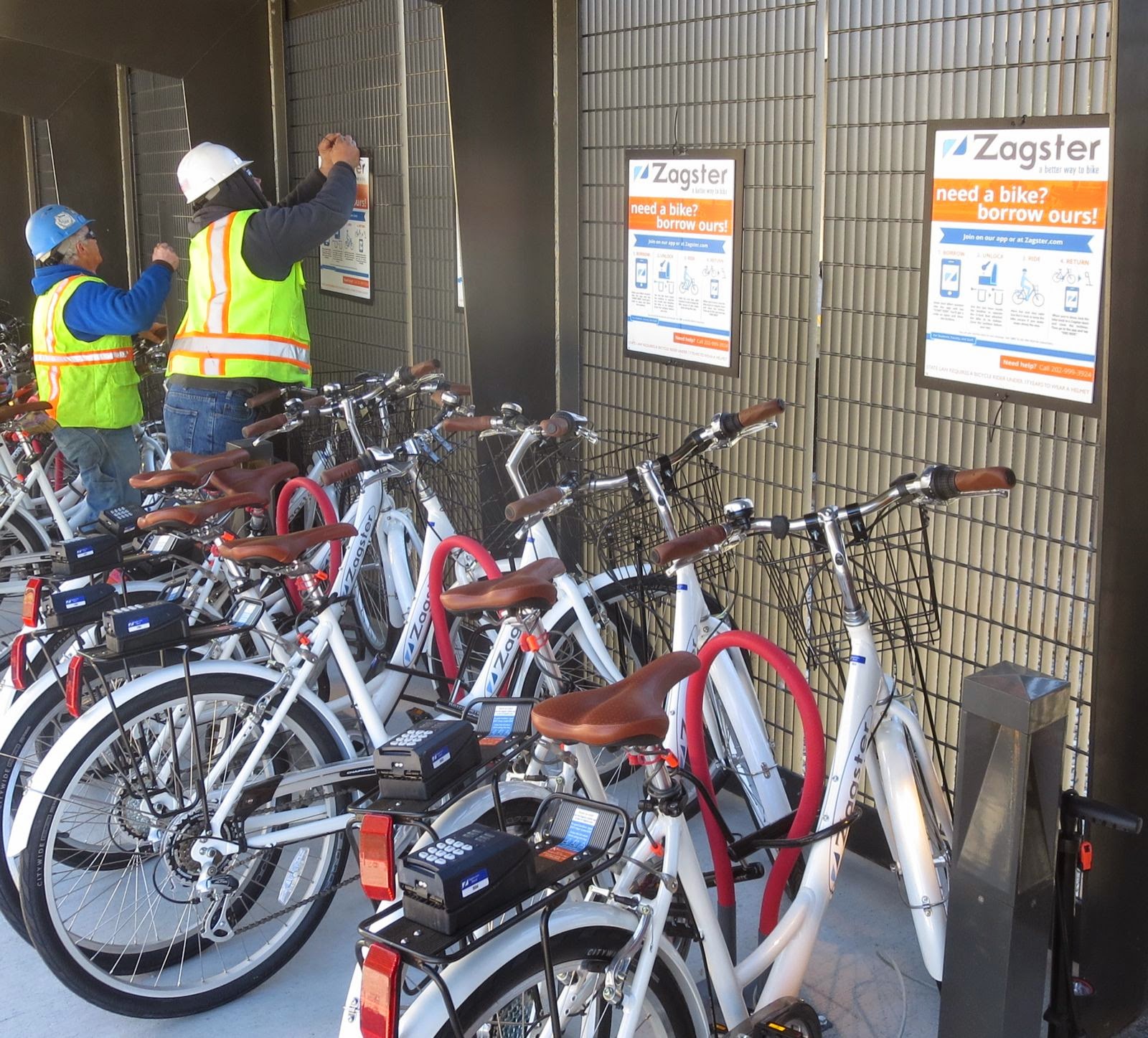
The shelter for bicycles runs parallel in placement and size to the train it's meant to complement.
The bikes seem to say "Don't leave me behind. Let me take a ride, too."
Workmen were putting the finishing touches on the bike borrowing self-service.
Interesting concept.
Another coffee-centric photo, of the inside of the Wawa on its first day open, just a few steps across the plaza from the train. This may be the first Wawa ever to have a big skylight over the cashier area,
and several slivery ones in the bathrooms that cast ethereal light on the proceedings. That may be why the woman collecting donations at the front door for a church's humanitarian efforts recommended the bathrooms so highly.
The bathrooms also have an Airblade hand dryer whose "420 mph sheets of air scrape water from hands, drying them quickly and hygienically", along with faucets that automatically turn on and off, and a waterless urinal (no photo, sorry). The forced air approach to hand drying avoids the waste of paper towels and the energy-intensive hot air of traditional hand dryers.
From the top of the parking structure next door, you can see the "green" roof of the Wawa, with circular skylight. The roof actually looks like a small hill, and should green up with plants come spring. Not your typical Wawa roof.
Seen from above, the arrival of the Dinky brought back a sweet memory of the train set I had as a kid--a mass transportation mecca laid out on a 4x8 piece of plywood in the basement.
Though there is lamentably no photo of my childhood train set, here's what it might have looked like if my big brother had come along, torn up some track, and inserted a center for the performing arts. How long would it have taken, after such an intrusion, before I could emerge from the shadows and walk in the sun once more? The Dinky offers its own answer, with an early morning "toot!" that yet and still begins each new day in Princeton.
(Previous writings on Big Bro's, a.k.a. Ma U's, relocation of the Dinky can be found here.)
Monday, November 17, 2014
Bob Moses Speaks--Fifty Years After Freedom Summer
A great man spoke on Sunday, Nov. 16, at JW Middle School's auditorium. Bob Moses is one of the most influential leaders of the civil rights movement, beginning with Freedom Summer in 1965. He began his talk by asking all the kids in the audience to come down to the front rows so he could speak "to them", not "at them", and then proceeded to lead them on a journey that began with the Preamble of the Constitution. In his talk with the kids, he was relaxed, patient, but firm in his goals--the embodiment of a movement for change that continues to the present day.
He began by asking what it means to be "a constitutional person". In the Constitution when first written, white men who owned property were constitutional people, while Africans were constitutional property. When one of the kids would give a good answer to various questions, he would have him or her stand up and repeat the answer to the audience. He then divided the movement for equality up into three periods of roughly 75 years each. The first extended from the Constitution's writing in 1789 to the Civil War's slaughter. The second period extended to 1941, just after the attack on Pearl Harbor, when Roosevelt's Circular 3591 (he had the kids commit the number to memory) finally abolished slavery. It decreed that blacks could no longer be rounded up as vagrants and sent to work in mines for U.S. Steel and other industries. Douglas Blackmon, in his book "Slavery By Another Name", documents that second period.
It has been left to the third period, from 1941 up through the present, to deal with the contents of the 13th and 14th amendments, according to Moses. He said we still have only "a negative right to vote, not an affirmative right to vote", and asked "will young people become constitutional people?" I would extend that to include those generations still to come, the posterity who are included in the Preamble but left to fend for themselves as we permanently transform life and climate on this planet.
Some adults in the audience wished Moses would have spoken more about his role in the 1964 campaign to register African-Americans in Mississippi to vote, and his activities since then. (When asked afterwards if he is discouraged by recent efforts to restrict voter access, he said the movement has historically lurched forward and back, and this is one of those lurches backwards.) But his interactions with the kids were touching, and informative in a different way. We were in a school, after all. He ended by having everyone recite the Preamble of the Constitution.
"We the people of the United States, in order to form a more perfect union, establish justice, insure domestic tranquility, provide for the common defense, promote the general welfare, and secure the blessings of liberty to ourselves and our posterity, do ordain and establish this Constitution for the United States of America."Of additional interest is Moses' Algebra Project, which he founded in 1982 to "use mathematics as an organizing tool to ensure quality public school education for every child in America." He sees algebra as the gatekeeper, critical for anyone wishing to go to college. His approach is student- and relationship-centered, not the teacher-centric approach that is a legacy of the industrial era. Afterwards, I told him about our efforts to restore the Veblen House, home of the famous visionary mathematician Oswald Veblen. Though the Algebra Project focuses on historically underserved communities, perhaps there's a way to connect. Moses' connecting of numbers and the civil rights movement, the increments of 75, Circular 3591, amendments 13, 14, and 15, Blackmon's birth in the meaningful year of 1964, and the importance of algebra in a kid's future--these suggest a special relationship to mathematics.
Additional events organized by the Princeton Public Library can be found through this link, including a panel discussion this Thursday.
Sunday, November 09, 2014
Bicycles in Princeton
Some interesting info came out of Sustainable Princeton's most recent Great Ideas breakfast at the Princeton Public Library. One of the issues raised was the riding of bicycles on sidewalks. Mayor Lempert explained that, contrary to many people's impression, bicycling on sidewalks is legal, except along the town side of Nassau Street, where signs to that effect are posted. She hastened to add, however, that bicyclists using sidewalks need to be sensitive to pedestrians, and also get off their bikes when crossing streets.
(edited to reflect comment) There was also word of a proposal to rework a portion of Hamilton Avenue to make it more bicycle-friendly, and interest in providing bicyclists riding between Princeton and West Windsor with a route away from automobile traffic. It would require, however, a new bridge to be built over Route 1. If that comes to (by)pass, then Biking Rev-Olution will be more than a catchy title for an edifying breakfast.
Friday, November 07, 2014
Que soLar, soLar
After this week's election, which put the Que sera, sera, climate denying, out-of-control Party firmly in control of Congress, I remembered a brighter moment a month ago, walking by my neighbor's house, where light is more welcome than in the political process. The finances of solar energy in NJ are such that the installation required no money down, followed by lower energy bills.
Then, a chance encounter yesterday with the tail end of a radio program called Onpoint, and a discussion of climate change with just the right potion of urgency, objectivity and good old American can-do spirit. By the end of the program, it seemed possible that all those backfiring cash-for-clunkers just elected will be rendered irrelevant by a stampede of enlightened action. And Doris Day will return to sing to Congress:
Que soLAR, soLAR,
The future is ours, you see.
As long as we're carbon free.
Que soLAR, soLAR.
Monday, November 03, 2014
Vote on Plastic Bags Tuesday--Plastic Bags Kill Cattle
Vote tomorrow on the "county question" on the ballot, which asks if you support a 5 cent fee for each single-use plastic bag given out at groceries, drug stores and convenience stores in Mercer county. It's not binding--more like a poll conducted at the polls.
Interestingly, cities in Texas have been leaders on this issue, because the winds blow bags out into the countryside, the cattle eat the bags, and some of the cattle die. I learned this at an October "Climate Chat" organized by the Sierra Club, and an internet search bears it out. Here's a bit of insight coming from the plains of Texas:
"Hoss Cartwright didn't have to worry about plastic. The range was clean and no one was constructing a subdivision joining the Ponderosa. Today, much different, most people live within a mile of an open construction dumpster, trash pickup container or uncovered disposal site of plastic and litter. Add to that condition a strong wind and various plastics will float into your cattle grazing or growing areas. From bread wrappers hanging on a fence to grocery bags, hay bale wraps, weather balloons, party balloons, to pallet wrappings; some people even toss plastic bale strings on the ground. It is all lethal once inside a critter. Internally let a few hay strings wrap around a bread wrapper and you have a "deadly cow plug.'"California's statewide ban of single-use plastic bags goes into effect next July. Interesting how the statewide ban came after 100 municipalities banned bags. In other words, municipal action can lead cumulatively to state action, which can lead to national action. Which is why it's so important that Princeton lead on climate change.
I reuse single-use plastic bags for many things--kitchen trash can liner, picking up after the dog, and they're great for transporting plants that have been dug up, since they conform to the shape of the rootball. But even while using reusable bags most of the time on trips to the grocery, we still somehow end up with more single-use plastic bags than we can make use of. A fee will serve to prompt everyone to remember to actually use those reusable bags sitting in the car trunk. And for anyone who really likes the single use bags for some reason, most can be used multiple times for groceries.
Friday, October 31, 2014
Lonely Night for Pets
For many a pet, Halloween can mean a night spent home alone. For Duke here, there's little to do but scarf down Greenies and wait for the kids to come home.
Wednesday, October 29, 2014
Great Ideas Breakfast this Thursday: Making Streets Safe for Bicycles
Thursday, October 30, 8:15am, Princeton Public Library, a breakfast and presentations/discussions on making streets safe for bicycles.
Realized the other day that, unlike some, I have long associated bikes with safety. I grew up near an observatory, and because of the restrictions on light pollution, the neighborhood could be very dark at night. For a kid with a fertile imagination, not so much for ghosts and goblins but for some menacing figure that for all I knew could be hiding behind the nearest tree, the speed of a bike at least gave me a better chance of escaping unscathed.
Tuesday, October 28, 2014
Reflections On a Sweet and Sour Soccer Night
A new genre for journalism: sustainable sports coverage:
The new Neuroscience building may have played a small role in an evening of exciting soccer at Princeton University this past Saturday. As the sun angled low, the white facade presented a bright white background to the Princeton women's goalie as a free kick by Harvard's Bethany Kanten came rocketing from the far side over her head and into the goal. Because of all the machinery, lighting, and people in large buildings, they tend to generate an excess of heat from within, which may explain why the designers of the Neuroscience Institute wanted to reflect off as much of the afternoon's sunlight as possible.
While I was researching the impact of a brightly shining building on the game, Princeton's bright sophomore star Tyler Lussi was scoring the tying goal at the other end of the field. She and senior Lauren Lazo are particularly fleet of foot. Incredibly, Lussi's four goals were not enough to win, with Harvard star Margaret Purce getting the go-ahead score late in the game.
Halfway through the men's game later on, I went foraging for ripe persimmons just below the pedestrian bridge on the other side of the Neuroscience building. Not your typical halftime activity. The men's game was marred somewhat by poor officiating, but it too demonstrated the importance of having an exceptional player or two in a sport where goals can be so hard to come by. The Harvard men fielded a strong team, but without a real standout who could make the difference.
Unfazed by losing a man early on to a red card, Princeton promptly scored two more goals to take a 3-0 lead, then held on to win, nearly erasing the sour taste in my mouth left by the persimmons.
The new Neuroscience building may have played a small role in an evening of exciting soccer at Princeton University this past Saturday. As the sun angled low, the white facade presented a bright white background to the Princeton women's goalie as a free kick by Harvard's Bethany Kanten came rocketing from the far side over her head and into the goal. Because of all the machinery, lighting, and people in large buildings, they tend to generate an excess of heat from within, which may explain why the designers of the Neuroscience Institute wanted to reflect off as much of the afternoon's sunlight as possible.
While I was researching the impact of a brightly shining building on the game, Princeton's bright sophomore star Tyler Lussi was scoring the tying goal at the other end of the field. She and senior Lauren Lazo are particularly fleet of foot. Incredibly, Lussi's four goals were not enough to win, with Harvard star Margaret Purce getting the go-ahead score late in the game.
Halfway through the men's game later on, I went foraging for ripe persimmons just below the pedestrian bridge on the other side of the Neuroscience building. Not your typical halftime activity. The men's game was marred somewhat by poor officiating, but it too demonstrated the importance of having an exceptional player or two in a sport where goals can be so hard to come by. The Harvard men fielded a strong team, but without a real standout who could make the difference.
Unfazed by losing a man early on to a red card, Princeton promptly scored two more goals to take a 3-0 lead, then held on to win, nearly erasing the sour taste in my mouth left by the persimmons.
Monday, October 27, 2014
Two Short Parallel Contrails in a Cloudless Night Sky
While walking the dog around the block around 9:30pm, I looked up at the usually not very interesting New Jersey night sky and saw two short, narrow, parallel, contrail-like slashes in an otherwise cloudless sky. By the time I got home and got a camera, they had drifted southeast towards the horizon.
Throwing a cluster of words similar to the title of this post into the googlesphere yielded first this post, and then this one, on a site called contrailscience, which gives a logical explanation: jets descending through a relatively thin layer of moisture. The lines are oriented towards Newark/New York, and an additional possibility is that the jets entered the layer of moisture, then turned off their engines as they began coasting in to the airport from about fifty miles out. We hear this frequently over Princeton--what sounds like downshifting as a jet flies over.
Thursday, October 23, 2014
Super Pen--More Powerful Than a Mulch Volcano
MULCH VOLCANO BEGONE
When last we saw our writer he was walking his dog through a dystopic residential landscape of yardwaste-littered streets and trees fallen prey to volcanic eruptions of mulch. The rising tide of misplaced organic matter seemed beyond his powers to counter. All he had was the power of his pen (in the form of a blog), his trusty dog Leo, and, adding to the sense of dysfunction, a bike made nearly unusable by deferred maintenance, in the form of wobbly wheels and a stretched chain.
Two blog posts later, the tide has turned, particularly for the Norway Spruce, rescued from a siege of volcanic mulch by the tenant, who, we choose to assume, was inspired by the blog post to seize the moment and take organic matters into his own hands.
CYCLAB
And the bike has made considerable progress towards recovery since visiting the student Cyclab, in the basement of Rockefeller College just down University Place from Nassau Street. Knowing next to nothing about bike repair, I stopped by and got assistance truing the wheels, adjusting the brakes and replacing the chain. All assistance and parts were free, thanks to financing by the college.
It's open to students and town residents alike, and I have to say that town residents can present the students with new and exciting challenges. Until a town resident like me showed up, the student who helped me would have had no opportunity to encounter a bike chain so woefully and for so long neglected. He didn't believe me when I passed along a local bike shop's warning, that a chain stretched by ten years of use and altogether too sporadic oilings will have worn down the gears so much that a new chain will not work. We put a new chain on and, sure enough, the chain was incompatible with the worn down gears, and kept slipping. On the next visit, I'm hoping they'll help me put on a new derailleur to better match the new chain. They'll have learned a real world lesson about bike chains a lot earlier than I did, and This Old Bike will be ready to take on another winter of salty streets.
Wednesday, October 15, 2014
Fall Leaves--Pleasure vs. Fear
After a Monday evening spent at a town council meeting earlier this week, I was struck by how I feel pleasure when others feel fear. Take as a for instance my bike ride over to town hall. There was the mild exhilaration of exercise, the comfortable temperature, deep breaths of evening air, and a mist that felt refreshing on the face. I later told someone at the meeting about the pleasure of mist, and she said she'd worry that the bicycle tires might slip on the pavement. Well, bicycle safety is important, but in an instant, pleasure was turned into fear.
At the meeting, a Princeton Environmental Commission member presented a resolution on leaf collection. There has long been a tradition of dumping any and all yardwaste, leaves and brush out on the street, helter skelter, with the expectation that big machines will come to carry it away. The commission's resolution calls this practice wasteful, dangerous and largely unnecessary, given that nature long ago perfected the art of breaking down leaves, etc. into valuable fertilizer for the next year's growth. But Princeton, somewhat like sending kids to private schools, has traditionally also sent its leaves to a finishing school outside of town, where the passage from raw bits to finished compost is surely more reliable than homeschooling leaves in a back corner of the yard. In New Jersey, it could be called "pay to decay".
With leaves, as with a bicycle, I register pleasure where others experience fear. I have vivid memories as a child of the whole family raking the yard. The brightly colored leaves would dance before us as we raked them onto a tarp and hauled them down to the woods. I'd take a running jump into the high, loose pile of dry leaves, be surrounded by their crispness and color, then crawl out, fluff up the pile and take another running leap. Years later, wanting to grow some tomatoes in our soil of dense clay, I knew to go to where observatory's grounds crew had been dumping leaves in the woods year after year, in a pile so large and broad that it had overwhelmed the capacity of the trees to consume all the nutrients. I dug down to get the richest compost anyone could desire.
But at the town council meeting, this pleasure too was injected with fear. One council member asserted that leaf piles in the woods could kill trees, the logic being that if leaves are piled too high, they could cut off water and oxygen to roots. What I have observed is quite the opposite, that tree roots, like kids, go running towards any pile of leaves just as fast as their apical meristems can carry them. Gardeners hoping to get compost from a normal-sized leaf pile in the backyard will likely find that the tree roots have beaten them to the goodies.
The biggest fear for council members, though, was aroused by the commission's suggestion that leaf/yardwaste collection be phased out in coming years. There was a promise made during consolidation that there would be no cut in services, particularly to borough homeowners with small lots. The urge to dump leaves on the street, which in turn sets in perpetual motion the scramble of town employees to deal with the mess, seems now as deeply embedded in the populace as the migratory instinct in wildlife. Though we are one of the most adaptable species on the planet, anyone wishing to change that entrenched horticultural habit will have to slog through a blizzard of rationalizations for why policy, and people, couldn't possible change. Council members may well have concluded that hell hath no fury like a leaf spurner spurned.
For someone like me, who has long seen leaves as a gift to be valued, this mass banishment of leaves to distant locales is hard to fathom. So much depends on whether one perceives nature to be ally or enemy.
At the meeting, a Princeton Environmental Commission member presented a resolution on leaf collection. There has long been a tradition of dumping any and all yardwaste, leaves and brush out on the street, helter skelter, with the expectation that big machines will come to carry it away. The commission's resolution calls this practice wasteful, dangerous and largely unnecessary, given that nature long ago perfected the art of breaking down leaves, etc. into valuable fertilizer for the next year's growth. But Princeton, somewhat like sending kids to private schools, has traditionally also sent its leaves to a finishing school outside of town, where the passage from raw bits to finished compost is surely more reliable than homeschooling leaves in a back corner of the yard. In New Jersey, it could be called "pay to decay".
With leaves, as with a bicycle, I register pleasure where others experience fear. I have vivid memories as a child of the whole family raking the yard. The brightly colored leaves would dance before us as we raked them onto a tarp and hauled them down to the woods. I'd take a running jump into the high, loose pile of dry leaves, be surrounded by their crispness and color, then crawl out, fluff up the pile and take another running leap. Years later, wanting to grow some tomatoes in our soil of dense clay, I knew to go to where observatory's grounds crew had been dumping leaves in the woods year after year, in a pile so large and broad that it had overwhelmed the capacity of the trees to consume all the nutrients. I dug down to get the richest compost anyone could desire.
But at the town council meeting, this pleasure too was injected with fear. One council member asserted that leaf piles in the woods could kill trees, the logic being that if leaves are piled too high, they could cut off water and oxygen to roots. What I have observed is quite the opposite, that tree roots, like kids, go running towards any pile of leaves just as fast as their apical meristems can carry them. Gardeners hoping to get compost from a normal-sized leaf pile in the backyard will likely find that the tree roots have beaten them to the goodies.
The biggest fear for council members, though, was aroused by the commission's suggestion that leaf/yardwaste collection be phased out in coming years. There was a promise made during consolidation that there would be no cut in services, particularly to borough homeowners with small lots. The urge to dump leaves on the street, which in turn sets in perpetual motion the scramble of town employees to deal with the mess, seems now as deeply embedded in the populace as the migratory instinct in wildlife. Though we are one of the most adaptable species on the planet, anyone wishing to change that entrenched horticultural habit will have to slog through a blizzard of rationalizations for why policy, and people, couldn't possible change. Council members may well have concluded that hell hath no fury like a leaf spurner spurned.
For someone like me, who has long seen leaves as a gift to be valued, this mass banishment of leaves to distant locales is hard to fathom. So much depends on whether one perceives nature to be ally or enemy.
Sunday, October 12, 2014
Simple Changes Made Hard
A volcano has erupted on Linden Lane. You know, the much maligned piling of mulch against a tree trunk that could prove deleterious for the tree. I'm not passionate as some about this, but thought I'd knock on the door in a friendly neighborly sort of way. Nothing to it, really. Empowered by newly gained knowledge, the resident would pull the mulch away from the tree and the problem solved. Five minutes, tops.
The guy who answered the door is a renter. Nice conversation as his pre-toddler looked up at me with bright curiosity. But it's the owner who hires the landscape crew. The renter would need to contact the owner, who would need to contact the landscaper, who would need to alert his crew, which has probably always done things this way and would need persistent reminding to change.
In other words, a five minute task to benefit the tree has just become impossible.
Another example: An old window-mounted air conditioner runs all day in an office overlooking Nassau Street, barely cooling the small room. It needs to be replaced. Seems simple enough. But the building owner requires a new one be 110 rather 220volt. The building is so wired that all 110 appliances are automatically shut off at 8pm, as an energy saving policy. But the office is sometimes used until 9pm, and on hot summer evenings that last hour could be uncomfortable for clients. So the old AC rattles on.
Another example: A homeowner's landscaper dumps leaves on a street frequented by kids on the way to school. The leaves narrow the street, pushing bicyclists out into car traffic, and the leaf dumping ignores the town leaf pickup schedule. The homeowner has a huge lawn and could easily pile leaves in a back corner. Friendly conversations ensue with the owners and with the landscaper, who drives to Princeton from south Jersey every couple weeks, but no change.
Funny. We're a highly adaptable species, and yet the resistance to change, both personal and institutional, so often wins out.
Saturday, October 11, 2014
Repairs Late in the Learning
Who knew? All these years, walking on the back patio, or stepping up to the front door, and never noticing that someone had previously gone to the trouble to caulk the cracks that develop between the bricks and the concrete. Why would they have done that? The question would not have occurred to whomever I was in the past. But in recent months, the presence of those cracks has been seeping into my thoughts, until finally a few days ago I found the tranquility within to stop, and to ponder said cracks with a sense of foreboding. I began to worry about the rain, and how it might seep into those cracks, and freeze in the winter, expanding the cracks and loosening the bricks. How did I make it through ten years without worrying that the front steps might be corrupted beyond repair by these silent forces of entropy?
Thank you, imagination, for your intimations of impending infrastructural decay, for I rode their power directly to the neighborhood hardware store, there to buy caulk to load into my caulk gun and apply with much haste and some precision, in the fading light, with rain and winter fast approaching.
And how could I have lived so many years, in a lifelong pursuit of knowledge, and yet remained unaware that a bicycle chain stretches over time, thereby wearing down the derailer, which is really spelled derailleur, which is all the gears in back, that then need to be replaced along with the chain at considerable expense, all because I had no idea there were consequences for not replacing a bike chain periodically? This, actually, can be explained: Because I never before lived in a town where all that I needed was within biking distance, and so hadn't before had occasion to wear out a bike chain.
Speaking of caulkguns, a proposed slogan, to update "from swords to ploughshares": "From guns to caulkguns". And begin by melting down those army surplus armored vehicles from Iraq, rather than giving them to police departments. "From guns to caulkguns, the better to mend the deepening cracks in the world."
Fully adapted quote:
And He shall judge among the nations, and shall rebuke many people: and they shall beat their guns into caulkguns, and their assault rifles into loppers: nation shall not lift up sword against nation, neither shall they learn war any more.—Isaiah 2:3–4 (the retrofitted version).
Friday, October 03, 2014
Witnessing the Climate March
If you weren't able to make it to the Climate March, or only got to see the portion of it you were a part of, here's a showing and telling of the whole progression, all four hours worth, as it passed down 42nd Street. Included are its many themes, a compilation of the most memorable slogans and chants, and serendipitous visual interactions between the march banners and the commercial billboard mega-images that served as a visual frame for the marchers. Having long ago realized that human-caused destabilization of the planet was the overarching issue of our times, I was deeply moved by its spirit, its sounds, diversity, and sheer scale.
I tell my friends, excitedly, that I went to the Climate March and got to see the whole thing,
from start
to finish.
"You watched?", they ask, disappointed. "Why weren't you in it?" Well, I was, or at least I felt like I was a part of it. Standing next to the stream of humanity passing by, I could look into people's faces, read the banners, hear the chants, feel the exhilarating rhythm of the occasional band, absorb a full sense of the march's size and variety. Early on, some people in the march were calling urgently to us on the sidelines to join in. "Don't watch. Join!", a banner read. Here I've been writing about climate change for years, squeezing carbon energy out of our lives, and at the biggest climate rally ever, they thought I was one of those standing "on the sidelines."
But others in the march were happy to have someone standing there to connect with. What, after all, were all the banners for if there were no one to read them?
Who would have witnessed the infinite variety of expression, from the joy of unified purpose to the bedrock seriousness of the cause?
The march did not lack for participants. The turnout was so massive that when time ran out they still had many blocks worth of people waiting at the beginning of the route.
And to be walking in the march would have, in some ways, been more like being in the stands at a football game, looking at the backs of everyone's heads.
There was, though, one magnificent moment that our late arrival caused us to miss.
Earlier, as we had stood beside the still empty street midway in the route, waiting for the marchers to arrive, the march had seemed stuck in the distance. I later heard that the marchers, before they reached us, had stopped at 12:58 for two minutes of silence, hands linked above their heads in tribute to those already victimized by the transformations wrought by climate change. After the silence, a great roar rose from the streets, beginning at the front of the march and traveling back up 6th Avenue and across on 59th, like a wave, a warning sounded, a primal scream for the world we take for granted, the magnificent spaceship we call home. By my wife's telling, that moment was like no other she had ever experienced.
When the march again began moving forward, it came by us led by one of those big, black SUVs with tinted windows.
But from there on, it was all walking humanity, stripped of the star-crossed machines that serve our present needs while invisibly altering the planet upon which life ultimately depends.
By chance, we were situated on a block of 42nd Street lined with immense images advertising everything from beauty products to McDonald's hamburgers. Serving as backdrop for our photos, relevantly enough, was an advertisement for Destiny, a sci-fi computer game set 700 years into the future, in a shattered world "littered with the remains of humanity's golden age."
That's one of the greatest challenges of conveying the urgency of climate destabilization. Rather than making a mature acknowledgement that we are all part of the problem and all need to be part of the solution, rather than using today's magnificent animation capabilities to help people see where we're headed and motivate us to change our ways, American movie and video culture is instead churning out epic battles between good and evil, reveling in the drama of future ruin.
Thirty years into the climate crisis, we still haven't gone much beyond black balloons to aid visualization of CO2. "Keep it in the ground", her sign says. It's okay, as far as it goes, but why, in this image-bathed culture, are the Masters of Imagery not doing more to help this woman help us visualize the invisible?
Sometimes, as the evening news programs lead with whatever bleeds, or the BBC News sounds like an endless re-answering of the question "What did people do with guns today?", I wonder if sustainability, if it were attained, would deprive the news media of the dramatic storylines it needs to attract an audience. Sustainability would be highly satisfying in terms of happiness and well-being, but for a consumerist culture hooked on a diet of death and destruction, any step towards solving problems and living in peace actually poses a threat. Health and happiness make a lousy script, devoid of the sort of dramatic tension and violence needed to catch people's attention and compete in the news media marketplace. At least for four hours on a Sunday afternoon, food justice eclipsed the dominance of DESTINY.
Next to the "Destiny" billboard was an even larger and equally relevant sign boldly stating "The curve changes everything."
Though I'm sure Samsung's curved thin screen TV is exciting, the curve that changes everything is the curve on this blackboard, where atmospheric CO2 levels took a radical turn upwards as the industrial revolution took hold, there, above the head of the woman with the blue shirt.
As the marchers passed by (this banner and sunflowers marked the leading edge of the march), we started to make a collection of the more memorable slogan and chants.
Some of the banners were huge. This one stretched a whole city block. I have no idea what it said, but it was really impressive.
Other signs were small. Do you see it, the little blue one the girl with the red ribbon is holding, quoting Bob Dylon? "How many times can a man turn his head, pretending he just doesn't see?" That's really the central question, isn't it? How, in the information age, can people remain so stubbornly uninformed?
I also see someone I know poking her head out in the upper right corner. Hi, Liz! What are the chances of unknowingly photographing a familiar face among tens of thousands of marchers?
One sign, contrasting the Frontlines of Crisis with the Forefront of Change, depicted a Diego Rivera-like struggle against rising seas, while the real men holding the center pole struggled to keep the sign aloft.
Here, for me, is what makes climate the central issue of our times. "There's no planet B", said one placard. "Earth's first. There is no second.", said another. We mess this one up, we're looking at a very harsh universe out there. One sign, captured the urgency in one word: "CO2NSEQUENCE". The vaunted founders of our nation were thinking longterm, as far beyond their lifetimes as they could imagine. Why aren't we?
A lot of slogans centered around the failure to act.
"Stop fueling around."
"Men argue, Nature acts."
"Everyone's planet, everyone's problem."
"Oh shoot, we left the oven on."
"If you're not part of the solution, you're part of the pollution."
"Care now, you might be coming back."
Or, stated simply, stripped of rhyme and wit: "It's time to cut carbon"
My favorite chant, heard several times during the march, was "HEY! oBAma! WE DON'T WANT no CLImate DRAma!"
Why aren't we acting? For some, the answer is clear. The blame should firmly be put on those among the economically powerful who have been funding doubt.
Others pointed to a massive failure of the market, which doesn't seem free to place a price on the future cost of using carbon-based fuels.
This guy had one of the more creative signs, linking the way we view our inner nature to the way we treat outer nature.
Inner healing will lead us to connect in healing ways to the world. I like it, especially if it leads to a tax on carbon
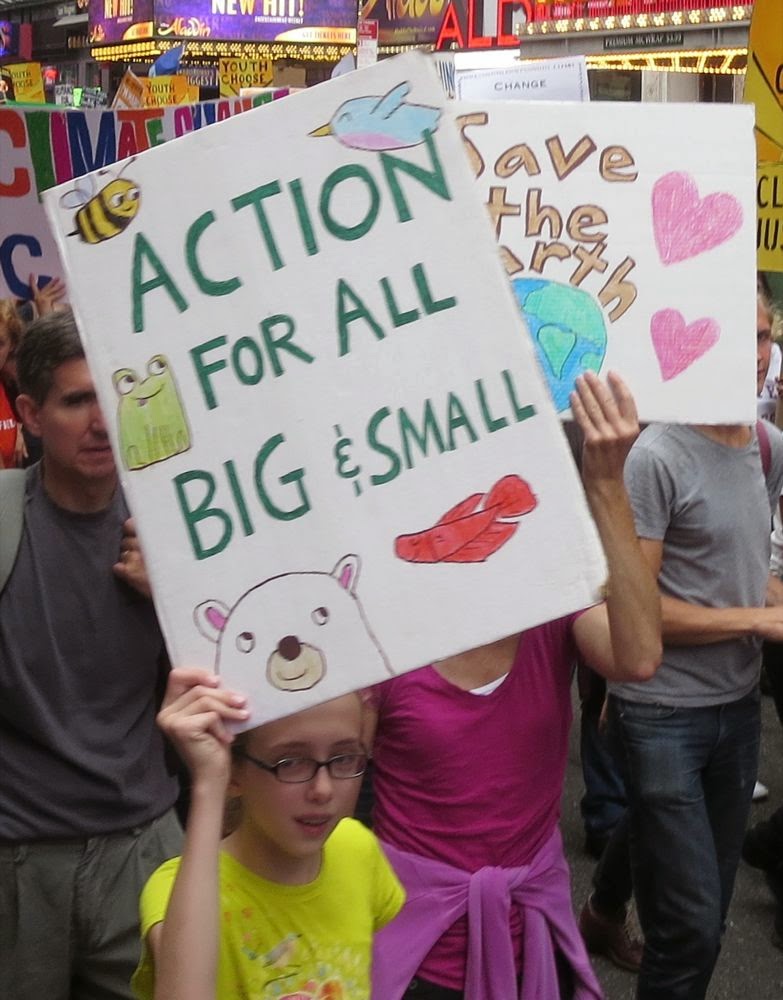
There was a small kid carrying a big sign, calling for unified action. There were kids "marching for Mom's Clean Air Force". A young woman held a sign saying, "Climate--I was just getting to know it".
On the other end of life's story, there was a gang of "Elders off their rockers."
Along with that intergenerational unity, this sign, "100% for the 100%", spoke to the potential unifying effect of all people realizing that climate change is a common enemy that we all can contribute to fighting.
Even the alleged conflict between economy and environment is questioned. "The economy can't swim.""Save the earth, and capitalism".
And here: "Preservation is not liberal or conservative; it is common sense." and "No economy on a dead planet."
These speak to all the climatological and ecological services that form the foundation for a healthy economy.
"Live on nature's income, not its capital.", was getting at something similar.
Others were less sanguine about the chances of making capitalism earth-friendly:
"Green capitalism can't save us.", said one placard. More emphatic was the chant: "The PROBlem is the PROFit, and WE are GOING to STOP it!"
Fracking was not winning any popularity contest. There were endless plays on the word "frack".
There was some rudimentary mathematics (Fracking = Death) and some playing on words ("Buck fig oil").
A few anti-war riffs:
"No more fake wars."
"Climate change leads to war, war leads to climate change."
and, in an update of swords to plowshares,
"Windmills, not weapons"
The march grew denser as the hours passed by. Marchers spilled into the sidewalk. If I hadn't exactly joined the march, the march had joined me. Even the marquee across the street was impressed.
(Earlier in the march the marquee had offered a more paradoxical comment, suggesting that climate change was all part of humanity's deathwish.)
Here's an angle I honestly hadn't considered. I had always thought that our alien overlords, who had already destroyed their own planet, were taking sadistic pleasure in watching our self-destructive behavior, and had actually manipulated our political and mental processes so they could sit back and watch us blow it bigtime on this little piece of paradise.
This was a rare shift into the doomier and gloomier.
Made more believable by the surging numbers of marchers, some placards spoke to the unstoppable power of a social movement. The chants often emphasized this ascribed power: "The PEOple...uNITed...will NEVer BE deFEATed!"
Or, "We're going to BEAT...BACK...CLImate CHANGE, we're going to BEAT BEAT BACK BACK CLImate CHANGE!"
Or "What do we want? CLIMATE JUSTICE. When do we want it? NOW!"
College students linked the social movement to collective economic influence, through divestment in carbon-based energy companies.
This was about as straightforwards as you could get.
NYU added some words, while other universities got some power from rhyme:
Fossil free MIT
Fossil free NYC
Or alliteration. Which slogan is going to spur the most rapid divestment, the ones with rhyme or the one powered by alliteration? Those Duke students look pretty confident.
This man offered a pillow talk version of the Divest theme.
By the way, there's a letter to the editor that makes a post-Climate March call to look at our portfolios with divestment in mind. It links to sustainableinvesting4all.com, which looks promising.
Throughout the march, peeking through the crowd from across the street, a model for Sephora offered her own quiet suggestion. It's time for a makeover.
Some signs spoke specifically to the predicament of NY City. There was considerable dismay directed at Fresh Direct, whose delivery trucks have been fouling the air in some neighborhoods.
FRESH DirECT has GOT to GO, hey HO.
And something more general: "Rising tides, rising rents, rising people."
I'm thinking these must be folks from low-lying areas of the city.
An acrobatic bicyclist carried an I Love NY sign showing water flooding the letters "NY". His bike looks well adapted for pedaling in flooded streets.
In other examples of climate-inspired balancing acts, there were elevated people,
and graceful elevated birds, their flight symbolically dependent on their human stewards below.
Native Americans had a presence.
Indigenous people's rights were placed in opposition to incursions into their lands by oil companies.
Yasuni National Park in Equador is threatened by oil exploration and extraction.
An internet search suggests that REDD+ stands for Reducing Emission from Deforestation and Degradation.
There were calls to respect the four elements.
This contingent, Mayan I believe, had fewer placards,
and more dancing.
I'm thinking this is Mother Earth, who showed up in various forms and languages.
In this chance photo, a nurturing embrace of earth and its fertility, suggesting love, devotion, and gratitude, competes bravely with the looming Destiny of rapacious humanity standing bold and proud upon the barren ruins. Think Wall*E.
In another chance photo, a kid's placard commented on the climate implications of all those McDonalds hamburgers.
I was glad to see some emphasis on the important role in climate maintenance that fossil fuels play when they are left in the ground. Energy companies see underground reserves as trillions of dollars of potential profits. But leaving them underground would likely mean trillions of dollars in reduced damage from destabilized seas, climate and economies.
"Coal, gas, and oil. Leave it in the soil." managed to turn this into a rhyme.
Some signs were elaborate and thoughtful, but a challenge to read.
During one lull in the march, early on, an attractive woman, playing the cheerleader, held a sign high while she jumped up and down, looking expectantly at all of us lining the street. She wanted us to cheer, but her sign was very complex and impossible to read with all the bouncing. We were ready to cheer, but didn't know quite for what.
I asked this man to pose to allow a proper reading.
This woman sought a new definition of masculinity, in which a smaller carbon footprint is sexier than that oversized pickup truck. Another woman held a banner saying, "I'm hot, but the planet shouldn't be." And then there were "Mermaids against offshore drilling."
Mixed in was a lot of can-do about alternative energy. The question "Why?", placed over a coal plant's smokestacks, had its complement in "Why not?" combined with an image of a solar panel.
"Turn up the hope, not the heat."
"Renewable, doable"
"Think outside the barrel."
and the endearing "It's not too oily to go solar."
In the Do It Yourself category:
"You control climate change"
"Cook organic, not the planet."
and the simple assertion: "Lawns are dumb."
When I saw "Support hemp for a clean planet.", I called out HEMP!, with raised fist. The signholder returned the cheer in kind. You'd cheer for industrial hemp, too, if you'd seen the documentary "Bringing It Home."
Just to spread the love, I also shouted out "PUPPIES!" when a woman walked by with an "I'm marching for puppies" sign.
Later in the march, a science theme came through, stating emphatically that the debate is over.
By then, the march was one solid mass of humanity filling the urban canyon wall to wall.
Then, at 5pm, exactly four hours after the march had started at our spot along the route, the march ended.
I tried to make some calculations, roughly having counted 300 people passing by per minute. Times 240 minutes, that doesn't exactly equal the 310,000 figure being used, but with the roughness of my count, all of those who didn't make it to 42nd Street, all those told to disperse when time ran out, and all those on the sidewalks, it could add up.
The BusForProgress came by, then four policeman on motorcycles.
Then it was over, and the streets were reclaimed by cars that our alien overlords make us drive to satisfy their jones for dystopia. Can't they just get a Netflix account and leave us alone?
I've heard there were some complaints about the mess marchers left behind, but where I was there was almost no trash, except for this abandoned sign run over by a delivery truck.
If you've made it this far, you've experienced something of the sprawling immensity and diversity of the march. I leave you with two parting posters:
I tell my friends, excitedly, that I went to the Climate March and got to see the whole thing,
from start
to finish.
"You watched?", they ask, disappointed. "Why weren't you in it?" Well, I was, or at least I felt like I was a part of it. Standing next to the stream of humanity passing by, I could look into people's faces, read the banners, hear the chants, feel the exhilarating rhythm of the occasional band, absorb a full sense of the march's size and variety. Early on, some people in the march were calling urgently to us on the sidelines to join in. "Don't watch. Join!", a banner read. Here I've been writing about climate change for years, squeezing carbon energy out of our lives, and at the biggest climate rally ever, they thought I was one of those standing "on the sidelines."
But others in the march were happy to have someone standing there to connect with. What, after all, were all the banners for if there were no one to read them?
Who would have witnessed the infinite variety of expression, from the joy of unified purpose to the bedrock seriousness of the cause?
The march did not lack for participants. The turnout was so massive that when time ran out they still had many blocks worth of people waiting at the beginning of the route.
And to be walking in the march would have, in some ways, been more like being in the stands at a football game, looking at the backs of everyone's heads.
There was, though, one magnificent moment that our late arrival caused us to miss.
Earlier, as we had stood beside the still empty street midway in the route, waiting for the marchers to arrive, the march had seemed stuck in the distance. I later heard that the marchers, before they reached us, had stopped at 12:58 for two minutes of silence, hands linked above their heads in tribute to those already victimized by the transformations wrought by climate change. After the silence, a great roar rose from the streets, beginning at the front of the march and traveling back up 6th Avenue and across on 59th, like a wave, a warning sounded, a primal scream for the world we take for granted, the magnificent spaceship we call home. By my wife's telling, that moment was like no other she had ever experienced.
When the march again began moving forward, it came by us led by one of those big, black SUVs with tinted windows.
But from there on, it was all walking humanity, stripped of the star-crossed machines that serve our present needs while invisibly altering the planet upon which life ultimately depends.
By chance, we were situated on a block of 42nd Street lined with immense images advertising everything from beauty products to McDonald's hamburgers. Serving as backdrop for our photos, relevantly enough, was an advertisement for Destiny, a sci-fi computer game set 700 years into the future, in a shattered world "littered with the remains of humanity's golden age."
That's one of the greatest challenges of conveying the urgency of climate destabilization. Rather than making a mature acknowledgement that we are all part of the problem and all need to be part of the solution, rather than using today's magnificent animation capabilities to help people see where we're headed and motivate us to change our ways, American movie and video culture is instead churning out epic battles between good and evil, reveling in the drama of future ruin.
Thirty years into the climate crisis, we still haven't gone much beyond black balloons to aid visualization of CO2. "Keep it in the ground", her sign says. It's okay, as far as it goes, but why, in this image-bathed culture, are the Masters of Imagery not doing more to help this woman help us visualize the invisible?
Sometimes, as the evening news programs lead with whatever bleeds, or the BBC News sounds like an endless re-answering of the question "What did people do with guns today?", I wonder if sustainability, if it were attained, would deprive the news media of the dramatic storylines it needs to attract an audience. Sustainability would be highly satisfying in terms of happiness and well-being, but for a consumerist culture hooked on a diet of death and destruction, any step towards solving problems and living in peace actually poses a threat. Health and happiness make a lousy script, devoid of the sort of dramatic tension and violence needed to catch people's attention and compete in the news media marketplace. At least for four hours on a Sunday afternoon, food justice eclipsed the dominance of DESTINY.
Next to the "Destiny" billboard was an even larger and equally relevant sign boldly stating "The curve changes everything."
Though I'm sure Samsung's curved thin screen TV is exciting, the curve that changes everything is the curve on this blackboard, where atmospheric CO2 levels took a radical turn upwards as the industrial revolution took hold, there, above the head of the woman with the blue shirt.
As the marchers passed by (this banner and sunflowers marked the leading edge of the march), we started to make a collection of the more memorable slogan and chants.
Some of the banners were huge. This one stretched a whole city block. I have no idea what it said, but it was really impressive.
Other signs were small. Do you see it, the little blue one the girl with the red ribbon is holding, quoting Bob Dylon? "How many times can a man turn his head, pretending he just doesn't see?" That's really the central question, isn't it? How, in the information age, can people remain so stubbornly uninformed?
I also see someone I know poking her head out in the upper right corner. Hi, Liz! What are the chances of unknowingly photographing a familiar face among tens of thousands of marchers?
One sign, contrasting the Frontlines of Crisis with the Forefront of Change, depicted a Diego Rivera-like struggle against rising seas, while the real men holding the center pole struggled to keep the sign aloft.
Here, for me, is what makes climate the central issue of our times. "There's no planet B", said one placard. "Earth's first. There is no second.", said another. We mess this one up, we're looking at a very harsh universe out there. One sign, captured the urgency in one word: "CO2NSEQUENCE". The vaunted founders of our nation were thinking longterm, as far beyond their lifetimes as they could imagine. Why aren't we?
A lot of slogans centered around the failure to act.
"Stop fueling around."
"Men argue, Nature acts."
"Everyone's planet, everyone's problem."
"Oh shoot, we left the oven on."
"If you're not part of the solution, you're part of the pollution."
"Care now, you might be coming back."
Or, stated simply, stripped of rhyme and wit: "It's time to cut carbon"
My favorite chant, heard several times during the march, was "HEY! oBAma! WE DON'T WANT no CLImate DRAma!"
Why aren't we acting? For some, the answer is clear. The blame should firmly be put on those among the economically powerful who have been funding doubt.
Others pointed to a massive failure of the market, which doesn't seem free to place a price on the future cost of using carbon-based fuels.
This guy had one of the more creative signs, linking the way we view our inner nature to the way we treat outer nature.
Inner healing will lead us to connect in healing ways to the world. I like it, especially if it leads to a tax on carbon
There was a small kid carrying a big sign, calling for unified action. There were kids "marching for Mom's Clean Air Force". A young woman held a sign saying, "Climate--I was just getting to know it".
On the other end of life's story, there was a gang of "Elders off their rockers."
Along with that intergenerational unity, this sign, "100% for the 100%", spoke to the potential unifying effect of all people realizing that climate change is a common enemy that we all can contribute to fighting.
Even the alleged conflict between economy and environment is questioned. "The economy can't swim.""Save the earth, and capitalism".
And here: "Preservation is not liberal or conservative; it is common sense." and "No economy on a dead planet."
These speak to all the climatological and ecological services that form the foundation for a healthy economy.
"Live on nature's income, not its capital.", was getting at something similar.
Others were less sanguine about the chances of making capitalism earth-friendly:
"Green capitalism can't save us.", said one placard. More emphatic was the chant: "The PROBlem is the PROFit, and WE are GOING to STOP it!"
Fracking was not winning any popularity contest. There were endless plays on the word "frack".
There was some rudimentary mathematics (Fracking = Death) and some playing on words ("Buck fig oil").
A few anti-war riffs:
"No more fake wars."
"Climate change leads to war, war leads to climate change."
and, in an update of swords to plowshares,
"Windmills, not weapons"
The march grew denser as the hours passed by. Marchers spilled into the sidewalk. If I hadn't exactly joined the march, the march had joined me. Even the marquee across the street was impressed.
(Earlier in the march the marquee had offered a more paradoxical comment, suggesting that climate change was all part of humanity's deathwish.)
Here's an angle I honestly hadn't considered. I had always thought that our alien overlords, who had already destroyed their own planet, were taking sadistic pleasure in watching our self-destructive behavior, and had actually manipulated our political and mental processes so they could sit back and watch us blow it bigtime on this little piece of paradise.
This was a rare shift into the doomier and gloomier.
Made more believable by the surging numbers of marchers, some placards spoke to the unstoppable power of a social movement. The chants often emphasized this ascribed power: "The PEOple...uNITed...will NEVer BE deFEATed!"
Or, "We're going to BEAT...BACK...CLImate CHANGE, we're going to BEAT BEAT BACK BACK CLImate CHANGE!"
Or "What do we want? CLIMATE JUSTICE. When do we want it? NOW!"
College students linked the social movement to collective economic influence, through divestment in carbon-based energy companies.
This was about as straightforwards as you could get.
NYU added some words, while other universities got some power from rhyme:
Fossil free MIT
Fossil free NYC
Or alliteration. Which slogan is going to spur the most rapid divestment, the ones with rhyme or the one powered by alliteration? Those Duke students look pretty confident.
This man offered a pillow talk version of the Divest theme.
By the way, there's a letter to the editor that makes a post-Climate March call to look at our portfolios with divestment in mind. It links to sustainableinvesting4all.com, which looks promising.
Throughout the march, peeking through the crowd from across the street, a model for Sephora offered her own quiet suggestion. It's time for a makeover.
Some signs spoke specifically to the predicament of NY City. There was considerable dismay directed at Fresh Direct, whose delivery trucks have been fouling the air in some neighborhoods.
FRESH DirECT has GOT to GO, hey HO.
And something more general: "Rising tides, rising rents, rising people."
I'm thinking these must be folks from low-lying areas of the city.
An acrobatic bicyclist carried an I Love NY sign showing water flooding the letters "NY". His bike looks well adapted for pedaling in flooded streets.
In other examples of climate-inspired balancing acts, there were elevated people,
and graceful elevated birds, their flight symbolically dependent on their human stewards below.
Native Americans had a presence.
Indigenous people's rights were placed in opposition to incursions into their lands by oil companies.
Yasuni National Park in Equador is threatened by oil exploration and extraction.
An internet search suggests that REDD+ stands for Reducing Emission from Deforestation and Degradation.
There were calls to respect the four elements.
This contingent, Mayan I believe, had fewer placards,
and more dancing.
I'm thinking this is Mother Earth, who showed up in various forms and languages.
In this chance photo, a nurturing embrace of earth and its fertility, suggesting love, devotion, and gratitude, competes bravely with the looming Destiny of rapacious humanity standing bold and proud upon the barren ruins. Think Wall*E.
In another chance photo, a kid's placard commented on the climate implications of all those McDonalds hamburgers.
I was glad to see some emphasis on the important role in climate maintenance that fossil fuels play when they are left in the ground. Energy companies see underground reserves as trillions of dollars of potential profits. But leaving them underground would likely mean trillions of dollars in reduced damage from destabilized seas, climate and economies.
"Coal, gas, and oil. Leave it in the soil." managed to turn this into a rhyme.
Some signs were elaborate and thoughtful, but a challenge to read.
During one lull in the march, early on, an attractive woman, playing the cheerleader, held a sign high while she jumped up and down, looking expectantly at all of us lining the street. She wanted us to cheer, but her sign was very complex and impossible to read with all the bouncing. We were ready to cheer, but didn't know quite for what.
I asked this man to pose to allow a proper reading.
This woman sought a new definition of masculinity, in which a smaller carbon footprint is sexier than that oversized pickup truck. Another woman held a banner saying, "I'm hot, but the planet shouldn't be." And then there were "Mermaids against offshore drilling."
Mixed in was a lot of can-do about alternative energy. The question "Why?", placed over a coal plant's smokestacks, had its complement in "Why not?" combined with an image of a solar panel.
"Turn up the hope, not the heat."
"Renewable, doable"
"Think outside the barrel."
and the endearing "It's not too oily to go solar."
In the Do It Yourself category:
"You control climate change"
"Cook organic, not the planet."
and the simple assertion: "Lawns are dumb."
When I saw "Support hemp for a clean planet.", I called out HEMP!, with raised fist. The signholder returned the cheer in kind. You'd cheer for industrial hemp, too, if you'd seen the documentary "Bringing It Home."
Just to spread the love, I also shouted out "PUPPIES!" when a woman walked by with an "I'm marching for puppies" sign.
Later in the march, a science theme came through, stating emphatically that the debate is over.
By then, the march was one solid mass of humanity filling the urban canyon wall to wall.
Then, at 5pm, exactly four hours after the march had started at our spot along the route, the march ended.
I tried to make some calculations, roughly having counted 300 people passing by per minute. Times 240 minutes, that doesn't exactly equal the 310,000 figure being used, but with the roughness of my count, all of those who didn't make it to 42nd Street, all those told to disperse when time ran out, and all those on the sidewalks, it could add up.
The BusForProgress came by, then four policeman on motorcycles.
Then it was over, and the streets were reclaimed by cars that our alien overlords make us drive to satisfy their jones for dystopia. Can't they just get a Netflix account and leave us alone?
I've heard there were some complaints about the mess marchers left behind, but where I was there was almost no trash, except for this abandoned sign run over by a delivery truck.
If you've made it this far, you've experienced something of the sprawling immensity and diversity of the march. I leave you with two parting posters:
Subscribe to:
Posts (Atom)