Clint Eastwood's rambling performance at the Republican Party convention last night brought back memories of Chevy Chase's similarly rambling and awkward Senior Day speech at Princeton University a few years back. Chase claimed to have accidentally left his speech at home in his bathroom, which was about as funny and informative as anything else he could think of to say, his imagination failing to respond to the spur of the moment. Eastwood addressed some of his words to an empty chair placed to the left of him, in which he pretended President Obama was sitting. The effect was of a ventriloquist with his sidekick puppet, though it came off as hard-hearted because usually the puppet pokes fun at the ventriloquist, instead of the other way around.
Eastwood also poked fun at Obama's environmentalism, as did Romney later in the evening. Climate change got a good laugh, and caring for the planet was portrayed as contrary to the needs of families. There is always a need to split the world into competing kingdoms and then stage a fight. People oppose nature to nurture, environment to economy, capitalism to governmental regulation, when these opposites are in fact complementary parts of a whole.
Friday, August 31, 2012


Wednesday, August 29, 2012
Christie and Climate Change
About a month ago, Governor Christie stopped by Contes Pizza in Princeton. I found myself standing next to him near the cash register, while we both waited for pizzas to go. My impulse, not acted upon, was to offer to help him save the Republican Party from its denial of climate change. No one talks a better game of making tough choices than Governor Christie, and acting to slow climate change before it spirals out of control, stripping New Jersey of its beloved beaches in the process, is the toughest and most necessary choice of all.
To hear him speak, as he did at the Republican Party convention last night, is to hear a man speaking passionately about a subject he refuses to name. In taking on the really tough choices, he said, it's been easy for leaders to say "Not us, not now." "Now it's up to us," he says, the "grandchildren of the Greatest Generation", to eschew creature comforts, "stand up and make the tough choices." Let us "never be the victims of destiny; always the masters of our own." "Answer the call as a generation," for the sake of "our children and grandchildren."
A call to bold action and personal sacrifice for the sake of posterity? A call to consciously steer destiny rather than let the unintended consequences of our collective actions do permanent harm to future generations? There is no subject for which that sort of talk fits better, no tougher political topic given the entrenched resistance to sacrifice and collective effort, no issue with higher stakes for our shared future, than the irreversible destabilizing of climate. Christie, with his volcanic power as a speaker, his rep for shaking things up, could lead his Party out of its fantasy world of denial, and thereby help rather than hinder the global effort to finally take responsibility for our collective impacts.
Maybe, if he refuses to declare the most fitting subject for his gallant words, a sign could be placed in front of the lectern at his speaking engagements with words in parentheses:
To hear him speak, as he did at the Republican Party convention last night, is to hear a man speaking passionately about a subject he refuses to name. In taking on the really tough choices, he said, it's been easy for leaders to say "Not us, not now." "Now it's up to us," he says, the "grandchildren of the Greatest Generation", to eschew creature comforts, "stand up and make the tough choices." Let us "never be the victims of destiny; always the masters of our own." "Answer the call as a generation," for the sake of "our children and grandchildren."
A call to bold action and personal sacrifice for the sake of posterity? A call to consciously steer destiny rather than let the unintended consequences of our collective actions do permanent harm to future generations? There is no subject for which that sort of talk fits better, no tougher political topic given the entrenched resistance to sacrifice and collective effort, no issue with higher stakes for our shared future, than the irreversible destabilizing of climate. Christie, with his volcanic power as a speaker, his rep for shaking things up, could lead his Party out of its fantasy world of denial, and thereby help rather than hinder the global effort to finally take responsibility for our collective impacts.
Maybe, if he refuses to declare the most fitting subject for his gallant words, a sign could be placed in front of the lectern at his speaking engagements with words in parentheses:
(Climate Change)
Princeton's Recycling Future
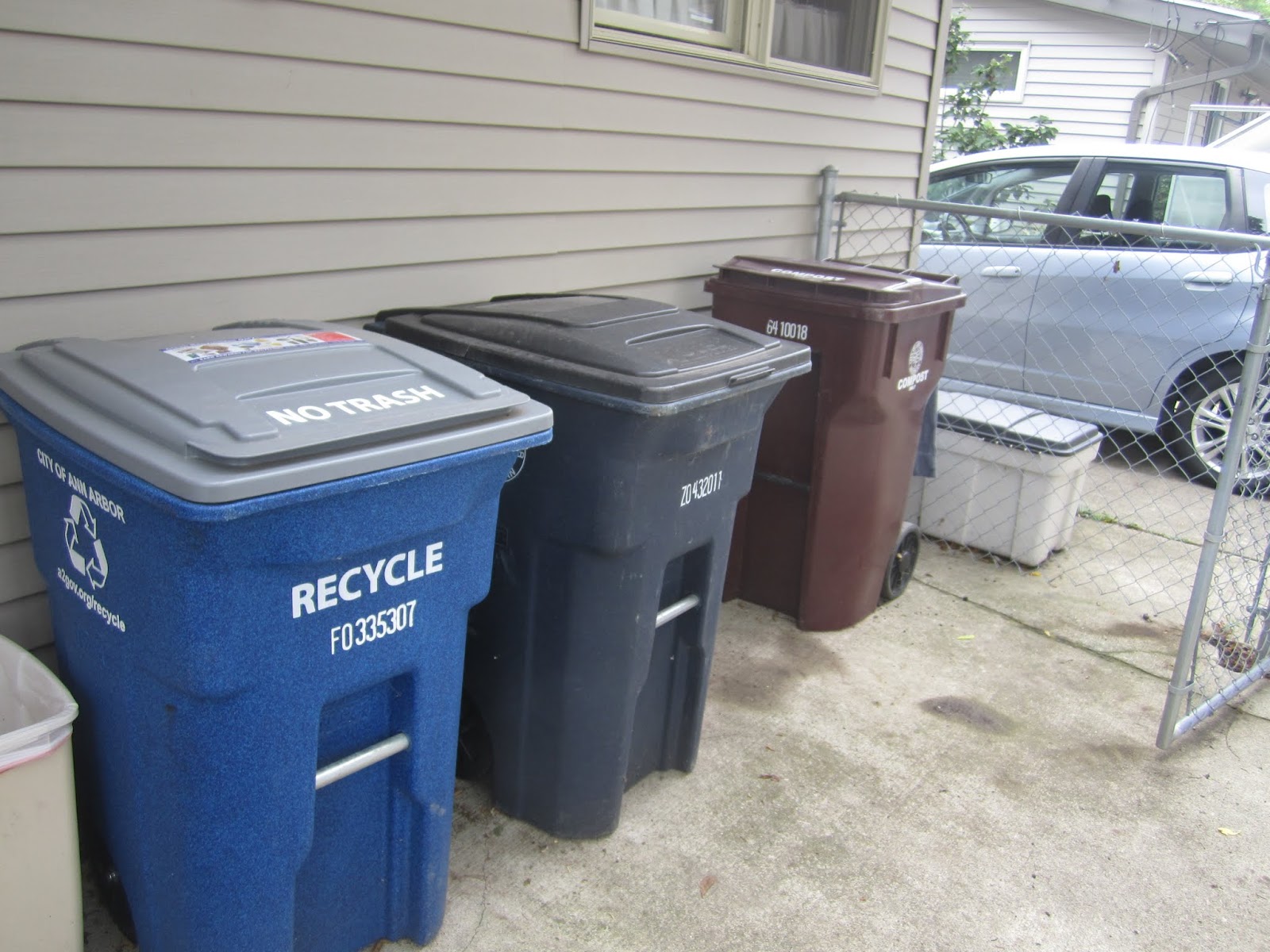
Ann Arbor was one of the early adopters of curbside recycling in the U.S., which I know because some friends started the pilot program in 1978, and got me out there heaving baled newspapers up onto a flatbed truck converted to the purpose.
My educated guess is that Princeton will sooner or later be using rollout bins like these town-wide, rather than the hodge podge assortment of trash containers and the uncovered yellow and green recycling buckets. I'm also guessing that Mercer County, which runs Princeton's recycling program, will eventually add plastics 3-7 to its list of accepted recyclables, along with aerosol cans and aluminum trays and foil. These items are recycled if you put them in the bin, but you aren't supposed to put them in because they aren't on the official list. My visit to Ann Arbor and Cleveland Heights reinforced the sense that these items are now routinely recycled by municipalities across the country, though styrofoam is often excluded due to its bulk.


Wednesday, August 22, 2012
Stuff Finds New Lease On Life


Though some stuff acquired at garage sales may simply relocate from one garage to another, other items were clearly going to be put to use, like the round table a neighbor passing by was so happy to buy because she had been wanting one for a certain spot in her house and the one I had rescued and put out for the sale was perfect!


All in all, though, the morning was well spent, and my daughter was happy with both the hauling away and the haul that was made.
Tuesday, August 21, 2012
Plastic Cups Speak Up About Recycling

Among the rejected is the second cup here, a #5. Used by Starbucks, it defends itself in small print near the bottom of the cup: "This polypropylene cup uses 14% less plastic and creates 45% fewer carbon emissions than a cup made from PET." Take that, all you #1s out there.
The third cup, a #6, has nothing to say for itself, but the last cup there, a #7 with the trademark "Greenware", declares itself to be eco-friendly, environmentally sustainable, compostable, and made in the U.S.A., entirely from plants. That one's headed for my compost pile to see if it actually decomposes.
If any other plastic cups would like to speak up on this issue, send in a comment.
Recycling--Sorting Fact From Fiction
The following appeared as a column in the July 31 Princeton Packet, with the title "Sorting out the recyclables issue".
This past January, I wrote a column for the Packet about the disparity between what Princeton residents are told to put in the yellow and green recycling buckets, and what is accepted at the sorting plant that takes our recyclables. Mercer County, which runs Princeton’s curbside recycling program, excludes plastics #3-7, empty aerosol cans, and aluminum trays and foil from its list of accepted recyclables, even though the sorting plant accepts them. It was interesting that items I had long thought to be contaminants in the recycling stream were actually getting separated out and successfully marketed by the plant.
Much to my surprise, the column set off quite a controversy. Should these additional items be added to the county’s official list? Since many Princeton residents, from my observations, ignore the list and fill the buckets with whatever they think looks recyclable, the controversy was limited to the subset of humanity that is actually trying to do the right thing.
The discussion quickly became contaminated with dubious claims, demonstrating again the power of misinformation to needlessly polarize our world, locally and nationally. Truth has become devalued as just another opinion. People can claim whatever they want, and needn’t feel regret if the claim has no basis in fact.
As the plot thickened into a gumbo of mumbo jumbo, I decided to research the matter further, culminating in a trip to the Colgate sorting facility 12 miles up the road in New Brunswick, where our curbside recyclables are taken. Recycling, with its ever-changing markets and rapidly evolving sorting technology, provides an excellent training ground for developing humility, flexibility and detachment when seeking the truth. The path from uncertainty to relative certainty requires conversations with many sources, and what’s true now could always change later on.
Many municipalities and counties in the area accept all plastics #1-7 for recycling. Among these are Philadelphia, Newark, Montgomery, and Somerset. Morris County excludes #3 and 6, but includes the others. Though of lesser value than plastics #1 and 2, the 3-7 plastics do find markets, often overseas. Concern has been expressed about whether the plastics 3-7, most of which go to China or India, are being used in environmentally unfriendly ways. It’s nearly impossible to know. Given a global economy, neither Princeton nor Mercer County has any control over where its recyclables go, and destinations can shift with the markets. Since many other recyclables also go overseas, any concern about end usage would render much of our current recycling stream suspect.
After being sorted, our recyclables are sold to the highest bidder. Some 60% of recyclables in our region head overseas, often on ships that would otherwise be returning empty to their home ports. That cardboard you put out on the curb may be headed to China, where paper plants that are newer and more sophisticated than ours will make it into new boxes to fill with more stuff for us to buy. If more plastics #3-7 are collected, businesses closer to home might be more motivated to utilize it.
At the sorting plant in New Brunswick, our recyclables head up a conveyor belt into a cavernous enclosure filled with sophisticated sorting technology. Spinning wheels lift cardboard out of the mix, while smaller items fall through the gaps. Elsewhere along the way, magnets pull out tin cans and aerosol cans, which get baled together. When the recyclables pass over a roller energized to create an "eddy current", aluminum is repelled, rising upward and onto its own conveyor belt. Aluminum cans fetch the highest price, and may show up in the store as new cans in as little as 60 days.
Another sorting mechanism has 19 tiny air jets, each with a sensor that can recognize PET plastic (#1) in the recycling stream, triggering a micro-blast of air that pops the PET plastic out of the mix faster than you can say "PolyEthylene Terephthalate." Some materials, like large plastics and aluminum trays, are still hand sorted.
When asked what contaminants cause problems at the plant, the Colgate staff mentioned plastic bags and metal bars like crowbars, both of which can gum up the sorting equipment. Wet paper tends to drop down through the sorters and end up in the trash--one of a number of arguments for eventually replacing our yellow and green buckets with rollout bins with covers.
There are a number of changes that would make curbside recycling work better. One would be a regulatory expectation that manufacturers produce products and packaging that are easily recycled. Another would be to eventually replace the county’s yellow and green buckets, which tip over in the wind, roll out onto the street, and let the rain in. Rollout bins with attached lids are the industry standard.
Another important step will be the composting of food waste. Backyard composting is much easier than people think, and Princeton’s alternative curbside collection of foodwaste has gotten good reviews. Many trash cans in public places are stuffed with paper products that should be getting composted with the foodwaste rather than landfilled.
If all of this comes to pass--if manufacturers take more responsibility, if trash can be freed of foodwaste, and as sorting technology continues to improve--it is conceivable we may reach a point where the distinction between trash and recyclables will largely dissolve, and all of our discards outside of electronics and toxics will merge into one stream headed to a plant for sorting.
This past January, I wrote a column for the Packet about the disparity between what Princeton residents are told to put in the yellow and green recycling buckets, and what is accepted at the sorting plant that takes our recyclables. Mercer County, which runs Princeton’s curbside recycling program, excludes plastics #3-7, empty aerosol cans, and aluminum trays and foil from its list of accepted recyclables, even though the sorting plant accepts them. It was interesting that items I had long thought to be contaminants in the recycling stream were actually getting separated out and successfully marketed by the plant.
Much to my surprise, the column set off quite a controversy. Should these additional items be added to the county’s official list? Since many Princeton residents, from my observations, ignore the list and fill the buckets with whatever they think looks recyclable, the controversy was limited to the subset of humanity that is actually trying to do the right thing.
The discussion quickly became contaminated with dubious claims, demonstrating again the power of misinformation to needlessly polarize our world, locally and nationally. Truth has become devalued as just another opinion. People can claim whatever they want, and needn’t feel regret if the claim has no basis in fact.
As the plot thickened into a gumbo of mumbo jumbo, I decided to research the matter further, culminating in a trip to the Colgate sorting facility 12 miles up the road in New Brunswick, where our curbside recyclables are taken. Recycling, with its ever-changing markets and rapidly evolving sorting technology, provides an excellent training ground for developing humility, flexibility and detachment when seeking the truth. The path from uncertainty to relative certainty requires conversations with many sources, and what’s true now could always change later on.
Many municipalities and counties in the area accept all plastics #1-7 for recycling. Among these are Philadelphia, Newark, Montgomery, and Somerset. Morris County excludes #3 and 6, but includes the others. Though of lesser value than plastics #1 and 2, the 3-7 plastics do find markets, often overseas. Concern has been expressed about whether the plastics 3-7, most of which go to China or India, are being used in environmentally unfriendly ways. It’s nearly impossible to know. Given a global economy, neither Princeton nor Mercer County has any control over where its recyclables go, and destinations can shift with the markets. Since many other recyclables also go overseas, any concern about end usage would render much of our current recycling stream suspect.
After being sorted, our recyclables are sold to the highest bidder. Some 60% of recyclables in our region head overseas, often on ships that would otherwise be returning empty to their home ports. That cardboard you put out on the curb may be headed to China, where paper plants that are newer and more sophisticated than ours will make it into new boxes to fill with more stuff for us to buy. If more plastics #3-7 are collected, businesses closer to home might be more motivated to utilize it.
At the sorting plant in New Brunswick, our recyclables head up a conveyor belt into a cavernous enclosure filled with sophisticated sorting technology. Spinning wheels lift cardboard out of the mix, while smaller items fall through the gaps. Elsewhere along the way, magnets pull out tin cans and aerosol cans, which get baled together. When the recyclables pass over a roller energized to create an "eddy current", aluminum is repelled, rising upward and onto its own conveyor belt. Aluminum cans fetch the highest price, and may show up in the store as new cans in as little as 60 days.
Another sorting mechanism has 19 tiny air jets, each with a sensor that can recognize PET plastic (#1) in the recycling stream, triggering a micro-blast of air that pops the PET plastic out of the mix faster than you can say "PolyEthylene Terephthalate." Some materials, like large plastics and aluminum trays, are still hand sorted.
When asked what contaminants cause problems at the plant, the Colgate staff mentioned plastic bags and metal bars like crowbars, both of which can gum up the sorting equipment. Wet paper tends to drop down through the sorters and end up in the trash--one of a number of arguments for eventually replacing our yellow and green buckets with rollout bins with covers.
There are a number of changes that would make curbside recycling work better. One would be a regulatory expectation that manufacturers produce products and packaging that are easily recycled. Another would be to eventually replace the county’s yellow and green buckets, which tip over in the wind, roll out onto the street, and let the rain in. Rollout bins with attached lids are the industry standard.
Another important step will be the composting of food waste. Backyard composting is much easier than people think, and Princeton’s alternative curbside collection of foodwaste has gotten good reviews. Many trash cans in public places are stuffed with paper products that should be getting composted with the foodwaste rather than landfilled.
If all of this comes to pass--if manufacturers take more responsibility, if trash can be freed of foodwaste, and as sorting technology continues to improve--it is conceivable we may reach a point where the distinction between trash and recyclables will largely dissolve, and all of our discards outside of electronics and toxics will merge into one stream headed to a plant for sorting.
Wednesday, August 08, 2012
Poem of the Puzzled Bottletop Recycler

Thus, a poem:


not!!!?
Tuesday, July 31, 2012
Stormwater and the New Westminster Parking Lot


Friday, July 27, 2012
PCDO Potluck

In my rough replication of his words, he wished that his colleagues in the U.S. House of Representatives would learn, as is the nature of scientific thought, to always keep room in one's mind for the possibility that one is wrong. Those who believe they are right beyond all doubt are the least likely to be testing their own assumptions. He encouraged people, especially those who don't plan to go into science as a career, to take a science course in order to be exposed to the scientific thought process.
Other speakers included Sue Nemeth (who very graciously urged her supporters to support District 16 NJ Assembly candidate Marie Corfield) Princeton mayoral candidate Liz Lempert, and three Mercer County freeholders who are running against minimal opposition: Pasquale Colavita, Jr, Ann Cannon, and Sam Frisby.

Wednesday, July 25, 2012
Canal Nature Walk This Sunday, 10am

Some parking is just off Washington Road on the West Windsor side of the canal.

Princeton Battlefield's Portico


(A botanical interpretation of the visit can be found here.)
Sunday, July 22, 2012
Solo Jazz Piano Performance Tuesday
My good friend and former band partner Phil Orr teaches music at Ryder University and plays jazz piano with great inventiveness, prowess and eclectic taste. You can hear his solo concert this Tuesday at Westminster Choir College for free, at 7:31pm. More info below:
Phil Orr Plays a Mean Jazz Piano
Solo concert: The usual Eclecto-Maniac blend of Orr-iginals, jazz standards, transmogrified Broadway tunes and mongrel music,
run through the style-o-matic stride/boogie/swing/bop/post-
Mmmm, tasty music!
Tuesday (yes, Tuesday) July 24, 7:31 PM for 59 minutes.
Bristol Chapel, Westminster Choir College of Rider University, 101 Walnut Lane, Princeton, NJ 08540 / directions - map
Unticketed and Absolutely Free --- such a deal!
Phil Orr Plays a Mean Jazz Piano
Solo concert: The usual Eclecto-Maniac blend of Orr-iginals, jazz standards, transmogrified Broadway tunes and mongrel music,
run through the style-o-matic stride/boogie/swing/bop/post-
Mmmm, tasty music!
Tuesday (yes, Tuesday) July 24, 7:31 PM for 59 minutes.
Bristol Chapel, Westminster Choir College of Rider University, 101 Walnut Lane, Princeton, NJ 08540 / directions - map
Unticketed and Absolutely Free --- such a deal!
Friday, July 20, 2012
Repair Cafe in Princeton

Tara brought a coat stand that needed a screw and a nut in order to stand proudly once again. The nut was not available at the store, but my neighbor found the right size and thread on an old lamp he's getting rid of. Tony rode his bike over from Kingston, carrying the bottom of a blender that refused to show its symptoms without the top.
With the internet, our nearby Ace Hardware store, and some common sense about safety, it's possible to fix quite a few things that would otherwise get hauled to the landfill. Over the past year, outside of the repair cafe, I managed to fix our garage door, our 15 year old Bosch washing machine, and when my 94 Ford pickup suddenly started leaking gas last week, I was able to take off the bed and peer down at where a mouse had made a furtive living above the gas tank until it decided to sink its teeth into the gas line as if it were corn on the cob.
Youtube videos, chat rooms and blog posts provide the support needed for this sort of cautious adventuring that can prolong the lives of possessions and save thousands of dollars. The repair cafes extend that with the power of collective thinking to solve problems, and the pleasures of good company. I think of us as kindred spirits to WALL-E, fixing stuff with our wits, spare parts and the tools at hand, wishing we could fix the planet, too.
Monday, July 16, 2012
Recycling Scrap Metal


These and other metal items not found on the standard lists of accepted recyclables have some value as scrap. Though it's possible to take metal to a scrap yard in Trenton, I tend to collect a few items and then put them out on the curb with a few days to go before any trash or recycling pickups (and not in a recycling bucket). Invariably, some guy with an old pickup truck comes along and takes them, oftentimes within an hour. It helps to live on a busy street.
Thursday, July 12, 2012
July 14 Mercer County Recycling Event

These events run from 8am-2pm, three times a year, and accept a great variety of toxics and old electronics that can not be legally put out with the garbage.
Follow the link below for more info.
http://www.mcianj.org/filestorage/119/MCIA_HH%26Elec2012_Web.pdf
Wednesday, July 11, 2012
Power Down, Neighborliness Up

These power outages, as inconvenient as they are, have a way of bringing people together. Biking along the dark streets that evening, I came upon neighbors gathered in a driveway, seated in a circle as if in an outdoor living room. A few candles and the few stars daring to penetrate a New Jersey sky were all that was needed to illuminate their conversation. I stayed for awhile, glad for a chance to get to know neighbors who had until then, through all the powered, illuminated years, remained unseen.
Music on Princeton's "Greens"

The first, my own, the Sustainable Jazz Ensemble, performed in Palmer Square's Lunchtime Music on the Green series to a crowd that appreciated the mix of original music and a cooling mid-day breeze. Being both a botanist and musician, I thanked Palmer Square for hosting as well as the sugar maple and silver maple that were providing the much needed shade and air conditioning for the event.

Palmer Square offers quite a few outdoor performances during the summer that may not be on people's radar, typically from 12-2 on Thursdays and 2-4 on Saturdays.


Conductor Caught in Tuba-Toned Tutti


Tuesday, July 03, 2012
Sustainable Jazz Lunch This Thursday

Music runs from 12-2pm. Last year, we sprinkled chairs across the lawn, but some bring a favorite lawn chair or a blanket for a picnic.
Sunday, July 01, 2012
Black Bear Encounters
Last Tuesday, a third black bear was spotted in Princeton, this time sprawled out front and center in the main meeting room of township hall. Having arrived late, I took awhile to notice the animal, quiet and still as the rest of us while a state wildlife official delivered a powerpoint presentation on bears in New Jersey. No doubt the committee chambers have seen their share of paper tigers, red herrings, fishy development proposals and other forms of political wildlife. On this particular night, however, town officials were safely off at borough hall, hybridizing a new Princeton while township chambers took on a more rustic, camp lodge feel, with the six foot bear skin, its sidekick Skull, and assorted radio collars and other tracking equipment on display.
In a way, the young woman making the presentation, breaking the woodsy stereotype with a fashionable pantsuit and high-heeled clogs, could be seen as presenting an unusual powerpoint eulogy for the bear as it rested in state on the table just behind her.
Here is what I learned, mixed with some info from the states informative website: Black bears used to range over all of what is now NJ, but were killed indiscriminately until 1953, when they were given some protection under New Jersey's game laws. The hunting season was closed in 1971. Over the past fifteen years, their population has spread from northwest New Jersey until they have now been sighted in every county in NJ. Despite the expansion, funding for bear management has faced deep cuts. Complaints about bears doubled from 2006 to 2008, but have remained fairly stable since then. Hunts were allowed in 2010 and 2011 during a five day stretch in December.
In spring, the one and a half year olds head out to seek new territory. Bears are highly territorial, and the young bears much prefer to seek new territories than to risk what can be very violent and debilitating battles with already established bears. Princeton's recent visits by bears are of this nature.
Lots of photos were shown of bear-proof trash cans, and bears climbing up to empty the contents of birdfeeders. Another showed a garage door bent out of shape by bears seeking food. Since any bear that experiences the satisfactions of garbage will seek more of the same, it's important that homeowners in northern Jersey and other areas where bears have become numerous act in concert to keep food out of reach. Some towns have passed ordinances to regulate trash storage.
In the description of what to do if you see a black bear, I was astonished to learn that, in the very rare case that a black bear attacks, the best tactic is to fight back. Princetonians have not been called upon to display such courage since 1777, when we all could conveniently claim we had yet to be born.
To bridge this gap between experience and expectation, I herein provide a translation of the wildlife officials’ instructions, customized to fit the Princetonian lifestyle:
Black bears are near-sighted, so make noise to avoid surprising it. If the bear stands up on its hind legs, don’t worry. It’s just trying to see you better. Make sure the bear has an escape route. For instance, if it is following you out of the public library, hold the door open and give it plenty of room. If you encounter the bear in the woods, or on Nassau Street, you can back away slowly, but don't turn your back to the bear. In a calm, assertive voice, put the bear on notice that you are a Princetonian fully armed with opinions, and will not hesitate to express them.
Avoid eye contact. If it doesn't run away right off, bang the pot you happen to be carrying with you, or download a "kitchenware noise" app on your iphone. Bears hate to cook, which explains their interest in garbage. Otherwise, clap your hands, raise your arms over your head, wave a jacket, all of which should make you look large and impressive.
On rare occasions, the bear will do a bluff charge, at speeds up to 35 mph. If a cafe is close by, this is a good time to duck in for a double latte. If that option is not available, then you'll need to dig deep. Fleeing will only make you appear weak. Perhaps the stirring words of a high school football coach will come to mind. In any case, stand your ground, wave your arms and shout. Pretend you're in front of town council, venting your outrage over moving the Dinky. The bear should veer away from you at the last moment, providing a bigger thrill than any 3D movie at the mall.
If the bear actually attacks, which is extremely rare, it's time to drop all remaining pretense of civility. Fight back. Don't worry about the bear's lack of access to dental care. Without asking permission, bop it on the nose. Bears' noses are 100 times more sensitive than ours. Use this sensitivity to your advantage, all the while reveling in what a great story this will make to tell the grandkids.
In case you surf the internet for more info, don't be confused by accounts of how to behave when encountering a grizzly bear out west, where the protocol is completely different and not nearly so gallant.
Black bears are near-sighted, so make noise to avoid surprising it. If the bear stands up on its hind legs, don’t worry. It’s just trying to see you better. Make sure the bear has an escape route. For instance, if it is following you out of the public library, hold the door open and give it plenty of room. If you encounter the bear in the woods, or on Nassau Street, you can back away slowly, but don't turn your back to the bear. In a calm, assertive voice, put the bear on notice that you are a Princetonian fully armed with opinions, and will not hesitate to express them.
Avoid eye contact. If it doesn't run away right off, bang the pot you happen to be carrying with you, or download a "kitchenware noise" app on your iphone. Bears hate to cook, which explains their interest in garbage. Otherwise, clap your hands, raise your arms over your head, wave a jacket, all of which should make you look large and impressive.
On rare occasions, the bear will do a bluff charge, at speeds up to 35 mph. If a cafe is close by, this is a good time to duck in for a double latte. If that option is not available, then you'll need to dig deep. Fleeing will only make you appear weak. Perhaps the stirring words of a high school football coach will come to mind. In any case, stand your ground, wave your arms and shout. Pretend you're in front of town council, venting your outrage over moving the Dinky. The bear should veer away from you at the last moment, providing a bigger thrill than any 3D movie at the mall.
If the bear actually attacks, which is extremely rare, it's time to drop all remaining pretense of civility. Fight back. Don't worry about the bear's lack of access to dental care. Without asking permission, bop it on the nose. Bears' noses are 100 times more sensitive than ours. Use this sensitivity to your advantage, all the while reveling in what a great story this will make to tell the grandkids.
In case you surf the internet for more info, don't be confused by accounts of how to behave when encountering a grizzly bear out west, where the protocol is completely different and not nearly so gallant.
Wednesday, June 20, 2012
Roll On, Rollout Bins, Roll On


Not everyone would be happy with the change, but there are advantages to having containers that have covers to protect the contents from wind and rain, and wheels to make rolling them to the curb easier. Hopefully there would be different sizes offered, so residents who generate little waste need not have an oversized rollout bin. The best approach, environmentally, is to provide a large container for recyclables and a smaller container for trash, in order to promote less generation of waste. Municipal officials are putting a variety of service options out to bid, with some flexibility built in to accommodate conditions in both the rural and congested parts of town.
If Princeton finally enters the age of streamlined waste and recyclables collection, there will be a lot of outdated trash and recycling containers to recycle.
Update: I was wrong! After consolidating township and borough, Princeton decided that everyone in the township would have to buy their own container, of any style. So now there's a hodgepodge of containers workers have to empty into the trucks, by hand.
Saturday, June 16, 2012
Nature Walk at Mountain Lakes June 24

I will be leading a nature walk at Mountain Lakes Preserve on Sunday, June 24 from 10 to noon. The walk is sponsored by the Princeton Borough Shade Tree Commission. Meet at Mountain Lakes House, which can be accessed by going up the long driveway at 57 Mountain Ave in Princeton. Parking is in the gravel lot just before you reach the house.
The walk will include discussion of trees, invasive shrubs, and is also a great chance to admire the newly restored historic dams and lakes. We'll stick to main trails around the lakes, but sturdy shoes are recommended.
Friday, June 15, 2012
Riveting Detective Series Threatens To Paralyze Nation
It's time to sound a warning. There is a force of distraction afoot that I fear could incapacitate the nation at a critical juncture in its economic recovery.
I have recently come under the spell of "The Killing", a detective series that apparently began last year and concludes this Sunday. We first encountered it a couple weeks ago via netflix instant access, through which one can watch one 45 minute episode after another, without commercial interruptions.
I hear there are television series that are so good people feel they "have to watch them." In this one, the acting seemed to me so convincing, the characters so intriguingly flawed, the steady thickening and surprising twists of the plot so compelling, that I found myself feeling like the show needed ME to watch IT. I was ready to set aside my work and let the kids fend for themselves--the characters and the unsolved murder needed my full attention.
If this can happen to me, a person nearly impervious to abandoning disbelief, rarely sucked in by a movie, and who has no interest in seeking more violence and problem-filled lives to supplement what already flows nonstop into our ears from news reports, in short if such a program could take control of my psyche and all but command me to watch it, then imagine what could happen to national productivity if the more vulnerable multitudes are exposed.
The troubling implications go well beyond the threat to our work ethic. It was with considerable distress that I found my fate beginning to parallel the fate of the detectives. As the lead detective Sarah Linden became more sleep deprived, forgot to eat, and neglected her son in the obsessive search for the murderer, I too found myself living on leftovers and remaining glued to the screen right through bedtime for the kids and well into the night. As clues led them deeper into Seattle's pockets of political corruption and seedy behavior, and the 13 episodes available through Netflix left us still with the murder far from solved, we found ourselves entering seedier areas of the internet in search of free viewings of the next episodes. Scantily clads beckoned from the fringes of the screen as we clicked on yet another quasi-legal episode in the wee hours of the night.
By the time we caught up with the weekly broadcasts, the series' simple but slightly off-kilter theme music was replaying all day in my mind. There seemed no escape from the program's influence, yet now I see one ray of hope. We watched the actual broadcast of the next-to-last episode this past Sunday, and encountered for the first time the spell-breaking power of advertisements. The online episodes had been 45 minutes long because 15 minutes of advertisements had been excised. Now, if I felt myself getting sucked in, I knew there'd soon be five or six advertisements to pull me out of it.
The ads reminded me there are bigger problems in the world than who killed Rosie, like enhancing my virility through the purchase of a Lincoln Town Car or, failing that, a bottle of Viagra. And though it wasn't entirely clear that justice would be served in the plot, at least I could get a better deal on car insurance.
I'm sure this Sunday's concluding episode will deliver a great ending, but I don't feel compelled to watch it. Maybe I'll wait until it's archived somewhere on the internet. Thanks to advertisements, I have my life back, and the nation's children are more likely to get tucked into bed.
Update, June 25: Though the case is solved, those dissatisfied with the ending suspect that the writers who had gotten the script off to such a fine start may have been killed or kidnapped before they were able to complete the series. Tune in next season as Linden and Holder go backstage in search of the culprit.
I have recently come under the spell of "The Killing", a detective series that apparently began last year and concludes this Sunday. We first encountered it a couple weeks ago via netflix instant access, through which one can watch one 45 minute episode after another, without commercial interruptions.
I hear there are television series that are so good people feel they "have to watch them." In this one, the acting seemed to me so convincing, the characters so intriguingly flawed, the steady thickening and surprising twists of the plot so compelling, that I found myself feeling like the show needed ME to watch IT. I was ready to set aside my work and let the kids fend for themselves--the characters and the unsolved murder needed my full attention.
If this can happen to me, a person nearly impervious to abandoning disbelief, rarely sucked in by a movie, and who has no interest in seeking more violence and problem-filled lives to supplement what already flows nonstop into our ears from news reports, in short if such a program could take control of my psyche and all but command me to watch it, then imagine what could happen to national productivity if the more vulnerable multitudes are exposed.
The troubling implications go well beyond the threat to our work ethic. It was with considerable distress that I found my fate beginning to parallel the fate of the detectives. As the lead detective Sarah Linden became more sleep deprived, forgot to eat, and neglected her son in the obsessive search for the murderer, I too found myself living on leftovers and remaining glued to the screen right through bedtime for the kids and well into the night. As clues led them deeper into Seattle's pockets of political corruption and seedy behavior, and the 13 episodes available through Netflix left us still with the murder far from solved, we found ourselves entering seedier areas of the internet in search of free viewings of the next episodes. Scantily clads beckoned from the fringes of the screen as we clicked on yet another quasi-legal episode in the wee hours of the night.
By the time we caught up with the weekly broadcasts, the series' simple but slightly off-kilter theme music was replaying all day in my mind. There seemed no escape from the program's influence, yet now I see one ray of hope. We watched the actual broadcast of the next-to-last episode this past Sunday, and encountered for the first time the spell-breaking power of advertisements. The online episodes had been 45 minutes long because 15 minutes of advertisements had been excised. Now, if I felt myself getting sucked in, I knew there'd soon be five or six advertisements to pull me out of it.
The ads reminded me there are bigger problems in the world than who killed Rosie, like enhancing my virility through the purchase of a Lincoln Town Car or, failing that, a bottle of Viagra. And though it wasn't entirely clear that justice would be served in the plot, at least I could get a better deal on car insurance.
I'm sure this Sunday's concluding episode will deliver a great ending, but I don't feel compelled to watch it. Maybe I'll wait until it's archived somewhere on the internet. Thanks to advertisements, I have my life back, and the nation's children are more likely to get tucked into bed.
Update, June 25: Though the case is solved, those dissatisfied with the ending suspect that the writers who had gotten the script off to such a fine start may have been killed or kidnapped before they were able to complete the series. Tune in next season as Linden and Holder go backstage in search of the culprit.
Thursday, June 14, 2012
Where Princeton's Curbside Recyclables Go

The trip was in part triggered by a debate about whether Princeton should ask Mercer County, which runs Princeton's curbside recycling program, to add several items to its list of accepted recyclables, in particular plastics 3-7. (For background on this subject, see previous research I've posted here and here.)


This particular machine is compressing aluminum cans into big blocks.

which look like modern art. I heard a figure of $1400/ton mentioned for aluminum cans. The energy-intensive process of making aluminum from ore dug out of the ground may have something to do with the high value fetched by recycled aluminum, which unlike many other materials can be recycled indefinitely.

One thing they mentioned about paper: If it gets wet, as can easily happen in Princeton's uncovered yellow or green recycling buckets during rains, the machinery can't separate the paper as well. The portion that fails to be sorted out ends up going to the landfill. Shredded paper also tends to fall through the cracks, making it a better prospect for backyard or curbside composting.


Mercer County does not include plastics 3-7, aerosol cans, and aluminum trays and foil on its list of accepted recyclables. Yet, all of these items are accepted and successfully marketed by the Colgate plant.


Neither Princeton nor Mercer County has any control over where our recyclables end up. If we decide not to recycle various materials because we don't know where they go, then most recyclables would have to be sent to the landfill. Though it may seem a waste of energy to send recyclables overseas, they likely are carried by ships that would otherwise be empty as they return to China or elsewhere to pick up more merchandise.
Plastics 3-7 represent only 1% of the materials currently coming to the Colgate plant. Staff there gave us the sense that the more of a particular material that can be collected, the more likely it can be successfully marketed, and new uses found for it. This echoes what Kevin Lyons of Rutgers University has said.
A separate but related issue is whether manufacturers can and should be required to design products and packaging so they can be more easily recycled, and reduce packaging in general. For example, one can feel good buying ecologically friendly Fair Trade coffee, but the package is seemingly designed to defeat any attempt at recycling.
Whether or not Mercer County finally adds plastics 3-7, aluminum trays and foil, and aerosol cans to its list of accepted curbside recyclables, at least we now have a better understanding of the first leg of our recyclables' journey back to utility.
Thanks to our hosts at Colgate for the tour!
Subscribe to:
Posts (Atom)