Showing posts with label recycling. Show all posts

Wednesday, December 20, 2023

Mercer County Needs to Upgrade its Recycling Containers

Here's a story that demonstrates two surprising aspects of life in Princeton: the stubbornly backward nature of recycling in Mercer County, and the prevalence of unintentional pollution. 

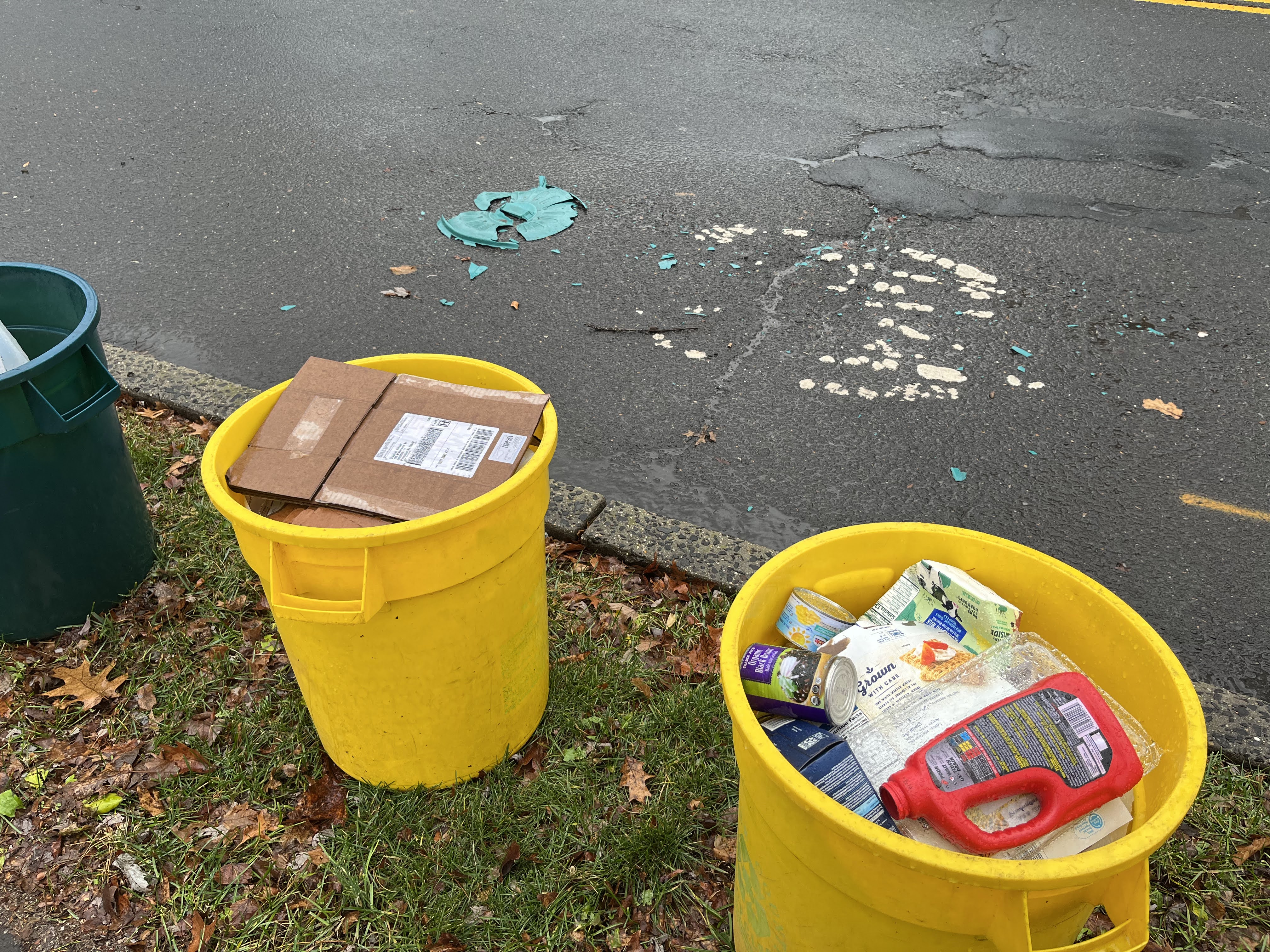
Sunday evening, I put my recyclables out on the curb for pickup on Monday. Rain was forecast, so I left the lids on the otherwise lidless yellow and green "buckets" that Mercer County supplies us. Without lids, rain soaks the paper and makes the containers heavier for the crews to empty into the truck, and may lower the recycling value of the paper. 

I thought of putting a brick on top of each lid to prevent them from being blown off in the storm, but didn't have any close at hand. 

The next day, I found the lids had been blown into the street by the storm and were quickly crushed by passing cars, breaking into myriad pieces. 

Really hoping that the new administration in Mercer County replaces these recycling buckets with rollcarts that 1) have greater capacity, 2) have wheels and 3) have attached lids. The county is decades behind on this.

Friday, May 15, 2020

Picking Up Litter During a Pandemic

Local environmental groups--the Watershed Institute, DR Greenway, Friends of Princeton Open Space, Friends of Herrontown Woods, Friends of Rogers Refuge--are encouraging people to pick up trash while out for walks. The pandemic changes the dynamics of this activity, so Sustainable Princeton offered a protocol, below, that includes gloves and a mask.

The urge to intervene in public spaces varies considerably from one individual to the next. My habits of intervention probably began when my father offered my brother and me a nickel (or was it a penny?) for every tin can or bottle we could bring back from the woods. It must have been a throwback to WWII, when every little scrap of metal was needed for the war effort. With the investment of only a dollar or two, my father incentivized me for a lifetime, not only to pick up trash but also to keep sidewalks and nature trails free of obstruction. The act is motivated by an empathy for those who come after--a sense that we are guardians of the future, be it the next person to come along or the next generation.

The most dramatic evidence that not everyone is invested with this instinct came when I'd walk my daughter to grade school. One time, a sidewalk close to the school became blocked by a fallen branch. It wasn't large, but was enough to force parents and kids to walk around it, onto ground that could get muddy after a rain. My instinct was to bend down and move the branch, but I decided instead to leave it there as an experiment, to see how long parents would passively tolerate being inconvenienced. Finally, after two weeks, I couldn't take it any more and spent the thirty seconds required to push the branch out of the way.

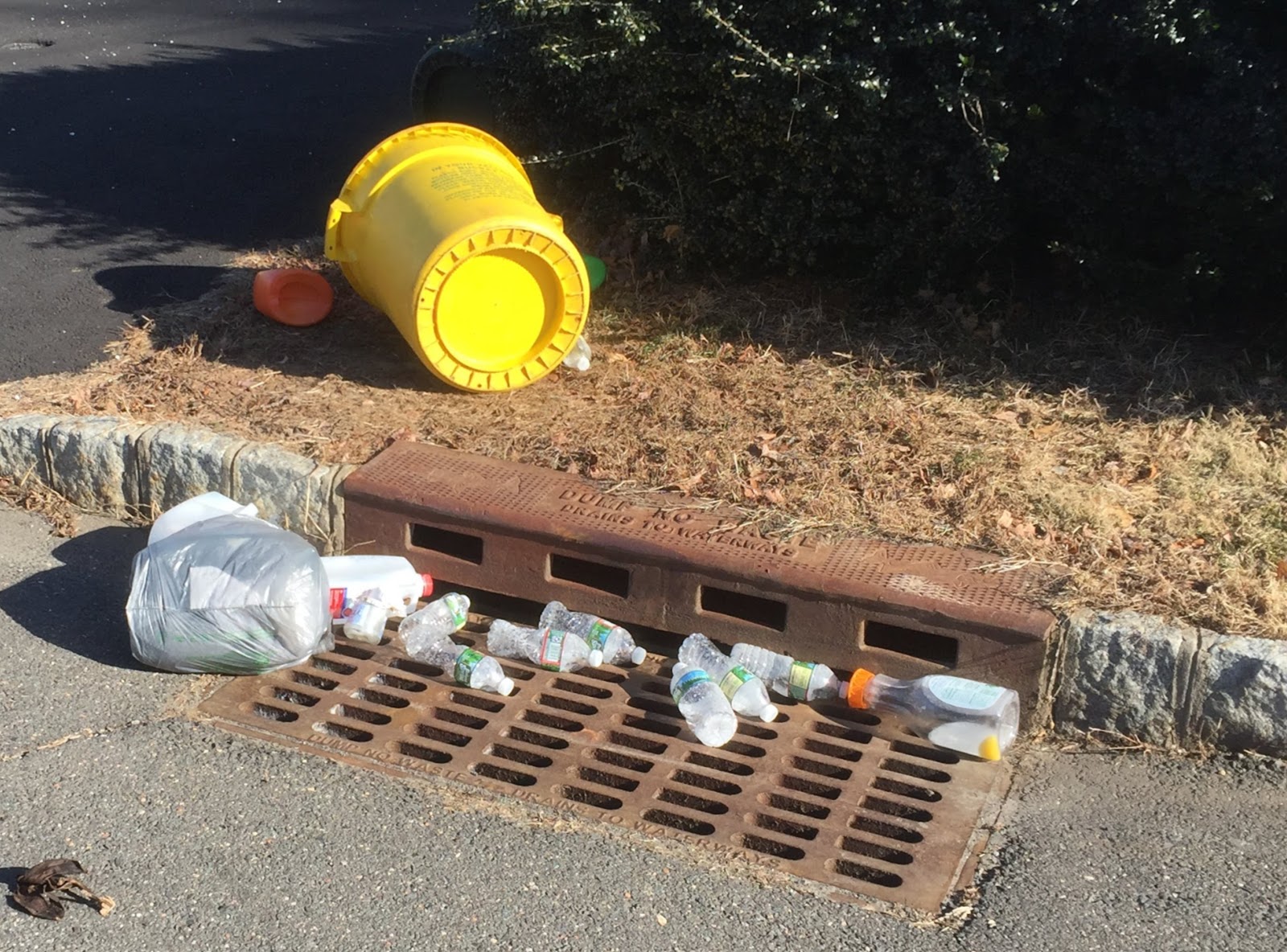
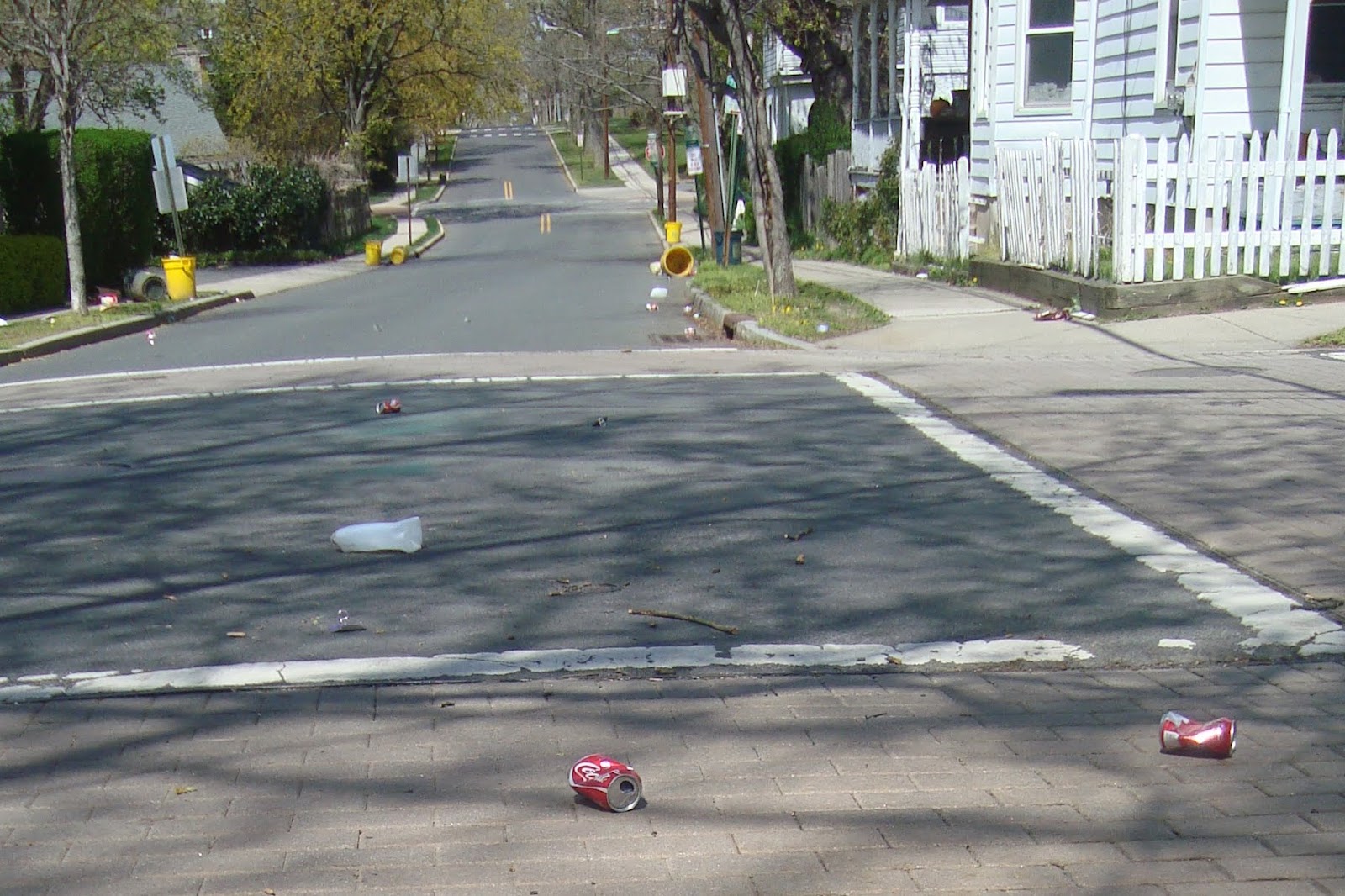
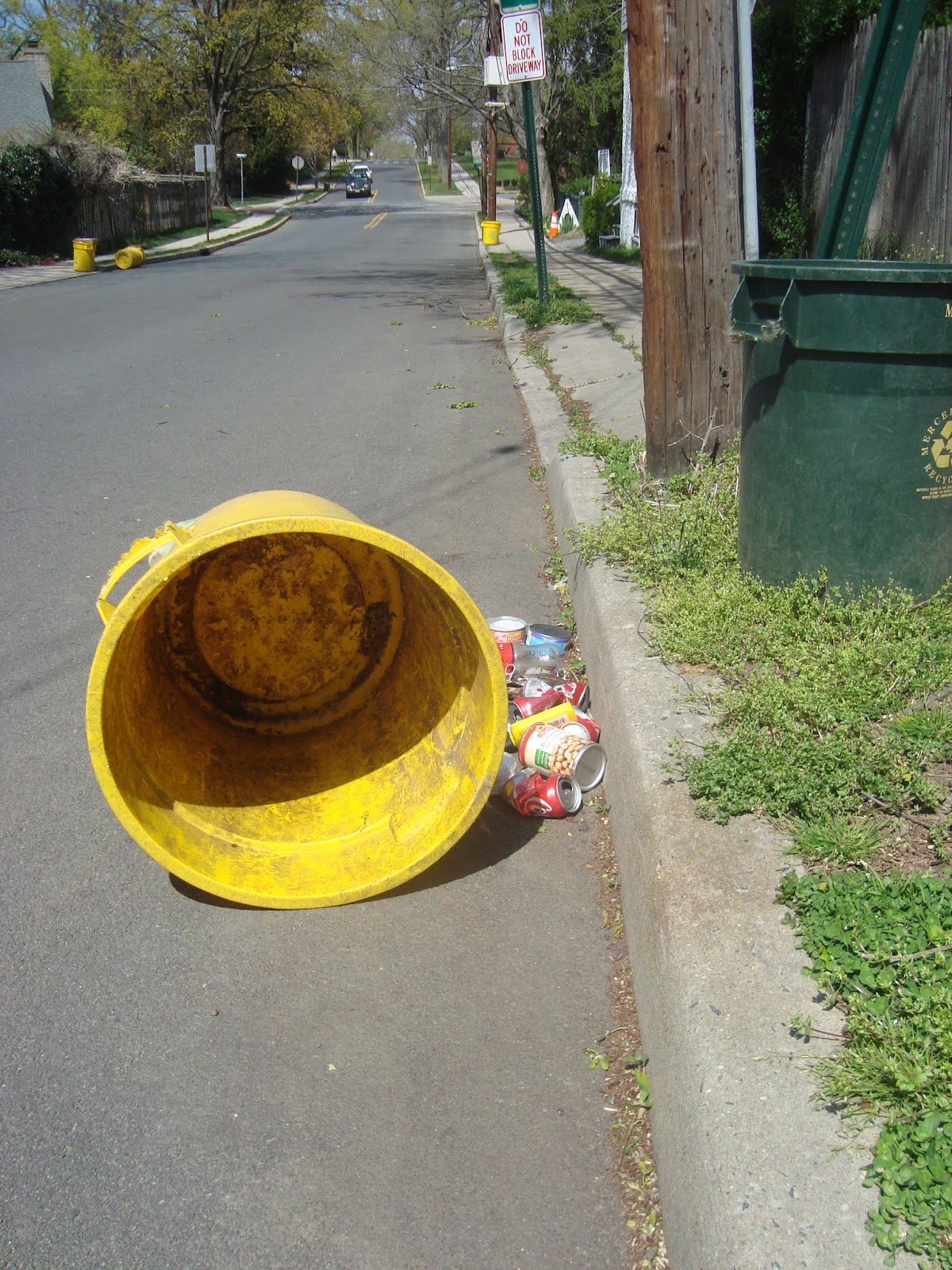
Though there are a few litter bugs out there, most litter on the streets is unintentional, the collateral spillage that happens during curbside collection of recyclables. The recycling bins Mercer County has Princeton using are of small capacity and lack lids, making them more prone to spillage. If strong winds coincide with recycling day, bins on the curb can capsize, spilling contents into the street. Rain then directs the litter down storm drains and into local waterways.

Therefore, cleaning up a streetscape or naturescape is largely an opposition not between good people and bad people, or the thoughtful and the thoughtless, but between intentionality and unintentionality. When it comes to nature and the planet in general, unintentionality is winning, particularly given the widespread ideological bias against intentional collective action to solve collectively created problems. But the pandemic has dramatized the importance of intentional, collective action to minimize the unintentional spread of the coronavirus.

That said, here are the guidelines being recommended locally for picking up litter during a pandemic:

The next time you go outside or take your dog for a walk, grab gloves and a bag, and pick up trash. You can pick up litter during a walk around the neighborhood, in your backyard, in the street, in a nearby park or anywhere else you see trash on the ground.

When you participate, be sure to exercise
social distancing and follow these guidelines:
  • Do this activity alone or with your family or the people you are living with, not with friends or other groups
  • Wear gloves and a mask
  • Stay 6 feet apart – be sure to give people plenty of room to pass around you
  • Exercise caution on trails where the paths can be narrow; step off as needed to ensure that the 6 feet distance is maintained
  • Do not congregate in groups!
  • Wearing brightly colored clothing if picking up litter along streets
  • Dispose of gloves and trash properly and wash hands thoroughly with soap and water when finished

Monday, April 20, 2020

For Recycling: Necessity Is the Best Educator

The pandemic has demonstrated how quickly people can change their ways and adapt to new circumstances when they have to.


Another example is how quickly homeowners have adjusted to new restrictions on what can be recycled curbside. The rules were always in place, while earnest environmentalists and town staff labored unsuccessfully for years to convince homeowners to voluntarily comply.

The underlying message of all those calls for voluntary compliance was, alas, that compliance is voluntary, and therefore unimportant and unnecessary. That's the message people picked up on.

Only when collection crews began leaving contaminated bins of recyclables uncollected at the curb did homeowners wake up. They experienced what I would call "catharsis interruptis." Most bins went uncollected the first week, due to contamination with plastic bags, motor oil containers, etc. On the second collection, maybe a third of the bins remained unemptied.


By the third pickup, nearly all homeowners had gotten the message and adjusted their recycling habits to fit requirements, except for a stray pizza box (the greasy cardboard isn't recyclable) and some unflattened boxes.

In other words, necessity achieved in a month what education initiatives failed to achieve in twenty years. People may seem stuck in their ways, but that's deceptive. Impose necessity and we suddenly become very adaptable and quick to change.

Thursday, March 05, 2020

Mercer County Begins Enforcing its Curbside Recycling Rules


It's still winter, yet change is in the air. On recycle day this past Monday, some bins were emptied while others were left untouched by the collection crew. Why? Because Mercer County, which administers Princeton's curbside recycling program, has begun enforcing its ban on various items it deems unrecyclable.

This caught a lot of homeowners by surprise, particularly those who habitually put their recyclables in plastic bags. The lack of enforcement in the past had led to widespread indifference by homeowners, who in addition to flouting the ban on plastic bags would leave at the curb unflattened boxes full of styrofoam, mercury-containing fluorescent lightbulbs, stuffed animals, whatever--all of which would until now dependably disappear into the maw of the recycling trucks.

There is some pleasure in seeing long-ignored rules finally being enforced, but the underlying message homeowners have long been sending is that they want their packaging to be recyclable. This is where the economy and an anti-regulatory mentality have let us down.

Capitalism has some positive traits, but it places emphasis on increasing consumption. To that end, marketing and engineering creativity is focused on designing packaging that will lure the consumer to buy the product. Once the purchase has been made, capitalism thinks its job done, and leaves it to government and the individual to deal with the resulting mess of packaging and the consumed product. That's the unacknowledged socialist (for lack of a better word) side of our economy, where the private profit of consumption leaves behind a shared collective burden of disposal.

Why, in this day and age, 50 years after the first Earthday, are manufacturers allowed to use an infinite variety of packaging without consideration for what can plausibly be recycled, composted, or safely burned for energy?

There is as well a lack of uniformity in the nation's recycling programs. A product can be sold country-wide, but each town, city and county has its own recycling program that may or may not be able to deal with a product's packaging. While Princetonians are being told that plastic bags clog the machinery used to separate recyclables at the recycling plant, some recycling programs, for instance in Cleveland Heights, actually require that all recyclables be put in plastic bags.

Such contradictions led me some years back to organize a visit to the recycling facility that sorts out our mixed recyclables. At the time, and likely still, the destination for our curbside recyclables was the Colgate Paper company, which despite its name accepts a broad range of recyclables. Adding to recycling's contradictions, the company accepts plastics #1-7, but Mercer County has long banned plastics #3-7 from our recycling stream. Over the years, I've made follow-up phone calls to the company, asking what materials really mess with their machinery or otherwise create inconvenience. The only item they would mention was long metal pipes, which you could imagine doing major mischief if they got caught in the myriad moving parts in separating machinery. They did say that plastics #3-7 often require stockpiling for long periods before a market can be found, but would not admit to having to haul non-recyclables to the landfill.

Why the contradiction between Mercer County's rules and those of the separating plant? My guess is that the plant offers to take a broader range of materials in order to serve as many businesses and governments in the area as possible, even though it may not wish to receive the more marginal materials.

Though the rules, and the stories told in an effort to motivate people to follow them, have their share of contradictions, enforcement is the most dependable form of education, since everyone--not only those who care--will suddenly need to follow the rules or deal with an unemptied bin at the end of recycling day. Education happens when there are consequences for behavior.

If the enforcement continues, we will no longer be able to dump on the collection crews teddy bears, lightbulbs, and whatever else we wish were recyclable. But capitalism's dumping on the public sector will continue. As long as they can get away with it, manufacturers will continue to lure us into buying a baffling complexity of materials that frustrate our desire to recycle and place an ever expanding burden on our governments and nature.

Sunday, September 29, 2019

Funkiest Recycling Containers Ever at Princeton University Football Stadium


People celebrate Princeton for many things. Computers had some of their beginnings here, as did football apparently, which is now celebrating its 150th anniversary at the Princeton University stadium.

I wish that, for this grand occasion, they might have sprung for some new recycling containers to adorn the stadium's fine interior. Instead, the stainless steel containers that were dysfunctional ten years ago are even moreso now. It's more accurate to call them anti-recycling containers.


Back when I was trying to improve recycling, I devoted a whole blog to critiquing public recycling containers, so few of which are well designed. Walk down the stadium's interior corridors--a nice sort of indoor/outdoor experience--and you'll see some of the most confusing labeling imaginable.


This one says "recycling", but the "bottles-cans" label is crossed out.

Two of this one's labels suggest recycling, but the third label says "trash." Does one go with the majority?

There are two basic rules for successful recycling: Pair up the trash and recyclables containers, because people won't take the time to go searching for the right container. And create a clear visual distinction between the two containers. Otherwise, people throw stuff wherever.

Here's a particularly helpful post from more than ten years ago that describes the recycling situation at Jadwin Gym, and how it could be easily and inexpensively improved. It was written back when I was contacting Princeton University's athletic department, wanting to help them improve their stadium recycling. We made some progress, but in the end, the lack of motivation for maintenance staff ultimately undoes any improvements initiated from above.


A better design for a recycling container is this one, in the minority at the stadium, shaped like the bottles you're supposed to put in it.

Another good design has been used in Princeton's parks for many years. It won't win awards for beauty, but actually works. The trash and recycling receptacles are paired and of contrasting appearance. It isn't expensive, and it really isn't hard.

Sunday, March 03, 2019

The Four "C"'s Princeton Needs to Reduce, Reuse, and Recycle

Here's a useful mnemonic device for summarizing the challenges Princeton faces with recycling and collection of various residential organic materials. The four "C"'s (containers, compliance, consequence, and control) are necessary to achieve the three "R"'s (reuse, reduce, recycle).


Containers: In municipalities outside NJ, and perhaps inside as well, the 32, 64, or 96 gallon carts with wheels and attached covers are the norm. Every homeowner has the same containers, rolls them out to the curb once a week, then stows them away.


Princeton is not like that. Perhaps there's a resistance to conformity. Trash day brings out a hodgepodge of trash containers. The recycling containers are stubbornly undersized, uncovered, and unstable, and yardwaste ends up in endlessly varied piles in the streets and on the curb, for lack of containerization beyond a limited collection of yardwaste bags.

The situation begs for better containerization. More and more Princeton residents purchase trash carts with lids and wheels, proving the utility and popularity of this design. Though a small version of the standard cart design has been used for the curbside organics (foodwaste) collections (green cart in photo), there are larger versions widely used elsewhere for trash, recycling, and a mix of foodwaste and yardwaste. The lidded carts also provide an opportunity to put instructions on the lids, to improve compliance (see below).

Compliance: Lack of compliance is an ongoing problem in recycling (plastic bags, etc.) and both containerized and loose yardwaste collections.

Consequence: Princeton has cut back on the spring/fall yardwaste bag pickups because people were putting dirt in the bags and Lawrenceville didn't like that (see "control", below), but another approach would be to maintain or expand containerized pickups while enforcing the rules. Lack of consequence drives lack of compliance. Though enforcement of rules for throwing loose yardwaste in the streets proved very difficult, it would be relatively easy to enforce regulations for containerized yardwaste if compost carts were provided. The carts can be clearly labeled as to what can be put in them, and since collection is done by town crews (unlike recycling and trash), notes can be left on the carts alerting the owner of any infraction.

Control: Princeton's recycling program is run by Mercer County. That means that the town has no control over the container design and what people put in them. Thus, we're still stuck with undersized green and yellow tubs that overflow and spill in the wind. On the composting front, Lawrenceville owns and controls the composting facility, and because the facility apparently still has a grinder that cannot grind leaves and sticks at the same time, Princeton residents are required to separate brush from leaves. This requirement complicates any move towards the sort of streamlined containerization of yardwaste one sees elsewhere in the country, where leaves, food scraps, and sticks can be tossed in the same compost cart. State regulations will pose an additional hurdle, since the most logical and efficient solution--co-composting of food scraps and yardwaste--requires a special permit in NJ.

These four "C"'s all impact a fifth, namely Cost. For an example, Princeton has had four separate pickups for compostables: leaves, brush, yardwaste bags, and organics (foodwaste). That's a lot of heavy vehicles driving down the street, and a lot of administrative time working out complicated schedules. Though it would be nice to be wrong about this, the cost of all these various pickups has yet to be analyzed, as far as I know. 

Thursday, February 07, 2019

Do Princeton's Recyclables Go to the Landfill?

There's an urban legend that recyclables don't really get recycled. I've proven this legend false in the past, and decided to research our local situation once again after reading a letter to the editor about recycling in a local paper.


The letter rightly lamented how residents frequently contaminate their curbside recyclables by using plastic bags to hold the bottles, cans and plastics. The bags are not supposed to be included in the curbside recyclables, and in fact can gum up the machines at the plant where the mixed recyclables are taken for sorting.

You can see in these photos that part of the problem is that Princeton's recycling containers are undersized and overwhelmed. People seem to use plastic bags in part because the recyclables might otherwise spill out of the bins, as happens when wind blows them over.

Something didn't sound quite right, however, about another assertion in the letter: that perfectly good recyclables (plastics 1 and 2, cans, paper, etc) are often rejected due to plastic bag contamination, and therefore get sent to the landfill. Though this assertion is dramatic, and might motivate some people to be more careful about keeping plastic bags out of their recycling bins, it also can feed the cynical urban legend that recyclables don't really get recycled.

The letter writer had been careful to run the letter by members of town government prior to submitting it to the local paper, and had gotten her information from a staff member in the town's Department of Public Works. So the claim came with a seemingly good pedigree.

What's true? On multiple occasions in the past, I've contacted the sorting plant where Princeton's recyclables go, and even toured the facility, and though plastic bags can cause problems with their machinery, they did not say anything about rejecting recyclables due to plastic bag contamination. I tried to imagine the scenario. Our recyclables are taken to a transfer station, then the many individual truckloads are co-mingled and loaded in semis for the trip to the MRF (Material Recovery Facility--here's an example), where they are dumped on the tipping floor. Where in this process do we know of a load of recyclables being rejected and sent instead to the landfill?

I decided to call Colgate Paper Recycling, the past and presumably present destination for Mercer County's recyclables, including Princeton's. They take recyclables from towns and businesses, often arriving in semi-trailers that spill their contents on the tipping floor. From there, the recyclables travel up through a maze of conveyor belts with sensors that help sort out the recyclables. Out the other end of the plant come bails of separated paper, plastics, and metals.

Through some luck, a knowledgable man answered the phone. We talked for awhile, and it came to light that no load of recyclables is ever rejected. If a load is contaminated in some way, the plant may pay the hauler less for that particular load. This can happen a couple times a week. There is no way a municipality can be held accountable by Colgate, because they receive recyclables in large semis from the transfer station, and each load contains recyclables from multiple towns, all mixed together.

The only other place a load of Princeton's recyclables could be rejected is at the transfer station. Imagining the logistics, it's hard to see how this could happen. The load would have to be dumped in order to tell whether it is contaminated, and then the contaminated load would have to be set aside, reloaded in a truck and taken to the landfill--a tremendous inconvenience. And for the contamination to be sufficiently severe, Solterra's own crews would need to have willingly put the contaminated materials in their truck during curbside collection.

Logistically, the claim that good recyclables are going to the landfill due to contamination doesn't make sense. More likely, all recyclables, no matter how contaminated, get hauled to the Colgate plant, which deals with them as best it can.

I then asked about plastics numbered 3-7. The man said that these are no longer recycled. However, that doesn't mean that Colgate sends them to the landfill. There are alternative uses that are being experimented with. This raises the question of whether we should be including plastics 3-7 in our recycling bins. Mercer County says no, and Princetonians are expected to follow that dictate. The presence of 3-7 plastics in the waste-stream means more sorting by Colgate, for little or no profit.

But given that many, perhaps most, residents ignore the rules and put plastics 3-7 in their bins, and Princeton is not in a position to enforce the county's rules, a case can be made that any accumulation of a particular material will stimulate someone to seek a use for it. If 3-7 get sent straight to the landfill, there will be no motivation for people to find uses for those plastics. Colgate doesn't like to deal with plastics 3-7, but given their presence in the recycling stream, the plant does try to find alternatives to sending them to the landfill. To be clear, if anything having to do with recycling is clear, even though Colgate includes plastics 3-7 on their list of acceptable materials, they prefer not to have to deal with them.

All of this complexity drives home some basic truths. A lot of people like plastic bags. People want packaging to be recyclable. They prefer putting items in the recycle bin even when repeatedly told not to. Do we deal with this by sending people long, complicated lists only to see those lists ignored? Or do we demand that government at the state and federal levels regulate packaging to require that it all be easily recycled anywhere the product is sold?

Though it's true that regulation can create unnecessary complexity, it's also true that a lack of regulation of packaging has created huge complexity for ordinary people who must scrutinize each one-use container to decide whether to throw it in with recyclables or in with the trash. The unregulated manufacturers are happy. They can create a package most likely to seduce the shopper, and then the shopper, the environment, and the whole recycling industry has to deal with the "day after," the bafflingly complex task of deciding what to do with all those spent containers.

Some other tidbits: The man at Colgate said that soiled pizza boxes cause problems for cardboard processors. (This, as is typical in the complex world of recycling, contradicts what I heard last year on a PBS NewsHour segment on recycling, where an interviewee said that greasy pizza boxes aren't a problem.) He also said that a big problem comes from businesses--long strips of backing for labels get tangled in the machines.

Wednesday, January 23, 2019

Princeton Recyclables Litter Local Waterways


For anyone who has lived outside the Princeton bubble, the approach to recycling collection here can seem odd. Other towns and cities I've lived in or visited have long since switched to rollcarts as the container of choice for holding recyclables and, for that matter, trash and yardwaste, but Princeton has long been a part of Mercer County's recycling program, which uses these small yellow and green tubs. Despite their flaws, they sometimes seem like they will outlive civilization.

The flaws become apparent any time recycling day coincides with stormy weather. The small, lidless tubs or "buckets" are often overflowing with recyclables, and unstable. Winds tip them over, scattering their contents and causing the containers themselves to roll out into traffic. Many stormdrains have bigger openings than this one, which means that all over Princeton on recycling day, thousands of plastic containers are dropping into the stormdrain system, from which they will enter local waterways and potentially feed the widening gyres of plastic out in the oceans.

As with the feeding of climate change that we do daily, this massive littering is unintentional, and is therefore tolerated. When, as a member of the Princeton Environmental Commission years back, I suggested switching to rollcarts, which are more stable, have wheels, lids and larger capacity, there was a surprising amount of pushback, suggesting that the town and county are tightly bound to a status quo that gives Princetonians little choice but to continue collectively littering streets and waterways for the foreseeable future.

This blog has many posts about recycling in Princeton, to be found at this link.
Some examples:
https://princetonprimer.blogspot.com/2012/04/great-recyclables-escape.html https://princetonprimer.blogspot.com/2012/02/struggle-to-improve-recycling-in.html
https://princetonprimer.blogspot.com/2013/03/recycling-policy-meets-reality.html
https://princetonprimer.blogspot.com/2011/12/are-rollout-bins-right-for-princeton.html

Saturday, May 06, 2017

Recycling Plastic Flower Pots

Have plastic pots you don't want to throw away? A local resident called up nurseries, asking if they take used pots. Finally, he found out that Lowes has a recycling program for pots. Below is text from their website. I'd encourage people not to make a special trip, but integrate it into other Route 1 errands, lest the gas burned do more harm than the good of recycling the pots.

Lowe's is committed to exploring new opportunities to reduce waste and help consumers do the same. We launched a nationwide Garden Center recycling program in February to help keep rising mounds of plastic plant containers out of landfills. 
Lowe's recycled 230,000 pounds of plastic in just three months during a pilot test in which 22 stores collected plastic pots, trays and tags that are used with live nursery items. Following that success, Lowe's expanded the program to all stores in the continental United States, more than 1,700 locations.
Generally, curbside recycling programs are unable to accept plastic plant containers, such as pots and hanging baskets. This new program gives consumers a responsible recycling option and makes it easy for them. We provide a cart for stores and customers to return plastic plant trays, pots and tags, regardless of condition. No matter where consumers purchase the plant, they are encouraged to return the materials to a Lowe's Garden Center to be recycled.

Tuesday, June 28, 2016

Status of Recycling in Princeton High School

The photo below speaks volumes about recycling, or lack thereof, at Princeton High School. I'm a fan of the school. It's been a good place for my daughters. Most of the teachers are excellent. But there's an opportunity being wasted when it comes to teaching kids basic citizenship skills for living on the planet. There was a time when Princeton's public schools, with the exception of Riverside Elementary, were recycling in name only. Based on my conversations with the truck drivers who pick up recyclables, many schools in NJ were and probably still are in a similar state. Almost ten years ago, I worked with facilities staff, teachers and custodians to develop a protocol to improve recycling in Princeton's public schools. We got the elementary schools recycling again, but JW Middleschool and PHS proved much harder, since students don't spend all day in a single classroom. It seemed to me that the administrators had made recycling a very low priority. There was no signal coming from the top that recycling matters. Recycling only works if everyone--students, teachers, custodians and other staff--do their part. Only if there's a clear and ongoing signal coming from the top will the system work.

My point, which didn't seem to sink in at the time, was that school is the place to develop lifelong habits, and any effort to engrain recycling habits would have lasting benefits. Each student's participation matters, since contamination of recyclables with trash can mean the whole bag ends up in the trash dumpster out back.

This year, a teacher and some students made a visual statement about the state of recycling at PHS. In the cage on the left are all the containers thrown out in an average week. A much smaller portion, on the right, actually get recycled.


The school has decent receptacles--contrasting in shape, color and opening, and paired so that students don't have to walk extra distance to reach the right receptacle. But that's clearly not enough.

One aspect of recycling is that you can tell how a building is doing simply by checking the ratio of recycling and trash dumpsters. In the back of the school, the ratio is 1:3. Not exactly great.


Monday, February 17, 2014

Knot Now--Nonsensical Non-Recycling


Build it, and they will ignore it. In the lobby of the Princeton Particle Physics Laboratory, the staff have built monuments to recycling--impressively edifying edifices, temples to diversion from the landfill--and put them on full display in the lobby and lecture hall.


After sipping coffee and munching on generously supplied bagels and donuts before the Science on Saturday lecture, the crowd had plenty of paper cups and napkins to throw away. The lined up containers were like a choir, calling to us to put the paper products in the receptacle for compostibles.

And where did people tend to throw their paper--this brainy bunch, intellectually curious enough to seek out a lecture on the mathematics of knot tying on a Saturday morning, and resourceful enough to find the PPPL campus despite lousy google map directions and minimally marked winding roads? (Maybe I'm the only one without GPS, or who didn't look at PPPL's directions.)Without a thought, or perhaps consumed by other thoughts, the attendees I observed completely ignored the recycling signage and the nicely contrasting containers and threw all their paper in the trash.

It may be that the concept of composting paper products is too new for people to have changed their habits. But it's also likely that brains big enough to delve into the subtleties of Reidemeister Moves and Tricoloration knot theory are not going to pause to consider the individual's trivial but measurable role in solid waste management. Perhaps each paper cup needs its own GPS to direct the user to the nearest compost bin. Otherwise, we seem to be at the mercy of an extremely primitive instinct. When it comes to awareness of what each of us litters the world with, the brain must have a convenient shutoff valve.

One paper cup tossed here or there is of course trivial, and yet the cumulative effect of something as trivial as individual snowflakes falling on the ground can bring whole cities to a standstill. It is the repetition of trivial acts, be they carbon dioxide molecules streaming from exhaust pipes and chimneys, the consequent accumulation of carbonic acid in the oceans, and the water dripping from Greenland's ice sheet, that will ultimately determine our fate. That seems to be something that most brains are cleverly wired not to understand.

Saturday, February 08, 2014

Something's (Not) Rotting in Princeton


The whole idea of recycling is to reduce the amount of trash being trucked to the landfill. What matters environmentally is not how much material gets recycled, but how little material gets thrown away. We used to try to measure environmental progress by the tonnage of material recycled. In fact, the main duty of municipal recycling coordinators in New Jersey is to compile how many tons of paper, plastic, glass, etc. got recycled in each town. But the numbers have been losing their meaning. Heavy glass is being replaced by light plastic bottles. Fewer people get newspapers. So tonnages can go down even if people are being more conscientious about recycling.

This is why Sustainable Princeton's goal for solid waste doesn't mention recyclables, but instead puts the focus on trash reduction: 50% by 2016. (Hey, that's coming up!)

Recycling will help reach that goal, but you can see in the two photos that, even when recycling is done well, the trash cans are still overflowing. The basic rule of recycling is being followed here. The recycling containers are visually distinct, and paired with the trash containers. So, why is the majority of material still ending up in the trash?


What's missing is an additional container that would hold compostables. Many cafes have shifted away from styrofoam, fortunately, but there's no protocol in place to keep all the resulting paper containers from filling the trash can. Food waste and all of these food-soiled paper containers should be getting composted. The result, as any Princeton resident who either composts in the backyard or has signed up for the curbside service has discovered, is a dramatic reduction in trash volume and weight.

There are a number of obstacles in the way of doing what obviously needs to be done. One for merchants is space constraints, both in the store and in the back alley. You'd think that keeping compostables out of the trash would greatly reduce the footprint of trash cans and dumpsters, but it would require considerable motivation and commitment to change the status quo. The other is that, though a more local composting facility is in the works, the closest current destination for foodwaste is 70 miles south in Wilmington, Delaware.

In the well-meaning time, while all of this is getting worked out by the often seemingly powerless powers that be, there are individual solutions. A year or two ago, after consuming a large dose of environmental documentaries at the Princeton Environmental Film Festival, I decided to incorporate some aspects of camping into my town lifestyle. Camping is pleasurable. We don't get around to it very often, so why not make it part of everyday life? One way is to emulate the "leave no trace" approach to camping. Pack it in, pack it out. And so the paper products I use at the cafe get scrunched up in a pocket or a backpack, to be carried home and either used to start a fire in the woodstove or composted with the food scraps in the backyard. This approach to camping avoids the long drive to some distant campground, and the local "campsite" serves a great cappuccino.

Friday, December 20, 2013

Will Foodwaste Recycling Succeed in Princeton's Public Schools?


Earlier in the fall, some rollout bins labeled for foodwaste showed up behind the Princeton High School. I had heard that foodwaste recycling was going to begin at the public schools, but the bins remained empty. Finally, I emailed superintendent Judy Wilson to ask what was up. A response came from facilities head, Gary Weisman, a week later:

"In response to your recent inquiry regarding food waste recycling at PHS, I wanted you to know that the program is underway and has been for the past few weeks. The bins have been on-site since September, but there were many factors that caused us to delay implementation. All schools are currently on board, but no one should be under the illusion that the ongoing implementaton will be seamless. However, with the support of our administration, custodial staff, aides and students we are hopeful that the program will quickly become part of our normal routine." --Gary Weisman, Dec. 2

Since then, plastic bags (presumably compostable plastic) of foodwaste have begun to show up in the bins. The opportunity here goes beyond saving some money by reducing the amount of trash headed for the landfill. One of the biggest lessons kids can learn is the cumulative power of our individual actions. Each individual's impact seems too minor to be concerned about, but if multiplied by everyone else doing the same thing, the result is game changing. 

Though this philosophy is drilled into athletes, it's in everyday life that the game is being played for keeps. The cumulative impact of individual actions--like recycling, voting, and how much carbon we pump into the atmosphere--determines what sort of future we will share. If one student throws non-compostables in the cafeteria compost bin, the custodians are likely to toss the whole contaminated bagful into the trash, sabotaging everyone else's efforts to make the system work. Everyone has to assume responsibility and pitch in. Foodwaste recycling will be toughest at the high school, where students are allowed to eat lunch anywhere in the school. That dispersion and general lack of supervision makes it all the more important that an ethic of recycling be promoted and sustained, lest cynicism grow about whether the high school's recycling program is actually functioning. 

What I've heard from conversations with staff fits with my experience back in 2007, while helping get recycling restarted at the public schools. Success is most assured if there's someone at the bin in the schools' cafeterias, ingraining new habits by making sure students throw their scraps and other waste in the right bins. This is essentially the role a coach plays with a sports team. The compost bin needs to be paired with the recycling and trash bins, so students don't have to walk extra steps. Signage has to be clear, both in word and, for those too distracted to notice labels, the "body language" of the containers. There has to be monitoring out back to make sure the after hours custodians aren't just throwing everything in the trash dumpster. To overcome cynicism, there needs to be feedback and updates so students have some assurance that what they are dutifully throwing in the recycling bins is actually getting recycled. Because it's so easy for recycling programs to fall apart over time, someone in each school with passion for recycling needs to be designated to monitor the program over time.

Above all, the administrators have to lead, to send a message repeatedly to staff and students that recycling matters. Otherwise, everyone will take silence to equal indifference. Recycling is not something peripheral to the educational experience, but central to the individual's understanding of his/her place in the world and impact upon it. It's a habit students can learn and carry with them for a lifetime.

In sports, there's a coach, and someone keeping score. Recycling is essentially a sport being played without any ongoing coaching for the individual players, and without a score at the end of the week (e.g. pounds of foodwaste diverted from the trashstream) that people can take pride in or work to improve. 

More tips on making recycling work in the workplace can be found at this link.

For information on how foodwaste may in the future be hauled to Trenton for composting and biogas production, rather than to the current composting site an hour away in Wilmington, links here and here are a start.


Tuesday, October 29, 2013

The Fall and Rise of a House


Most houses pegged for replacement in Princeton suffer a decisive and violent, machine-mediated end. If not a wrecking ball, then a massive claw chomps away at its fabric until all lies in a heap, to be carted away before anyone can notice, or recall what used to be in that sudden void.

So it was surprising to be passing by this long neglected house one day and see several men hammering at its chimney, with a pile of bricks and debris slowly accumulating on the ground. I asked what was up, and the supervisor told me they had decided to take the house apart piece by piece--for the neighbors' sake. They also seemed to think it was cheaper.

After the chimney was taken down, the walls were stripped off. Seeing all that fine wood on display, my hunter-gatherer ancestry kicked in, and the question was posed whether I might obtain some of the lumber for a little project I had cooking. There were in particular 16 or so long 2X6 cross braces in the attic, free of naily bones, that looked like they could be easily trimmed from the carcass like a fish fillet. Not only would the wood be saved from disposal, but it would also likely be of finer quality than what's available these days.

The situation brought back memories of Ann Arbor in 1977, when U. of Michigan's giant Waterman-Barbour gym was pegged for demolition. Built 80 years prior, with separate gyms for men and women, it was, at least in the 70s, the scene of many a pickup basketball game, with what seems now an unlikely diversity of ages and backgrounds, including some Sioux Indians, who were puzzled when I showed up one day without my ponytail, as if they thought I had cut off a piece of my soul. The gym was cavernous, the inner space rising up and up to a long skylight--the sort of building one is more likely to encounter now in dreams that in the waking world.

When we heard the great building was coming down, some artist friends and I asked if we could rescue some of the gym flooring for a dance studio in our third floor downtown loft. We worked quickly, motivated by the wrecking ball that was crashing against a not all that distant corner of the building. There was less worry about liability in those days. The dance floor proved a success, though the loft, too, was later demolished in the real-estate bubble of the 1980s.

But back to the house on Hamilton Ave. The supervisor was at first enthusiastic with the idea of recycling the house, or at least parts thereof, but a week or so later he balked, offering what sounded like a prefabricated excuse.


One can only do so much to shift the throwaway culture. After the about face, there was nothing to be done than to watch the slow motion fall, which in fact just took a few days. In any situation like this, the contractor's goal is to deconstruct as quickly as possible, then have the remains whisked away. Recycling is seen as an unnecessary complication. Without strong incentive to reclaim the wood, it just gets chopped up and stuffed in a dumpster. Presumably, the carbon in the wood will be sequestered in a landfill, for what's that's worth.


The strategy here was to save the basement, foundation and the floor joists, then build a new house on top. Additional basement space was added towards the back, so the new house will be, of course, bigger.

It only takes a day for another floor to be added to the skeletal structure.

Though the recycling dream grew, then burst, the revelation remains that an old, unwanted house can in fact be dismantled by hand, in the process employing many workers and raising at least the possibility of reuse.

Sunday, October 06, 2013

Three (Four) Kinds of Energy


There are at least three kinds of energy in this photo on Nassau Street. One is the gasoline for sale in the background, the second is the firewood, and a third is something called "embedded energy", which can be found in the solid oak chest of drawers and the 1994 Ford pickup.

There are also three kinds of scavenging going on. Two are obvious and above ground: the firewood and the abandoned vintage furniture. The third is both universal and hidden. Civilization as we currently know it is based on a massive scavenger operation, digging up energy and minerals from underground.

Each of these kinds of energy and scavenging have global consequences.

Gasoline
I always thought of gas stations as just another town business, but seen from the perspective of the planet, they are part of a climate change industry, the impact of which, in addition to the highly convenient aspect of getting us where we need to go, is to liberate carbon from its underground storage.

Some would say that burning gas has the same climate consequences as burning wood, but that's not the case. They both release carbon dioxide, but the carbon in each is different. The energy for sale at the gas station is from ancient underground deposits of oil. By the time it gets into the truck's gas tank, a lot of energy has already been burned. There's the exploration, the extraction, the transport to a refinery, the refining, and the transport to the gas station.

Gasoline contains strings of carbon left over from ancient life. You could say there's solar energy stored in the bonds between the carbon atoms, but the last time that carbon saw the light of day, the climate and life on earth were very different. Ancient life extracted carbon from the air, then died and settled into the watery ooze. Gravity, pressure, and time all contributed to transforming that ancient life into massive underground storage of carbon in fossil fuel. All that extracting of carbon from the atmosphere over hundreds of millions of years cooled and tempered the climate. To exhume these graveyards of ancient life is to undo the climate in which civilization has flourished up to now.

The carbon in the gasoline is still contained, still locked up in chains. In fact, because it's been contained and underground for millions of years, its carbon is different from the above ground carbon that has been getting exposed to radiation from the sun. This difference, found in the relative percentage of carbon isotopes, can be measured, which is how we know that enough ancient carbon has already been pumped into the atmosphere to increase the carbon dioxide level by 40%.

It's the truck engine that performs the carbon's liberation, using fire to break the chains and release the wonderful burst of energy that propelled my heavy truck magically up Linden Lane with nothing more than a nudge to the gas pedal. While I'm enjoying such ease, the backside of the truck is quietly sending the ghosts of life and climate-past back up into the atmosphere.

That's why I use those machines as little as possible, and that's why the wood is in the back of the truck.

Wood
The second kind of energy is the firewood. It was a custom in Princeton Borough, when street trees needed to be removed, to leave the wood at the curb, conveniently cut to size, for homeowners to scavenge. That custom apparently lives on, at least occasionally, post-consolidation. For those of us with wood stoves, this free heat provides a way to limit how often the furnace kicks on.

Now, doesn't burning wood also release carbon into the atmosphere? It does, but that carbon was already part of the above-ground system, part of the present era's climate. The trees pulled it out of the atmosphere, stored it for 50 or 60 years, and the wood stove returns it. This is a cycling of carbon, not a linear movement of carbon from deep underground storage up into the atmosphere.

The alternative to burning the wood is to have it chipped up and trucked out of town for composting. A useful product is created, but that highly mechanized process, which includes mechanical mixing and remixing during the composting process, uses more gasoline, and the wood's carbon still gets released back into the atmosphere through the "slow burn" of decomposition. Though there's some air pollution associated with burning wood, the highly mechanized composting alternative also pollutes, and a well-tended wood stove is far cleaner than a fireplace. To collect firewood in the neighborhood, then, actually reduces climate change by reducing the fuel used to truck and compost the wood outside of town.

The wood, then, could be called "today's energy", as opposed to the ancient energy from underground, and it is "local energy", gathered nearby as opposed to whatever distant locale the gasoline comes from. It is also energy that didn't require industrializing some landscape, in stark contrast to oil drilling and fracking.

Harvesting the wood from a tree also allows a chance to celebrate the tree's life, to participate in a transformation from sadness to joy. Princeton has been losing a lot of red oaks and pin oaks to a disease called bacterial leaf scorch. To ram the remains into a giant chipper and haul it all out of town, there to mix anonymously with all the others, is to give short shrift to this tree's long life of giving shade, beauty and habitat to a Princeton thoroughfare. Splitting up the segments for firewood, the massive trunk laying there on the curb, is to experience something of what Eskimos must have felt, harvesting the life-sustaining blubber of a beached whale. The rich texture and color of the grain reveals itself with each new split--too beautiful for firewood, but no one is there to turn it into furniture. The back of the pickup truck fills with the promise of a future celebration of the tree's life, in the beauty of the flames and the radiant warmth on a winter evening.


Embedded energy
Embedded energy, the third type in the first photo, is the energy that went into making things. For the pickup truck, there was the energy to build it, to mine the iron ore, manufacture and transport all the parts, plus the miles the employees drove to work, the heating and cooling of the factory, on and on. The chest of drawers also took energy to build, and to consign it to the landfill would be to lose the product of all that energy.

As with the firewood, there is an aesthetic aspect to this rescue of crafted wood: the beauty of the grain, the authenticity of solid wood, and the pleasure of rescuing something from premature demise. The same impulse is central to the artistic process, which fashions beauty out of experience and the materials at hand.


Repair Energy
The truck and oak chest, though, require a fourth kind of energy to survive. That would be the energy to repair--a very special kind of human energy that comes partly from the metabolism of food and partly from the mysteries of the heart and mind. We all have it, but it can remain dormant for days, months, or with some projects, years, stifled by the abundance of new products, or a lack of time, parts, focus, ability or confidence. It involves courage to take on entropy, which seeks to unravel all things.

That is the world as seen from the back of a pickup truck parked on Nassau Street.

Tuesday, September 24, 2013

Riding Climate Through Princeton on a Saturday

An environmentally themed Saturday should ideally begin big, with, for instance, the idea of recycling a house. The house in question, brimming with well preserved 2X4s and long spans of 2X8s, is being taken down piece by piece in my neighborhood, which of course I probably wouldn't have noticed if I wasn't the designated dog walker. I introduced myself and asked if they could set aside the wood so that the Friends of Herrontown Woods could use it for refurbishing the historic Veblen house and cottage. Yes, said the contractor. A small cheer rose from my heart. It will take some followup, though, to make sure the workers don't cut all those beautiful old floor joists and rafter braces up into short lengths.

Saturday being the last electronics recycling day of the year, I asked a neighbor if I could take his television along. He had put it out on the curb a couple weeks prior, hoping someone would take it home and use it. I had taken that opportunity to knock on his door, introduce myself as a neighbor, and let him know that it's "illegal" (that's the New Jersey spelling of illegal) to landfill TVs and computers. I doubted anyone would take the TV home to use. More likely, a scavenger would come along, break the back panel and make off with the copper coil--good for a couple dollars at the local scrap yard. By the time electronics recycling day arrived, he had a matching pair of behemoths ready to go, making the pickup truck look like an ark for electronics.

As we pushed them up onto the truck with a dolly (no back-breaking heroics, thank you), I noticed he had an old Mustang in his garage. He bought it in 1965, and it still serves as a backup for his bicycle. He said he bicycles more miles in a month than he drives in a year. Now there's something to aspire to.


The guys at Princeton's Shrredtemberfest (closer than the county's parallel event) were good sports about unloading.


Found two more TVs out on the curb on the way to the bank,

so it was back to Shrrrrrrredtemberrrrrfest so the rejected TVs could join the rest of the old and bloated on a journey to productive deconstruction.

With 300 pounds of TVs delivered for recycling, it was time to repair a folding ping pong table. With the quick tempo of life, and factories glutting the marketplace with merchandise, the art of repair has generally fallen into disrepair. Many people give up on an item at the first sign of defect. Though the ping pong table had been abandoned, it was still in good shape, and needed only a couple screws and some tightening up of the metal frame to be functional again. That's another 250 pounds diverted from the landfill, and a $500 item that can now have a new life.


Later, I was taking my family to the train station when we started seeing bicyclists funneling into Princeton on Washington Rd, like monarch butterflies making a fall migration. They turned out to be 175 strong, part of the annual Climate Ride from New York to Washington, D.C. Back in colonial times, it took two days to ride a horse the 100 miles between New York and Philadelphia. Princeton was conveniently located midway for a stopover. Remnants of the historic inn may still exist in the Gulick House, out towards Kingston.

The Climate Riders (shall we call them the Earth's Angels, with strong hearts instead of leather jackets?) use Princeton the same way, for their first night's stopover. They pitch their tents on the lawn at the YM/WCA, then head to campus for some inspiring lectures. With each speaker receiving cheers, it was one of the more spirited gatherings to talk about climate change, starting with a showing of the short video, The Man Who Lived On His Bike. The leader of the student group Surge made brief remarks, followed by the ride's top fundraiser, who works at the World Bank. She described the projected impact of a 4 degree centigrade rise in temperature this century. "Small number, big problem," was the memorable phrase. She was followed by Deborah Goldberg of EarthJustice, who gave a primer on the many downsides of fracking, lest we think that natural gas is a clean alternative to other fossil fuels.

On the way out, one of the cofounders encouraged me to join the ride next year--flattering, though as a veteran puddle jumper I look upon touring bicyclists as somehow inhabiting another plane of reality, beyond anything I could aspire to. Heading home, with Nassau Street alive with people on a mild fall Saturday evening, I heard a roar coming from the stadium area of campus. It was a bigger roar than the 175 climate riders could muster, with the focus not on carrying civilization and nature safely into the next century, but rather carrying a ball across the goal line.

Have to say, Princeton's offence is impressive. They kept Lehigh on their heals with varied plays, no huddle, and a quarterback who can both throw and run. Princeton scored easily on the series that I watched before departing as the first raindrops began to fall. It was ultimately a losing effort, 28 to 29, but they showed up, played hard, and their skill and spirit made for a thrilling contest. The articles in the paper will tell of the tough loss, the lessons learned, the need to bounce back. In a day, a week, a season, what mattered so much at that moment when the game was won or lost will be forgotten.

Meanwhile, the biggest game of all, the one whose consequences will never be forgotten, is being played every day. It's the fourth quarter, and all the players (that would be all of us, the Climate Tigers?) are still arguing about whether to show up, whether the opponent is really, really real, who will carry the ball, whether victory is even possible. The recyclers made a nice end run around the landfill with all of those TVs. Reusing the wood from the house could be a breakthrough right down the middle, if the contractor agrees to play. The Climate Riders are leading the cheer right down the eastern seaboard.

My now, two days later, the Not So Easy Riders are halfway to D.C., riding 50 to 75 miles a day along country roads. Monarchs, also headed south, can do 30 to 50 miles a day, gliding on favorable winds.

On one level, it's all a game, in the exhilarating sense that there is a goal, an obstruction, victory and defeat. There's the sport of recycling a house, or a TV, of moving a ball down the field or a bike down the road, or of reaching 2100 with a hospitable planet still in our keeping. It's just that the stakes are radically different. Lose a football game, life goes on. Lose a stable climate, life is forever diminished. And yet the loudest cheers are for what matters least. All that passion being spilled on ephemera, day after day. Yes, let's revel in the thrill of a goal line stand. But don't forget that we're players, too, whether we admit it or not, in the highest stakes game any of us will ever play.

I savored the cheers rising from the crowd of Climate Riders, and can only hope they grow.
Sunday, December 30, 2012

Coffee Packaging

Is it really necessary to package products in materials our recycling program won't accept, such as this mylar? I called Pete's Coffee not long ago, and was told they had not found a substitute material sufficiently airtight.

But our local Small World coffee offers a different story. At the Small World cafes in town, and at the Whole Earth health food grocery, they sell their coffee in brown paper bags. But when forced to compete with other brands with shiny packaging at Whole Foods out on Route 1, Small World uses mylar like everyone else.

Is mylar, then, necessary for preserving the coffee's freshness, or primarily a way of competing visually on the shelf?

This is where regulation, by requiring that packaging be easily recyclable, could stimulate innovation while sparing the manufacturers from an escalated battle they don't really want to be fighting.

Monday, April 09, 2012

The Great Recyclables Escape

It was a wild and crazy day for recycling in Princeton, as high winds caused cans, paper and plastic to burst out of their tipsy confinement and head cross-town on unintended journeys. I was riding my bike down Chestnut Street when a yellow bin a block down spilled its contents on the street, sending a colorful, sparkly party of aluminum cans rolling uphill in my direction. Was this a messy sort of welcome? Or had the Swiss Family Robinson just unleashed a passel of anti-gravity logs to deter my invasion of the neighborhood?

Meanwhile, on Spruce Street, some papers and plastic had their escape cut short by some shrubbery,
while others congregated strategically at stormdrains that could take them down Harry's Brook to Carnegie Lake and onward to the Atlantic. "Sargasso Sea, here we come!", they rejoiced, daring any hound to track their scent down the waterways of New Jersey. They'd heard rumors about the downcycling that would be their destiny if taken away by the recycling truck, and weren't looking back.
The great escape revealed the flaws in Princeton's aging but seemingly immortal fleet of green and yellow recycling buckets, which, being cyclindrical, tend to roll out into the street,
or onto the sidewalk.
Their open tops and small size encourage overfilling, which plays right into the wind's complicity.

Somewhere, over the recycling rainbow, there exist large containers with wheels on the bottom and hinged lids on top. If other municipalities can have them, why oh why can't we?

On a more serious note: The alternative approach, seen in other municipalities, and also the more recent method of choice for private trash haulers in the township, is to have large rollout bins that the homeowner rolls to the curb and the worker rolls to the truck. The bin fits on a hook on the back of the truck that mechanically lifts and empties the bin. This saves the worker's back, and the lids help keep the contents safe from rain and wind. 


More sophisticated and expensive systems have only one worker per truck, and the truck has an arm that reaches out and plucks the rollout bin from the curb, empties it and places it back on the curb.


If I were to argue for maintaining the status quo, I'd say that new bins would be costly and their construction consumes more resources. I'd wonder if the old bins could be effectively recycled. As heavy recyclables like newspapers and glass bottles become less common, back problems for workers may be easing. The current system may also employ more workers.


All of this would need to be explored, with an open mind. Even if the town wished to make a change, the county has the final decision, and only when the current contract with a hauler expires. 

In the meantime, the wind will have its occasional field day, and before the municipality can slap the culprit with 10,000 counts of littering, it will have vanished into thin air.