Another of Princeton's stealth public services is the community gardens that can be rented for $21/season by residents who otherwise lack access to the magical powers of direct sunlight. (You can find the service mentioned briefly on page 10 of the Rec. Dept.'s 2012 Spring/Summer Activity Catalog.)The 10 X 10 plots in the photo are located out at the back entrance to the township's Smoyer Park.
There's a deer fence around the gardens,
and the little solar-powered beepers are reportedly pretty good at keeping the groundhogs away.
For anyone interested in a garden plot, the Johns Street gardens are all taken, but as of today there's still one plot available out at Smoyer Park. (head out Snowden Lane, turn right on Herrontown Rd, and pull in to the back parking lot to take a look). For more info, call the Princeton Recreation office at 921-9480 and ask for Vikki.
Tuesday, May 22, 2012
Sunday, May 20, 2012
Westminster Gets Its New Parking Lot
What's this? Has Westminster Choir College decided to erect play structures in the parking lot for the amusement of its younger students? Not exactly.
A day or two prior, three stumps appeared where three healthy oak trees had been. Princeton has been losing many red oaks and pin oaks to bacterial leaf scorch, but these trees were cut down for a different reason.
In the fall of 2009, this field next to the parking lot became a flashpoint for controversy when Rider University, of which Westminster is a part, proposed expanding its parking lot. The neighbors along Linden Lane, in the distance in the photo, fought the proposal at planning board meetings.
It seemed to me that the field was better suited to become a wetland to catch the surrounding runoff, and the last thing the world needs in the age of climate change is another parking lot. The neighbors would be looking out on pavement and the glare of streetlights where before an open field had stretched. Couldn't the students catch a shuttle from Rider to Westminster?
After the planning board approved the project, a neighbor's will provided funding for legal efforts to stop the construction. Those efforts continued until recently, judging from a phone call I got from a lawyer asking what stream the field's runoff flows into (Harry's Brook).
But the tyranny of car culture continues to sabotage efforts to circumvent it. Westminster made the case that its students often had no choice but to drive, and then scramble for parking spaces on local streets, competing with high school students and neighbors for scarce spaces. The uncertainty of parking often led to students being late for class.
Within a day or two of the oaks coming down, the fence went up.
Topsoil was scraped into a pile at the edge of the field.
People have been worried about the parking lot increasing runoff from the area. In fact, if memory from the planning board presentations serves, runoff from the parking lot will filter through several narrow raingarden-like plantings, then drain into an underground matrix of three-foot-wide tubes that will serve as an elaborate retention basin beneath the pavement.
There's going to be a whole lot of digging going on to bury these pipes.
After a storm, the collected runoff will then slowly drain out of the pipes through smaller openings and flow underground through the town's stormwater system down to Harry's Brook, which runs parallel to Hamilton Avenue a few blocks away.
Westminster will plant a berm along the back of the Linden Lane houses as a visual buffer, and students won't have to burn extra gas searching for parking spaces compromised by dumpings of yardwaste. We'll see if some arrangement was made to keep the lighting pointed down towards the ground.
Here, by the way, is the stream the runoff will flow to. Harry's Brook "daylights" at Harrison Street and Hamilton Avenue, after traveling underground from its beginnings at Palmer Square (and the bottom floor of the borough parking lot next to the library, which used to be a pond--thus the name Spring Street).
Back when kids had more free-range childhoods, without electronic distractions or air conditioning, hot summer days could be made cooler and more fun by exploring the insides of piped streams.
If Westminster has some pipes left over, there's a precedent for using them for playground equipment after all.
A day or two prior, three stumps appeared where three healthy oak trees had been. Princeton has been losing many red oaks and pin oaks to bacterial leaf scorch, but these trees were cut down for a different reason.
In the fall of 2009, this field next to the parking lot became a flashpoint for controversy when Rider University, of which Westminster is a part, proposed expanding its parking lot. The neighbors along Linden Lane, in the distance in the photo, fought the proposal at planning board meetings.
It seemed to me that the field was better suited to become a wetland to catch the surrounding runoff, and the last thing the world needs in the age of climate change is another parking lot. The neighbors would be looking out on pavement and the glare of streetlights where before an open field had stretched. Couldn't the students catch a shuttle from Rider to Westminster?
After the planning board approved the project, a neighbor's will provided funding for legal efforts to stop the construction. Those efforts continued until recently, judging from a phone call I got from a lawyer asking what stream the field's runoff flows into (Harry's Brook).
But the tyranny of car culture continues to sabotage efforts to circumvent it. Westminster made the case that its students often had no choice but to drive, and then scramble for parking spaces on local streets, competing with high school students and neighbors for scarce spaces. The uncertainty of parking often led to students being late for class.
Within a day or two of the oaks coming down, the fence went up.
Topsoil was scraped into a pile at the edge of the field.
People have been worried about the parking lot increasing runoff from the area. In fact, if memory from the planning board presentations serves, runoff from the parking lot will filter through several narrow raingarden-like plantings, then drain into an underground matrix of three-foot-wide tubes that will serve as an elaborate retention basin beneath the pavement.
There's going to be a whole lot of digging going on to bury these pipes.
After a storm, the collected runoff will then slowly drain out of the pipes through smaller openings and flow underground through the town's stormwater system down to Harry's Brook, which runs parallel to Hamilton Avenue a few blocks away.
Westminster will plant a berm along the back of the Linden Lane houses as a visual buffer, and students won't have to burn extra gas searching for parking spaces compromised by dumpings of yardwaste. We'll see if some arrangement was made to keep the lighting pointed down towards the ground.
Here, by the way, is the stream the runoff will flow to. Harry's Brook "daylights" at Harrison Street and Hamilton Avenue, after traveling underground from its beginnings at Palmer Square (and the bottom floor of the borough parking lot next to the library, which used to be a pond--thus the name Spring Street).
Back when kids had more free-range childhoods, without electronic distractions or air conditioning, hot summer days could be made cooler and more fun by exploring the insides of piped streams.
If Westminster has some pipes left over, there's a precedent for using them for playground equipment after all.
Friday, May 18, 2012
National Bike Month/Week/Day
With National Bike Month (May), Bike to Work Week (May 14-18), Bike to Work Day (May 18), and Bike to School Day (oops, missed it, May 9), things can get pretty confusing. Better to bike every day and hope it coincides with one or another designated calendar event.
For instance, I was doing my usual pedaled puddle jump to get groceries two days ago when I saw many bicyclists converging at the Princeton Shopping Center parking lot. The purpose was to take part in the national Ride of Silence, "in honor of those who have been injured or killed while cycling on public roadways."
For Anchor House in Trenton, this year's ride of silence had particular significance, given the loss of long time rider Doug McCune last year in an accident during the last day of the the 2011 Anchor House Ride.
Tomorrow, May 19, hundreds of bicyclists will be staying overnight in Princeton as part of the Climate Ride, a ride from New York to Washington, D.C. The mission of Climate Ride is "to inspire and empower citizens to work toward a new energy future. We use sport as a means to change lives and build an effective, citizen-based sustainability movement.
Here is their website's description of the ride's first day, from New York City to Princeton:
A past post of photos of the campout on the YMCA lawn, can be found here. In colonial times, Princeton, specifically an inn on Gulick Farm in eastern Princeton, was the stopover for travelers riding by horse from Philadelphia to New York. It's about 50 miles from either city to here.
For instance, I was doing my usual pedaled puddle jump to get groceries two days ago when I saw many bicyclists converging at the Princeton Shopping Center parking lot. The purpose was to take part in the national Ride of Silence, "in honor of those who have been injured or killed while cycling on public roadways."
For Anchor House in Trenton, this year's ride of silence had particular significance, given the loss of long time rider Doug McCune last year in an accident during the last day of the the 2011 Anchor House Ride.
Tomorrow, May 19, hundreds of bicyclists will be staying overnight in Princeton as part of the Climate Ride, a ride from New York to Washington, D.C. The mission of Climate Ride is "to inspire and empower citizens to work toward a new energy future. We use sport as a means to change lives and build an effective, citizen-based sustainability movement.
Here is their website's description of the ride's first day, from New York City to Princeton:
45 MILES
"Climate Riders will depart from Manhattan’s spectacular urban landscape, riding en masse through New York City.
A ferry awaits to transport our group across New York Harbor to Atlantic Highlands, NJ. After disembarking, we'll enjoy a tasty picnic, before hopping on our bikes and pedaling into rural countryside of the Garden State. Quiet roads weave past small farms on the way to tonight’s destination, Princeton, NJ, home to Princeton University. In the evening, we'll gather in a ivy-covered McCosh hall on the Princeton campus to hear from some of our expert speakers." A past post of photos of the campout on the YMCA lawn, can be found here. In colonial times, Princeton, specifically an inn on Gulick Farm in eastern Princeton, was the stopover for travelers riding by horse from Philadelphia to New York. It's about 50 miles from either city to here.
Impassable Sidewalks
What's a pedestrian to do? Though sidewalks are built within the street right of way, it's the homeowner's responsibility to keep the sidewalk clear. This sort of neglect is particularly common when the sidewalk is located on the back side of the property, where the homeowner seldom goes.
In this particular case, even when the owners are made aware, and have a landscape crew that could easily clear the vegetation, nothing gets done. That's poison ivy at the upper right.
It's possible to go through an evolution from neglect of one's piece of the pedestrian puzzle to actually taking some pride in giving Princeton's increasing numbers of passers by clear passage.
An expanded version of this post, including identification of the many species of plants eager to grow into this void in attention, can be found at this link.
In this particular case, even when the owners are made aware, and have a landscape crew that could easily clear the vegetation, nothing gets done. That's poison ivy at the upper right.
It's possible to go through an evolution from neglect of one's piece of the pedestrian puzzle to actually taking some pride in giving Princeton's increasing numbers of passers by clear passage.
An expanded version of this post, including identification of the many species of plants eager to grow into this void in attention, can be found at this link.
Tuesday, May 08, 2012
Garden Care and Activation Energy
Turned out that looks were deceptive. The grass I took for weeds in some of the beds is actually an experiment with winter wheat. And most of the other raised beds were soon planted by the horticultural students.
But as dry days piled up, a flaw became apparent. There was no easy access to water for the gardens. Making inquiries, I heard back that the spigot on the wall nearby was broken and would be hard to fix.
So it looked like the spigot was going to remain broken, and each watering would require going into the school, finding someone to unlock a custodial closet, push a hose out a window, go back out, water, then go back in to shut off the water and retrieve the hose.
In chemistry, there's something called "activation energy", which is the initial dollop of energy required to get a chemical reaction to take place. People need a similar sort of activation energy to do what needs to be done. For example, the repeated annoyance of a squeaky door may or may not finally lead to a search for some oil to lubricate the hinges. My observation has been that people are much more willing to tolerate repeated annoyance than to take action to prevent the annoyance from recurring.
Thus, even though the process required each time to water the gardens was very inconvenient, it was not sufficiently onerous to overcome the resistance to repairing the broken spigot. The likely result would be that any budding high school gardener would finally get tired of the inconvenience, give up on the watering, the plants would wither and the community investment in the 15 raised beds would be for naught.
So, I persevered, sent a couple more emails, and left a phone message for the head janitor, trying to be congenially persuasive. This input of "activation energy" doesn't always bring results, but in this case the head janitor turned out to be a very nice guy.
His crew took a look at the spigot, came up with a fix and found a hose. Now, the ongoing convenience of the water supply will reduce the energy needed to "activate" the garden's caretakers every time they remember the garden needs watering. It doesn't guarantee success, but makes it much more likely.
Community activators (never much liked the term "activist") push against walls of resistance, hoping one or another will finally budge and some positive change can take place. Usually, the walls don't budge, but in this case a little extra push, and a resourceful staff, was enough to make the wall bear water.
Sunday, May 06, 2012
New Map Proves World Is Upside Down
Let's start with the basics. Where is Princeton?
As can be seen clearly on this map (or not so clearly--I took this photo on a very hazy day), Princeton is on the west coast of the United States.
It was long assumed that our country was south of Canada, but a fresh look at the data has proven this not to be the case. Now that up is the new down, Princetonians will need to adopt a west coast mentality. Some good news for those seeking stability in these topsy-turvy times: Central Jersey remains central no matter which way is up. And the map below shows definitively what few hereabouts would contest, that Princeton is located at the center of the world.
Wednesday, May 02, 2012
Art Walk in Princeton Tomorrow
Art Walk is a bit of a stealth event in downtown Princeton. If you missed the first two, you can catch the third tomorrow, Thursday. It's an elaboration of the university art museum's Thursday evening programming, and involves coordination with many town institutions and businesses.
As part of Art Walk, from 6-8pm, the Labyrinth Bookstore on Nassau St. will be hosting my group, the Sustainable Jazz Ensemble. I write all the music, with names like Scrambled Eggs, Fresh Paint, Crying It Out and Forgotten Memories. Labyrinth will provide tea and coffee, or you can bring your own. You'll find us on the lower level, but the music drifts up the stairs to the main floor if you want to take it in while browsing.
The university art museum website has more info about Art Walk, including a Sustainable Fashion Design Competition starting at 5pm. By sustainable, I assume they mean the sort of clothing that looks great while reducing dependency on fuel to keep you warm in the winter and cool in the summer.
Another great opportunity to hear our music and socialize is a potluck/performance on Saturday, May 19, at a private music room across Route 1 a short ways. That one starts at 7, with a couple sets starting at 8pm. Please send me an email for details (If you move your cursor over to the right edge of this blog, some labels will pop out. One is called "about me", and includes my email address.)
As part of Art Walk, from 6-8pm, the Labyrinth Bookstore on Nassau St. will be hosting my group, the Sustainable Jazz Ensemble. I write all the music, with names like Scrambled Eggs, Fresh Paint, Crying It Out and Forgotten Memories. Labyrinth will provide tea and coffee, or you can bring your own. You'll find us on the lower level, but the music drifts up the stairs to the main floor if you want to take it in while browsing.
The university art museum website has more info about Art Walk, including a Sustainable Fashion Design Competition starting at 5pm. By sustainable, I assume they mean the sort of clothing that looks great while reducing dependency on fuel to keep you warm in the winter and cool in the summer.
Another great opportunity to hear our music and socialize is a potluck/performance on Saturday, May 19, at a private music room across Route 1 a short ways. That one starts at 7, with a couple sets starting at 8pm. Please send me an email for details (If you move your cursor over to the right edge of this blog, some labels will pop out. One is called "about me", and includes my email address.)
The Back Side of Communiversity
To find Communiversity, jump on your bike and follow the traffic, which may not actually be moving, but is generally pointed in the right direction.
Soon you will speculate that cars are amassed elsewhere because they have been displaced by a mass takeover of downtown streets by pedestrians.
At first ignoring the copious material and intellectual offerings of the booths, I wandered Nassau Street to witness the result of lengthy email discussions months prior about how to finally get recycling integrated into the festival. Initial observations were not promising.
But over towards Palmer Square, the long-called for had finally appeared--well-designed recycling receptacles paired with trash cans.
On the university side of Nassau St., an a cappella group called the Wildcats took advantage of favorable acoustics at Pyne Hall, recalling a time when streets and buildings were designed to flatter the human voice.
Student guards were posted in front of the feline guardians of Nassau Hall,
perhaps having heard that there was a loose cannon in the vicinity.
I used the map of the Battle of Princeton to tell a friend-of-the-battlefield about the hican trees growing near the battlefield's farmhouse.
Some of the most interesting music was tucked in between the booths. There was some hot dixieland happening on Nassau, and then a jazz singer on Witherspoon St. who said he came because he's friends with the food vendor. He packed his big band in a box, his jazz standards in a tiny ipod, and was so hip
he even got the furniture to adopt jazzy pozes.
After this pleasant making of the rounds, I transitioned abruptly into the public library's showing of The Call of Life, a gripping documentary about mass extinction. Half of the earth's species could blink out by mid-century, never to return. The executive producer of the film was on hand, and shared his thoughts on the predicament while a seemingly endless stream of cars passed by just outside the window of the second floor Princeton Room.
That's the reality lurking behind the back side of everyday life, stored well back in people's minds. There is the pleasure and necessity of the present, and then there's the collective consequence of all that seemingly sensible human activity, steadily unraveling the planet that has so quietly sustained us.
Communiversity offered the full gamut, a full expression of the two worlds we simultaneously inhabit. It represents in name and well-organized deed a one day coming together of community and university. That's quite a feat in and of itself. But even as a festival prospers, a call gains strength from the back side, along back streets and in a darkened movie room at the library, how to fuse present and future, which seem on such separate trajectories. To be fully aware is to inhabit both worlds, the bright light of the present and the dark extrapolations of the future, and seek improbable reconciliation--an ongoing Presenture, Futurent Lifestyle Festival.
Soon you will speculate that cars are amassed elsewhere because they have been displaced by a mass takeover of downtown streets by pedestrians.
At first ignoring the copious material and intellectual offerings of the booths, I wandered Nassau Street to witness the result of lengthy email discussions months prior about how to finally get recycling integrated into the festival. Initial observations were not promising.
But over towards Palmer Square, the long-called for had finally appeared--well-designed recycling receptacles paired with trash cans.
On the university side of Nassau St., an a cappella group called the Wildcats took advantage of favorable acoustics at Pyne Hall, recalling a time when streets and buildings were designed to flatter the human voice.
Student guards were posted in front of the feline guardians of Nassau Hall,
perhaps having heard that there was a loose cannon in the vicinity.
I used the map of the Battle of Princeton to tell a friend-of-the-battlefield about the hican trees growing near the battlefield's farmhouse.
Some of the most interesting music was tucked in between the booths. There was some hot dixieland happening on Nassau, and then a jazz singer on Witherspoon St. who said he came because he's friends with the food vendor. He packed his big band in a box, his jazz standards in a tiny ipod, and was so hip
he even got the furniture to adopt jazzy pozes.
After this pleasant making of the rounds, I transitioned abruptly into the public library's showing of The Call of Life, a gripping documentary about mass extinction. Half of the earth's species could blink out by mid-century, never to return. The executive producer of the film was on hand, and shared his thoughts on the predicament while a seemingly endless stream of cars passed by just outside the window of the second floor Princeton Room.
That's the reality lurking behind the back side of everyday life, stored well back in people's minds. There is the pleasure and necessity of the present, and then there's the collective consequence of all that seemingly sensible human activity, steadily unraveling the planet that has so quietly sustained us.
Communiversity offered the full gamut, a full expression of the two worlds we simultaneously inhabit. It represents in name and well-organized deed a one day coming together of community and university. That's quite a feat in and of itself. But even as a festival prospers, a call gains strength from the back side, along back streets and in a darkened movie room at the library, how to fuse present and future, which seem on such separate trajectories. To be fully aware is to inhabit both worlds, the bright light of the present and the dark extrapolations of the future, and seek improbable reconciliation--an ongoing Presenture, Futurent Lifestyle Festival.
Thursday, April 26, 2012
Steps for the Taking
The sign declaring "Free" is fading, but the houseless steps at 22 Fisher Ave. still wait for the right person with the right need and the right rig to come along. The steps are 6 feet wide and about 1.5 feet high, with holes already drilled for railings. Given the weight of solid concrete, it might be easier to bring a house to the steps.
Thursday, April 12, 2012
The Titanic: Lessons for Avoiding Future Tragedies
I've recently written about climate change for the Princeton Packet, PlanetPrinceton.com, and today I had an opinion piece published in the Trenton Times, entitled "Earth's passengers should learn from the Titanic." Though the issue of climate change can seem grim, for me it is intriguing--a slow-motion drama with so many dimensions that reach to the core of our being and our fate, as individuals and as a civilization.
Today's oped starts like this:
"The good ship America is steaming full speed ahead toward the 100th anniversary of the Titanic’s demise — the biggest symbol of avoidable disaster ever to sail the seas of human discourse. Given concerns about where we are headed, as a nation and as a planet, it’s worth asking what were the ingredients for disaster as the Titanic approached ice fields on a moonless night." ........
Note, April 15: If the link to the Trenton Times stops working, the piece can now be found at NewsCompanion.com.
Today's oped starts like this:
"The good ship America is steaming full speed ahead toward the 100th anniversary of the Titanic’s demise — the biggest symbol of avoidable disaster ever to sail the seas of human discourse. Given concerns about where we are headed, as a nation and as a planet, it’s worth asking what were the ingredients for disaster as the Titanic approached ice fields on a moonless night." ........
Note, April 15: If the link to the Trenton Times stops working, the piece can now be found at NewsCompanion.com.
Monday, April 09, 2012
The Great Recyclables Escape
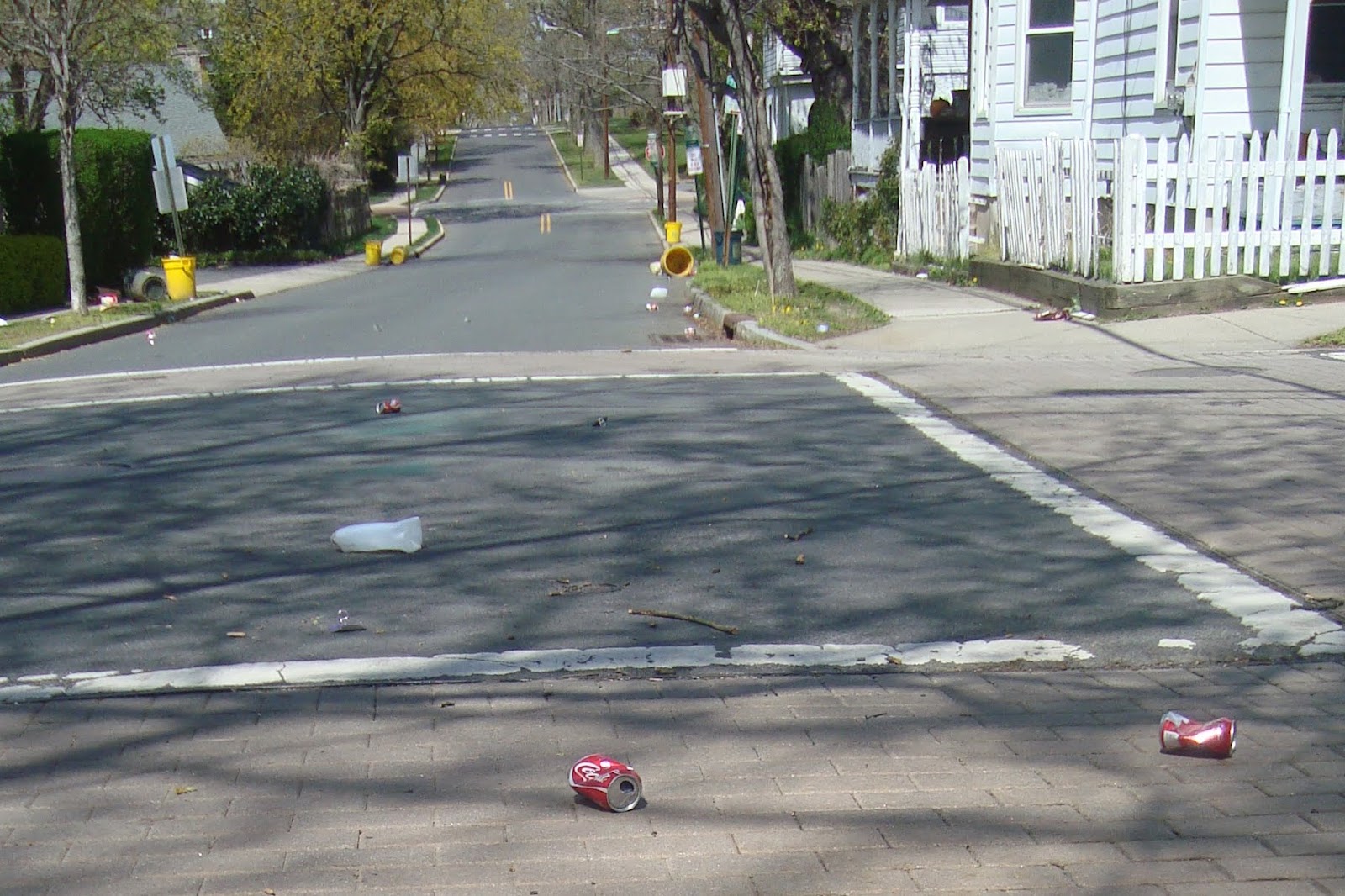
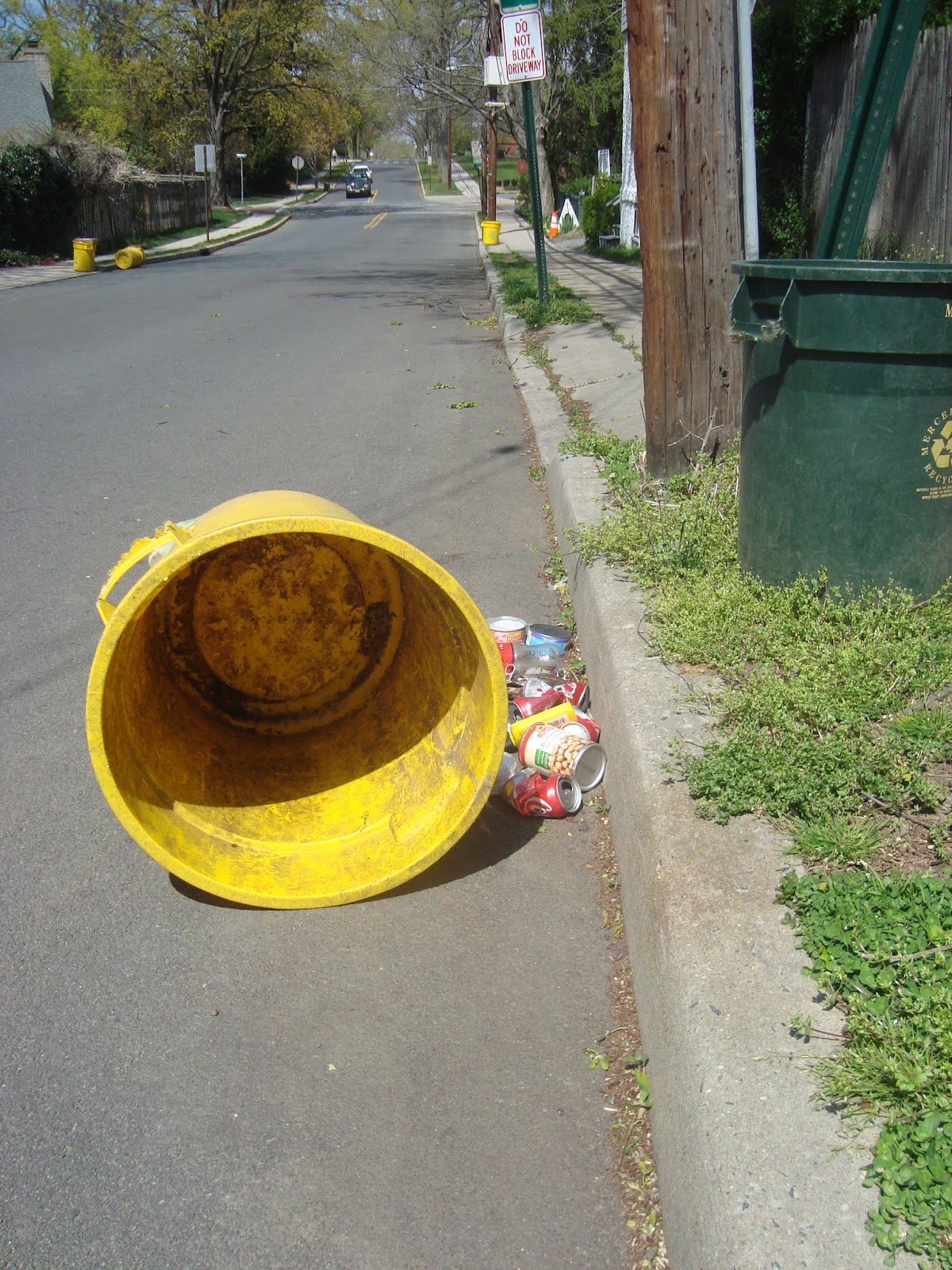
It was a wild and crazy day for recycling in Princeton, as high winds caused cans, paper and plastic to burst out of their tipsy confinement and head cross-town on unintended journeys. I was riding my bike down Chestnut Street when a yellow bin a block down spilled its contents on the street, sending a colorful, sparkly party of aluminum cans rolling uphill in my direction. Was this a messy sort of welcome? Or had the Swiss Family Robinson just unleashed a passel of anti-gravity logs to deter my invasion of the neighborhood?
Meanwhile, on Spruce Street, some papers and plastic had their escape cut short by some shrubbery,
while others congregated strategically at stormdrains that could take them down Harry's Brook to Carnegie Lake and onward to the Atlantic. "Sargasso Sea, here we come!", they rejoiced, daring any hound to track their scent down the waterways of New Jersey. They'd heard rumors about the downcycling that would be their destiny if taken away by the recycling truck, and weren't looking back.
The great escape revealed the flaws in Princeton's aging but seemingly immortal fleet of green and yellow recycling buckets, which, being cyclindrical, tend to roll out into the street,
or onto the sidewalk.
Their open tops and small size encourage overfilling, which plays right into the wind's complicity.
Somewhere, over the recycling rainbow, there exist large containers with wheels on the bottom and hinged lids on top. If other municipalities can have them, why oh why can't we?
On a more serious note: The alternative approach, seen in other municipalities, and also the more recent method of choice for private trash haulers in the township, is to have large rollout bins that the homeowner rolls to the curb and the worker rolls to the truck. The bin fits on a hook on the back of the truck that mechanically lifts and empties the bin. This saves the worker's back, and the lids help keep the contents safe from rain and wind.
More sophisticated and expensive systems have only one worker per truck, and the truck has an arm that reaches out and plucks the rollout bin from the curb, empties it and places it back on the curb.
If I were to argue for maintaining the status quo, I'd say that new bins would be costly and their construction consumes more resources. I'd wonder if the old bins could be effectively recycled. As heavy recyclables like newspapers and glass bottles become less common, back problems for workers may be easing. The current system may also employ more workers.
All of this would need to be explored, with an open mind. Even if the town wished to make a change, the county has the final decision, and only when the current contract with a hauler expires.
In the meantime, the wind will have its occasional field day, and before the municipality can slap the culprit with 10,000 counts of littering, it will have vanished into thin air.
Meanwhile, on Spruce Street, some papers and plastic had their escape cut short by some shrubbery,
while others congregated strategically at stormdrains that could take them down Harry's Brook to Carnegie Lake and onward to the Atlantic. "Sargasso Sea, here we come!", they rejoiced, daring any hound to track their scent down the waterways of New Jersey. They'd heard rumors about the downcycling that would be their destiny if taken away by the recycling truck, and weren't looking back.
The great escape revealed the flaws in Princeton's aging but seemingly immortal fleet of green and yellow recycling buckets, which, being cyclindrical, tend to roll out into the street,
or onto the sidewalk.
Their open tops and small size encourage overfilling, which plays right into the wind's complicity.
Somewhere, over the recycling rainbow, there exist large containers with wheels on the bottom and hinged lids on top. If other municipalities can have them, why oh why can't we?
On a more serious note: The alternative approach, seen in other municipalities, and also the more recent method of choice for private trash haulers in the township, is to have large rollout bins that the homeowner rolls to the curb and the worker rolls to the truck. The bin fits on a hook on the back of the truck that mechanically lifts and empties the bin. This saves the worker's back, and the lids help keep the contents safe from rain and wind.
More sophisticated and expensive systems have only one worker per truck, and the truck has an arm that reaches out and plucks the rollout bin from the curb, empties it and places it back on the curb.
If I were to argue for maintaining the status quo, I'd say that new bins would be costly and their construction consumes more resources. I'd wonder if the old bins could be effectively recycled. As heavy recyclables like newspapers and glass bottles become less common, back problems for workers may be easing. The current system may also employ more workers.
All of this would need to be explored, with an open mind. Even if the town wished to make a change, the county has the final decision, and only when the current contract with a hauler expires.
In the meantime, the wind will have its occasional field day, and before the municipality can slap the culprit with 10,000 counts of littering, it will have vanished into thin air.
Monday, March 26, 2012
Celestial Triangle of Venus, the moon, and Jupiter
A beautiful sight in the sky in early evening tonight, with Venus right next to the crescent moon in the west after sunset, with Jupiter some distance below.
Recycling #5 Plastics, Corks, Brita Filters
A friend told me some weeks ago that Whole Foods accepts some items for recycling. I called Whole Foods out on Route 1, took careful notes and then promptly misplaced them. The woman mentioned yogurt containers and other #5 plastics, and corks from wine bottles. She also said that Brita filters are #5 and can be returned there.
This past Saturday, there was an article in the NY Times about companies taking responsibility for recycling the packaging that comes with their products. It provided good context for that phone call to the local Whole Foods, and had information about PreserveProducts.com:
Click here and scroll down for a pictorial list of items made of #5 plastic.
As mentioned in previous posts, everything I've been able to learn about our curbside recyclables suggests that Princeton's hauler and recycling facility accept and market #5 and other plastics, but Mercer County is resisting adding plastics 3-7 to its official list of accepted curbside recyclables. In the meantime, the Whole Foods/PreserveProducts option at least provides more certainty about where the recyclables will end up.
Another option is to make yogurt at home, which I've heard is quite easy to do.
This past Saturday, there was an article in the NY Times about companies taking responsibility for recycling the packaging that comes with their products. It provided good context for that phone call to the local Whole Foods, and had information about PreserveProducts.com:
"Finally, in 2008, the company struck a deal to put collection bins in Whole Foods stores, and the effort took off. Customers can take any No. 5 container to Whole Foods stores — margarine tubs, other brands’ yogurt containers — where they are collected, taken to a plant for processing, and then turned into toothbrushes and razors by Preserve."For Brita filter info, click here.
Click here and scroll down for a pictorial list of items made of #5 plastic.
As mentioned in previous posts, everything I've been able to learn about our curbside recyclables suggests that Princeton's hauler and recycling facility accept and market #5 and other plastics, but Mercer County is resisting adding plastics 3-7 to its official list of accepted curbside recyclables. In the meantime, the Whole Foods/PreserveProducts option at least provides more certainty about where the recyclables will end up.
Another option is to make yogurt at home, which I've heard is quite easy to do.
Sunday, March 25, 2012
A Ceremonial Welcome
An air of expectancy filled the space surrounding township hall yesterday morning as I passed by. A grand entryway had been improvised on Valley Road, and mayors, people in uniform and citizens gathered in front of the fire station,
while a bagpiper played in the courtyard. Something was up, something was coming, and it turned out to be a piece of steel from the World Trade Center. Where the section of beam will be displayed was not clear.
I didn't stay to witness the arrival, but thought the magnolia blossoms mixing with stones offered a fitting tribute to go along with the town's welcome.
while a bagpiper played in the courtyard. Something was up, something was coming, and it turned out to be a piece of steel from the World Trade Center. Where the section of beam will be displayed was not clear.
I didn't stay to witness the arrival, but thought the magnolia blossoms mixing with stones offered a fitting tribute to go along with the town's welcome.
Friday, March 23, 2012
Journey of the Recyclables--Mercer County's Electronics Day
The semi-annual journey to the Mercer County electronics recycling event on March 10 went even more smoothly than usual, thanks to some luck of the Irish.
There was no line to wait in, apparently due to a St. Patrick's Day parade in Hamilton that had drawn many wouldbe recyclers away. I was tempted to head over to the parade with my green pickup and join in, my payload of vintage electronics serving as a makeshift float. All I would have needed was someone to sit on top of the computer monitors and wave proudly to the crowds. Few people know that St. Patrick was one of the great recyclers of his day. Of course, in the pre-industrial age, just about everyone was a great recycler without thinking twice about it.
With a combination of contributions from friends and curbside rescues, our contribution to the county's haul for the day added up to
Five computer monitors
Four televisions
Three lazer printers
Two printer/scanners
One toaster oven
And a harddrive in a pear tree.
I forget where they said the electronics are taken for recycling, but it sounded like somewhere in NJ.
There was no line to wait in, apparently due to a St. Patrick's Day parade in Hamilton that had drawn many wouldbe recyclers away. I was tempted to head over to the parade with my green pickup and join in, my payload of vintage electronics serving as a makeshift float. All I would have needed was someone to sit on top of the computer monitors and wave proudly to the crowds. Few people know that St. Patrick was one of the great recyclers of his day. Of course, in the pre-industrial age, just about everyone was a great recycler without thinking twice about it.
With a combination of contributions from friends and curbside rescues, our contribution to the county's haul for the day added up to
Five computer monitors
Four televisions
Three lazer printers
Two printer/scanners
One toaster oven
And a harddrive in a pear tree.
I forget where they said the electronics are taken for recycling, but it sounded like somewhere in NJ.
Monday, March 19, 2012
A Shuttered Observatory--FitzRandolph in Princeton
A post about vines, an unused Princeton observatory, stainless steel tigers, geese, and uncertain futures in general, at another website of mine, princetonnaturenotes.org.
Friday, March 16, 2012
Winter Gives Way To Yardwaste Season
Southern Michigan, where I used to live, was said to have two seasons: winter and road construction. It was a gloomy assessment, but sometimes seemed all too accurate.
Thankfully, Princeton lacks the interminably grey winters of southern Michigan, and is bikeable enough that road construction is less often an obstruction. But for those who walk borough streets, it feels more and more like the town's two seasons are winter and yardwaste. Winter lasts roughly from January through February, during which one can enjoy clean streets if it doesn't snow. With March comes the first modest dumpings at the curb,
which continue through the summer and into fall, climaxing with the blitz of leaves that threaten to obscure the pavement altogether.
I try to imagine that this tradition reflects a dogged effort to do away with pavement and turn Princeton into one large greenspace, but the reality is that a whole bunch of soft, rainwater-absorbing material is being exported, making Princeton's yards less absorptive of rainwater, and more apt to amplify flooding.
It's not that hard for most homeowners to make a little spot in a back corner, screened by some shrubs if desired, where leaves and even some brush can be tossed. Take advantage of nature's onsite recycling services, and make a spot this year where a little dk is ok.
Thankfully, Princeton lacks the interminably grey winters of southern Michigan, and is bikeable enough that road construction is less often an obstruction. But for those who walk borough streets, it feels more and more like the town's two seasons are winter and yardwaste. Winter lasts roughly from January through February, during which one can enjoy clean streets if it doesn't snow. With March comes the first modest dumpings at the curb,
which continue through the summer and into fall, climaxing with the blitz of leaves that threaten to obscure the pavement altogether.
I try to imagine that this tradition reflects a dogged effort to do away with pavement and turn Princeton into one large greenspace, but the reality is that a whole bunch of soft, rainwater-absorbing material is being exported, making Princeton's yards less absorptive of rainwater, and more apt to amplify flooding.
It's not that hard for most homeowners to make a little spot in a back corner, screened by some shrubs if desired, where leaves and even some brush can be tossed. Take advantage of nature's onsite recycling services, and make a spot this year where a little dk is ok.
Wednesday, March 14, 2012
Free Compost for Princetonians
Another of Princeton government's stealth services is free compost for residents. Word of mouth has worked pretty well on this one, but it hasn't always been easy to find info online, in part because the name of the composting center is the Lawrenceville Ecological Center or, even more correctly than that the Joseph H. Maher, Jr. Ecological Center.
There are two kinds of compost: composted leaves and thrice-ground woodchips. It's free if you shovel your own, otherwise something like $8/yd3 if they load it in your truck. They take checks, no cash. Drive out Mercer St past the Princeton Battlefield. It turns into Princeton Pike. If you reach I-95, you've gone too far. Address is 3701 Princeton Pike. This link provides more info.
I used to go out there, but now I just find an arborist taking a tree down in the neighborhood, ask if they want to dump their woodchips in my driveway, and usually end up with a free load of chips. That way, I save myself, and the arborist, a trip out of town, and the chips last much longer as mulch than the already pretty decomposed product they give away at the compost center.
Note: A few caveats with the raw woodchips. They aren't as pretty as the dark, composted mulch, they may borrow some nitrogen from the soil during decomposition, and they may even host an "artillery fungus" that shoots tiny black blobs at your house. But it's still highly convenient and long-lasting stuff to use away from the house, in informal areas.
There are two kinds of compost: composted leaves and thrice-ground woodchips. It's free if you shovel your own, otherwise something like $8/yd3 if they load it in your truck. They take checks, no cash. Drive out Mercer St past the Princeton Battlefield. It turns into Princeton Pike. If you reach I-95, you've gone too far. Address is 3701 Princeton Pike. This link provides more info.
I used to go out there, but now I just find an arborist taking a tree down in the neighborhood, ask if they want to dump their woodchips in my driveway, and usually end up with a free load of chips. That way, I save myself, and the arborist, a trip out of town, and the chips last much longer as mulch than the already pretty decomposed product they give away at the compost center.
Note: A few caveats with the raw woodchips. They aren't as pretty as the dark, composted mulch, they may borrow some nitrogen from the soil during decomposition, and they may even host an "artillery fungus" that shoots tiny black blobs at your house. But it's still highly convenient and long-lasting stuff to use away from the house, in informal areas.
Tuesday, March 13, 2012
THE TOWPATH'S UNCERTAIN FUTURE
One of Princeton’s beloved and longest running assets is the towpath that borders the DandR Canal. Third among New Jersey’s most popular state parks, the canal and its path are long-running in both space and time. Until recently, an ambitious bicyclist could ride the trail 25 miles towards the Atlantic, or 35 miles over and up the Delaware, avoiding car culture altogether.
As long as I’ve been in town, the towpath has been covered with a sturdy, dependable, well-drained surface of crushed stone, firm enough for pushing a stroller or riding a bike, but easy on joggers.
All that changed last August when the floods from tropical storm Irene washed out some sections of the trail and deposited a thick layer of silt on the rest.
Now, almost seven months later, little has been done to restore the trail. Though portions are passable when dry, it quickly becomes a quagmire after a rain. The DandR Canal State Park website is replete with photos of destruction, including damage to bridges and historic buildings. I called to inquire about prospects for repair, and was told that there are plans to restore and improve the crushed stone surface now buried under silt, but all depends on the eventual arrival of money from the Federal Emergency Management Agency (FEMA). Repairing even the less damaged sections may cost $10,000 per mile. Meanwhile, the park’s personnel, reportedly reduced to a third of 1980s staffing levels, struggle to find funding for basics like office paper.
There’s a problem here. Storms are getting stronger. Government is getting weaker. And though some may see this as just another natural disaster to deal with, natural disasters aren’t as natural as they used to be. Increasingly, the climate is gaining a human imprint as much as the land, and these two massive, collectively wrought influences--the paving of landscapes and the warming of the atmosphere--merge to powerful effect along our river corridors.
Warmed atmosphere spawns more powerful storms. Meanwhile, we harden the landscape with roads, buildings and not-very-absorbent lawns, all of which convey that rainfall more quickly and destructively into the rivers.
Who’s to blame? No one and everyone. There is safety and peril in numbers. Certainly there’s a long history of inadequate public policy, and changes to policy that could still help, but what intrigues me is the role of the individual in contributing to, and potentially steering us incrementally away from, a dangerous course.
In Princeton, where the hardscape of roads and buildings is largely a given at this point, our main contribution to saving a shared asset like the towpath comes down to individual homeowners’ decisions. The aim is to stop feeding nature’s fury, and to make more absorbent those portions of the landscape we have control over. As owners of cars and other assorted climate-changing machinery, we can find ways to use them less. It’s possible to make a yard more absorbent, by replacing lawns with more deep-rooted plantings, catching runoff in raingardens, and using fall’s harvest of leaves as mulch to absorb water and soften the earth. I’m a bit less sanguine about the role of rainbarrels, though they could help if they were five times larger, on many downspouts, and happened to be empty when the big rains hit.
Even if the towpath is eventually repaired, the chance of future damage continues to increase with changing climate. The towpath may prove a harbinger of things to come--a steady erosion of shared assets if we take no action to protect them. The solution, like the problem, will be a collective endeavor, through what we make of government and the actions we take as individuals far from the towpath itself.
In human interactions, we don’t expect our individual acts of kindness to change the world, and yet we do them anyway. It’s time to view an individual’s impacts on land, river and air in a similar light, and extend acts of kindness to the long shared path, from the comfort of our own homesteads.
This post first appeared March 9 at www.planetprinceton.com.
As long as I’ve been in town, the towpath has been covered with a sturdy, dependable, well-drained surface of crushed stone, firm enough for pushing a stroller or riding a bike, but easy on joggers.
All that changed last August when the floods from tropical storm Irene washed out some sections of the trail and deposited a thick layer of silt on the rest.
Now, almost seven months later, little has been done to restore the trail. Though portions are passable when dry, it quickly becomes a quagmire after a rain. The DandR Canal State Park website is replete with photos of destruction, including damage to bridges and historic buildings. I called to inquire about prospects for repair, and was told that there are plans to restore and improve the crushed stone surface now buried under silt, but all depends on the eventual arrival of money from the Federal Emergency Management Agency (FEMA). Repairing even the less damaged sections may cost $10,000 per mile. Meanwhile, the park’s personnel, reportedly reduced to a third of 1980s staffing levels, struggle to find funding for basics like office paper.
There’s a problem here. Storms are getting stronger. Government is getting weaker. And though some may see this as just another natural disaster to deal with, natural disasters aren’t as natural as they used to be. Increasingly, the climate is gaining a human imprint as much as the land, and these two massive, collectively wrought influences--the paving of landscapes and the warming of the atmosphere--merge to powerful effect along our river corridors.
Warmed atmosphere spawns more powerful storms. Meanwhile, we harden the landscape with roads, buildings and not-very-absorbent lawns, all of which convey that rainfall more quickly and destructively into the rivers.
Who’s to blame? No one and everyone. There is safety and peril in numbers. Certainly there’s a long history of inadequate public policy, and changes to policy that could still help, but what intrigues me is the role of the individual in contributing to, and potentially steering us incrementally away from, a dangerous course.
In Princeton, where the hardscape of roads and buildings is largely a given at this point, our main contribution to saving a shared asset like the towpath comes down to individual homeowners’ decisions. The aim is to stop feeding nature’s fury, and to make more absorbent those portions of the landscape we have control over. As owners of cars and other assorted climate-changing machinery, we can find ways to use them less. It’s possible to make a yard more absorbent, by replacing lawns with more deep-rooted plantings, catching runoff in raingardens, and using fall’s harvest of leaves as mulch to absorb water and soften the earth. I’m a bit less sanguine about the role of rainbarrels, though they could help if they were five times larger, on many downspouts, and happened to be empty when the big rains hit.
Even if the towpath is eventually repaired, the chance of future damage continues to increase with changing climate. The towpath may prove a harbinger of things to come--a steady erosion of shared assets if we take no action to protect them. The solution, like the problem, will be a collective endeavor, through what we make of government and the actions we take as individuals far from the towpath itself.
In human interactions, we don’t expect our individual acts of kindness to change the world, and yet we do them anyway. It’s time to view an individual’s impacts on land, river and air in a similar light, and extend acts of kindness to the long shared path, from the comfort of our own homesteads.
This post first appeared March 9 at www.planetprinceton.com.
Sunday, March 11, 2012
Southern Comfort--Passing Pleasure, Long Hangover
New Jersey is in its thirteenth warmer than normal month in a row. Averaged over the past three decades, March's high temperatures for Princeton would typically go from 46 at the beginning of the month to 56 at the end. By contrast, the 10-day forecast for the middle of the month this year is for days in the 60s and 70s--ten to twenty degrees above normal.
NJ state climatologist David Robinson posts periodic updates on weather trends. February was about 5 degrees above the average for the past thirty years, and was the fifth warmest February since records began being kept back in 1895.
I'm taking advantage of the warm weather, but also know that this southern comfort could bring with it a very long and beastly hangover come summer, and an even longer, perhaps permanent hangover if we can't find less climate-changing ways to live.
NJ state climatologist David Robinson posts periodic updates on weather trends. February was about 5 degrees above the average for the past thirty years, and was the fifth warmest February since records began being kept back in 1895.
I'm taking advantage of the warm weather, but also know that this southern comfort could bring with it a very long and beastly hangover come summer, and an even longer, perhaps permanent hangover if we can't find less climate-changing ways to live.
Whale of a Kale Sale
Ask Abigail to let the people know
There's a whale of a kale sale at the Whole Earth Center, so
Buy it all the month by pound or pail,
By and by your health it will avail,
In scrumptious soups from Alice Waters,
With onions, garlic and pataters.
--anonymous
There's a whale of a kale sale at the Whole Earth Center, so
Buy it all the month by pound or pail,
By and by your health it will avail,
In scrumptious soups from Alice Waters,
With onions, garlic and pataters.
--anonymous
Subscribe to:
Posts (Atom)