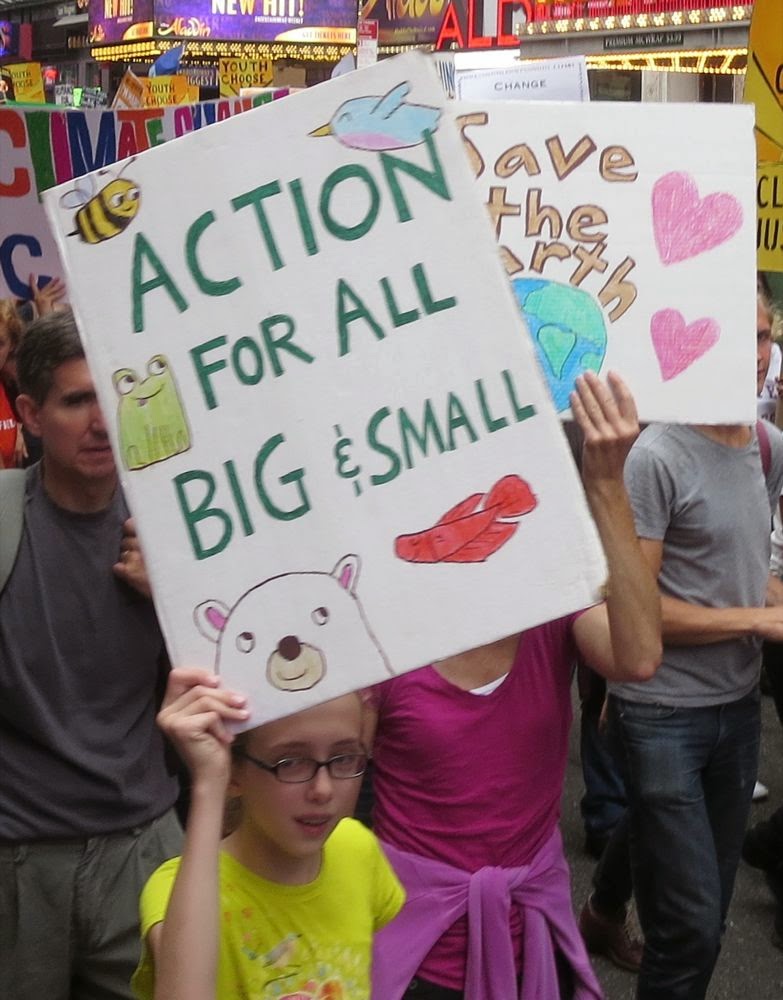
If you weren't able to make it to the Climate March, or only got to see the portion of it you were a part of, here's a showing and telling of the whole progression, all four hours worth, as it passed down 42nd Street. Included are its many themes, a compilation of the most memorable slogans and chants, and serendipitous visual interactions between the march banners and the commercial billboard mega-images that served as a visual frame for the marchers. Having long ago realized that human-caused destabilization of the planet was the overarching issue of our times, I was deeply moved by its spirit, its sounds, diversity, and sheer scale.
I tell my friends, excitedly, that I went to the Climate March and got to see the whole thing,
from start
to finish.
"You
watched?", they ask, disappointed. "Why weren't you in
it?" Well, I was, or at least I felt like I was a part of it. Standing
next to the stream of humanity passing by, I could look into people's
faces, read the banners, hear the chants, feel the exhilarating rhythm
of the occasional band, absorb a full sense of the march's size and
variety. Early on, some people in the march were calling urgently to us
on the sidelines
to join in. "Don't watch. Join!", a banner read. Here I've been writing
about
climate change for years, squeezing carbon energy out of our lives, and
at the biggest climate rally ever, they thought I was one of those
standing
"on the sidelines."
But others in the march were happy to have someone
standing there to connect with. What, after all, were all the banners
for if there were no one to read them?
Who
would have witnessed the infinite variety of expression, from the joy
of unified purpose to the bedrock seriousness of the cause?
The
march did not lack for participants. The turnout was so massive that
when time ran out they still had many blocks worth of people waiting at
the beginning of the route.
And
to be walking in the march would have, in some ways, been more like
being in the stands at a football game, looking at the backs of
everyone's heads.
There was, though, one magnificent moment that our late arrival caused us to miss.
Earlier,
as we had stood beside the still empty street midway in the route,
waiting for the marchers to arrive, the march had seemed stuck in the
distance. I later heard that the marchers, before they reached us, had
stopped at 12:58 for two minutes of silence, hands linked above their
heads in tribute to those already victimized by the transformations
wrought by climate change. After the silence, a great roar rose from the
streets, beginning at the front of the march and traveling back up 6th
Avenue and across on 59th, like a wave, a warning sounded, a
primal scream for the world we take for granted, the magnificent
spaceship we call home. By my wife's telling, that moment was like no
other she had ever experienced.
When the march again began moving forward, it came by us led by one of those big, black SUVs with tinted windows.
But
from there on, it was all walking humanity, stripped of the
star-crossed machines that serve our present needs while invisibly
altering the planet upon which life ultimately depends.
By
chance, we were situated on a block of 42nd Street lined with immense
images advertising everything from beauty products to McDonald's
hamburgers. Serving as backdrop for our photos, relevantly enough, was
an advertisement for Destiny, a sci-fi computer game set 700 years into
the future, in a shattered world "littered with the remains of
humanity's golden age."
That's one of the greatest
challenges of conveying the urgency of climate destabilization. Rather
than making a mature acknowledgement that we are all part of the problem
and all need to be part of the solution, rather than using today's
magnificent animation capabilities to help people see where we're headed
and motivate us to change our ways, American movie and video culture is
instead churning out epic battles between good and evil, reveling in
the drama of future ruin.
Thirty
years into the climate crisis, we still haven't gone much beyond black balloons to aid visualization of CO2. "Keep it in the ground", her sign
says. It's okay, as far as it goes, but why, in this image-bathed
culture, are the Masters of Imagery not doing more to help this woman
help us visualize the invisible?
Sometimes,
as the evening news programs lead with whatever bleeds, or the BBC News
sounds like an endless re-answering of the question "What did people do
with guns today?", I wonder if sustainability, if it were attained,
would deprive the news media of the dramatic storylines it needs to attract an audience. Sustainability would be highly satisfying in terms
of happiness and well-being, but for a consumerist culture hooked on a diet of death and destruction, any step towards solving problems and living in
peace actually poses a threat. Health and happiness make a lousy script,
devoid of the sort of dramatic tension and violence needed to catch people's attention and compete in the news media marketplace. At least for four hours on a Sunday afternoon, food justice eclipsed the dominance of DESTINY.
Next to the "Destiny" billboard was an even larger and equally relevant sign boldly stating "The curve changes everything."
Though
I'm sure Samsung's curved thin screen TV is exciting, the curve that
changes everything is the curve on this blackboard, where atmospheric
CO2 levels took a radical turn upwards as the industrial revolution took
hold, there, above the head of the woman with the blue shirt.
As
the marchers passed by (this banner and sunflowers marked the leading
edge of the march), we started to make a collection of the more
memorable slogan and chants.
Some of the banners were huge. This one stretched a whole city block. I have no idea what it said, but it was really impressive.
Other
signs were small. Do you see it, the little blue one the
girl with the red ribbon is holding, quoting Bob Dylon? "How many times
can a man turn his head, pretending he just doesn't see?" That's really
the central question, isn't it? How, in the information age, can people
remain so stubbornly uninformed?
I also see
someone I know poking her head out in the upper right corner. Hi, Liz!
What are the chances of unknowingly photographing a familiar face among
tens of thousands of marchers?
One
sign, contrasting the Frontlines of Crisis with the Forefront of
Change, depicted a Diego Rivera-like struggle against rising seas, while
the real men holding the center pole struggled to keep the sign aloft.
Here,
for me, is what makes climate the central issue of our times. "There's
no planet B", said one placard. "Earth's first. There is no second.",
said another. We mess this one up, we're looking at a very harsh
universe out there. One sign, captured the urgency in one word:
"CO2NSEQUENCE". The vaunted founders of our nation were thinking
longterm, as far beyond their lifetimes as they could imagine. Why
aren't we?
A lot of slogans centered around the failure to act.
"Stop fueling around."
"Men argue, Nature acts."
"Everyone's planet, everyone's problem."
"Oh shoot, we left the oven on."
"If you're not part of the solution, you're part of the pollution."
"Care now, you might be coming back."
Or, stated simply, stripped of rhyme and wit: "It's time to cut carbon"
My favorite chant, heard several times during the march, was "HEY! oBAma! WE DON'T WANT no CLImate DRAma!"
Why
aren't we acting? For some, the answer is clear. The blame should
firmly be put on those among the economically powerful who have been
funding doubt.
Others
pointed to a massive failure of the market, which doesn't seem free to
place a price on the future cost of using carbon-based fuels.
This guy had one of the more creative signs, linking the way we view our inner nature to the way we treat outer nature.
Inner healing will lead us to connect in healing ways to the world. I like it, especially if it leads to a tax on carbon
There
was a small kid carrying a big sign, calling for unified action. There
were kids "marching for Mom's Clean Air Force". A young woman held a
sign saying, "Climate--I was just getting to know it".
On the other end of life's story, there was a gang of "Elders off their rockers."
Along
with that intergenerational unity, this sign, "100% for the 100%",
spoke to the potential unifying effect of all people realizing that
climate change is a common enemy that we all can contribute to fighting.
Even
the alleged conflict between economy and environment is questioned.
"The economy can't swim.""Save the earth, and capitalism".
And here: "Preservation is not liberal or conservative; it is common sense." and "No economy on a dead planet."
These speak to all the climatological and ecological services that form the foundation for a healthy economy.
"Live on nature's income, not its capital.", was getting at something similar.
Others were less sanguine about the chances of making capitalism earth-friendly:
"Green
capitalism can't save us.", said one placard. More emphatic was the
chant: "The PROBlem is the PROFit, and WE are GOING to STOP it!"
Fracking was not winning any popularity contest. There were endless plays on the word "frack".
There was some rudimentary mathematics (Fracking = Death) and some playing on words ("Buck fig oil").
A few anti-war riffs:
"No more fake wars."
"Climate change leads to war, war leads to climate change."
and, in an update of swords to plowshares,
"Windmills, not weapons"
The
march grew denser as the hours passed by. Marchers spilled into the
sidewalk. If I hadn't exactly joined the march, the march had joined me.
Even the marquee across the street was impressed.
(Earlier
in the march the marquee had offered a more paradoxical comment,
suggesting that climate change was all part of humanity's deathwish.)
Here's
an angle I honestly hadn't considered. I had always thought that our
alien overlords, who had already destroyed their own planet, were taking
sadistic pleasure in watching our self-destructive behavior, and had
actually manipulated our political and mental processes so they could
sit back and watch us blow it bigtime on this little piece of paradise.
This was a rare shift into the doomier and gloomier.
Made
more believable by the surging numbers of marchers, some placards spoke
to the unstoppable power of a social movement. The chants often
emphasized this ascribed power: "The PEOple...uNITed...will NEVer BE
deFEATed!"
Or, "We're going to BEAT...BACK...CLImate CHANGE, we're going to BEAT BEAT BACK BACK CLImate CHANGE!"
Or "What do we want? CLIMATE JUSTICE. When do we want it? NOW!"
College
students linked the social movement to collective economic influence,
through divestment in carbon-based energy companies.
This was about as straightforwards as you could get.
NYU added some words, while other universities got some power from rhyme:
Fossil free MIT
Fossil free NYC
Or
alliteration. Which slogan is going to spur the most rapid divestment,
the ones with rhyme or the one powered by alliteration? Those Duke
students look pretty confident.
This man offered a pillow talk version of the Divest theme.
By the way, there's a letter to the editor that makes a post-Climate March call to look at our portfolios with divestment in mind. It links to sustainableinvesting4all.com, which looks promising.
Throughout
the march, peeking through the crowd from across the street, a model
for Sephora offered her own quiet suggestion. It's time for a makeover.
Some
signs spoke specifically to the predicament of NY City. There was
considerable dismay directed at Fresh Direct, whose delivery trucks have
been fouling the air in some neighborhoods.
FRESH DirECT has GOT to GO, hey HO.
And something more general: "Rising tides, rising rents, rising people."
I'm thinking these must be folks from low-lying areas of the city.
An
acrobatic bicyclist carried an I Love NY sign showing water flooding
the letters "NY". His bike looks well adapted for pedaling in flooded
streets.
In other examples of climate-inspired balancing acts, there were elevated people,
and graceful elevated birds, their flight symbolically dependent on their human stewards below.
Native Americans had a presence.
Indigenous people's rights were placed in opposition to incursions into their lands by oil companies.
Yasuni National Park in Equador is threatened by oil exploration and extraction.
An internet search suggests that REDD+ stands for Reducing Emission from Deforestation and Degradation.
There were calls to respect the four elements.
This contingent, Mayan I believe, had fewer placards,
and more dancing.
I'm thinking this is Mother Earth, who showed up in various forms and languages.
In
this chance photo, a nurturing embrace of earth and its fertility,
suggesting love, devotion, and gratitude, competes bravely with the
looming Destiny of rapacious humanity standing bold and proud upon the
barren ruins. Think Wall*E.
In another chance photo, a kid's placard commented on the climate implications of all those McDonalds hamburgers.
I
was glad to see some emphasis on the important role in climate
maintenance that fossil fuels play when they are left in the ground.
Energy companies see underground reserves as trillions of dollars of
potential profits. But leaving them underground would likely mean
trillions of dollars in reduced damage from destabilized seas, climate
and economies.
"Coal, gas, and oil. Leave it in the soil." managed to turn this into a rhyme.
Some signs were elaborate and thoughtful, but a challenge to read.
During one lull in the march, early on, an attractive woman, playing the cheerleader, held a sign high while she
jumped up and down, looking expectantly at all of us lining the street. She wanted
us to cheer, but her sign was very complex and impossible to read with
all the bouncing. We were ready to cheer, but didn't know quite for
what.
I asked this man to pose to allow a proper reading.
This
woman sought a new definition of masculinity, in which a smaller carbon
footprint is sexier than that oversized pickup truck. Another woman
held a banner saying, "I'm hot, but the planet shouldn't be." And then
there were "Mermaids against offshore drilling."
Mixed in was a lot of can-do about alternative energy. The question
"Why?", placed over a coal plant's smokestacks, had its complement in
"Why not?" combined with an image of a solar panel.
"Turn up the hope, not the heat."
"Renewable, doable"
"Think outside the barrel."
and the endearing "It's not too oily to go solar."
In the Do It Yourself category:
"You control climate change"
"Cook organic, not the planet."
and the simple assertion: "Lawns are dumb."
When
I saw "Support hemp for a clean planet.", I called out HEMP!, with
raised fist. The signholder returned the cheer in kind. You'd cheer for
industrial hemp, too, if you'd seen the documentary "Bringing It Home."
Just to spread the love, I also shouted out "PUPPIES!" when a woman walked by with an "I'm marching for puppies" sign.
Later in the march, a science theme came through, stating emphatically that the debate is over.
By then, the march was one solid mass of humanity filling the urban canyon wall to wall.
Then, at 5pm, exactly four hours after the march had started at our spot along the route, the march ended.
I
tried to make some calculations, roughly having counted 300 people
passing by per minute. Times 240 minutes, that doesn't exactly equal the
310,000 figure being used, but with the roughness of my count, all of
those who didn't make it to 42nd Street, all those told to disperse when
time ran out, and all those on the sidewalks, it could add up.
The BusForProgress came by, then four policeman on motorcycles.
Then
it was over, and the streets were reclaimed by cars that our alien
overlords make us drive to satisfy their jones for dystopia. Can't they
just get a Netflix account and leave us alone?
I've
heard there were some complaints about the mess marchers left behind,
but where I was there was almost no trash, except for this abandoned
sign run over by a delivery truck.
If you've made it
this far, you've experienced something of the sprawling immensity and
diversity of the march. I leave you with two parting posters:
Friday, October 03, 2014
Wednesday, October 01, 2014
Sustainable Investing
A letter in the Town Topics last week by Theodore Casparian offers an interesting perspective on why we should scrutinize where our money is invested, to see what sort of corporations we're providing capital to. He mentioned an online source that could help bring one's investments more into line with one's environmental/sustainability goals, but I didn't see the actual url published. Here it is: http://sustainableinvesting4all.com/. Looks promising.
Tuesday, September 23, 2014
Local Energy Spurned
Princeton imports energy from distant locales, largely unaware of the environmental fallout both at the source of that energy and at the destination of the resulting greenhouse gases. It would be far more sustainable, and responsible, to source energy from local above-ground sources rather than the underground sources we import, and that means harvesting solar energy either directly or from trees.
In that light, so to speak, there's something less than beautiful about the Westminster Choir College's new building. It's that bare roof. I've heard they intentionally gave the roof an auspicious southern orientation, but decided to hold off on solar panels for budgetary reasons.
I'd like to see what numbers were used to support that logic. As shown by a neighbor of mine in an earlier post, it's possible to lease solar panels for no money down, then pay for the resultant energy at a lower rate than if it were coming from a power plant. The persistent belief that solar panels are expensive reminds me of circular conversations I've had about native landscaping: "I can't afford the maintenance." "But natives require less maintenance than you're doing now." "But I can't afford the maintenance." "But natives require less maintenance than you're doing now." Ad nauseum. Current realities don't penetrate through long held assumptions.
Another spurning of local energy is the chipping up of all wood. This is understandable for softwoods and pesky branches, but chippers are now so strong that they can swallow whole trees, trunk and all. I've heard there are clean-burning incinerators that could turn the chips into energy, but none nearby, so the chips are hauled away to be composted--a nice-sounding but machine-intensive process that requires turning of the windrows by big machines, and then more hauling to get the product to a new location. Nice mulch, but the end result is consumption of imported energy, rather than production of local energy.
Princeton borough used to leave cut street trees at the curb for a few days for residents to scavenge good firewood, and wood stoves are an efficient, deeply satisfying, and surprisingly clean source of heat. But the new town policy is to haul wood away to distant locales, which increases energy consumption, staff time spent, plus whatever fee the composting facility charges.
At last night's town council meeting, Princeton resident Daniel Harris called for an accounting of all the town's energy usage, including vehicle use, to determine how to cut back. It won't come close to matching the phenomenal amount of energy used to, for instance, incinerate the town's sludge, far from the public eye down on River Road, but it's a useful exercise that could shift thinking and consumption habits. We also need to be looking at all the sources of potential local energy that are currently being spurned, and ask why we continue to ignore local energy harvest in favor of distant sources like fracked gas.
A Summer of Leaky Water Fountains
We have a wonderful park behind our house. It's Potts Park, the pocket park that's become popular even though it's hidden away on a back street. If we were to, in true Princetonian fashion, ignore its many fine features and instead zero in on an annoying fault, it would be the water fountain that on and off all summer refused to turn off, despite attempts to fix it. Other parks, too, like Harrison Street Park, succumbed to water fountain dysfunction. Perhaps all the sand kids keep putting in there gets lodged in the mechanism. Or maybe town parks departments, seeking the most foolproof fountain to buy, assuming they have a budget, need the sort of online equipment reviews we use to make purchase decisions.
Thursday, September 18, 2014
Free Dinky Parking Weekends and After Hours
Those climbing on the Dinky to head to the Climate March this weekend can park for free in the University Lot 7 parking structure (back left in the photo) located midway between the old Dinky station and the current temporary station. Access it from the traffic circle on Faculty Road. Drive up Elm Drive, take the next traffic circle left.
The ongoing University policy, and I assume it remains unchanged from when I checked some months ago, is that the parking structure is open to the public without charge on weekends and after hours on weekdays.
Tuesday, September 16, 2014
Join the Climate March in NY This Sunday
This Sunday, Sept. 21, beginning at 11:30, people from all across the
country will gather at Columbus Circle in New York for what's being
billed as "the largest climate march in history." I've never taken part
in a march, but I'll go to this one, and I encourage everyone else to
head to the Dinky that morning with plenty of time to spare.
The
most troubling thing about climate destabilization is that so little is
being done to slow it down. The worst sorts of problems, whether at the
level of the individual or global, are those that languish and deepen
for lack of action. Once a problem is acknowledged and the first few
significant steps are taken to solve it, there is an immediate sense of
relief.
For
instance, there was no lack of scary pronouncements on the world’s
prospects at a meeting of Princeton's chapter of the Citizens' Climate
Lobby this past weekend. Yet, there's comfort in participating in a
national organization working patiently for positive, bipartisan action.
At
this month’s meeting, we gathered in a Princeton living room to hear
via speaker phone from retired Rear Admiral Len Hering. It felt
reminiscent of President Roosevelt's fireside chats during WWII. During
his career in the Navy, Hering led a successful effort to reduce the
Navy's energy consumption by 40%. I felt some kinship, having reduced
our home energy consumption by a similar amount without sacrificing
comfort.
Hering
sees a clear and present risk to the world his three grandchildren will
inherit, and says "we're not having the adult conversation needed." He
described how a 12 year drought in Syria and the resulting social and
political instability had opened the door for radical elements like
ISIS. Dramatic sea level rise this century, combined with storm surges,
will create millions of refugees, further destabilizing governments
around the world.
These
grim prognoses will be far less depressing the moment we take action
and shift course. Staying with the status quo may feel safe, yet it is
creating huge risks. Climate destabilization, collectively created, is a
shared enemy. Action to slow it will be a unifying force, and that
action must come at all levels, from the global down to the individual.
The march is timed to precede the U.N. Climate Summit later in the month. Details on how to participate in the march (e.g. no wooden sticks for banners!) can be found at PeoplesClimate.org.
Note: There are many events this weekend related to the march, info for which should be on the website.
Friday, September 12, 2014
A Dream That McCaffery's Supermarket Was Moving
Recently, I had a dream in which the McCaffery's supermarket at the Princeton Shopping Center was moving. I was in the store and noticed most of the shelves were bare. Were they remodeling? I asked a manager, and was told that they were moving to some distant intersection I didn't recognize but assumed was out on a strip development outside of town. I was understanding. No doubt they'd get more customers out on some busy road.
This is not a recurring dream, and it was unusual in being very matter of fact, lacking the improbable leaps in plot and logic that dreams usually display. One of the more instructive things dreams often leave behind is a feeling, and the feeling in this dream was of a stripping away of power. I rarely drive to McCaffery's. It's so close I can ride the bike, and bring a considerable amount of food home, stacked carefully in a large paper grocery bag in the kidseat. A backpack accommodates any overflow, and the occasional bag of dogfood fits well between the seat and the kidseat. At the cash register, I ask for one paper bag if I haven't brought one along, and put most of the food back in the cart loose, explaining that it all has to be repacked on the bicycle. Outside at the bicycle hitching post, memories of westerns in which the cowboy is carefully stowing provisions in those leather satchels on his horse come to mind.
The payoff, as I put canned food and flour in the bottom of the bag on the kidseat, saving lighter and more fragile items for the top, is a feeling of freedom and independence. Cars are wonderful tools, but they are deeply flawed, which when I need to use one makes me feel not guilt but a sense of mourning. They are so beautifully engineered, so smooth and quiet, that it's easy to forget the backstory, that the fuel cars use becomes steadily more difficult and risky to extract, and the consequences of their exhaust, though stripped of odor and smoke, are fraught with longterm peril.
But beyond that, the sense of empowerment a car can provide is also a form of dependence. The world most people wake up to every morning is scaled not to us and our capabilities, but to a machine's. Businesses, schools and friends are scattered and unreachable without contributing to a vast atmospheric experiment fraught with risk.
The layout of suburbs strips any kid under 16 of the power to reach school or friend without adult assistance, which in turn tethers adults to the steering wheel, shuttling kids hither and yon. This is not freedom but freedom lost. It means walking out the door knowing that you are helpless, your legs insufficient to the task of getting anywhere meaningful without the assistance of a machine. That's the bad dream that, living in a town like Princeton, with businesses, schools and many friends close by, we might dream but need not live.
This is not a recurring dream, and it was unusual in being very matter of fact, lacking the improbable leaps in plot and logic that dreams usually display. One of the more instructive things dreams often leave behind is a feeling, and the feeling in this dream was of a stripping away of power. I rarely drive to McCaffery's. It's so close I can ride the bike, and bring a considerable amount of food home, stacked carefully in a large paper grocery bag in the kidseat. A backpack accommodates any overflow, and the occasional bag of dogfood fits well between the seat and the kidseat. At the cash register, I ask for one paper bag if I haven't brought one along, and put most of the food back in the cart loose, explaining that it all has to be repacked on the bicycle. Outside at the bicycle hitching post, memories of westerns in which the cowboy is carefully stowing provisions in those leather satchels on his horse come to mind.
The payoff, as I put canned food and flour in the bottom of the bag on the kidseat, saving lighter and more fragile items for the top, is a feeling of freedom and independence. Cars are wonderful tools, but they are deeply flawed, which when I need to use one makes me feel not guilt but a sense of mourning. They are so beautifully engineered, so smooth and quiet, that it's easy to forget the backstory, that the fuel cars use becomes steadily more difficult and risky to extract, and the consequences of their exhaust, though stripped of odor and smoke, are fraught with longterm peril.
But beyond that, the sense of empowerment a car can provide is also a form of dependence. The world most people wake up to every morning is scaled not to us and our capabilities, but to a machine's. Businesses, schools and friends are scattered and unreachable without contributing to a vast atmospheric experiment fraught with risk.
The layout of suburbs strips any kid under 16 of the power to reach school or friend without adult assistance, which in turn tethers adults to the steering wheel, shuttling kids hither and yon. This is not freedom but freedom lost. It means walking out the door knowing that you are helpless, your legs insufficient to the task of getting anywhere meaningful without the assistance of a machine. That's the bad dream that, living in a town like Princeton, with businesses, schools and many friends close by, we might dream but need not live.
Wednesday, September 10, 2014
Recharging Non-Rechargeable Batteries, and Axeless Woodchopping
When Joe Budelis came to my "open garden" event last month, he mentioned he had found some nifty answers to a couple of life's persistent questions. One of these recurrent questions is what to do with spent alkaline batteries. Currently (subtle pun there) they aren't accepted for recycling locally.
And of course they aren't rechargeable, or so I assumed, until I saw Joe's Rosewill recharger for alkaline batteries. Yes, we live in a magical world where non-rechargeable batteries can in fact be recharged. There are a few tricks to using it, but Joe says it has served him well, and he used to have a model that charged the larger sized alkaline batteries as well.
Unfortunately, an internet search shows this fine item to be unavailable. Dare we suspect that liability has once again reared its fearsome head? Or perhaps Rosewill has decided to focus instead on perfecting its reversible aging chamber. That would be a bed with electrodes at either end for head and feet that send a gentle electrical current through your body while you sleep, causing you to wake up in the morning feeling five years younger.
Speaking of batteries, in the form of energy that's stored in firewood, Joe also showed me a way to split wood without an axe. It's a wedge with a telescoping handle. A good name for it is elusive. One vender calls it a Manual Slide Log Splitter. On ebay, it's called a "Hand sliding slide hammer type wedge log splitting tool". It doesn't apply as much splitting pressure as a axe or maul, but Joe says it works well enough to supply wood for his fireplace. For anyone who'd rather not wield an axe, this is a good alternative.
Thanks to Joe for recharging our sense of the possible.
In the process of seeking out the log splitter on the web, I found a variation of an axe that looks like it has potential. The blade is flared at the top to shift the center of gravity to one side, so the blade enters the wood, then acts like a pry bar, all in one downward stroke. A bit pricey, but worth exploring, here and here. The videos also demonstrate the "old tire" approach to log splitting, which keeps the wood upright while you split it.
Tuesday, September 09, 2014
It's National Walk/Bike To School Century!
A beautiful September morning, 20 minutes before classes start, and no traffic jam to be seen. Instead, students are flocking to Princeton High School on bikes and on foot. Is it real? It was real yesterday morning. Had I missed the memo? Was it National Walk/Bike to School Day? No, that's October 8. Maybe there was an inspiring announcement in school the previous week about the benefits to self and future of walking/biking. Or maybe they all plumbed last year's depths of WalkablePrinceton. Has Princeton embraced unified action to slow climate change, inspired by the upcoming march in NY?
Whatever it was, it felt safe, for Princeton's streets, for the kids, and for the future. And it felt right--individual action and global realities suddenly aligned. But maybe I read too much into it. Maybe kids are riding and biking simply for the taste of independence, the pleasure of morning air, or because their parents have other things to do.
I've played the chauffeur at times, so can attest that a school day morning is the worst time to be crowding the streets with bulky cars. Drivers are in a hurry, perhaps not fully awake--I suspect some are still in their pajamas--and the dropoff in front of school is awkward. I drive up Franklin Ave, dismayed by the inefficiency of a cold engine while cars poke their noses out from side streets like ghosts in a game of Pacman. The best thing one can do for safety in Princeton is to take a car off the street.
Still, there are attractions to chauffeuring a kid to school. It's a quiet moment to talk, if one isn't too harried by the traffic. And maybe it's interpreted, by the kid at least, especially a middle schooler ambivalent about independence, as an expression of parental love.
But the sentiments inside the car are in conflict with the back end of the car, which is quietly feeding the atmosphere with the ghosts of climate future. (No, that's not a Prius exhaust pipe.)
So kudos to the kids who are participating in Walk/Bike To School Century, and one question for the schoolboard: Have you thought of getting more bike racks? They're packed to the max.
Sunday, September 07, 2014
Saving Money Through Solar Energy for the Home
It may come as a surprise that you can get a solar array on your house with no up front cost, and reduce your energy bills in the process. That sounds like something a phone solicitor might say, but my friend and neighbor Peter Thompson, who has considerable technical expertise as manager of IT at Princeton High School, decided to research the issue, and ended up with solar panels on his roof.
He went with solar even though his roof doesn't face south, and is shaded for part of the day by nearby trees. Despite these less than ideal conditions, the panels are projected to supply nearly half of his home's energy needs. Since getting the panels up and running, he's learned that they produce significant energy even when it's cloudy.
In a detailed writeup with photos and graphs about his experience researching solar and getting the panels installed, he describes the various factors that influenced his decisions about whether to purchase or lease, how many panels to get, and what sorts of financial incentives are in place.
His explorations of this may have begun when I asked him about the possibility of using energy from solar panels during power outages. Most solar arrays shut down during power outages, for reasons Peter explains in his writeup. But he was able to negotiate with the installer to include a way to feed solar-generated electricity to one wall outlet even during a power outage. That electricity can then run small electronics and charge a battery that could be used at night.
My ideal would be to have an electric car whose batteries could keep the house going in low energy mode during a power outage, with the solar panels providing a means to charge the car's batteries. Peter's writeup shows how he took a significant step in that direction. He also gives contact info if you want to ask him any questions. If you're driving down Hamilton Ave, his house is at the corner of Horner, just past Harrison St.
Thanks to Peter for sharing his research and experience with the community!
Friday, September 05, 2014
Riverside Elementary Getting New Insulation
Princeton's Riverside Elementary is getting a new roof. If the materials stacked on the roof are any indication, that may mean the school's getting better insulation as well. I'm told that the insulation being applied varies in thickness, so that water will drain off the otherwise flat roof. Roofs are replaced every 20 years or so.
It seems a mundane thing, but any money spent to heat/cool the buildings is money that's diverted from our childrens' education.
Saturday, August 30, 2014
Democratic Party's Party Gets A for Recycling
A subtle suggestion for Labor Day weekend parties: At their annual party in Harrison Street Park this past July, Princeton's Democrats were proud of how little trash got generated. When throwing a party, it's hard to remember to be ready with the right array of bins. Paper cups, plates, napkins and food went into the green compostable bin. Bottles and cans landed in the yellow tub.
That left just a scant few items like utensils to go in what they labeled the "bad garbage" can.
The system worked because a few simple rules were followed: Make the various containers visually distinct, and put them side by side so that anyone with something to throw away doesn't have to walk farther to put it in the right container.
Friday, August 29, 2014
Foodwaste Bins and the Missing Hook
Princeton's curbside foodwaste collection uses small rollout bins. I happened to encounter one of Central Jersey's trucks making its rounds the other day. The bins are emptied by hand, without any mechanical assist. Rollout bins are widely used in other communities for trash or recyclables, and in places like San Francisco, Seattle and Ann Arbor, MI, foodwaste is combined with yardwaste in a large rollout bin as well.
It's customary to give workers' backs a break by mounting a small hydraulic hook on the back of the truck. The worker rolls the bin up to the hook, which grabs the metal bar on the bin, lifts it up, gives it a shake and then eases it back down to the pavement.
Princeton's foodwaste bins are small, so most have loads light enough for the worker to deal with. But foodwaste is mostly water, and can be heavy if the bin is full. Maybe that's why the worker said he'd love to have one of those hooks. I priced them out once. It costs 3-5 thousand for a retrofit. Seems a small price to pay for saving a man's back.
Wednesday, August 27, 2014
Excavation Exposes One of Princeton's Underground Streams
There she flow! Ain't she a beaut? Harry's Brook, in all her glory. Where has she been all these years? Why, just beneath the ground, buried alive, embraced by concrete, seven feet wide, seven feet high--spacious compared to most pipes, I suppose, with all the room in the (under)world...
This post continues with more photos and text at the PrincetonNatureNotes site.
Friday, August 22, 2014
Think and You Shall Receive--the Kurbside Kmart Comes Through Again
Look what appeared on the curb across the street the other day--a nearly new and entirely functional Canon MX 922 printer. How convenient, seeing as I had meant to head out to Route 1 two days before to buy a new one, but had gotten sidetracked.
One by one, our printers had failed over the past six months. An old HP flashed some sad excuse or other on its screen. A Canon outright lied, pretending to have a paper jam when clearly no paper was jammed at all. An internet search, which usually brings up some wisdom about how to repair stuff, gave only a mocking suggestion to turn off, unplug, then plug in and turn back on, to be repeated ad nauseam. Then my wife's fancy Lexmark laser printer, nearly new, suddenly claimed it was missing a thingamajig. This, too, was a baldfaced lie--probably some sensor that had lost its sense. Support said to extract the "missing" part from the printer's innards, then put it back in. Three times I did this, turned the printer back on and, voila, the same error message. Useless printers were beginning to accumulate like dysfunctional pens that, for some reason, are so hard to give up on.
In the past, before religion became so politically charged, one would call the appearance of a nearly new, functional printer on the curb a Godsend, without any implication as to one's personal beliefs. It was just part of the language. Perhaps a tenant in the rental across the street was moving out and couldn't take the printer along. Or perhaps they found an annoying glitch in the printer's performance that we have yet to notice. In any case, it was nice of them to put the printer out after the overnight rain rather than before.
I'd like to think that the exasperating attempts to fix the other printers were a necessary prelude to finding the printer on the curb, that fruitless effort eventually bears fruit. Hard to prove. This would be akin to curbside Kharma, in which reward for earnest effort is oblique rather than direct. Going out in search of a printer on the curbs of Princeton would have surely gained nothing. The key to shopping at the Kurbside Kmart is to never actually go looking for anything. Call it serendipity, which works like ideas or insights bubbling up out of the unconscious mind. Its gifts always come by surprise.
Wednesday, August 13, 2014
It's Only Spilled Glass on a Sidewalk
There's a story in this picture. Two pet peeves converged, and the result was broken glass for pedestrians to tread through on their way to and from the Princeton Shopping Center. And the municipal response? Not so great.
Pet Peeve #1: Television put out for the trash. State law bans televisions from the landfill, therefor, putting them on the curb with your trash puts the garbage collectors in the position of breaking the law. What to do with them? Here's a previous post on the subject. You can also check out the town website's "What to do with.." info sheet here. Hopefully it's up to date. TVs have lots of lead and other toxics that should be recycled rather than placed in a landfill where the toxics could leach into groundwater.
Pet Peeve #2: These folks put two long fluorescent light bulbs out with their trash. Some people put fluorescents out with the recyclables, which is just as bad if not worse. The fluorescent light bulbs have traces of mercury in them, which are released when the bulb breaks as it's being compacted by the garbage truck, with the trash collector standing close by. The trash collectors, who are already sacrificing their backs and their sense of smell, should not have to breathe mercury as well. What to do with the burnt out bulbs? Well, the options aren't great. Three county recycling days a year, or give Home Depot a call to ask if they still take them.
So, what happened when the neighbors put out both a TV and the light bulbs at the same time? The clues are a broken fluorescent bulb and a TV taken apart. What happened here is that a scavenger driving by stopped, opened up the TV case and took the copper coil of wires to sell as scrap for a few dollars. During the struggle with the TV, he must have accidentally broken a light bulb, leaving us pedestrians--kids, the elderly, the handicapped guy with an electric cart--with broken glass and traces of mercury to dodge for X number of days. Jolly.
I called the police. Law breaking had led to vandalism. What can they do? The first call yielded nothing. A second call the next day prompted an officer to stop by. He was nice enough, and spent some time on the issue, but seemed less than concerned, and was unaware that putting TVs out on the curb is illegal. I had to email him the link to the Princeton Health Department's April memo on the subject. He said it's the neighbor's responsibility to clean the sidewalk, but if no one is home when he knocks, there's nothing to be done. He kicked some glass aside. There is now less glass on the sidewalk, and one officer is somewhat better informed about the environmental laws they are being paid to enforce.
Can we call this progress? There is essentially no communication with residents (or with police for that matter) to inform them of the law, and then no communication after residents break it. The glass, the law, the system--all are broken.
-- This post provided by the Princeton Peeve Society
Friday, August 01, 2014
Free Concerts at Pettoranello Gardens
People are starting to discover the hidden concerts in the hidden Pettoranello Gardens in Princeton. Twice a year, those of us who stay in town for the summer are rewarded by free infusions of world music put on by Blue Curtain. The second (and last) concert is this Saturday, August 2, beginning at 7pm.
The concert two Saturdays ago featured Cuartetango, a New York-based string quartet that plays Argentine tangos, led by the son of a violinist who performed with famed Argentine composer Astor Piazzola.
Such a pleasure to sit on the grass, music wafting across the park, cloud patterns above on a perfect summer evening.
Adonis Puentes followed up with his salsa band as the sun set over nearby Mountain Lakes. The contagious rhythm and bon ami stage presence of Puentes quickly filled the outdoor dance floor.
After all of these years, I've finally figured out why it's call Blue Curtain.
Stage lighting made the tent for the band photogenic as well.
Blue Curtain has a facebook page, and another concert coming up
this Saturday, with the first group performing at 7pm. Performers are Awa Sangho and Noura Mint Seymali. You can usually google the names to find youtube videos, to get a sense of their music.
Here's a post about a previous performance, in which a tempestuous performance by saxophonist Oliver Lake was finally enveloped by a real tempest. Very exciting.
Subscribe to:
Posts (Atom)