Friday, September 23, 2016

The Half Mast Flag


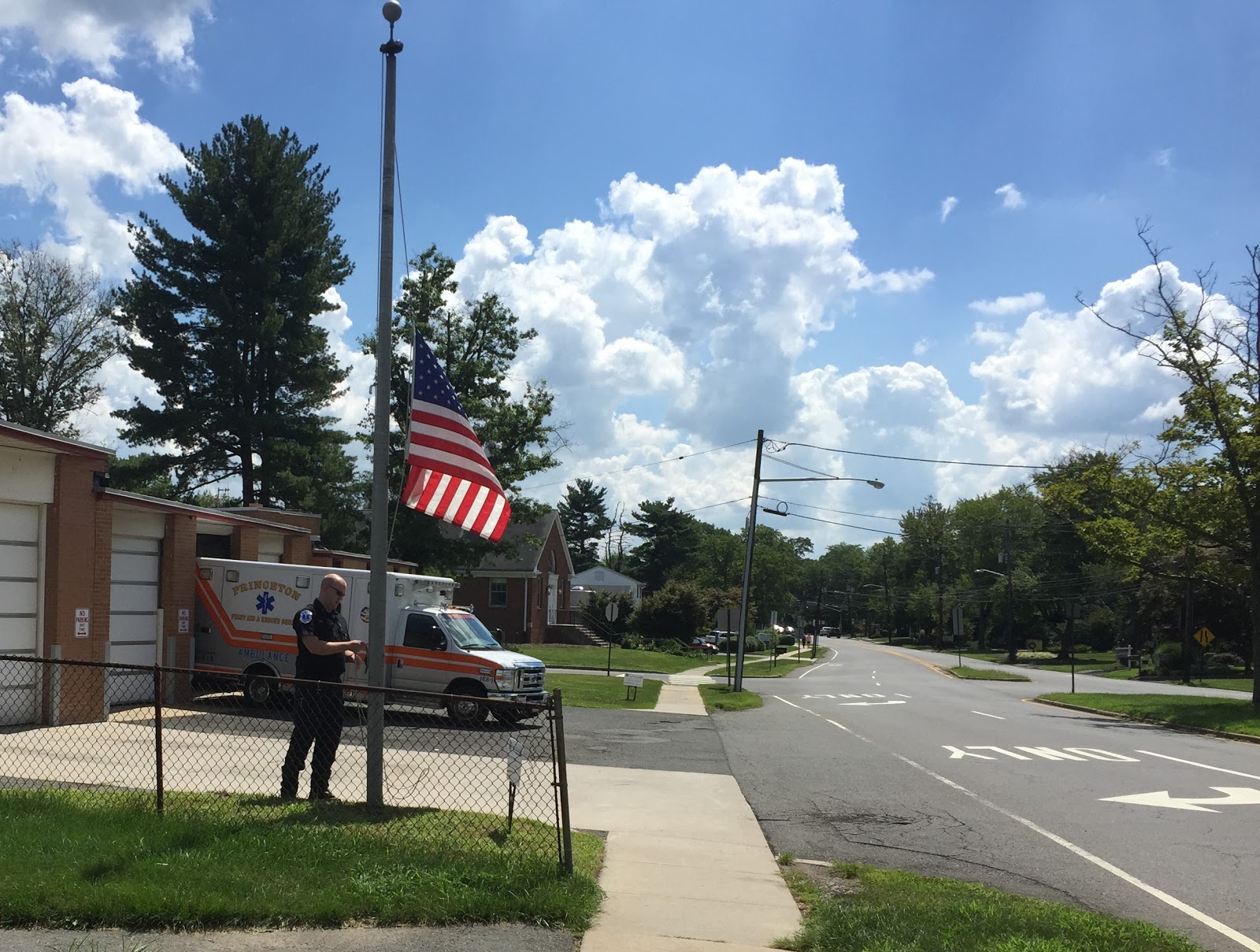
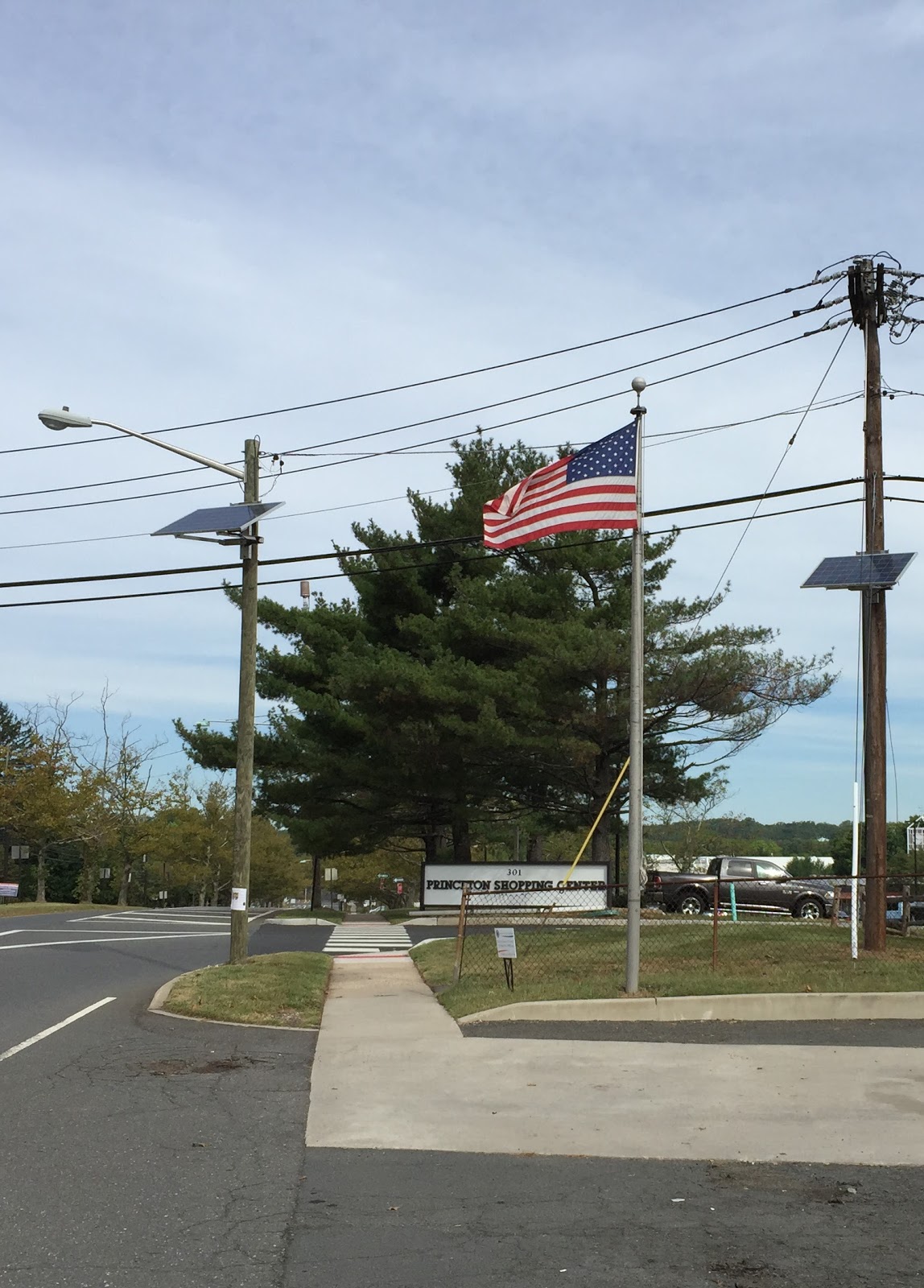
Sometimes, the American flag hoisted in front of the Princeton First Aid and Rescue Squad will fly at half mast. I assume it's to honor the memory of a volunteer who lost his or her life in the line of duty. This happens fairly frequently, though, and since this is the most visible American flag on our side of town, catching the eye as we pull into the Shopping Center, it can give a sense that the nation is repeatedly in mourning. A few weeks ago, the flag was remaining at half mast for a number of days running, and I finally stopped by to ask for some background. Turned out to be in honor of an officer who had lost his life somewhere else in the country.

Though I didn't express any opinion, they raised the flag back up within the hour, as if they'd forgotten how long it had been at half mast.

This raises the question of how to rightly honor those who risk their lives to protect us, without it beginning to seem, particularly in an election year, like a political statement that the nation is on the wrong course.

Might some other flag be flown at half mast for those times of mourning?

A few days later, I stopped by a friend's house and noticed his neighbor was flying the Thin Blue Line, which, according to Wikipedia, "is a symbol used by law enforcement, originating in the United Kingdom but now prevalent in the United States and Canada to commemorate fallen and to show support for the living law enforcement officers and to symbolize the relationship of law enforcement in the community as the protectors of fellow civilians from criminal elements. It is an analogy to the term Thin Red Line."

Flying this flag, or something like it that included rescue squads, either on its own pole or beneath the American flag, would make more clear what and who is being mourned.


As a bit of an aside, I later noticed a flag just down the street, relevant here because it, too, is a variation on a theme. Turns out it's La Senyera Estelada, an unofficial flag generally waved in Barcelona and elsewhere by supporters of Catalonia's independence from Spain. It's modeled after the flags of Puerto Rico and Cuba, which gained independence from Spain in 1898 and 1902 respectively.

Two worthy goals: An American flag more consistently flying high, and honoring those who have given their lives. Without too much trouble, we could have both.


Wednesday, September 07, 2016

The Joys of Re-use


I had found this desk next to a dumpster in the neighborhood and knew it would soon be headed for the landfill if Mr. Sustainable didn't come to the rescue. Some careful maneuvering of its significant mass onto the ol' pickup safely transported it to our Kurbside Kmart location one block away on busy Harrison Street, where it sat, curiously unclaimed for several days, despite being in good condition. With people moving in to town, it seemed perfect timing.

As the furniture lingered in our front yard, I had begun to wonder about the aesthetics and practicality of this passion for re-use, when a knock came at the door. A young woman asked, with a tone of disbelief, if I was really giving away that fine desk. I said yes, and her eyes lit up. She and her mother had been passing by on their way home to a distant town, and decided it was perfect for their needs.

The next challenge was to fit it in their little hatchback. Part of the fun of repair and re-use is finding out how things work. Deciding which tools to use, finding all the hidden screws, making all the pieces fit in the car--solving all these physical puzzles has got to be good for the brain. This is basic resourcefulness in the service of saving resources. And serendipity, when it happens to oneself or others, feeds the soul and spares the landfill.

Wednesday, August 31, 2016

Local Trash Cans Overfloweth With Paper

Here's an example of hundreds of seemingly insignificant individual actions leading collectively to a big mess. This is small scale stuff, marring the view outside a cafe, but the same dynamic is at work in sealing the fate of our planet.

This overflow runs counter to other uses of paper in the digital age. Newspapers grow scarce, and we're often reminded not to print things out if we don't need to. There's talk of going paperless in the office. But when it comes to food and drinks, the use of paper is burgeoning. Trash receptacles overflow, in this case spreading over towards the relatively empty receptacle for recyclables. Paper feels ecological. It's from nature, unlike most plastics. It won't drift out to the ocean and work mischief with the food chain. We hear that plastics won't decompose in landfills, but sequestering the plastic's carbon underground can be a good thing. If paper decomposes in a landfill, it produces methane, some of which will escape and feed climate change.

For anyone who reads the fine print on the blue lid of the recycling receptacle here, it includes paper, which means most of the paper in this photo, separated from the food, could actually be stuffed in the recycling rather than the trash. Either people have really bad aim, or they didn't get the memo.


Friday, August 19, 2016

A Rare Curbside Sighting

A surprisingly rare sight in front of our house is this trash can. Every month or so, if that, and on the small side--32 gallon capacity. Why it's so slow to fill is nothing we've kept track of, but likely has to do with a habit of thought that everything has a place--usually some place other than the trash can. By the time most items have landed in the recycling bin, or the kitchen counter compost bucket, or the plastic bag full of plastic bags to head to McCaffery's, or has been put out on the curb for reuse or scrap, there just isn't much left.

This blog post might more appropriately have a photo not of the trash can but of an empty, clean curb, for it's absence from the curb most weeks is what's most worthy of note. A lot of environmentalism has to do with seeing the significance in what is nowhere to be seen.

Saturday, July 30, 2016

Princeton High School Flooded Again


Why are thousands of gallons of water flowing into the Princeton High School basement?

And more water flowing under the door that leads directly to the wood stage of the high school performing arts center?

The first answer is poor design by the architect, who didn't consider where stormwater would flow during prolonged downpours like the one we had today.

A big storm in 2009 damaged the wooden stage, which then had to be replaced at great expense.


Walnut Street was one foot deep in water after torrential rains this afternoon, and because the performing arts and science wings of the school were built lower than the street, water flowed towards the school rather than away from it, causing massive flooding.

Since 2009, I have raised concern with school superintendents and facilities directors, town engineers and a few council members, on five separate occasions about the potential for a destructive repeat flood. The only response that I'm aware of was that staff would place sandbags against the doors to block the floodwater. It was a bandaid approach, and when Princeton got hit this afternoon with a big downpour, there were no sandbags to be seen.

Here's a 2011 post that explains why the flooding occurs, and offered a solution. A now retired science teacher, Tim Anderson, and I explained the solution to school staff a year or two ago. How frustrating to see what looks like a repeat of 2009's flood, with no action taken in the interim.

Wednesday, July 27, 2016

Green Shade

Shade in a parking lot becomes very popular this time of year. Even better if the shade comes from solar panels, which are vastly better than trees at reducing overall greenhouse gases in the atmosphere. (One estimate suggests an average home array is equivalent to growing 50 trees.)

We chanced by Orchard Hill Elementary in Montgomery Township while taking the scenic route home. What a pleasant oasis! Parking in its dappled shade for a few minutes, it was time to dream of a time when all parking lots might be so elegantly and productively shielded from the sun, and you can return to find your car not burning hot but recharged, ready to take you to your next destination. Then we'll really have it made in the shade, with shade made by energy makers.

This is one of several projects apparently paid for not by the schools but by Somerset County. Check out the site's energy production at this link.


Wednesday, July 20, 2016

Happy Scrap

When it comes to recycling, nature puts the human economy to shame. Nature quickly breaks everything down, no matter where it falls, until it can take on new life as part of anything else. We're lucky if even a small percentage of our stuff finds new life. All we can do is try to emulate in some small way nature's genius. Frontage on a busy street can be used to "showcase" stuff that deserves a better fate than the landfill. This week's offerings: a hundred pounds of scrap, a guitar, a couple bed frames.


The guitar was gone within an hour. "Needs work", I told the girl, who couldn't believe her luck. She seemed undeterred by the news. If nothing else, she'll learn about how guitars are put together.

I finally relinquished my prize collection of defunct toasters, which disappeared at 6:30am the following morning with the rest of the scrap.


A neighbor on a side street had put out one of those lightweight carts to carry two recycling buckets. It, too, looked destined for scrap, but needed only a nut and bolt to become serviceable again. Nice when that happens.

Wednesday, July 13, 2016

Future Road Congestion, EAB-Style


I have seen the future, and it's a New Jersey full of single lane roads. This scene on 206, where crews are removing a dead ash tree, will become commonplace over the next few years, as the Emerald Ash Borer, a.k.a. EAB, lays waste all species of ash, excepting those that homeowners treat with chemical injections. Ash is the most common roadside tree species, and soon gets brittle once it dies, requiring quick removal.

It was easy to tell it was an ash, even from a distance, because it has thick twigs that come off the main stem in pairs.

All of this is happening because the insect was accidentally brought into the country in the wood in wooden packing crates from Asia. Because the insect didn't evolve in America, the native ash here have no resistance to it, and so quickly succumb as it eats the cambium of the trees, essentially choking them.

In the spirit of "get to know your federal government", check out APHIS. Here's a sample page from their website, about EAB.

Sunday, July 10, 2016

Clean Streets, California Style


During a recent trip to California, it was a relief to be able to walk along clean streets. One day a week, three different-colored rollcarts appear in front of each house. The smallest one holds trash, another holds recyclables, and another holds yardwaste and food scraps. By the end of the day, they're all emptied and retrieved by the residents, leaving the streets clean for the rest of the week.


In New Jersey, things are done a little differently. This pile of yardwaste in my neighborhood was on the street for three months. Each time the crews came by to scoop it up, there was a car parked there.

It was eventually hauled away, but by then it had already turned into compost.

Though the fall loose leaf pickup is viewed by many to be necessary, rollcarts could handle the quantities of yardwaste and leaves generated the rest of the year, greatly reducing the ten month long mess in the streets.

As pointed out in previous posts, the preferred behavior, backyard composting, is invisible, while dumping leaves in the street is highly visible, and therefore copied by neighbors. As any parent knows, no amount of education can counteract the power of example. A rollcart for yardwaste provides a much-needed visible, imitatable alternative to loose dumping.

In the meantime, we'll always have California (and North Carolina, and Michigan, and ...)

Friday, July 01, 2016

Why Did the Chicken Not Cross the Road?

Surprise. So rare to have someone knock on the door, but a guy from the local gas company, PSEG, came by yesterday. Long time no see. He said they check the meters every three years, particularly the relief valves. What's a relief valve?

He pointed to the disk-shaped gizmo next to the meter in the basement,


then scrambled behind some shrubbery to find where the gas would be released outdoors if there were some blockage inside. If gas pressure runs amok, the excess gas will be released outside rather than in, the homeowner will smell the gas outside and call the gas company. Since the methane in natural gas doesn't smell, they have to add mercaptan to give it that special leaky gas fragrance. My takeaway was that I need to trim the shrubs away from the house.

The man noticed our free-ranging chickens, which sometimes wander out into our or a neighbor's front yard. I said that thus far they've shown no desire to cross the road. Why would a chicken cross the road, after all, particularly a busy street like Harrison Street, when there's plenty of plants and mulch and good earth to scratch and inspect and gain nourishment from on our side of the car tracks? In this respect, the chickens have thus far displayed a higher intelligence than our otherwise intelligent dog, which would dash out in front of traffic in a second, if left to his own devices. If the cars were instead a herd of cattle stampeding by, would the dog have the same inclination, to head pell mell into a brutal chaos of thundering hooves? I think not, and thus conceived a theory that there's something about wheels that make cars and trucks somehow unreal for a dog.

The gas man and I did not come to a definitive conclusion about this matter, nor the larger matter, which I didn't broach, of human obliviousness towards the global consequences of all those machines rushing by. Are we as blind to danger as dogs, in our own way? He did mention, though, speaking of crossing the road, that a problem with the Prius and other hybrids is that blind pedestrians can't hear them at intersections. There's talk of requiring that electric and hybrid vehicles emit an artificial sound--the equivalent of mercaptan in natural gas.

I was taken back to another streetside conversation I had in the 1960s with a school friend. He said that electric cars are too quiet. Fifty years later, and the same conversation is still being had, with the same din of cars driving by, sending that wonderfully, terribly invisible carbon dioxide skyward. If there's one thing we humans are good at, it's finding reasons to stick with the internal combustion engine. Why would we cross the road to new technologies, sooner rather than later? The answer is up in the air, Junior Birdmen, in a world where our priorities are upside down.

Don't feel too bad if you've never heard of this song, from the 1930s, but here are some new lyrics.
Up in the air, Junior Birdman.
Up in a world that's upside down.
Up in the air, Junior Birdman.
Keep your carbon underground.
Maybe they should put the equivalent of mercaptan in gasoline, so that our noses would tell us what our eyes do not, that there's danger all around us--something planet-threatening leaking into the atmosphere from the backs of our cars. And you'd think there'd be someone, somewhere, the equivalent of the gas man, making sure that the planet remains in good working order and all the built-in safety mechanisms are in good condition.

As the gas man headed off to the next house, I braved the ambient traffic noise to offer one more idea, that rather than electric cars being too quiet, it's the engine-driven cars that are too noisy. He took it in a good natured, open minded way, and was gone. Nice to have spontaneous conversations now and then. Will anything be different three years from now, when he knocks again?


Tuesday, June 28, 2016

Status of Recycling in Princeton High School

The photo below speaks volumes about recycling, or lack thereof, at Princeton High School. I'm a fan of the school. It's been a good place for my daughters. Most of the teachers are excellent. But there's an opportunity being wasted when it comes to teaching kids basic citizenship skills for living on the planet. There was a time when Princeton's public schools, with the exception of Riverside Elementary, were recycling in name only. Based on my conversations with the truck drivers who pick up recyclables, many schools in NJ were and probably still are in a similar state. Almost ten years ago, I worked with facilities staff, teachers and custodians to develop a protocol to improve recycling in Princeton's public schools. We got the elementary schools recycling again, but JW Middleschool and PHS proved much harder, since students don't spend all day in a single classroom. It seemed to me that the administrators had made recycling a very low priority. There was no signal coming from the top that recycling matters. Recycling only works if everyone--students, teachers, custodians and other staff--do their part. Only if there's a clear and ongoing signal coming from the top will the system work.

My point, which didn't seem to sink in at the time, was that school is the place to develop lifelong habits, and any effort to engrain recycling habits would have lasting benefits. Each student's participation matters, since contamination of recyclables with trash can mean the whole bag ends up in the trash dumpster out back.

This year, a teacher and some students made a visual statement about the state of recycling at PHS. In the cage on the left are all the containers thrown out in an average week. A much smaller portion, on the right, actually get recycled.


The school has decent receptacles--contrasting in shape, color and opening, and paired so that students don't have to walk extra distance to reach the right receptacle. But that's clearly not enough.

One aspect of recycling is that you can tell how a building is doing simply by checking the ratio of recycling and trash dumpsters. In the back of the school, the ratio is 1:3. Not exactly great.


Thursday, June 23, 2016

Tiny House Takes Princeton By Mini-Storm

What was coming is now here, at least for a few more days. An email from Sustainable Princeton arrived yesterday with news of the Tiny House on Wheels. A movie about these hyper-small structures was shown years back at the Princeton Environmental Film Festival, and there are movies online. The tiny house movement is relevant to Princeton if we wish there to be an affordable way for people of lesser means to live in town. Here's the text from the SP email:

Make sure to check out the "Tiny House on Wheels" before it leavesPrinceton! Grace and Corbett Lunsford specialize in building forensics and are traveling around the country in their tiny house that doubles as a tiny lab to demonstrate home performance. They are here in Princeton this week to educate homeowners how not to waste money on home improvements. Owning and maintaining a home can be an expensive and frustrating experience. However, with a little knowledge about home performance, you can ensure that your hard-earned money is spent on improvements that will get you the comfort, air quality and energy efficiency you expect.

Stop by the parking lot of the Unitarian Universalist Congregation of Princeton on Cherry Hill Rd. between 5 and 6 p.m. until this Friday for a tour. They are also hosting a free Home Performance Crash Course tomorrow from 6-8 p.m. and againon Saturday from 9-11 a.m. 
The Tiny House on Wheels' full schedule can be found here

Tuesday, June 21, 2016

Zika Virus and Princeton's Recycling Containers

The other day, I went to a block party in a part of town where we lived when we first moved to Princeton. With a cool gentle breeze, beer in hand, good food and company, I had this desire to talk of pleasurable things. I've noticed that conversations tend to gravitate towards problem solving, which is understandable, given all the problems in the world, but I think the habit has become too strong. There was a time when people spent their days working at some positive task while being serenaded by the beauty and order of a classical music station. Now, public radio has one talk show after another, analyzing this or that aspect of some societal dysfunction in a never ending quest for solutions. We are problem solvers, after all, though our other role as problem creators seems at times to be even more impressive.

So I was sitting there feeling all this pleasure, wanting to speak of things that would complement that mood, only to hear the words "Zika virus" forming in my brain and slipping out of my mouth. Once they were out, there was no turning back. The conversation raced full gear into problem solving. Turns out my former neighbors have for years suffered unusually high levels of backyard mosquitoes. Why would this be, given their position on high ground, so close to Princeton's backbone, the ridge road called Nassau Street? I pointed out that, in my experience, springs can sometimes be found just a few hundred feet down from a ridge, for reasons unknown. That fit with one neighbor's observation that something is making his sump pump work overtime. It wasn't clear how mosquitoes could breed in wet ground, however, since they need pools of water for that.

I suggested that everyone check their gutters, since roof gutters so easily get blocked by leaves in the fall, or flowers and seeds in the spring. A third possibility, though not at all limited to one neighborhood, is that our green and yellow recycling buckets may be contributing. Many people leave these outside, and since they lack covers, there's nothing stopping the rain from accumulating in cups and jars, where mosquitoes could then breed.

This article in the Princeton Packet says that the virus is spread by Aedes mosquitoes. Turns out there are two kinds in the U.S., both introduced from other continents. The yellow fever mosquito, Aedes aegypti, comes from Africa. The Asian tiger mosquito, Aedes albopictus, was likely introduced to the U.S. in 1985 in a shipment of old tires, and worked its way north to Princeton some years ago. Though it's less likely to transmit the disease than the yellow fever mosquito, it's active during the day, making it a particular nuisance. It also breeds well in small containers, like those found in a recycling bin. A google search found recyclables mentioned as potential breeding sites, e.g. here and here.

One could test this theory, that uncovered recycling bins are increasing mosquito populations, by putting water in some jars and seeing if the mosquitoes use them. Since the mosquitoes prefer dirty water, a gradient from dirty to clean water could be put in the jars to see if that's a factor.


The curbside recycling program is run by Mercer County, not the town of Princeton. The county has a centralized program that towns can buy into if they want. Though the green and yellow buckets have served well, they do have shortcomings regardless of whether they breed mosquitoes. They are small, tip over easily, roll into the streets, and tend to overflow after two weeks of accumulation. The collection crews can't help but spill some as they carry the buckets to the trucks, and the lack of covers can make any paper wet and heavy.

On a windy recycling day, the overflowing contents blow all over the streets. My observations suggest this is the biggest contributor to plastic and paper litter in Princeton, most of which ends up in Carnegie Lake via the storm drains. Any Clean Streets initiative that ignores the accidental litter of recycling day is missing a big piece of the puzzle.


If and when the recycling buckets ever get replaced, it will likely be with large rollcarts with covers and wheels for easy transport to the curb. Some places in Princeton, e.g. Spruce Circle, have already started shifting to rollcarts, though these are small and not of very good quality.

Any contribution recycling buckets make to breeding mosquitoes could sway opinion in a way that all the other deficiencies do not.

Now, to get back to that beer and a gentle breeze...

Sunday, June 12, 2016

Harry's Brook and the Tale of Two Parking Lots


Though the parking lot at the Princeton Shopping Center will surely look and function much better after its renovation is complete, there was a missed opportunity in terms of reducing how much polluted runoff the parking lot generates. (Update, 8/20/16): Not completely lost. See more recent post.) This is something the aquatic life in Harry's Brook notices, but we don't. We perceive a rain as cleansing. But the brook, one tributary of which begins near the shopping center and flows down to Carnegie Lake, is on the receiving end of that film of pollutants that cars shed wherever they go.

Though reconfigured, the islands of turf and trees at the shopping center will have the same design they had in the past, convex and higher than the surrounding pavement. They will shed water rather than receive it. A more stream-friendly approach is to make the islands concave and lower than the pavement, so they can receive both the quantity and tainted quality of runoff from the pavement. The vegetation and soil can then absorb some of the runoff and filter out some of the pollutants before the stormwater enters the stream. The result is less flashy floods and cooler, cleaner water entering the brook.

One example of this concave shape can be found at Stone Hill Church, up on Bunn Drive. Another is near the shopping center at Westminster Choir College's parking lot. The photo below, taken during construction years back at Westminster, shows the wavy curb where runoff enters on the left, and the drains that take any excess runoff the swale can't handle. The reason Westminster used a more stream-friendly approach? Because their parking lot was an addition, they had to adhere to the latest regulations, which require more sensitivity to the watershed. The shopping center was renovating an existing parking lot, rather than adding additional impervious surface, so the more recent, creek-friendly regulations didn't apply.


The shopping center renovation would have been an opportunity to reduce harmful stormwater impacts on Harry's Brook. That didn't happen, most likely because developers tend to do only what the government requires, and nothing more.

Saturday, June 11, 2016

Artistic Fundraiser for Princeton School Garden Cooperative

Paint your way to a better world at an upcoming fundraiser for the Princeton School Garden Cooperative. More details below, and at this link. It's open to adults and children.

Join us at Pinot's Palette Princeton on Wednesday, June 15th at 7pm, and bloom your own "Kitchen Radishes" with this two hour painting class. Reserve your canvas for $45, and proceeds go directly to the Princeton School Garden Cooperative, which fosters garden-based education in the classroom, cafeteria and community. We will supply some snacks and wine courtesy of our vendors, but feel free to BYOB it up!

Related, the Princeton Farmers Market, open Thursdays at Hinds Plaza, will be receiving an award at town council's June 13 meeting.


Saturday, May 07, 2016

Solar Jam May 14, 11-2p

Check it out at the Princeton High School tennis courts. Maybe the registration deadline is malleable for those who want to participate. My bad for a late posting.

SolarJam 2016, third annual solar car race event for K-8th graders co-sponsored by OASIS (Organizing Action on Sustainability In Schools) and PSEG

Event Basics:

What?
Solar Car race (vehicles made by students according to specifications below) and Photon Fair (tables available to display/demo anything that uses the sun)
All vehicles and projects must be made by the students!

Who?
Two age divisions (K-5 and 6-8)
Each team must have one registered adult chaparone present on site at the event.
Teachers are not required to attend if there is another adult chaparone (such as a parent).
Students may work in teams as part of school or not.

When and where?
May 14 10:30 registration, 11 first race-2pm at Princeton High School tennis courts (May 15: rain date)

Food?
BYO lunch. Water available. This is a no waste event. Please bring a water bottle.

How to register?
For registration contact alloyd@pds.org

When to register?
Required by May 1

How to get more info?
Open the info document attached and/or contact alloyd@pds.org

Thursday, April 21, 2016

The Water Proof is in the Pants


Bicycling turns one into an optimist. There's the empowerment of all that mechanical assist, the sense of levitation, of "taking a load off" and letting the wheels do the work. Over years of shifting from car to bike, I've changed my view of all that uncertain weather, located between sunshine and thunderstorm, when it looks like it might rain but hasn't yet. That prospect used to send me looking for the car keys, but much less so now. Like a glass half empty or half full, it might rain on me, or it might not, and my experience is that most of the time the rain doesn't manifest, or remains more of a mist that doesn't affect a bike ride into town at all.

Still, there've been a couple times, venturing out on a bike in a light rain, when the rain turned heavy, and my legs got soaked--the thighs being the one horizontal feature while pedaling, and therefore the most exposed to the rain. Amazingly, the pants dry off in an hour--a small and fleeting discomfort. Rain is just water, after all. But when the Blue Ridge outfitters store was going out of business, I finally bought the proof. The water proof. Pants, that is. They slip on before heading out, and one gets this uncanny feeling of being immersed in rain and yet remaining unaffected. It's the closest I might get to being a dolphin, or a duck.

People talk about sustainability. This, for me, is how it happens. Small insights that probably should have been obvious years ago, and yet they come when they come, and accumulate until one's life is considerably changed. Oftentimes, sustainability is experienced not as a closing down or limitation, but as an opening up, of possibility and awareness, a way of looking more to oneself and nature, and less to machines, for answers to the day's questions.


Monday, April 18, 2016

A Week Bursting With Events and Tree Metaphors

Princeton's always bursting with brain food, but coming days are remarkable. Feast, yee who can break minds and schedules free.

Monday, April 18
McCarter Theater, free symposium, The Ground On Which We Stand
Princeton Public Libary, 4pm -- I'm a Good Person, Isn't that enough? Author of Waking Up White
Toni Morrison Lectures, 5:30 -- In Praise--and Dread--of Trees

Tuesday, April 19
Arts Council, 7pm -- Tracy K. Smith, Pulitzer Prize winning poet reads from "Ordinary Light: A Memoir". (She played the role of interlocutor at remarkable, transformative recent events, a performance by Flexn, and a viewing at the Garden Theater of a documentary of poet Robert Bly.)

And on through the week at the library in the evening, with PBS's Warren Zanes Wednesday, the author of "Democracy for Realists: Why Elections Do Not Produce Responsive Government" on Thursday. Friday at 6:30 there's a film on autism produced by Princeton residents Roland and Pam Machold, who also helped bring about a film on Marquand Park, and on Sunday at 2pm, Princeton author and historian Clifford Zink tells the story of "Mercer Magic and the Story of America's First Sports Car".

The film about Marquand Park, shown at the recent Princeton Environmental Film Festival, is said to be on youtube, but all I could find thus far is a preview shot from a drone rising high over the park. 

April 26, Labyrinth Bookstore on Nassau Street -- Rootedness, the Ramifications of a Metaphor

Monday, April 04, 2016

Bicycle Books and Breakthroughs

Those of us who live in a relatively bikeable community know the pleasure of riding these "freedom machines" around town. Because my main bike is awaiting a new tire, I've been making do with my daughters' old bike. The thick tires, small frame and big basket in front somehow evoke a feeling of flying an old biplane.

What a coincidence, then, to hear from Steve Kruse about a new book called "The Mechanical Horse", which tells among others things about how bicycle technology played an important role in the development of airplanes.

Another book, encountered while researching the New York-based family that brought what later would be called the Veblen House to Princeton in the 1930s, is The Cycling City: Bicycles and Urban America in the 1890's. If you happen to be in NY this Wednesday, April 6th, the author's giving a talk.

Every now and then, I catch a glimpse of the role bicycles could play in the "AsIf" world--that imaginary place where people live as if the future of the planet matters. Early afternoon on April 1, I got a call from my daughter announcing that she had ridden her bike to Cranbury to see a friend. I had already been fooled earlier in the day by a friend who had called to ask why I wasn't at McCarter Theater for the auditions for environmental theater. I fell for that one hook, line, and sinker, and was searching the theater's website for information when she called back to say April Fools. Surely my daughter, who has a mischievous streak, was playing tricks, so it took her awhile to convince me she actually had made the cross-country ride, in less than an hour. Cranbury for serious bicyclists would be small potatoes, I suppose, but for a puddle jumper like me, it was as if my daughter had ridden her bike to the moon. She was calling, in part, to ask for a ride home, which I supplied, as we all do, because we can.


Wednesday, January 27, 2016

Shared Spaces: Snow as the Inverse of Leaves

If we dealt with snow the way we deal with leaves, people would shovel their lawns and dump the snow in the streets. Winter, then, is the opposite of fall. In fall, people clog the streets with leaves and expect the town to clean it all up. It represents a massive shift of responsibility from private to public. In the winter, it's the homeowner's responsibility to tend to the public space by clearing the sidewalk of snow. We're forbidden to push any snow out into the street, but a municipal plow can come along and push public snow onto our driveways. This often necessitates additional shoveling on our part, but people understand that the annoying reblocking of our driveways is unavoidable if the town is to efficiently clear the streets. Safe, clear streets are valued in winter, devalued in the fall.


The act of tending to the public space reacquaints many of us with some forgotten muscles, and sometimes with seldom seen neighbors. Public responsibilities drag us briefly out of our private caves. I saw the neighbor down the street out shoveling, the fatigue of owning a corner lot showing as she leaned on her shovel to take a break. Notice she shoveled an opening to the street. If the remaining Beatles showed up to replay their Abbey Road album photo, they'd be able to make it from crosswalk to sidewalk and continue on their way.


Not so just up the road, where a sidewalk was cleared but access to the street remained blocked, requiring pedestrians to either climb through 2-foot thick soft snow or double back and walk on the street. The homeowner stopped at the curbcut, apparently thinking any snow on the street was the town's responsibility. A lot of sidewalks must be like that, because the town had a front loader out at 5am, clearing pedestrian access to intersections.

Curiously, the Princeton Shopping Center left its sidewalks uncleared. This seemed as unlikely as my decision to walk to Dunkin' Donuts at 6:30am to buy the "stick" donuts my daughter had made an unusually persistent request for the day before. At least the errand doubled as exercise for the dog. What's the Shopping Center's logic, to be dissing its pedestrian customers four days after the storm?

(Update: the Shopping Center's sidewalks were cleared the day after this post was published.)


My wife, stirred by memories of growing up in snowy Patagonia, took to the shoveling with great verve and passion. Non-traditional shovel designs proved more back-friendly. The shovel on the left, rescued from the curb years back, with an extra handle built in down near the blade, turned out to be very useful, and is something I never would have thought to buy. There's a design with a wheel that I hear is great for manually clearing driveways.

Our house acquired a wavy look, Gaudi-esque, reminiscent of that annoying curve my hair had in front when I was a kid.

The neighbor's roof glacier carried icicles with it, looking a little scary and possibly suggesting poorer insulation in the attic, since a warmer roof would generate more snowmelt trickling down the shingles to the gutters, then turning into icicles. Come to think of it, the giant icicles remembered from childhood were probably an unheeded critique of the attic insulation. They looked great, though, and fed a boy's imagination.

Meanwhile, in the relatively natural setting of the backyard, snow could just be snow, neither annoyance nor burden, a beautiful, blanketing gift.


Sunday, January 24, 2016

Snow and the Two-Faced Machines


The most beautiful thing about the 20 inches of snow that blanketed Princeton was not that our aging patio furniture got a fresh coat of elegance, nor the recycling of winter's meagre light as it bounced around the landscape. The most beautiful thing was that the blanket of snow brought with it a blanket of silence. What few cars ventured out Saturday were further muted by the snow beneath their wheels.


The first flakes of snow fell Friday night, as we emerged from August Wilson's The Piano Lesson at McCarter Theater. A day later, we could have used the rhythm of the extraordinary railroad worksong scene as we excavated the sidewalk. And the unaccustomed peacefulness of a Harrison Street without traffic brought back a couple climate-relevant lines from the play. In one, a railroad laborer describes the frenetic pace of travel in America's railroad heyday, with a train heading every direction one could possibly want to go, and the people he would sometimes see jump on a train without checking to make sure it was going where they wanted to go. He concludes from a lifetime witnessing all the helter skelter coming and going that just maybe it would "be better if people stayed in one place." It sure felt like that out on snowy, peaceful Harrison Street Saturday afternoon, in a world that is being taken by machines to a place far different than we would wish. The storm's an inconvenience, but it also brings a brief respite from a perilous status quo. Might we not be in so much of a hurry to return to the "normalcy" of pouring fossil carbon into the atmosphere?


A couple days prior, I happened to photograph the machines that would later clear our streets of snow. A great and necessary service, and yet the two-faced aspect of machines, serving today's needs while foiling tomorrow's, brings back the other climate-relevant quote plucked from The Piano Lesson. Describing just how lacking in common sense someone is, one character says the man would "stand in the water and watch it rise until he drowned." That's a pretty good description of what we're doing, collectively, by seeding the atmosphere, decade after decade, until the oceans rise up to engulf the coastal cities. The machines are both faithful servants and radical climate revolutionaries, contributing to the overthrow of global stability.


How to live with this greatest of contradictions? Some, in order to avoid feeling a great burden of crippling guilt, convince themselves either there's no problem or no solution. I take a pragmatic approach, seeking productivity and pleasure in ways that steadily squeeze out dependence on fossil fuels. For a town government, it would mean having machines for when they're needed, but steadily shifting policy to squeeze out the unnecessary uses machines are put to. We are all stewards of climate-changing machines that are doing a big favor for the planet, for future peace and present peacefulness, when they are sequestered in the parking lot. Our culture values the visual stimulation of movement, but there is beauty in the stillness of a parked car, or a landscape cloaked in snow.

The challenges imposed by the storm--the preparations, the shoveling out--also tend not only to bring out the best in people, but to bring people out, of their houses. Shoveling the sidewalk is when I tend to meet the latest set of tenants next door. Stories come over the internet of neighbors helping each other out. A storm could be a teachable moment, in which we discover that the machine-enabled restlessness known as the status quo is not necessarily the best place to be.

Sunday, January 17, 2016

T-Rex Eats House


This is one way to discourage solicitations. Anyone thinking of walking up and knocking on the door will be inclined to move on down the road.

Hard to see the house for the looming machinery bent on destroying it.

If Princeton's smaller homes are endangered, and with them the prospects for housing people of fewer means, might we want to promote some way for small homes, or even the so-called "tiny houses", to coexist among the proliferating giants? How do we accommodate young couples, or the elderly wishing to age in place, or people who contribute to society in less remunerated ways?

Friday, December 25, 2015

'Twas the Night Before Progress

This is perhaps the most optimistic time of the year. Following winter solstice, our world becomes more flooded with light by the day, and the year's giant gap between expectations and reality is being blissfully forgotten in a seasonal surge of hope for the new year. As I said before town council this past Monday, in my twelve years in Princeton, I have never seen morale among those advocating for environmental progress lower than I've witnessed this fall. Sometimes, the role of an environmental advocate can feel like that of a crash test dummy, coming hard up against an unyielding wall preventing progress, the test being to see whether we have the resilience to give it another go. Though some cynicism can leak out through the cracks, an advocate is by nature optimistic. Otherwise, why bother? There is, then, a tendency to believe we're living through the night before progress actually happens. For me, there's a bedrock belief that things will surely change soon, given how little sense the current state of affairs makes. Creation is also an act of optimism, as in my leafy takeoff on "The Night Before Christmas", reposted below from four years ago.


A Visit From The Claw

'Twas the month before Christmas, when all through the town,
The streets were chocked full of great mounds of brown--
Yardwaste and tree limbs, dumped without care,
In hopes that the street crew soon would be there.

The kids, how they wished they could jump in a pile
Of leaves dry and crisp, where they'd linger awhile.
But all dreams were dashed! Their dad called a halt
To such thoughts of venturing near the asphalt.


The streets had become so exceedingly narrow,
That bicyclists mixed with the cars at their peril.
The street drains were clogged, the rains made a river.
I watched this insane spectacle with a shiver.

When just down the way there arose such a clatter.
I sprang to the door to see what was the matter.
From round the next corner at once there appeared
A caravan that was demonstrably weird.

With dump truck and pickup and street crew I saw
A giant contraption with grappling claw
That groaned as it scooped up the leaves in great gobs.
One thing that was clear was they wouldn't lose their jobs.

For no sooner did they the street cleaner make,
Than neighbors dumped even more leaves in their wake.
The mounds they grew higher than ever before.
I guessed that our town had gone nuts at the core.

How could such a state of affairs come to pass?
What sense underlies this self-made morass?
Is decomposition a thing to be purged
From yards prim and proper that so blandly merge?

The leaves, they have value, it's clear, don't you see?
To earthworms and robins and flowers and trees.
Let's make room between the back fenceline and shrubs,
And there place the leaves as good food for the grubs.

Hidden from view they will quietly mellow.
As Jefferson did at beloved Monticello.
To ground they return; no need for more work.
As they flatten and fade, no varmints will lurk.

Let humus and nutrients there feed your soil.
The mulch will kill weeds, and save you some toil.
The leaf-softened ground will soak up the rain
And lessen the floods that now seem to gain.

Or, grind up the leaves as you last mow the grass.
Okay, so it might take just one extra pass.
But saved be our streets from a public display
Of all that in nature is meant to decay.

I know that I'm fighting a dominant force,
That flouts local law as a matter of course.
No bureaucrat dares to deliver a fine,
Risking taxpayer wrath of a virulent kind.

But speak up I must, and speak up I will
As long as the streets continue to fill.
This dumping is wrong. It's an ongoing blight.
To all who love sense: Let's fight the good fight!


Background (from original post on Dec. 14, 2011): Yesterday, a man overheard me talking to a friend at the Arts Council about all the leaves clogging the streets. He came over and said that West Windsor has the same problem, and that their town council had just thrown its hands up in exasperation, for lack of a solution to the annual deluge of leaves. The thought of towns all over New Jersey struggling with the same intractable problem, mixed perhaps with the flush of vitamins from eating swiss chard from the backyard garden, had the unexpected effect of later moving me to verse, which I read yesterday night at the Princeton borough council meeting. When faced with adversity, write a poem. By coincidence, The Claw came by our house as I was writing it. My apologies to Clement Clarke Moore for rerouting his 1822 "A Visit From St. Nicholas" down a very messy street.

Sunday, December 20, 2015

Why Did the Leaf Pile Cross the Road?

Why did the leaf pile cross the road? (completely blocking traffic on Hamilton Ave. in the process)


To get to the other side. (where it blocked bicycles for the next week)