Wednesday, August 15, 2018

The Marginalization of Thrift


We're livin' large at the Toyota dealership, waiting for an oil change. Ten cars in the show room, complete with celebratory balloons, with mpg's that don't go beyond the lower 30s. For comparison, our 1986 Camry hatchback got better mileage than the current diminutive Yaris.

Meanwhile, there's no balloon for the 50 mpg Prius, here shown in the foreground, tucked away in comparative darkness, back near the bathrooms. And, new in my experience at the dealership, the salesman tried to add all sorts of things on to the oil change. Didn't seem to be that way, back before the major renovation.

Rental companies also push the oversized cars. It's like entering a gun store and being smoothly ushered towards the assault rifles, with nature and our shared future as the target.


I thank Toyota for the engineering brilliance that created the Prius, but it's strange to live in an era, knowing what we know, when the one car in the dealership's showroom that tries to minimize its chemical assault on the planet's atmosphere is tucked away in a corner.

Thursday, August 09, 2018

Trees Take a Hit for Pedestrians: the New Thoroughfare Along Walnut Lane


Back in early July, when local media were focused on four Norway maples threatened by construction on Hawthorn Avenue, there was considerable carnage going on just blocks away along Walnut Lane. About twelve mature London plane trees (or sycamores) met their demise.


The rings could be counted to tell the age.

Further down, across from JW Middle School, the roots of a row of hackberry trees next to the ballfield were dealt a considerable hacking when the old, uneven sidewalk was removed.


Soon, the only evidence that shade trees once stood near the highschool were neat mounds of woodchips left by the root grinder.


The reason for the logging and root disruption became clear in the weeks that followed, as workers removed the old curb and sidewalks and began installing new, along with upscale Belgian block curbs.


Judging from the double-wide sidewalks being installed on both sides of Walnut Lane, the trees were sacrificed as part of a vision for a broad pedestrian thoroughfare that, it can be hoped, will encourage walking and biking to school.


The new sidewalk construction includes the area where the highschool has been inundated by stormwater runoff twice in the past.


This is what the same spot looked like two years ago, after a flash flood sent runoff cascading into the school basement and onto the performing arts stage, requiring once again a replacement of the wooden stage. The recurrent damage is due to the school and its detention basin being lower than Walnut Lane. When the street's drain pipes become overwhelmed, there's no place for the water to go other than into the school.

A few of us had proposed a solution so that the high school would not be flooded the next time Princeton gets hit by another of those thick, heavy rains that all our earth-warming is making thicker and heavier. It's an approach influenced more by landscape thinking than engineering, and focuses on surface flow rather than putting faith in pipes that can clog and overflow. The solution would take advantage of a wonderful open field on Westminster property that Westminster's own consultant had declared unbuildable because of its wetland status. It might seem that Westminster would not be excited about having runoff directed onto its own property, but Westminster has a vested interest in preserving the high school performing arts center. I heard that they provided some of the funding for the construction of the facility, in exchange for access for periodic use. The idea, then, was to create a means--essentially a swale--for excess water from the street and the school to more easily flow into the adjacent Westminster property's field, thereby preventing the water from rising high enough to enter the school's basement and music facilities.


That idea seems not to have made much headway with the powers that be, and yet the sidewalk construction is still being used to make some positive changes.

Here you can see that the new curb is lower than the current street level. The street will actually be lowered,  knawed down by a giant asphalt-eating machine, so that the street can hold more floodwater. In addition, the town engineer informed me via email, "We are installing upsized pipes across Walnut Lane and adding an inlet to assist in getting overflow into the storm sewer system. All this increased capacity still runs into a smaller pipe that goes under the Westminster property.


The most positive change is that they lowered the sidewalk and driveway on the Westminster side of the street two inches. This is not as much as we suggested, but two inches could conceivably be the difference between inundation and preservation of the high school's basement and performing arts wing. As any beaver will tell you, when backing up water, an inch here and there can make a big difference.


A view down Walnut Lane, with hackberries on the left and Norway Maples on the right, in front of the middle school.


Though trees have been sacrificed or traumatized, the new double-wide sidewalks represent another of Princeton's improvements to the pedestrian experience near schools. It's a contrast with what many of us have to deal with in neighborhoods, ducking around shrubs left to grow by inattentive homeowners.


Some of the shade trees were saved along Walnut Lane, but it will take a lot of thoughtfully chosen and strategically placed new trees to eventually shade this new pedestrian-friendly corridor.

Update: With the passing of Aretha Franklin, the thought occurs: Why not name the walkway after her. "Aretha Way," perhaps. The sidewalk intersects with Franklin Avenue, and runs between two great centers of music.

Wednesday, August 01, 2018

Resourceful Californians Serve Themselves Gas


A trip to California for some gigs gave this New Jersian an opportunity to witness some remarkable behavior. People--young people, older people--were getting out of their cars, and doing crazy things. Like cleaning their own windows.

This driver managed to find a hole towards the rear of his car, and put something in it. I've never seen anything like this in New Jersey. The concentration, the resourcefulness, the skill to manipulate devices, indeed the courage to take on this sort of task was astonishing.

But I worried. What if a driver is unable to get out of the car, or it's too hot, or too cold?

My eyes grew wide as I looked around the corner of the station and saw the most amazing feature, a full service pump! With an attendant! Californians really do have it all.

(As of 2018, New Jersey is the only state that doesn't allow self-serve gas.)

Monday, July 23, 2018

Beta Bike Lane Presentation Tonight at Town Council


For one brief week or two in May, bikelanes bloomed in Princeton on Hamilton Avenue. They called it a beta bike lane, a trial run that left a trail of comments/impressions on the town website, by bike enthusiasts and, no doubt, disgruntled neighbors who saw parking spaces displaced to make room for the bike lanes on the narrow street. We get to hear all about it tonight (Monday, July 23), in a report on the results of the experiment in bicycle empowerment.

From emails urging attendance at the 7pm meeting at council chambers on Witherspoon Street, it sounds like the public will have an opportunity to speak of what it's like for a bicyclist to actually have designated space on the street.

For me, using the bike lanes was a revelation. I still remember, years ago, when I switched, mentally, from car to bike, when I overcame the ingrained impulse to grab the car keys any time I needed to go out. Over time, I became more of an optimist, slow to be deterred by a threat of rain, and I found myself feeling an inexplicable happiness while riding. What's that about? Fresh air? A new-found sense of empowerment, of freedom from the need to feed dystopia just to get where I need to go?

But the happiness is mixed with an awareness that there's no pavement upon which I can feel I belong. The sharrows were meant to show that we have a place on the street, but it's hard to feel comfortable when my uphill labors are testing the patience of the car driver close behind. My strategy is to stay out of the way of cars and pedestrians as much as possible, to be unobtrusive, unobstructive.

The bike lane removes that ambivalence. It gives a bicyclist a home, even if only for a few blocks.

Potentially relevant to tonight's discussion will be the town's policy on parking in driveways, which seems to forbid using driveways for parking except behind the house. If parking is to be sacrificed to create bikelanes, parking options for homeowners may need to be reviewed.

Sec. 17A-387. Required parking spaces - Size; design; signs.
...
(b) Areas counted as parking spaces include any private garage, carport or other paved off-street area
available for parking, other than a driveway; except, that in the cases of one-family and two-family dwelling, and
secondary residence buildings, driveway space not in the front yard may be counted as parking spaces.
(c) Parking spaces shall not be provided within a required front yard. If in a rear or side yard, parking
spaces shall not be located within four feet of any lot line.

Saturday, July 14, 2018

Blue Curtain Concerts July 14 and 21


Every summer, Blue Curtain brings to Princeton a welcome infusion of music from around the world. The Princeton Recreation Dept. hosts the free concerts at Pettoranello Gardens, just off 206, with parking accessed from Mountain Avenue.

The concerts are tonight and next Saturday, at 7pm.

Princeton Rec. Dept staff were out this week, sprucing up the grounds in preparation.

Four years ago, the concert continued into the night, allowing for some photos of the actual blue curtain for which the nonprofit is named.

Tuesday, July 10, 2018

Serving as a Redistributor of Scrap Metal


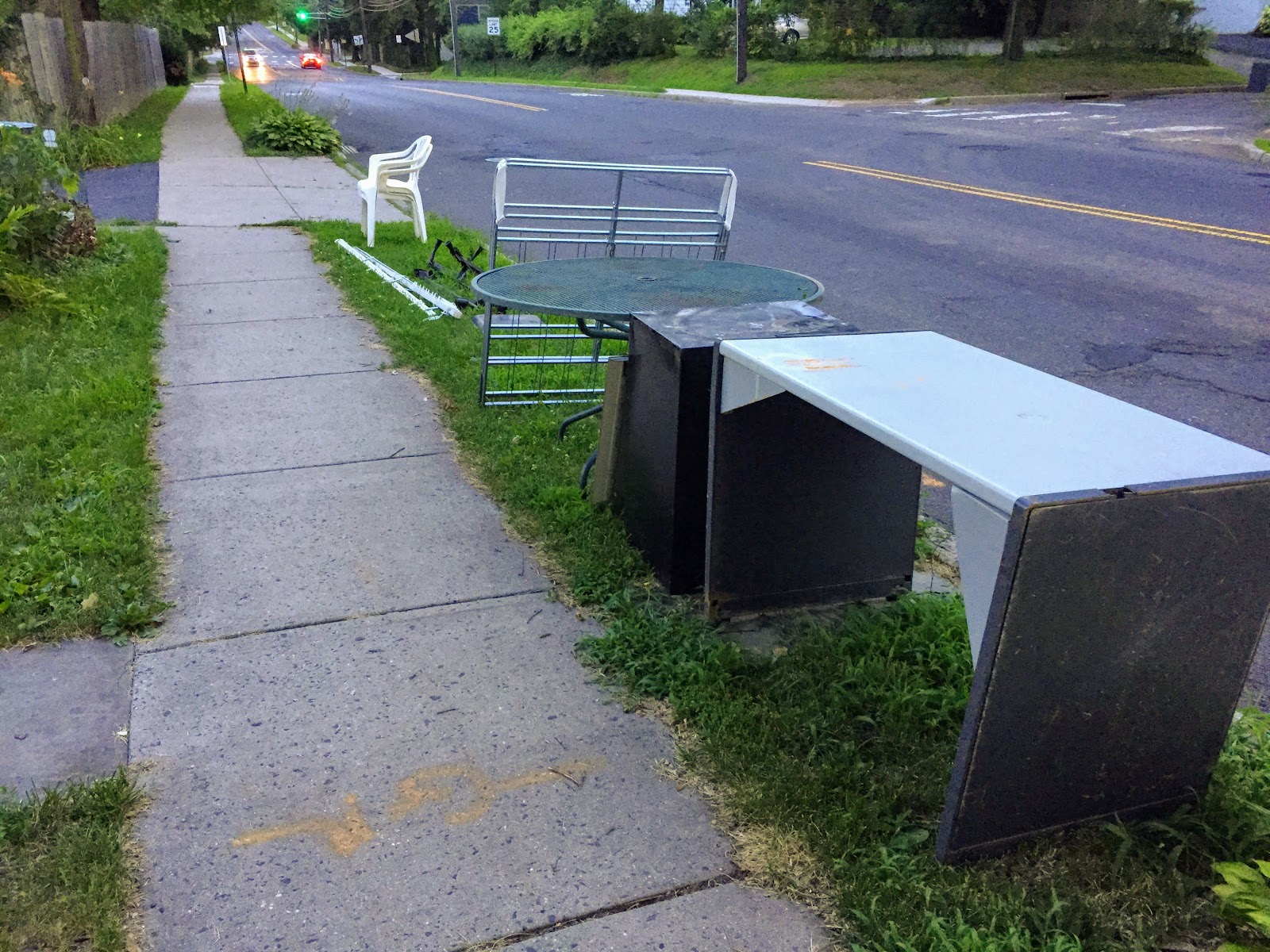
I never go looking, but often encounter metal placed out for the trash along town streets--slightly rusted lawn furniture, file cabinets, folding bed frames. During World War II, citizens would gather scrap metal and contribute it to the war effort. People back then felt like their small efforts could add up to a big success, and they proved right. We're cheated of that sense of empowerment today, as the ideology-based attacks on collective effort have left people feeling isolated and powerless.

Growing up in the post-WWII years, I absorbed enough of that can-do collective ethic that I can't let good metal languishing on back streets end up buried in the landfill. So I pick it up, put it on the curb of my busy street after trash day, and it quickly disappears into the truck of this or that scrap guy passing by.


A very nice wooden table ended up on the restored patio of Veblen House.

A lot of this is driven by imagination. The way my mind works, I instantly imagine the lost potential of the metal, the needless space taken up in the garbage truck as it drives to the landfill an hour away, the potential utility an object still has. All of these are real things--the long drive to the landfill, the lost potential--but can only be accessed through our imaginations. All too often, as political sabotage increasingly allows us only to use collective power to unintentionally create problems (climate change, water pollution) rather than intentionally solve them, people spend their mental energy not on thoughts that spur action, but instead on rationalizations for inaction.

Meanwhile, the pleasures of serendipity and steering stuff towards a better end await.

Using Parks to Demonstrate Sustainability

People tend to emulate what they see, but many sustainable practices are invisible. Composting, raingardens, leaf corrals--these tend to be in the backyard. Buildings don't advertise their carbon footprints. Making sustainable practices visible is an important step towards more widespread adoption.

Parks can be a great place to teach both kids and adults about sustainable practices--simple things, like letting the nutrients in leaves cycle back into the soil from which they came, or separating out recyclables from trash, or utilizing water runoff to feed a raingarden. The small municipal park behind my house holds a few examples.


First is the humble bucket hooked to the trash bin that makes a handy place for park users to put their recyclables. Nothing could be simpler, or cheaper to install, yet the duct-tape on this bucket testifies to its many years of service, and the copious, clean contents testify to the visual clarity this setup provides. Many high-priced recycling/trash dual containers encountered elsewhere may look good, but provide no clear visual cues as to where to put recyclables.


Second is the mulch mowing done in the fall. As the oak trees whose shade provides a haven for birthday parties and other gatherings in the summer have grown, they've generated more leaves. Two autumns ago, I watched as a crew of five spent four hours blowing the leaves into piles and hauling them away. Why not mow the leaves back into the grass, and save lots of staff and trucking time?


The parks department agreed, and now mows the leaves back into the grass. Yes, the lawn may appear less verdant for a month or two in the fall/winter as the leaf fragments break down and return to the soil, but the extra nutrients and organic matter sustain a healthy lawn the next year.

Aesthetics is a recurring issue in sustainable practices. The consequences of nature-abusive behavior (fossil fuel use, landfills, water pollution) are not seen by most people. For anyone who can visualize those consequences, though, the park's highly functional recycling bucket, or a solar panel on a telephone pole, or a mulch-mowed lawn, or a leaf corral in the frontyard, are welcome sights.


The water faucet offers an opportunity to demonstrate how water runoff, whether from sump pumps, air conditioners, water fountains, roofs or asphalt, can be used to feed a raingarden. This park has yet to take advantage of that opportunity.


A leaf corral--this one's in my front yard--is another possibility, though it would likely need to be made out of sturdier materials to endure the (welcome) hands-on curiosity of kids.

Parks are a place where people have some time on their hands to take a look around, and where some learning can happen. Let's use them.

Tuesday, July 03, 2018

Shade and Sustainability


Our house stays cool deep into the morning thanks to two trees, both imperiled. The one on the left in the photo is an ash, which in its love of the sun has bent southward like a shielding hand over the roof. Though it has yet to show any symptoms, we almost certainly will lose it to the appetites of the Emerald Ash Borer. If its lopsided growth were to cause it to fall against the house in an ice storm, we've decided it would do little damage, like the giant elm on Murray Ave that simply tipped a few feet in Hurricane Sandy's fierce winds to rest softly against a house. And so we keep it, for now, feeling fortunate when we think of those who have to crank the A/C in houses or apartments unprotected from the sun.

The other tree, taller and to the right, is a red oak, planted by the builders and first residents of the house, the Dubas, who love oaks in part because their family name is derived from the Ukrainian word for oak. That tree, too, is threatened, by the introduced bacterial leaf scorch that causes increasing dieback in the upper limbs.


The ash's sheltering embrace is most evident when seen from the inside of the house.

These trees are on the east-north-east side of the house, where solar panels are not an option. Trees on the south and west sides of the house, however, stir ambivalence. The shade is appreciated, as is the additional cooling effect that comes from all the water being transpired through the leaves.

But the two trees shading the southwest side don't come close to the beneficial effect of solar panels, which not only would shade the roof like trees do, but also would generate energy that would otherwise come from fossil fuels. Trees pull carbon out of the air, until they give most of it back when they die and decompose. Even more important in the longterm is to not be adding more and more carbon to the above ground world as we combust coal, oil and natural gas. The more carbon being pumped or dug up from where it has been safely sequestered underground, the less likely it is that the plant world can ever pull enough out to sustain a livable planet.

If I had my druthers, I'd cut down the large trees on the south and west sides of the house, which also are suffering from dieback, and use their collected solar energy in our wood stove to heat the house in winter. I'd install solar panels from the opened sky, and replant our southwest exposure with smaller tree species that will still provide cooling but not shade the solar panels.

Some people view trees as an unalloyed good. Others view them as pests that keep making a mess. What I'd advocate for, and would wish to see better reflected in our shade tree ordinance and in the actions of homeowners, is a more complex view of trees that integrates the many ways a tree can contribute to or interfere with sustainability, depending on location, size, and species.

Sunday, June 10, 2018

How Raingardens Reduce Plastics Pollution

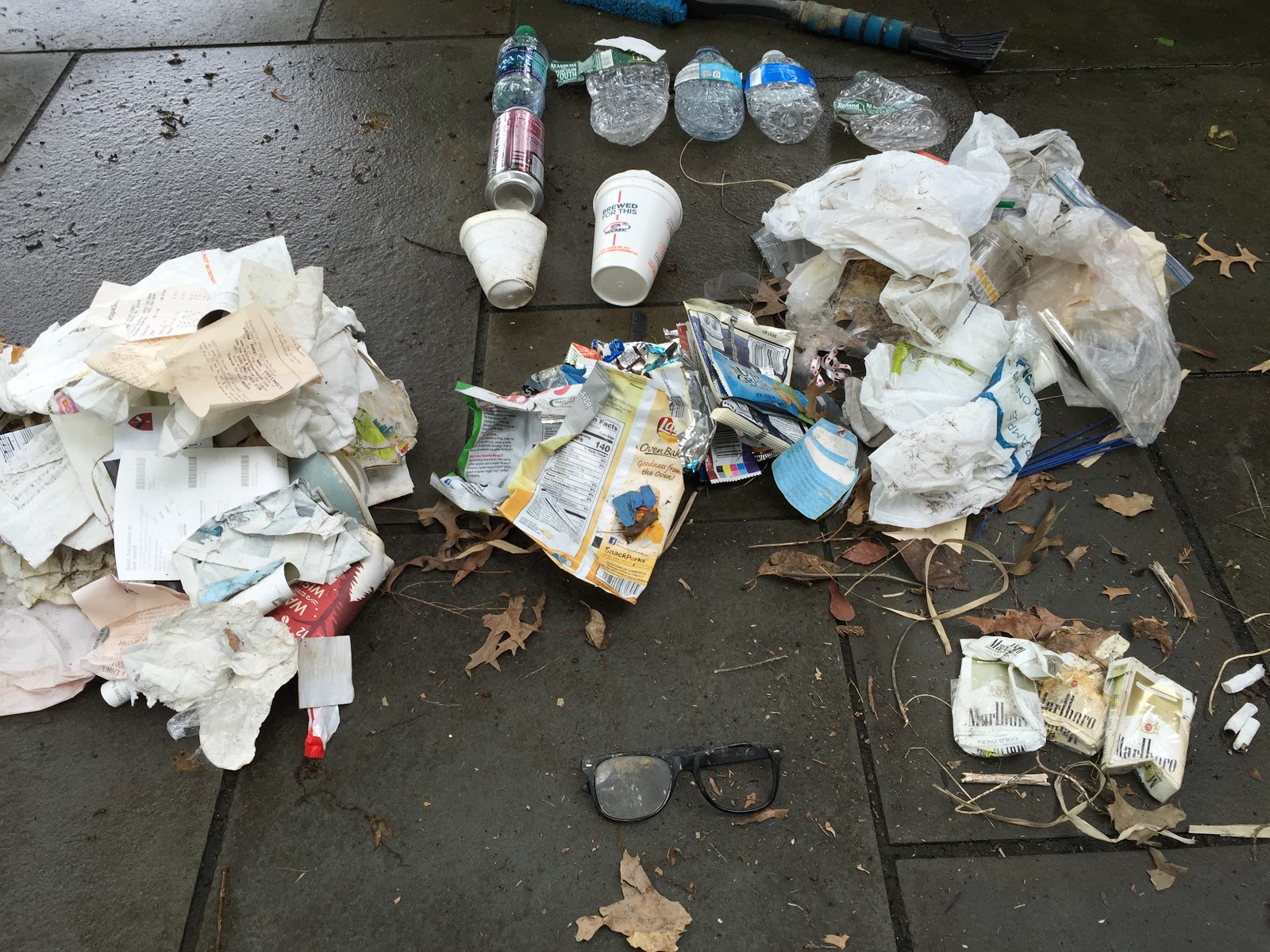
Chances are, this trash would have ended up in Carnegie Lake; might even have continued downstream and out into the ocean to join those massive gyres of plastic we hear about. But something filtered it out before it could get into the local waterways.


That something is a raingarden, in this case the two raingardens I've "adopted" at Westminster Choir College. You can see how the curb dips down to allow water to enter from the pavement.

People think of raingardens as plantings that reduce flooding, feed pollinators, and filter pollutants out of stormwater, but they also serve to protect waterways from trash.

Here's the typical stormdrain along the edge of a town street. A plastic water bottle and other small bits of trash, along with the nutrients in the leaves, stand poised to enter the stormdrain that will carry them down to Harry's Brook, then on to Carnegie Lake. Most storm drains have openings large enough to allow plastic bottles and other trash through. An additional issue, as can be seen in the photo, is that the asphalt around stormdrains eventually breaks down, requiring repair. Many stormdrains around town show signs of being patched multiple times in the past--a time-consuming, labor intensive proposition.


Here's another broken stormdrain. Not the most flattering depiction. Most are in good condition, and they certainly are a compact way to get rid of stormwater, but they essentially convey the problems of trash and nutrient pollution "down the pipe", for downstream aquatic life to deal with.

The raingarden, by contrast, traps the problems at the source, protecting the local waterways. Somehow, this fact didn't sink in for me until I found myself picking up the trash while doing some weeding. I was essentially cleaning a runoff filter, like one might clean the lint filter in a clothesdryer. That concrete structure in the photo is the drain. Water rarely if ever rises high enough to flow into it, seeping instead into the soil.

The photo, taken in the spring, doesn't show the raingarden at its aesthetic best. The native plants planted here are warm-season species that don't grow up and fill in until the beginning of summer. Below is a more flattering example of a wetland planting with species that get going early in spring,

The soft rush (dark green), sedges (light green), and sensitive fern grow naturally along a seepage slope at Smoyer Park.

The lush growth owes to the more stable supply of water from the seepage slope, while a streetscape planting will have greater extremes of dry and wet.

Wednesday, June 06, 2018

Upcoming Free Events -- Theater, Jazz, Video

(Also posted at PrincetonNatureNotes.org)

CLIMATE CABARET -- A free performance of original climate change theater and locally sourced "Sustainable Jazz" at the Labyrinth Bookstore in Princeton, 6pm on Wednesday, June 13. This performance will feature climate-adapted versions of Shakespeare, The King's Speech, a song from the Wizard of Oz, along with theatrical sketches ranging from comic to poignant. A suburban lawn undergoes therapy for recurring feelings of emptiness and chemical addiction, and for the first time, an environmentalist house cat will share her thoughts and concerns about earth and the human race. Actors: Cheryl Jones, Basha Parmet, Kitty Getlik, Fred Dennehy, Steve Hiltner. With Phil Orr, piano, and Steve Hiltner, sax/clarinet.

SUSTAINABLE JAZZ -- Another free show, this one hosted by the Princeton Public Library, from 2-3pm on Sunday, June 17. Steve Hiltner and the extraordinary pianist Phil Orr will perform Steve's original jazz compositions from their upcoming album. Styles range from straight-ahead jazz to funk, rumba and tango. Check out Phil's many other creative collaborations, including the ongoing Jazz On Broad series in Hopewell, at http://philiporrmusician.com/.

VIDEO PREMIER – Farming in the Millstone Valley: Past and Present 
--to be held at the Princeton Garden Theatre at 7:30 PM Tuesday June 12th, 2018. The viewing will be followed by a panel discussion. A preview of the video was shown at Eno Terra, but the final version has many new images. The video was made by the Millstone Valley Preservation Coalition (MVPC), in association with the Van Harlingen Historical Society. Kingston and the Princeton Nurseries Kingston Site are included in the video.

BIRTHDAY PARTY FOR OSWALD VEBLEN -- An outdoor picnic event at Herrontown Woods in celebration of Oswald Veblen's 138th birthday (still going strong) is being planned for 2pm Sunday, June 24. Oswald and Elizabeth Veblen donated Princeton's first dedicated nature preserve, Herrontown Woods, in 1957. The Friends of Herrontown Woods have been caring for this wonderful legacy, and researching the fascinating history of the Veblen House and farm cottage. Veblen was featured recently in a Princeton Alumni Weekly article, entitled "The Power of Small Numbers." Time to throw him a party. More details will be posted when available, at FOHW.org.


Tuesday, May 22, 2018

Bike Lanes Bloom on Hamilton Ave (for a week)

Update: Town council will be discussing bike lanes Jan. 26, 2021 at its 7:30pm meeting. Community input encouraged. More info on the meeting and how to comment can be found on the Princeton Bicycle Advisory Committee website. The post below dates from 2018.

The sun finally came out Sunday, and with it sprouted some bike lanes on Hamilton Avenue. A bit like Brigadoon--that Scottish village that comes to life for one day every 100 years--these bike lanes will last only a week, enough time for the community to fall in love with them and call for a future and more lasting return.

As serendipity would have it, I happened to be biking by during the transformation, guitar strapped to my back on the way to perform in Onstage at McCarter Theater. Two council members and a Princeton Environmental Commission member were carefully shifting the centerline over to accommodate bikelanes on either side. The street was closed while the volunteers worked, bringing a sudden sense of relaxation and freedom from the din and danger of machines. For one afternoon, while being refitted, the road wasn't serving as a climate change factory. Councilman Tim Quinn, the leading force behind this initiative, hailed me in good humor as "the Dean of Sustainability" as I rode by,


and more volunteers who had added new green bike symbols further up encouraged me to give the bikelanes a try. My usual approach to riding up Hamilton Ave is to use sidewalks when they're empty, in order to stay out of the way of cars as much as possible. A bikelane greatly simplifies the journey, with actual designated space provided for bicycles, so that people like me who want to stay out of the way of cars and pedestrians aren't having to constantly improvise a route. Significant car parking is being sacrificed while this "beta" bike lane is in existence, but for a week, until May 26 or 27, we get to enjoy and demonstrate the utility of these lanes.


Any initiative to increase the number of bike lanes in town comes up against not only cars and parking, but also leaves and brush, which get piled in streets pretty much year round and, if not timed with scheduled pickups, can sit for weeks, forcing bicyclists out into traffic.

The laudable push for bike lanes could be coordinated with a gradual shift towards containerization of leaves/brush. Supplying homeowners on busy main streets with large-capacity rollcarts to containerize their leaves/brush would be a low-cost way of beginning the shift away from the traditional loose dumping of yardwaste in the path of bicyclists, while making our streets cleaner and more attractive.

In the meantime, give the beta bikelanes a spin this week. They worked great yesterday during my bike ride to the Dinky.

Wednesday, May 09, 2018

One Man's Walk Through Communiversity


After performing at the Arts Council's Communiversity, with traffic kept at bay by an impressive assemblage of municipal vehicles, there was a decision to be made, either to adopt a jaded townie's view of this mass infusion of humanity as an annual annoyance to be avoided, or to dive in and explore? To flee or not to flee, that is the question. Buoyed by the pleasure of playing music for passersby, I chose the latter, saxophone strapped on my back, though an end around was needed to avoid the impenetrable human congestion on Witherspoon Street.


Nassau Street was much more easily navigated, allowing access to booths like Goofy Foot's not so goofy efforts to make comfortable clothing out of recycled plastic bottles. They told me that the color of the clothes comes not from extra dye but from the color of the bottles themselves, making each shipment's color a little different.


Then it was time for the novel concept of Meet a Muslim. I went over, shook some hands, and was told that the original jihad was directed inward, at getting oneself and one's own life together. That seemed to run parallel to some of my own thoughts about the pathological lack of self-scrutiny driving political polarization. One problem with the world is that what typically passes for a tough-minded skeptic these days is someone who only directs their skepticism outward, leaving their own views and beliefs unexamined. Deniers of the threats posed by climate change and invasive species are in this category.

Then it was off to the Princeton Historical Society's table, which had a dog theme. Here's the Stony Brook Hunt Club, featuring hats, horses and hounds. I wondered if the family that brought what later became the Veblen House to town might have taken part in one of these outings, seeing as Jesse Paulmier Whiton-Stuart was a man of wealth who loved horses and dogs. He also took a strong interest in mathematics, which suggests it wasn't completely coincidental that he later sold the house to the great mathematician Oswald Veblen.

Kip Cherry was hosting the tent for the Princeton Battlefield Society.

What got me reaching for my wallet at these nonprofit tables tended to be food and drink, which the nonprofits were offering for less than the concession stands. Communiversity offers a chance to save money by donating to a good cause--a dollar for a can of soda to support a Christian ministry's work in Appalachia, a dollar for a cookie to support some school project.

The Princeton Junior School had some initiative called a Wishing Garden, represented by a miniature garden of plastic dandelion seedheads that put a positive spin on what a lot of lawns look like this time of year. As with the introspective jihad, there was no time for deeper understanding. We got into a conversation about climate cabaret, and how it might fit into programming at the Junior School.


Talk of the climate cabaret continued at Sustainable Princeton's tent, with the head of the local Citizens Climate Lobby chapter.  I'll never get how sustainability is a niche interest, as if the future were optional.

It can be refreshing to make like a bee in a wishing garden of booths stretched along Nassau Street, talking to people wishing and working for a better world, with a saxophone strapped on my back like wings, feeling lucky that I needed only a bike parked nearby to fly me home.