Thursday, October 31, 2013
The Haunting Hole Where a House Once Was
No tricks or treats here on Halloween. There was a beautiful house with Frank Lloyd Wrightian lines here, and now it's gone.
The great beasts of demolition are only supposed to devour nondescript houses, not those with style.
Where will they strike next?
Tuesday, October 29, 2013
The Fall and Rise of a House
Most houses pegged for replacement in Princeton suffer a decisive and violent, machine-mediated end. If not a wrecking ball, then a massive claw chomps away at its fabric until all lies in a heap, to be carted away before anyone can notice, or recall what used to be in that sudden void.
So it was surprising to be passing by this long neglected house one day and see several men hammering at its chimney, with a pile of bricks and debris slowly accumulating on the ground. I asked what was up, and the supervisor told me they had decided to take the house apart piece by piece--for the neighbors' sake. They also seemed to think it was cheaper.
After the chimney was taken down, the walls were stripped off. Seeing all that fine wood on display, my hunter-gatherer ancestry kicked in, and the question was posed whether I might obtain some of the lumber for a little project I had cooking. There were in particular 16 or so long 2X6 cross braces in the attic, free of naily bones, that looked like they could be easily trimmed from the carcass like a fish fillet. Not only would the wood be saved from disposal, but it would also likely be of finer quality than what's available these days.
The situation brought back memories of Ann Arbor in 1977, when U. of Michigan's giant Waterman-Barbour gym was pegged for demolition. Built 80 years prior, with separate gyms for men and women, it was, at least in the 70s, the scene of many a pickup basketball game, with what seems now an unlikely diversity of ages and backgrounds, including some Sioux Indians, who were puzzled when I showed up one day without my ponytail, as if they thought I had cut off a piece of my soul. The gym was cavernous, the inner space rising up and up to a long skylight--the sort of building one is more likely to encounter now in dreams that in the waking world.
When we heard the great building was coming down, some artist friends and I asked if we could rescue some of the gym flooring for a dance studio in our third floor downtown loft. We worked quickly, motivated by the wrecking ball that was crashing against a not all that distant corner of the building. There was less worry about liability in those days. The dance floor proved a success, though the loft, too, was later demolished in the real-estate bubble of the 1980s.
But back to the house on Hamilton Ave. The supervisor was at first enthusiastic with the idea of recycling the house, or at least parts thereof, but a week or so later he balked, offering what sounded like a prefabricated excuse.
One can only do so much to shift the throwaway culture. After the about face, there was nothing to be done than to watch the slow motion fall, which in fact just took a few days. In any situation like this, the contractor's goal is to deconstruct as quickly as possible, then have the remains whisked away. Recycling is seen as an unnecessary complication. Without strong incentive to reclaim the wood, it just gets chopped up and stuffed in a dumpster. Presumably, the carbon in the wood will be sequestered in a landfill, for what's that's worth.
The strategy here was to save the basement, foundation and the floor joists, then build a new house on top. Additional basement space was added towards the back, so the new house will be, of course, bigger.
It only takes a day for another floor to be added to the skeletal structure.
Though the recycling dream grew, then burst, the revelation remains that an old, unwanted house can in fact be dismantled by hand, in the process employing many workers and raising at least the possibility of reuse.
Energy Panel Discussion Tonight
Practical ways to save energy and money: 7pm tonight at the Princeton Public Library. Looks like a good lineup.
1. Attend a Panel discussion on Home Energy Savings: OCTOBER 29, 7:00 p.m. at Princeton Public Library in the Community Room titled: "Get EnergySmart: Practical Ways for Princetonians to Save Energy and Money," Speakers include: Edward T. Borer Jr., Energy Plant Manager, Princeton University; Heidi Fichtenbaum, LEED Accredited Architect, Farewell Architects LLC.; Scott Fischer, Founder, Ciel Power LLC; Sandra Torres, Director of Outreach, Tri-State Light and Energy Inc., and Rees Keck, Founder, Potential Energies. This event is free and open to the public.
2. Sign Up for a $49 Home Energy Assessment: Sustainable Princeton negotiated for $49 energy assessments (half price) for local residents. Our goal is to have 100 residents sign up for energy assessments over the next year. Our Energy committee vetted a number of possible energy providers and chose Ciel Power LLC, which has successfuly worked in both Woodbridge and Highland Park to lower energy consumption in those towns. All sorts of energy rebates are available if you choose to make fixes to your home based on the assessment. Go to Cielpower.com to sign up (Princeton residents get a $50 discount from the stated price of $99), or to learn more.
1. Attend a Panel discussion on Home Energy Savings: OCTOBER 29, 7:00 p.m. at Princeton Public Library in the Community Room titled: "Get EnergySmart: Practical Ways for Princetonians to Save Energy and Money," Speakers include: Edward T. Borer Jr., Energy Plant Manager, Princeton University; Heidi Fichtenbaum, LEED Accredited Architect, Farewell Architects LLC.; Scott Fischer, Founder, Ciel Power LLC; Sandra Torres, Director of Outreach, Tri-State Light and Energy Inc., and Rees Keck, Founder, Potential Energies. This event is free and open to the public.
2. Sign Up for a $49 Home Energy Assessment: Sustainable Princeton negotiated for $49 energy assessments (half price) for local residents. Our goal is to have 100 residents sign up for energy assessments over the next year. Our Energy committee vetted a number of possible energy providers and chose Ciel Power LLC, which has successfuly worked in both Woodbridge and Highland Park to lower energy consumption in those towns. All sorts of energy rebates are available if you choose to make fixes to your home based on the assessment. Go to Cielpower.com to sign up (Princeton residents get a $50 discount from the stated price of $99), or to learn more.
Tuesday, October 15, 2013
Use Those Leaves in the Yard
This fall, rather than dump leaves in the street or stuff them in bags, consider these options.
Mow them back into the lawn
The easiest option by far is to mow the leaves back into the lawn--an approach recommended by county extension offices around the country, and even by company sites like Scotts Miracle Grow. They've studied it, and concluded that the ground up leaves provide valuable fertilizer for the lawn, and do not cause any problem with thatch.
Some kinds of leaves make this method particularly easy. Pine needles and honey locust leaves are so small they don't even need to be chopped up by a mower, or can be raked underneath shrubs to serve as a mulch. Leaves of silver or red maple also tend to "melt" back into the lawn, decomposing quickly.
Grind leaves up with an electric leaf mower/vac
This will take care of leaves the lawnmower can't reach. Electric leaf blowers are quieter than the gas varieties, and some designs can be reversed to vacuum up leaves and grind them. I have not tried this method, but the NPR show You Bet Your Garden had a segment singing the praises of leaves ground up this way as mulch for flower beds. Even if you buy locally, you can check out reviews of various brands here on Amazon, with prices well under $100.
Make Room(s) For Leaves in the Yard
If you choose to collect leaves into piles rather than grind them, the question becomes where to put them if not on the street. One factor that makes people more likely to blow leaves out to the street is that most yards lack "rooms." The typical yard has shrubs pushed against the house and fenceline, defining only one sprawling "room" that extends uninterrupted to the curb, all of which is then required to be ornamental.
Houses have rooms that separate utility and storage from living areas, so why not yards? If you use shrubs or wooden walls to define and screen small utility areas in the yard, it becomes very easy to store leaves while they decompose and slowly return to the soil from which they came. Nature's miraculous trash-free economy is then allowed to function, and we're spared a big mess in the streets and the considerable municipal cost of hauling, grinding and mechanically turning leaves at a distant composting center.
The photo shows one such configuration in a friend's backyard. The wall provides screening between the utility area with compost pile and tools, and the ornamental garden to the left.
Another way to break up space and screen a leaf pile from more ornamental areas is to plant shrubs out a distance from the fence. The leaves can then be piled inbetween the shrubs and the fence. Though a back corner is the most logical location, the one in the photo is next to the street.
Here's the view from the street. The shrubs are privet, but a native evergreen alternative would be inkberry (Ilex glabra). Other smaller native shrubs--not evergreen but with attractive flowers, would be Itea virginica, Clethra alnifolia or Fothergilla. The main idea is to reconfigure how shrubs of any kind are planted in the yard, so as to create refuges for leaf piles that will quickly be flattened down by the weight of rain and snow and benefit shrubs and trees through the steady process of decomposition. Sectioning off a "room" in the yard also breaks up the monotony of shrubs lining the fenceline and foundation.
Whether ground up or piled in a corner, leaves serve as a natural fertilizer and increase the capacity of the yard to absorb rain. The more organic matter a yard contains, the more moisture it can hold, which helps buffer the yard from extremes of rain and drought. A soil rich in organic matter welcomes the rain, which in turn reduces runoff into the streets and, collectively, the amount of flooding downstream.
Mow them back into the lawn
The easiest option by far is to mow the leaves back into the lawn--an approach recommended by county extension offices around the country, and even by company sites like Scotts Miracle Grow. They've studied it, and concluded that the ground up leaves provide valuable fertilizer for the lawn, and do not cause any problem with thatch.
Some kinds of leaves make this method particularly easy. Pine needles and honey locust leaves are so small they don't even need to be chopped up by a mower, or can be raked underneath shrubs to serve as a mulch. Leaves of silver or red maple also tend to "melt" back into the lawn, decomposing quickly.
Grind leaves up with an electric leaf mower/vac
This will take care of leaves the lawnmower can't reach. Electric leaf blowers are quieter than the gas varieties, and some designs can be reversed to vacuum up leaves and grind them. I have not tried this method, but the NPR show You Bet Your Garden had a segment singing the praises of leaves ground up this way as mulch for flower beds. Even if you buy locally, you can check out reviews of various brands here on Amazon, with prices well under $100.
Make Room(s) For Leaves in the Yard
If you choose to collect leaves into piles rather than grind them, the question becomes where to put them if not on the street. One factor that makes people more likely to blow leaves out to the street is that most yards lack "rooms." The typical yard has shrubs pushed against the house and fenceline, defining only one sprawling "room" that extends uninterrupted to the curb, all of which is then required to be ornamental.
Houses have rooms that separate utility and storage from living areas, so why not yards? If you use shrubs or wooden walls to define and screen small utility areas in the yard, it becomes very easy to store leaves while they decompose and slowly return to the soil from which they came. Nature's miraculous trash-free economy is then allowed to function, and we're spared a big mess in the streets and the considerable municipal cost of hauling, grinding and mechanically turning leaves at a distant composting center.
The photo shows one such configuration in a friend's backyard. The wall provides screening between the utility area with compost pile and tools, and the ornamental garden to the left.
Another way to break up space and screen a leaf pile from more ornamental areas is to plant shrubs out a distance from the fence. The leaves can then be piled inbetween the shrubs and the fence. Though a back corner is the most logical location, the one in the photo is next to the street.
Here's the view from the street. The shrubs are privet, but a native evergreen alternative would be inkberry (Ilex glabra). Other smaller native shrubs--not evergreen but with attractive flowers, would be Itea virginica, Clethra alnifolia or Fothergilla. The main idea is to reconfigure how shrubs of any kind are planted in the yard, so as to create refuges for leaf piles that will quickly be flattened down by the weight of rain and snow and benefit shrubs and trees through the steady process of decomposition. Sectioning off a "room" in the yard also breaks up the monotony of shrubs lining the fenceline and foundation.
Whether ground up or piled in a corner, leaves serve as a natural fertilizer and increase the capacity of the yard to absorb rain. The more organic matter a yard contains, the more moisture it can hold, which helps buffer the yard from extremes of rain and drought. A soil rich in organic matter welcomes the rain, which in turn reduces runoff into the streets and, collectively, the amount of flooding downstream.
Sunday, October 06, 2013
Three (Four) Kinds of Energy
There are at least three kinds of energy in this photo on Nassau Street. One is the gasoline for sale in the background, the second is the firewood, and a third is something called "embedded energy", which can be found in the solid oak chest of drawers and the 1994 Ford pickup.
There are also three kinds of scavenging going on. Two are obvious and above ground: the firewood and the abandoned vintage furniture. The third is both universal and hidden. Civilization as we currently know it is based on a massive scavenger operation, digging up energy and minerals from underground.
Each of these kinds of energy and scavenging have global consequences.
Gasoline
I always thought of gas stations as just another town business, but seen from the perspective of the planet, they are part of a climate change industry, the impact of which, in addition to the highly convenient aspect of getting us where we need to go, is to liberate carbon from its underground storage.
Some would say that burning gas has the same climate consequences as burning wood, but that's not the case. They both release carbon dioxide, but the carbon in each is different. The energy for sale at the gas station is from ancient underground deposits of oil. By the time it gets into the truck's gas tank, a lot of energy has already been burned. There's the exploration, the extraction, the transport to a refinery, the refining, and the transport to the gas station.
Gasoline contains strings of carbon left over from ancient life. You could say there's solar energy stored in the bonds between the carbon atoms, but the last time that carbon saw the light of day, the climate and life on earth were very different. Ancient life extracted carbon from the air, then died and settled into the watery ooze. Gravity, pressure, and time all contributed to transforming that ancient life into massive underground storage of carbon in fossil fuel. All that extracting of carbon from the atmosphere over hundreds of millions of years cooled and tempered the climate. To exhume these graveyards of ancient life is to undo the climate in which civilization has flourished up to now.
The carbon in the gasoline is still contained, still locked up in chains. In fact, because it's been contained and underground for millions of years, its carbon is different from the above ground carbon that has been getting exposed to radiation from the sun. This difference, found in the relative percentage of carbon isotopes, can be measured, which is how we know that enough ancient carbon has already been pumped into the atmosphere to increase the carbon dioxide level by 40%.
It's the truck engine that performs the carbon's liberation, using fire to break the chains and release the wonderful burst of energy that propelled my heavy truck magically up Linden Lane with nothing more than a nudge to the gas pedal. While I'm enjoying such ease, the backside of the truck is quietly sending the ghosts of life and climate-past back up into the atmosphere.
That's why I use those machines as little as possible, and that's why the wood is in the back of the truck.
Wood
The second kind of energy is the firewood. It was a custom in Princeton Borough, when street trees needed to be removed, to leave the wood at the curb, conveniently cut to size, for homeowners to scavenge. That custom apparently lives on, at least occasionally, post-consolidation. For those of us with wood stoves, this free heat provides a way to limit how often the furnace kicks on.
Now, doesn't burning wood also release carbon into the atmosphere? It does, but that carbon was already part of the above-ground system, part of the present era's climate. The trees pulled it out of the atmosphere, stored it for 50 or 60 years, and the wood stove returns it. This is a cycling of carbon, not a linear movement of carbon from deep underground storage up into the atmosphere.
The alternative to burning the wood is to have it chipped up and trucked out of town for composting. A useful product is created, but that highly mechanized process, which includes mechanical mixing and remixing during the composting process, uses more gasoline, and the wood's carbon still gets released back into the atmosphere through the "slow burn" of decomposition. Though there's some air pollution associated with burning wood, the highly mechanized composting alternative also pollutes, and a well-tended wood stove is far cleaner than a fireplace. To collect firewood in the neighborhood, then, actually reduces climate change by reducing the fuel used to truck and compost the wood outside of town.
The wood, then, could be called "today's energy", as opposed to the ancient energy from underground, and it is "local energy", gathered nearby as opposed to whatever distant locale the gasoline comes from. It is also energy that didn't require industrializing some landscape, in stark contrast to oil drilling and fracking.
Harvesting the wood from a tree also allows a chance to celebrate the tree's life, to participate in a transformation from sadness to joy. Princeton has been losing a lot of red oaks and pin oaks to a disease called bacterial leaf scorch. To ram the remains into a giant chipper and haul it all out of town, there to mix anonymously with all the others, is to give short shrift to this tree's long life of giving shade, beauty and habitat to a Princeton thoroughfare. Splitting up the segments for firewood, the massive trunk laying there on the curb, is to experience something of what Eskimos must have felt, harvesting the life-sustaining blubber of a beached whale. The rich texture and color of the grain reveals itself with each new split--too beautiful for firewood, but no one is there to turn it into furniture. The back of the pickup truck fills with the promise of a future celebration of the tree's life, in the beauty of the flames and the radiant warmth on a winter evening.
Embedded energy
Embedded energy, the third type in the first photo, is the energy that went into making things. For the pickup truck, there was the energy to build it, to mine the iron ore, manufacture and transport all the parts, plus the miles the employees drove to work, the heating and cooling of the factory, on and on. The chest of drawers also took energy to build, and to consign it to the landfill would be to lose the product of all that energy.
As with the firewood, there is an aesthetic aspect to this rescue of crafted wood: the beauty of the grain, the authenticity of solid wood, and the pleasure of rescuing something from premature demise. The same impulse is central to the artistic process, which fashions beauty out of experience and the materials at hand.
Repair Energy
The truck and oak chest, though, require a fourth kind of energy to survive. That would be the energy to repair--a very special kind of human energy that comes partly from the metabolism of food and partly from the mysteries of the heart and mind. We all have it, but it can remain dormant for days, months, or with some projects, years, stifled by the abundance of new products, or a lack of time, parts, focus, ability or confidence. It involves courage to take on entropy, which seeks to unravel all things.
That is the world as seen from the back of a pickup truck parked on Nassau Street.
Friday, October 04, 2013
Riding the Towpath--South to Brearley House
When fall weather stirs a desire to explore the great outdoors, Princeton is ready with a way to escape cars and claustrophobia along the DR Canal towpath.
We could have lingered at Turning Basin Park on a bench with Ailanthus blocking the view of the canal,
or waited for the porcelain berry to give up its spot on a bench next to the towpath.
The turtles had claimed the best spots for sun bathing.
So we heeded the call of the wide open towpath and headed south, past tupelos admiring their reflection in the canal,
past garlands of Virginia creeper brilliant red.
On a previous ride, we had turned left after a mile and a half, taking the pedestrian bridge at the golf course to head over to catch lunch at Whole Foods.
This time, we forged onward, past swamp forests
and through a beautifully designed underpass, after which the towpath adopts a more open, parklike look.
Every good bikepath should consist of a series of destinations, and the next one on the towpath turned out to be Brearley House, run by the Lawrence Historical Society.
The short spur to Brearley House crosses a broad wetland reminiscent of Princeton's Rogers Refuge,
Some may know Brearley House as the site of the annual New Years Eve Hogmanay celebration, and the bonfire whose flames rise thirty feet before settling down to a deeply glowing mass of hot coals, consuming all regrets from the year just lived.
Their website explains that the house was built in 1761 on the "Great Meadow, a farming and grazing land of the first residents of Lawrence - the Leni-Lanapi People." People don't think of the eastern U.S. as hosting grasslands, but some variations in soil and hydrology supported natural grasslands, augmented by the American Indians' use of fire. Radical alteration of the drainage during the digging of the DR Canal turned the grassland into the extensive wetlands we passed on the way in.
Returning along the towpath to Alexander Road, we got a drink at the canoe livery, and then headed home. Next ride, maybe all the way to the bridge over Route 1, beyond which I hear are even more beautiful, bike-friendly stretches of the towpath.
Tuesday, October 01, 2013
Water Line Redux
As Yogi Berra, the famous installer of urban water mains, once said, "It ain't over 'till it's over." The sound of yet more heavy equipment groaning on a nearby street yesterday meant that the climactic overnight repair blitz the other night had segued into a surprise encore. I went out and got the lowdown from the American Water supervisor about the water lines that run beneath the fair streets of our fair town.
He said they would have finished the other night, but they had been slowed down by careful digging in the vicinity of a high-pressure gas line that turned out not to exist. Though no alligators have been found beneath Princeton's streets, that I know of (now that would be a scoop), there are a slew of pipes, and sometimes the various utilities forget where they put them all.
Each year, they choose some more water lines in Princeton to replace. There are several reasons for this gradual updating. The pipes here on Horner (one of the founding families of Princeton, by the way) are probably 60 years old, and are made of cast iron. Because cast iron reacts with the chloramines that are used to disinfect our drinking water, the new pipes are lined with concrete in order to prevent contact with metal. The pipes are also laid in a bed of gravel that will reduce the stress on the pipes from the ground's shrink and swell. The new 8" pipes replace the old 6" ones, meaning more water flow capacity, just in case anyone wants to pour more drinking water on the lawn.
The supervisor proudly pointed out that no one loses water service during these updatings. Because the water lines form an interlinking network under our streets, the break in the water line during replacement doesn't affect anyone's water access. The water is simply "backfed", which means it flows in from the other end of the street. The water lines, like the streets, allow flow in either direction.
At the same time, the company is replacing water meters for each residence. The foreman explained that two-income households make it harder to access indoor meters during the day for monthly readings. The new meters transmit their information wirelessly to a meter guy driving down the street. Within a few years, they may put antennas on the tops of water towers, and simply collect individual meter readings that way. There's a gain in efficiency but also a reduction in workforce needs. It would be nice if these boring jobs like reading meters, once phased out, could be replaced by more interesting and useful jobs, but I don't think business works that way.
He said they would have finished the other night, but they had been slowed down by careful digging in the vicinity of a high-pressure gas line that turned out not to exist. Though no alligators have been found beneath Princeton's streets, that I know of (now that would be a scoop), there are a slew of pipes, and sometimes the various utilities forget where they put them all.
Each year, they choose some more water lines in Princeton to replace. There are several reasons for this gradual updating. The pipes here on Horner (one of the founding families of Princeton, by the way) are probably 60 years old, and are made of cast iron. Because cast iron reacts with the chloramines that are used to disinfect our drinking water, the new pipes are lined with concrete in order to prevent contact with metal. The pipes are also laid in a bed of gravel that will reduce the stress on the pipes from the ground's shrink and swell. The new 8" pipes replace the old 6" ones, meaning more water flow capacity, just in case anyone wants to pour more drinking water on the lawn.
The supervisor proudly pointed out that no one loses water service during these updatings. Because the water lines form an interlinking network under our streets, the break in the water line during replacement doesn't affect anyone's water access. The water is simply "backfed", which means it flows in from the other end of the street. The water lines, like the streets, allow flow in either direction.
At the same time, the company is replacing water meters for each residence. The foreman explained that two-income households make it harder to access indoor meters during the day for monthly readings. The new meters transmit their information wirelessly to a meter guy driving down the street. Within a few years, they may put antennas on the tops of water towers, and simply collect individual meter readings that way. There's a gain in efficiency but also a reduction in workforce needs. It would be nice if these boring jobs like reading meters, once phased out, could be replaced by more interesting and useful jobs, but I don't think business works that way.
Sunday, September 29, 2013
Post-Installation Pleasures
Anyone arriving late for Christopher Eisgruber's installation as president of Princeton University last weekend would have encountered a scene reminiscent of a yard sale, with a few fans, clothesracks, and a tiger or two still lingering in front of Nassau Hall.
I had been delayed by an installation of my own, lesser in portent and ceremony, of a spring and gasket set for a leaky kitchen faucet. Though the university installation would surely have been moving, I was moved by a sense of gratitude at the proximity of my home to the Princeton Shopping Center, where one of the Ace Hardware employees had led me to just the right part for one leaky faucet, and suggested flipping over the worn gasket on another. $4 bought me the right part, plus advice on how to fix the other faucet for free. Life's little annoyances just got smaller. (There's a useful concept called the 3/50 Project that helps channel the desire to support local business.)
Another reason for arriving late was that I knew that Eisengruber's speech could be found online. From the deserted bandstand, with a little imagination I could still hear the kettle drums stirring a sense of gravitas and even courage in all who managed to get there on time.
It was less satisfying to imagine the lavish buffet, which had dwindled to a few green apples and the dregs of ice tea.
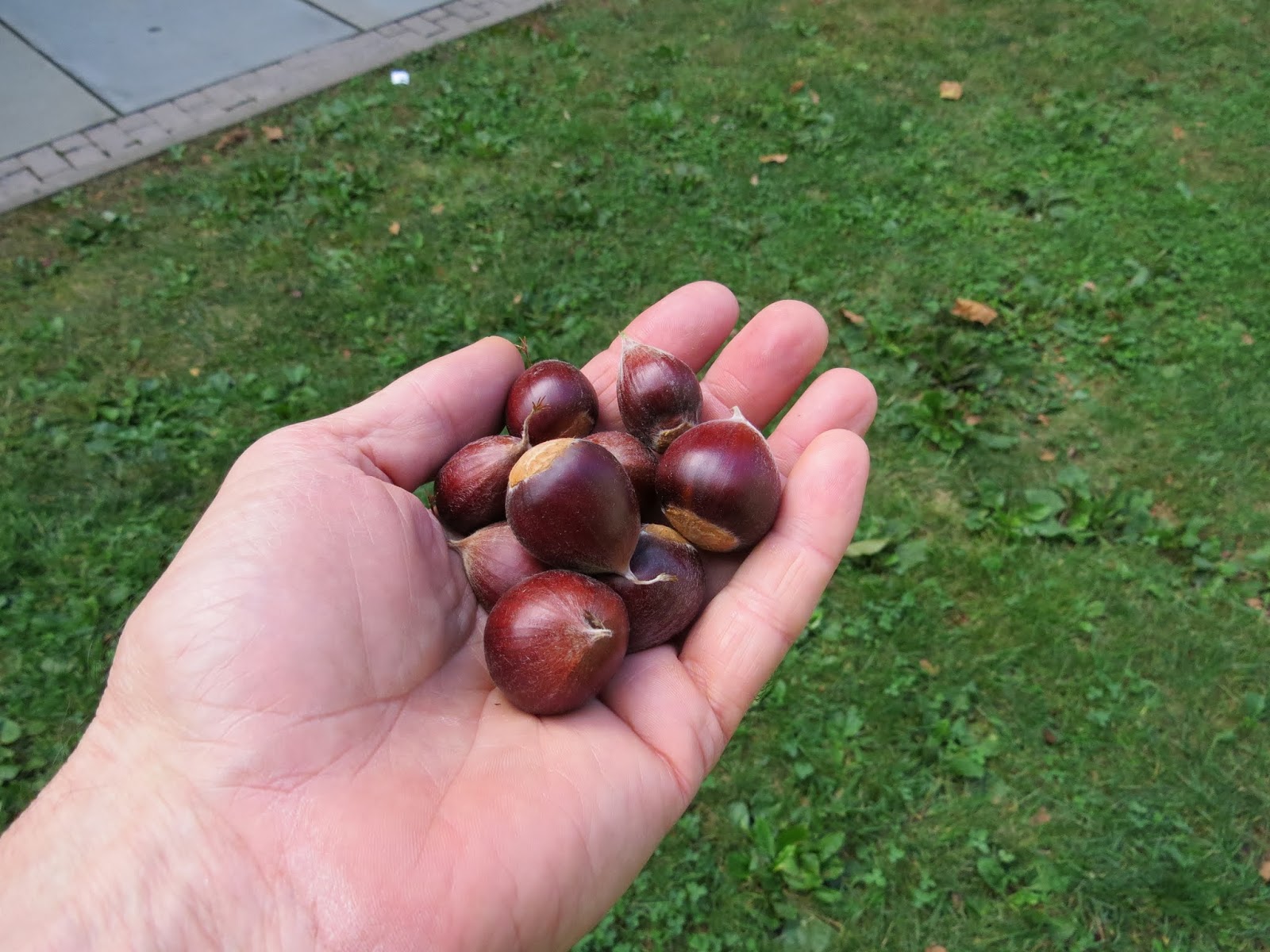
Fortunately, a chestnut tree grew nearby,
with a few chestnuts to take home, cure for a week and then boil or roast. Even latecomers can reap rewards. The move towards local food at the university has yet to lead to foraging on campus grounds, as I did back in the 70s, when a food workers strike at my college led me to discover the edibility of violets growing outside the dorm.
I finally caught up with the post-installation party at Blair Courtyard. Princeton's reputation for feeding its students very well didn't fit with the extremely long and extremely slow line for food.
Word had it that the pizza and Bent Spoon ice cream were worth the long wait,
and standing in line is a lot easier when the music of Grace Potter and The Nocturnals is floating out over the green.
Potter had a fine protege in the audience. With a daughter just off to college, I was moved to memories by this scene of a proud father filming his daughter from a makeshift seat.
Thursday, September 26, 2013
Late Night Operation
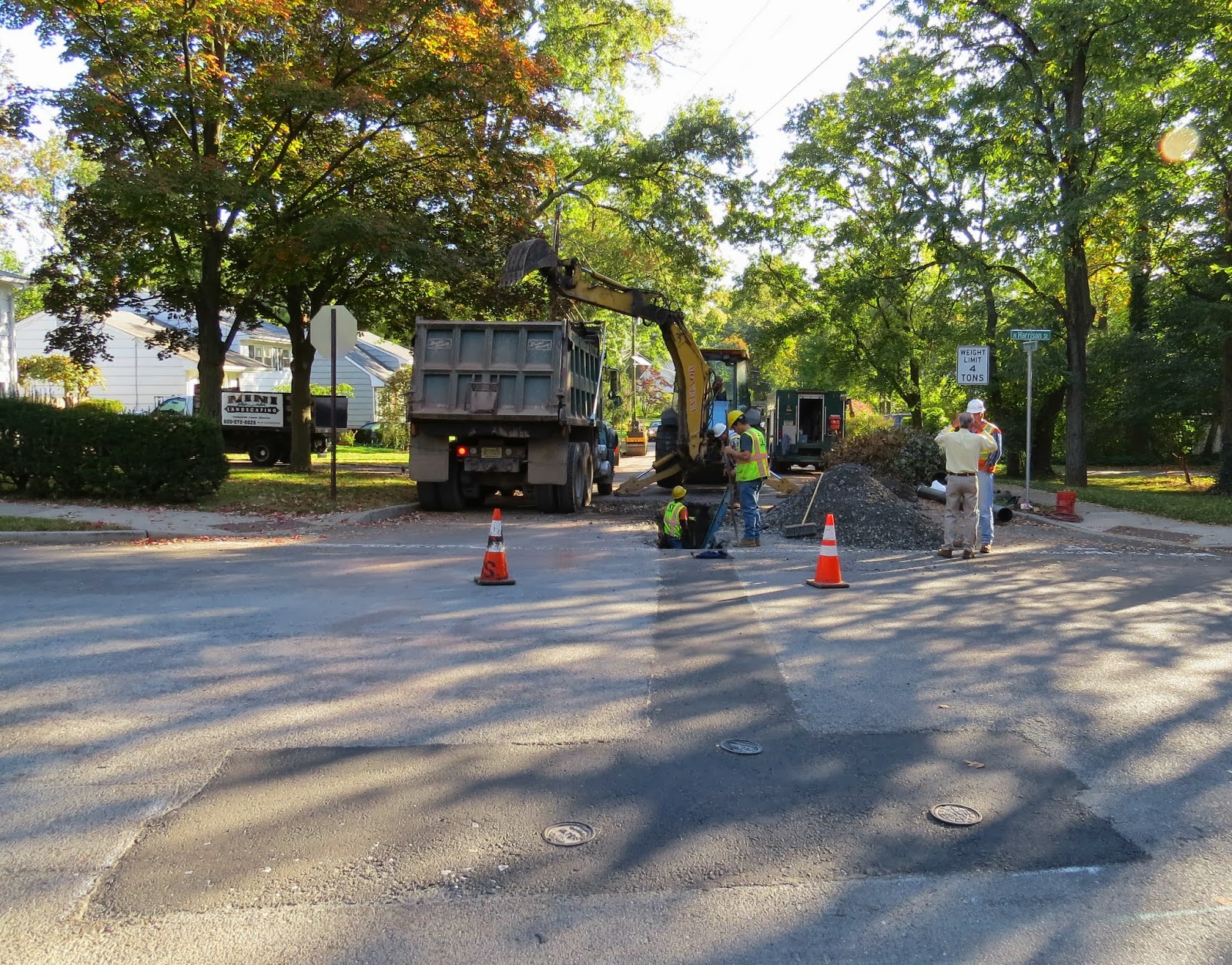
The climax came at 4:30am. I awoke to lights flashing in the bedroom window blue and red, and an impassioned duet of mid-range D flats pulsing in the night made day by backhoes outside repairing the road. A water line had been recently replaced, and this looked to be the final patch job.
I ventured out in my nightcap to find a steamy scene of hot asphalt, groaning machines and foot soldiers deployed to make Harrison Street passable by dawn. The surrounding homes were cast in a garish light. A few stars and a half awake moon offered their everfresh light and timeless telling of time, for anyone interested. We could learn from them. Unlike much-trod earth, they need no repair.
The metal slaves, so skillfully maneuvered, performed a bulky ballet, balanced on well-tired treads, beeping their D flats to warn all groggy neighbors that the backhoes were, once again, backing up.
Memory returned of the cavity the dentist had recently drilled and filled. Part dentistry, part vascular surgery, asphaltistry is the means by which our aging infrastructure of water lines is made new. There's the tough skin of the road to break, the cavitied old pipes to remove, the new to install, the links to homes to tie in to, and finally the wound to fill with steaming asphalt and scraping blade.
I'm glad for what sleep I got, glad the crew made haste safely, glad someone is fixing some small part of the world,
glad it's done.
Tuesday, September 24, 2013
Riding Climate Through Princeton on a Saturday
Saturday being the last electronics recycling day of the year, I asked a neighbor if I could take his television along. He had put it out on the curb a couple weeks prior, hoping someone would take it home and use it. I had taken that opportunity to knock on his door, introduce myself as a neighbor, and let him know that it's "illegal" (that's the New Jersey spelling of illegal) to landfill TVs and computers. I doubted anyone would take the TV home to use. More likely, a scavenger would come along, break the back panel and make off with the copper coil--good for a couple dollars at the local scrap yard. By the time electronics recycling day arrived, he had a matching pair of behemoths ready to go, making the pickup truck look like an ark for electronics.
As we pushed them up onto the truck with a dolly (no back-breaking heroics, thank you), I noticed he had an old Mustang in his garage. He bought it in 1965, and it still serves as a backup for his bicycle. He said he bicycles more miles in a month than he drives in a year. Now there's something to aspire to.
The guys at Princeton's Shrredtemberfest (closer than the county's parallel event) were good sports about unloading.
Found two more TVs out on the curb on the way to the bank,
so it was back to Shrrrrrrredtemberrrrrfest so the rejected TVs could join the rest of the old and bloated on a journey to productive deconstruction.
With 300 pounds of TVs delivered for recycling, it was time to repair a folding ping pong table. With the quick tempo of life, and factories glutting the marketplace with merchandise, the art of repair has generally fallen into disrepair. Many people give up on an item at the first sign of defect. Though the ping pong table had been abandoned, it was still in good shape, and needed only a couple screws and some tightening up of the metal frame to be functional again. That's another 250 pounds diverted from the landfill, and a $500 item that can now have a new life.
Later, I was taking my family to the train station when we started seeing bicyclists funneling into Princeton on Washington Rd, like monarch butterflies making a fall migration. They turned out to be 175 strong, part of the annual Climate Ride from New York to Washington, D.C. Back in colonial times, it took two days to ride a horse the 100 miles between New York and Philadelphia. Princeton was conveniently located midway for a stopover. Remnants of the historic inn may still exist in the Gulick House, out towards Kingston.
The Climate Riders (shall we call them the Earth's Angels, with strong hearts instead of leather jackets?) use Princeton the same way, for their first night's stopover. They pitch their tents on the lawn at the YM/WCA, then head to campus for some inspiring lectures. With each speaker receiving cheers, it was one of the more spirited gatherings to talk about climate change, starting with a showing of the short video, The Man Who Lived On His Bike. The leader of the student group Surge made brief remarks, followed by the ride's top fundraiser, who works at the World Bank. She described the projected impact of a 4 degree centigrade rise in temperature this century. "Small number, big problem," was the memorable phrase. She was followed by Deborah Goldberg of EarthJustice, who gave a primer on the many downsides of fracking, lest we think that natural gas is a clean alternative to other fossil fuels.
On the way out, one of the cofounders encouraged me to join the ride next year--flattering, though as a veteran puddle jumper I look upon touring bicyclists as somehow inhabiting another plane of reality, beyond anything I could aspire to. Heading home, with Nassau Street alive with people on a mild fall Saturday evening, I heard a roar coming from the stadium area of campus. It was a bigger roar than the 175 climate riders could muster, with the focus not on carrying civilization and nature safely into the next century, but rather carrying a ball across the goal line.
Have to say, Princeton's offence is impressive. They kept Lehigh on their heals with varied plays, no huddle, and a quarterback who can both throw and run. Princeton scored easily on the series that I watched before departing as the first raindrops began to fall. It was ultimately a losing effort, 28 to 29, but they showed up, played hard, and their skill and spirit made for a thrilling contest. The articles in the paper will tell of the tough loss, the lessons learned, the need to bounce back. In a day, a week, a season, what mattered so much at that moment when the game was won or lost will be forgotten.
Meanwhile, the biggest game of all, the one whose consequences will never be forgotten, is being played every day. It's the fourth quarter, and all the players (that would be all of us, the Climate Tigers?) are still arguing about whether to show up, whether the opponent is really, really real, who will carry the ball, whether victory is even possible. The recyclers made a nice end run around the landfill with all of those TVs. Reusing the wood from the house could be a breakthrough right down the middle, if the contractor agrees to play. The Climate Riders are leading the cheer right down the eastern seaboard.
My now, two days later, the Not So Easy Riders are halfway to D.C., riding 50 to 75 miles a day along country roads. Monarchs, also headed south, can do 30 to 50 miles a day, gliding on favorable winds.
On one level, it's all a game, in the exhilarating sense that there is a goal, an obstruction, victory and defeat. There's the sport of recycling a house, or a TV, of moving a ball down the field or a bike down the road, or of reaching 2100 with a hospitable planet still in our keeping. It's just that the stakes are radically different. Lose a football game, life goes on. Lose a stable climate, life is forever diminished. And yet the loudest cheers are for what matters least. All that passion being spilled on ephemera, day after day. Yes, let's revel in the thrill of a goal line stand. But don't forget that we're players, too, whether we admit it or not, in the highest stakes game any of us will ever play.
I savored the cheers rising from the crowd of Climate Riders, and can only hope they grow.
Subscribe to:
Posts (Atom)