Tuesday, July 10, 2018

Using Parks to Demonstrate Sustainability

People tend to emulate what they see, but many sustainable practices are invisible. Composting, raingardens, leaf corrals--these tend to be in the backyard. Buildings don't advertise their carbon footprints. Making sustainable practices visible is an important step towards more widespread adoption.

Parks can be a great place to teach both kids and adults about sustainable practices--simple things, like letting the nutrients in leaves cycle back into the soil from which they came, or separating out recyclables from trash, or utilizing water runoff to feed a raingarden. The small municipal park behind my house holds a few examples.


First is the humble bucket hooked to the trash bin that makes a handy place for park users to put their recyclables. Nothing could be simpler, or cheaper to install, yet the duct-tape on this bucket testifies to its many years of service, and the copious, clean contents testify to the visual clarity this setup provides. Many high-priced recycling/trash dual containers encountered elsewhere may look good, but provide no clear visual cues as to where to put recyclables.


Second is the mulch mowing done in the fall. As the oak trees whose shade provides a haven for birthday parties and other gatherings in the summer have grown, they've generated more leaves. Two autumns ago, I watched as a crew of five spent four hours blowing the leaves into piles and hauling them away. Why not mow the leaves back into the grass, and save lots of staff and trucking time?


The parks department agreed, and now mows the leaves back into the grass. Yes, the lawn may appear less verdant for a month or two in the fall/winter as the leaf fragments break down and return to the soil, but the extra nutrients and organic matter sustain a healthy lawn the next year.

Aesthetics is a recurring issue in sustainable practices. The consequences of nature-abusive behavior (fossil fuel use, landfills, water pollution) are not seen by most people. For anyone who can visualize those consequences, though, the park's highly functional recycling bucket, or a solar panel on a telephone pole, or a mulch-mowed lawn, or a leaf corral in the frontyard, are welcome sights.


The water faucet offers an opportunity to demonstrate how water runoff, whether from sump pumps, air conditioners, water fountains, roofs or asphalt, can be used to feed a raingarden. This park has yet to take advantage of that opportunity.


A leaf corral--this one's in my front yard--is another possibility, though it would likely need to be made out of sturdier materials to endure the (welcome) hands-on curiosity of kids.

Parks are a place where people have some time on their hands to take a look around, and where some learning can happen. Let's use them.

Tuesday, July 03, 2018

Shade and Sustainability


Our house stays cool deep into the morning thanks to two trees, both imperiled. The one on the left in the photo is an ash, which in its love of the sun has bent southward like a shielding hand over the roof. Though it has yet to show any symptoms, we almost certainly will lose it to the appetites of the Emerald Ash Borer. If its lopsided growth were to cause it to fall against the house in an ice storm, we've decided it would do little damage, like the giant elm on Murray Ave that simply tipped a few feet in Hurricane Sandy's fierce winds to rest softly against a house. And so we keep it, for now, feeling fortunate when we think of those who have to crank the A/C in houses or apartments unprotected from the sun.

The other tree, taller and to the right, is a red oak, planted by the builders and first residents of the house, the Dubas, who love oaks in part because their family name is derived from the Ukrainian word for oak. That tree, too, is threatened, by the introduced bacterial leaf scorch that causes increasing dieback in the upper limbs.


The ash's sheltering embrace is most evident when seen from the inside of the house.

These trees are on the east-north-east side of the house, where solar panels are not an option. Trees on the south and west sides of the house, however, stir ambivalence. The shade is appreciated, as is the additional cooling effect that comes from all the water being transpired through the leaves.

But the two trees shading the southwest side don't come close to the beneficial effect of solar panels, which not only would shade the roof like trees do, but also would generate energy that would otherwise come from fossil fuels. Trees pull carbon out of the air, until they give most of it back when they die and decompose. Even more important in the longterm is to not be adding more and more carbon to the above ground world as we combust coal, oil and natural gas. The more carbon being pumped or dug up from where it has been safely sequestered underground, the less likely it is that the plant world can ever pull enough out to sustain a livable planet.

If I had my druthers, I'd cut down the large trees on the south and west sides of the house, which also are suffering from dieback, and use their collected solar energy in our wood stove to heat the house in winter. I'd install solar panels from the opened sky, and replant our southwest exposure with smaller tree species that will still provide cooling but not shade the solar panels.

Some people view trees as an unalloyed good. Others view them as pests that keep making a mess. What I'd advocate for, and would wish to see better reflected in our shade tree ordinance and in the actions of homeowners, is a more complex view of trees that integrates the many ways a tree can contribute to or interfere with sustainability, depending on location, size, and species.

Sunday, June 10, 2018

How Raingardens Reduce Plastics Pollution

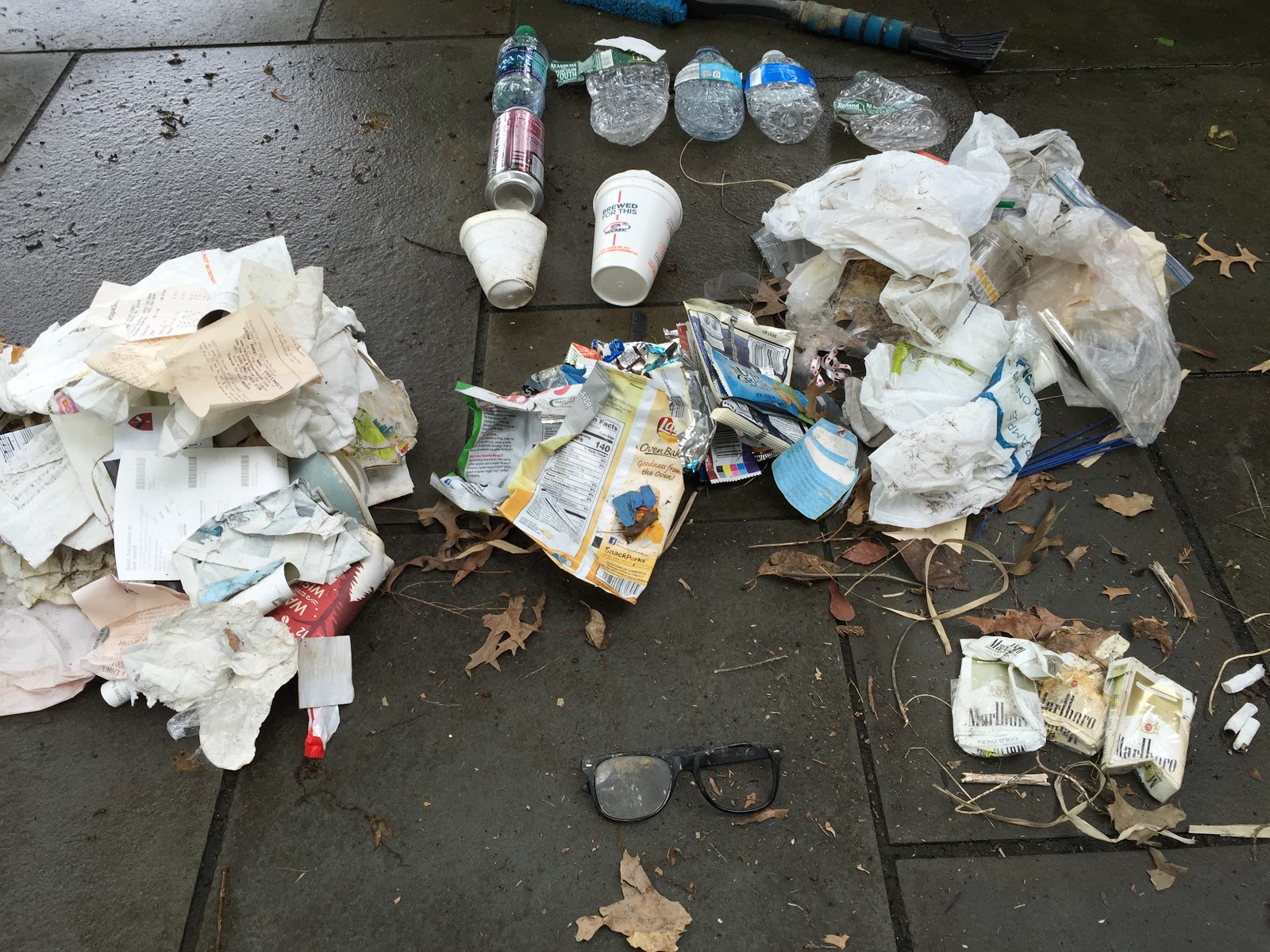
Chances are, this trash would have ended up in Carnegie Lake; might even have continued downstream and out into the ocean to join those massive gyres of plastic we hear about. But something filtered it out before it could get into the local waterways.


That something is a raingarden, in this case the two raingardens I've "adopted" at Westminster Choir College. You can see how the curb dips down to allow water to enter from the pavement.

People think of raingardens as plantings that reduce flooding, feed pollinators, and filter pollutants out of stormwater, but they also serve to protect waterways from trash.

Here's the typical stormdrain along the edge of a town street. A plastic water bottle and other small bits of trash, along with the nutrients in the leaves, stand poised to enter the stormdrain that will carry them down to Harry's Brook, then on to Carnegie Lake. Most storm drains have openings large enough to allow plastic bottles and other trash through. An additional issue, as can be seen in the photo, is that the asphalt around stormdrains eventually breaks down, requiring repair. Many stormdrains around town show signs of being patched multiple times in the past--a time-consuming, labor intensive proposition.


Here's another broken stormdrain. Not the most flattering depiction. Most are in good condition, and they certainly are a compact way to get rid of stormwater, but they essentially convey the problems of trash and nutrient pollution "down the pipe", for downstream aquatic life to deal with.

The raingarden, by contrast, traps the problems at the source, protecting the local waterways. Somehow, this fact didn't sink in for me until I found myself picking up the trash while doing some weeding. I was essentially cleaning a runoff filter, like one might clean the lint filter in a clothesdryer. That concrete structure in the photo is the drain. Water rarely if ever rises high enough to flow into it, seeping instead into the soil.

The photo, taken in the spring, doesn't show the raingarden at its aesthetic best. The native plants planted here are warm-season species that don't grow up and fill in until the beginning of summer. Below is a more flattering example of a wetland planting with species that get going early in spring,

The soft rush (dark green), sedges (light green), and sensitive fern grow naturally along a seepage slope at Smoyer Park.

The lush growth owes to the more stable supply of water from the seepage slope, while a streetscape planting will have greater extremes of dry and wet.

Wednesday, June 06, 2018

Upcoming Free Events -- Theater, Jazz, Video

(Also posted at PrincetonNatureNotes.org)

CLIMATE CABARET -- A free performance of original climate change theater and locally sourced "Sustainable Jazz" at the Labyrinth Bookstore in Princeton, 6pm on Wednesday, June 13. This performance will feature climate-adapted versions of Shakespeare, The King's Speech, a song from the Wizard of Oz, along with theatrical sketches ranging from comic to poignant. A suburban lawn undergoes therapy for recurring feelings of emptiness and chemical addiction, and for the first time, an environmentalist house cat will share her thoughts and concerns about earth and the human race. Actors: Cheryl Jones, Basha Parmet, Kitty Getlik, Fred Dennehy, Steve Hiltner. With Phil Orr, piano, and Steve Hiltner, sax/clarinet.

SUSTAINABLE JAZZ -- Another free show, this one hosted by the Princeton Public Library, from 2-3pm on Sunday, June 17. Steve Hiltner and the extraordinary pianist Phil Orr will perform Steve's original jazz compositions from their upcoming album. Styles range from straight-ahead jazz to funk, rumba and tango. Check out Phil's many other creative collaborations, including the ongoing Jazz On Broad series in Hopewell, at http://philiporrmusician.com/.

VIDEO PREMIER – Farming in the Millstone Valley: Past and Present 
--to be held at the Princeton Garden Theatre at 7:30 PM Tuesday June 12th, 2018. The viewing will be followed by a panel discussion. A preview of the video was shown at Eno Terra, but the final version has many new images. The video was made by the Millstone Valley Preservation Coalition (MVPC), in association with the Van Harlingen Historical Society. Kingston and the Princeton Nurseries Kingston Site are included in the video.

BIRTHDAY PARTY FOR OSWALD VEBLEN -- An outdoor picnic event at Herrontown Woods in celebration of Oswald Veblen's 138th birthday (still going strong) is being planned for 2pm Sunday, June 24. Oswald and Elizabeth Veblen donated Princeton's first dedicated nature preserve, Herrontown Woods, in 1957. The Friends of Herrontown Woods have been caring for this wonderful legacy, and researching the fascinating history of the Veblen House and farm cottage. Veblen was featured recently in a Princeton Alumni Weekly article, entitled "The Power of Small Numbers." Time to throw him a party. More details will be posted when available, at FOHW.org.


Tuesday, May 22, 2018

Bike Lanes Bloom on Hamilton Ave (for a week)

Update: Town council will be discussing bike lanes Jan. 26, 2021 at its 7:30pm meeting. Community input encouraged. More info on the meeting and how to comment can be found on the Princeton Bicycle Advisory Committee website. The post below dates from 2018.

The sun finally came out Sunday, and with it sprouted some bike lanes on Hamilton Avenue. A bit like Brigadoon--that Scottish village that comes to life for one day every 100 years--these bike lanes will last only a week, enough time for the community to fall in love with them and call for a future and more lasting return.

As serendipity would have it, I happened to be biking by during the transformation, guitar strapped to my back on the way to perform in Onstage at McCarter Theater. Two council members and a Princeton Environmental Commission member were carefully shifting the centerline over to accommodate bikelanes on either side. The street was closed while the volunteers worked, bringing a sudden sense of relaxation and freedom from the din and danger of machines. For one afternoon, while being refitted, the road wasn't serving as a climate change factory. Councilman Tim Quinn, the leading force behind this initiative, hailed me in good humor as "the Dean of Sustainability" as I rode by,


and more volunteers who had added new green bike symbols further up encouraged me to give the bikelanes a try. My usual approach to riding up Hamilton Ave is to use sidewalks when they're empty, in order to stay out of the way of cars as much as possible. A bikelane greatly simplifies the journey, with actual designated space provided for bicycles, so that people like me who want to stay out of the way of cars and pedestrians aren't having to constantly improvise a route. Significant car parking is being sacrificed while this "beta" bike lane is in existence, but for a week, until May 26 or 27, we get to enjoy and demonstrate the utility of these lanes.


Any initiative to increase the number of bike lanes in town comes up against not only cars and parking, but also leaves and brush, which get piled in streets pretty much year round and, if not timed with scheduled pickups, can sit for weeks, forcing bicyclists out into traffic.

The laudable push for bike lanes could be coordinated with a gradual shift towards containerization of leaves/brush. Supplying homeowners on busy main streets with large-capacity rollcarts to containerize their leaves/brush would be a low-cost way of beginning the shift away from the traditional loose dumping of yardwaste in the path of bicyclists, while making our streets cleaner and more attractive.

In the meantime, give the beta bikelanes a spin this week. They worked great yesterday during my bike ride to the Dinky.

Wednesday, May 09, 2018

One Man's Walk Through Communiversity


After performing at the Arts Council's Communiversity, with traffic kept at bay by an impressive assemblage of municipal vehicles, there was a decision to be made, either to adopt a jaded townie's view of this mass infusion of humanity as an annual annoyance to be avoided, or to dive in and explore? To flee or not to flee, that is the question. Buoyed by the pleasure of playing music for passersby, I chose the latter, saxophone strapped on my back, though an end around was needed to avoid the impenetrable human congestion on Witherspoon Street.


Nassau Street was much more easily navigated, allowing access to booths like Goofy Foot's not so goofy efforts to make comfortable clothing out of recycled plastic bottles. They told me that the color of the clothes comes not from extra dye but from the color of the bottles themselves, making each shipment's color a little different.


Then it was time for the novel concept of Meet a Muslim. I went over, shook some hands, and was told that the original jihad was directed inward, at getting oneself and one's own life together. That seemed to run parallel to some of my own thoughts about the pathological lack of self-scrutiny driving political polarization. One problem with the world is that what typically passes for a tough-minded skeptic these days is someone who only directs their skepticism outward, leaving their own views and beliefs unexamined. Deniers of the threats posed by climate change and invasive species are in this category.

Then it was off to the Princeton Historical Society's table, which had a dog theme. Here's the Stony Brook Hunt Club, featuring hats, horses and hounds. I wondered if the family that brought what later became the Veblen House to town might have taken part in one of these outings, seeing as Jesse Paulmier Whiton-Stuart was a man of wealth who loved horses and dogs. He also took a strong interest in mathematics, which suggests it wasn't completely coincidental that he later sold the house to the great mathematician Oswald Veblen.

Kip Cherry was hosting the tent for the Princeton Battlefield Society.

What got me reaching for my wallet at these nonprofit tables tended to be food and drink, which the nonprofits were offering for less than the concession stands. Communiversity offers a chance to save money by donating to a good cause--a dollar for a can of soda to support a Christian ministry's work in Appalachia, a dollar for a cookie to support some school project.

The Princeton Junior School had some initiative called a Wishing Garden, represented by a miniature garden of plastic dandelion seedheads that put a positive spin on what a lot of lawns look like this time of year. As with the introspective jihad, there was no time for deeper understanding. We got into a conversation about climate cabaret, and how it might fit into programming at the Junior School.


Talk of the climate cabaret continued at Sustainable Princeton's tent, with the head of the local Citizens Climate Lobby chapter.  I'll never get how sustainability is a niche interest, as if the future were optional.

It can be refreshing to make like a bee in a wishing garden of booths stretched along Nassau Street, talking to people wishing and working for a better world, with a saxophone strapped on my back like wings, feeling lucky that I needed only a bike parked nearby to fly me home.

Monday, April 30, 2018

Snowden Bridge Is Falling Down

Snowden bridge is falling down,
Falling down, falling down,
Snowden Bridge is falling down,
Why not fix it?

People drive by this old bridge all the time and never see it. Just beyond Overbrook Drive, Snowden Lane crosses over a tributary of Harry's Brook. Beside the bridge is an older bridge no longer used. It has a lovely stone arch that is gradually falling apart. This older bridge could at some point serve as a crossing for a bike/pedestrian trail out Snowden, but even if it weren't used it is a lovely bit of history, and will only obstruct the stream if it falls in.

Two years ago I appealed to the town's engineering department to fix it. There may have been a question as to whether it's the town's bridge or is the homeowner's responsibility (update: town engineering says it's on private property), but since then, another stone of the arch has fallen into the stream. The longer it goes unrepaired, the more expensive the fix.


Saturday, April 28, 2018

I Sing the Auto Electric


When my thoughts turn to transformative, hopeful things, I think of the empowerment of women, the increasing political participation of young people, the growth energy in native plants when given a chance to grow, and the promise of the electric car. It's more than promise these days, with the Chevy Bolt getting 230 miles to the charge, and charging stations sprouting up, often providing a recharge for free.

As long as vehicles have exhaust pipes--essentially weapons aimed at the future--there's little hope for the world. That's why our Prius here, wonderful as it is, will hopefully be our last internal combustion car. The electric BMW parked beyond it is beyond our price range, but is considerably cheaper than usual through the end of this month, for those who take advantage of PSEG's offer of $10,000 off. Add a $7500 federal rebate, and that gets the price down below $30,000.

Small, efficient cars are surprisingly spacious inside. An electric motor is much lower maintenance and more efficient than an internal combustion engine--even more so around town when a gas engine has no chance to warm up.

A friend with an electric car tells me that when he goes on trips with his Nissan Leaf, which gets half the distance as the Chevy Bolt on a charge, he approaches traveling with a different mindset. He takes a book along to read at recharging stops. Sometimes enforced idle time can create the space to attend to things that don't otherwise get done.

People can always find reasons not to change, but shifting to electric cars brings us closer to stripping travel of its collateral damage, allowing us to enjoy the exhilaration or necessity of travel by simply pushing electrons back and forth, leaving no lasting trace in the atmosphere to haunt the future.


Below is some PSEG info, gleaned somewhere on the web, about charging stations:

PSEG Brings EV Chargers to New Jersey Turnpike
PSEG and EVgo® have joined forces to bring electric vehicle (EV) charging stations to the Joyce Kilmer and Molly Pitcher service areas on the New Jersey Turnpike. There are two fast chargers at each service area that can provide electric vehicles with an 80 percent state of charge in 30 minutes, or about 150 miles of range per hour.

Participants in the Nissan No Charge to Charge and BMW ChargeNowprograms can utilize the chargers, as can EV drivers with an EVgo subscription plan. One-time customers can also use a credit card to pay for a charge.

In addition to the EVgo partnership, PSEG also offers an EV charging program designed to help spur the continued adoption of EVs in New Jersey by providing convenient charging options and gathering data on real-world use. That program currently has charging stations with a total of 135 plugs installed at 23 customer sites. PSEG also offers an Employee EV Charging Program with 45 plugs available at various company locations.

PSEG and EVgo plan to install chargers at additional service areas on the New Jersey Turnpike and Garden State Parkway in the near future. EVgo is the largest public fast charging network in the nation with more than 1,000 charging locations.

Sunday, March 25, 2018

Princeton's Carbon Footprint: An upcoming report, its history and meaning


Note: Sustainable Princeton will present the findings of an inventory of the town's greenhouse gas emissions on Tuesday, March 27, at the Andlinger Center. Details at this link. Below is a history of Princeton's long quest to comprehend its impact on the world's climate, and my thoughts on the powerful ethical and emotional implications of a town's "carbon footprint."

Through a generous grant from the Robert Wood Johnson Foundation, Sustainable Princeton has been able to fund a study of Princeton's carbon footprint, that is, how much carbon dioxide, methane and other greenhouse gases we are collectively sending skyward. That number represents the extent to which we as a town are trapped in a carbon economy, and thereby contribute daily to a collective, chemical undermining of nature. The main greenhouse gas, carbon dioxide, plays important positive roles in the earth's atmosphere, oceans, and in delivering to plants the carbon they use to grow, but as in our bodies, a significant change in its concentration can have disastrous consequences.

Few of us pay any notice to the exhaust pipes and chimneys in our lives, even though their emissions are quietly day to day determining our planetary fate. We abuse nature because we see little choice, because everyone else does it, because each individual's contribution seems insignificant, and because we can. Abuse can be inadvertent or, as in the photo of an outsized exhaust pipe in the back of a Dodge Ram pickup truck, a brazen show of power.

I may have been the first to attempt a carbon assessment of Princeton's energy use, in 2011, when I sought data from our energy provider, PSEG, on Princeton's consumption of gas and electricity. At the time, Princeton University was beginning to assess its own energy use, as was Sustainable Lawrence just down the road.

The premise, at least for me, was that awareness of our collective energy use as a town could help spur a move to use less, knowing the catastrophic global consequences of using carbon-based energy. We could compare our energy use year to year, and with other towns in the area, and thereby gain a sense of progress towards a shared goal.

My own experience with a home energy monitor, which displays how much electricity my house is using at any moment, suggested that knowledge is power. If I turned on the electric clothes dryer, our home energy use jumped by 3500 watts. Who knew? That's when we got clothes racks to hang-dry the clothes. A noisy, inefficient fan in the attic was replaced by passive ventilation. Turning off a few unneeded lights made the number drop even further. It was empowering and satisfying. We saved 35% on energy costs in the years that followed, with no loss in comfort or livability.

Immediate feedback seemed key in changing behavior. I dreamed of being able to go to a website where Princeton's energy use would be displayed in real time. Even more fine-grained data would allow neighborhoods to compete to see "how low we could go." But I quickly came up against the technical hurdles. PSEG was only set up to provide data every three months. Determining energy use by town government, or by the school system, required sending PSEG the meter numbers on every building. And then there's all the consumption of gasoline by cars and trucks driving through town. How to assess that?

I was stunned to learn that our town's biggest energy hog may be the incinerator that burns sewage sludge down on River Road. When natural gas prices were high, the town was spending more than one million dollars each year to fuel an incinerator most people don't even know exists. (I bet "Princeton's Finest" could outcompete Milorganite any day, and dramatically reduce our carbon footprint at the same time.)

In 2014 Heidi Fichtenbaum of Sustainable Princeton contacted me, wanting to pick up on my initial work with PSEG to quantify Princeton's energy use. I passed the data to SP's Christine Symington, who attended Hack Nights hosted by Code for Princeton, and sent the following update to me in 2015:

"Your past efforts to get this data were instrumental in getting a conversation started with PSEG that has led to us getting a commitment to getting updated data each quarter. 

We now have the start of a webpage that gives anyone in Princeton the ability to visualize our collective energy consumption. The team working on this included a 7th grader that designed the logo & created the styling for the site. Keep in mind that this is a work in progress. Ideas out there to expand on this include:
  • providing an import tool for residents and businesses who opt in to upload their personal utility bill information so it can be collected and used to create a "Princeton" energy consumption profile. This could be used to gather before and after energy costs from homeowners that participated in the EnergySmart Homes campaign 
  • an import tool for Sustainable Princeton to upload the data from PSEG easily and dynamically update the site with current usage data
  • a map of Princeton that would display energy efficiency or renewable energy implementations 
  • scenario builders that would show what Princeton could do to get to a 20% reduction in fossil fuels by 2020, i.e. increase solar installations by x%"
Then, in the fall of 2015, Christine published a report on Princeton's energy use on the SP website, the aim being to identify a baseline of energy use from which to measure Princeton's progress towards reducing energy use 20% by 2020.

Now, a grant-funded professional study may yield some meaningful number for Princeton's carbon footprint.

The big question going forward will be what Princeton does with that number. If we've learned anything in this long struggle to get action on climate change, it's that numbers don't make people change their behavior. The number on my home energy monitor moved me to action only because of a feeling in my gut that it is ethically wrong to be using energy that risks the future of our children, our nation, and a livable planet. How, we must ask, if Princeton is to be an example to the rest of the world, do we plant that feeling of ethical revulsion deep within more than a conscientious few of its residents?

One heartening development over the past year or two has been the growing gut-level rejection of discrimination, sexual harassment, and most recently gun violence. These issues have gone from the level of intellectual and political objection to a cathartic, visceral imperative that such behavior must be purged from society.

The Academy Awards this week was emblematic in its conscious shift towards inclusion and respect. And yet, predictably interspersed throughout that program and many others are car commercials that not only tolerate but glorify our collective chemical abuse of nature.

Our senses, of course, will not help us to reject the daily practice of pouring more and more CO2 into the atmosphere from the underground fuels we burn. Invisible, odorless, it all seems harmless enough. But if we were doing to our closely regulated bodies what we are doing indiscriminately to the earth--raising its temperature, acidifying the waters that sustain its life--we would literally feel in our guts the revulsion necessary to drive change in behavior.

It will be interesting on Wednesday to see the numbers that Sustainable Princeton has come up with, how business, commercial, residential, school and municipal sectors compare, and to see if the numbers are fine-grained enough to help drive decisions that will lead to substantive, measurable change.

Climate change is deceptive on so many levels. It is human nature to cling to the status quo, and yet it is the status quo that now drives radical change that increasingly threatens the lifestyle we wish to preserve. The more we cling, the less control we will ultimately have, as rising oceans claim our cities and super storms devastate communities. Each of us is left to grapple with the personal predicament arising from a collective failure, as in some lines I read at a recent poetry event at the library:

I don't mean to
I don't mean to
I don't mean to be so mean
To the earth.

How I love so much about it
As I travel all about it,
Spewing all that carbon as I go.
Where will I go,
When all that I love so,
When all that I go to,
Is gone?

Pessimists will say that it's already too late, that too much change is already baked into the system. But that is just one more in a long line of convenient excuses for inaction. Ending abusive behavior helps everyone. It not only makes life better for the abused, but also makes the former abuser a better person. Reducing the incredible disrespect for nature embedded in our economy and our culture will free us from an existential predicament we face as individuals every day, and make us better people.

A version of this piece was first published by PlanetPrinceton.com.

Friday, March 16, 2018

Roadside Snow Reveals the Two Worlds We Navigate


There is an important distinction that is often not made, between the impact of people and the impact of the machines people use. Machines are useful, even lovable, and yet the ones with exhaust pipes are, for all their fine attributes, contributing to a chemical assault on nature. That assault may be unintentional, undramatic, and mostly invisible, yet it is relentless and permanent in effect. Some of us participate reluctantly, others obliviously.

This photo is one of the ways to visualize the difference between People World and the Machine World we participate in. Pedestrians and bicyclists (it's legal to bicycle, respectfully, on most sidewalks in Princeton) leave no trace, while the snow is symbolic of the mess cars and trucks make of the world. That dirt that can be seen will seep into the ground or be washed away as a plug of pollution in local streams during the next rain, but is also symbolic of the larger, permanent damage: the CO2 rising from the exhaust pipes up into the air.

Once that distinction is clearly drawn in the mind as well as the snow, then one can begin to gain freedom from the sorts of machines creating slow havoc, and use one's own resourcefulness and partner with nature rather than the flawed machines. The aim is not self-denial but the pleasure of freeing oneself in more and more ways from the ethically challenged machines we feel dependent upon.

Thursday, March 15, 2018

Recycling Receptacle in a Princeton Park--Simple But Effective


One of life's persistent questions, in Princeton or anywhere else, has been how to improve recycling in public spaces. I used to write critiques of recycling arrangements wherever encountered, whether here, in airports, or in travels around the world. One of the posts, Ten Tips for Improving Recycling in Your Workplace, speaks to the importance of pairing trash and recycling containers, and making sure they contrast visually.

This very simple retrofit, initiated by the Princeton Borough parks department probably ten years ago, is a good example of how easy and inexpensive it can be to add a recycling container to an existing trash can. The bucket used to have a recycling sign on it, contrasts visually, and is simply hung on the trash receptacle to provide park users with a clear choice. Though it may not be the most attractive setup, this combo has survived years of use, and works much better than sleek, high-priced combo containers that often put appearance ahead of functionality, confusing users by giving very little visual contrast between the recycling and trash receptacles.

Of course, the high degree of separation of trash and recyclables that this simple retrofit achieves is only one step in getting the bottles, cans, etc. actually recycled. The next step is for the park custodial crew to actually keep the recyclables separate from the trash when they empty the containers. As the Ten Tips post explains, anyone wishing to determine whether recycling is actually happening at their workplace, school, parks or elsewhere, needs to track each step along the way to the recycling facility.

An empty bottle, then, is a bit like a salmon swimming upstream, having to negotiate many obstacles along the way, any one of which could prevent it from reaching that place where new bottles can be born. Thanks to this simple retrofit in one of Princeton's parks, a lot of bottles and other recyclables have made it past one of the major obstacles along that path to recycling.

Monday, February 05, 2018

SOLAR JAM 2018 - A Solar Car Race

This from Liz Cutler, Sustainability Coordinator for Princeton Day School. Please pass along to those who might be interested.

OASIS (Organizing Action on Sustainability In Schools) invites students grades 3-8 to participate in SOLARJAM 2018, a solar car race, May 19.

Students can come as a school group or register on their own.

The Top Three Finishing cars in Upper Division (grades 6-8)
are invited to race in the TransOptions Junior Solar
Sprints’ Inter-County Regional Race in Florham Park on Monday, May 21st.'

For information, registration contact: theandrewlloyd@gmail.com

Monday, January 22, 2018

Your Changing Climate, As Described by Your NJ Climatologist


Thanks to the Mercer County Master Gardeners and the Princeton Public Library for bringing NJ's climatologist, David Robinson, to Princeton this past week.

Here are some notes from the presentation. Unlike events on climate change years ago, this one was packed, with the audience spreading out into the hall. Robinson is an excellent ambassador for the subject of climate change. As I was taught by a theater director, even the darkest subjects or emotions must be presented with some element of joy, and Robinson does that.

  • Climate is your personality; weather is your mood.
  • A drawing of the biosphere, cryosphere, and atmosphere. Cryosphere is his favorite. Editor's comment: The cryosphere is all the frozen water on the earth, in ice sheets, glaciers, snow, ice caps, etc. The cryosphere has been doing a lot of "crying" as we warm the planet with our machines' emissions, and if all of it melted, your house would likely be under water (unless you're higher than Nassau Hall), which is one reason to be grateful for cold in our world.
  • Princeton was home to the foremost expert on the history of weather, David Ludlum.
  • You can see the urban heat island effect in the temperature patterns of NJ. Seemed like a five degree difference on the map. Air conditioners belching out heat, and the solar energy absorbed by asphalt, concrete, etc. extend hot spells.
  • While NJ was experiencing extreme cold recently, the rest of the world was warmer than usual.
  • There's 7 inches of evaporation happening in July/August, which means that even if we get 5 inches of rain, the ground is getting dryer.
  • He doesn't use the word "believe" with climate change. It's not a matter of belief. It's a matter of understanding what's going on.
  • It's hard for a lot of people to understand the difference in time frame between climate past and now. Human activity (the combustion used to power our machines) is changing climate much faster than it would happen naturally.
  • El Nino and La Nina may not be completely natural anymore, given how much we've heated the oceans.
  • The gases in the atmosphere--CO2, methane, etc.--bring the temperature of the earth's surface from zero degrees up to 55 degrees F.
  • The oceans are absorbing  huge amount of the excess heat caused by global warming. Because there is so much extra heat already in the system, "the train has left the station" with climate change. Reducing emissions of greenhouse gases will slow climate change rather than stop it.
  • NJ precipitation showing increased variability. "We're primed for more storms."
  • Hurricane Sandy rode ocean waters that had been above normal for 22 months leading up to the storm, plus a seasonal dip in the jet stream that caused the storm to come in towards land.
  • Climate change looks like it will be particularly extreme for the southwest U.S., where drier,
    hotter summers are predicted. The snowpack out there this winter is only 6% of normal.
  • Dr. Robinson mentioned Katharine Hayhoe, a climate scientist, evangelical, and an excellent speaker, based at Texas Tech. Editor's note: She is also a longtime member of the advisory board for Citizen's Climate Lobby, which has a local chapter.
  • There's a weather station at Stonybrook/Millstone Watershed.
  • Nice photo of the Great Falls at Patterson during the recent deep freeze.
  • In the Q and A, I asked him about how people are to learn about climate change when journalistic convention doesn't include basic facts in day to day reporting, like the graph showing the dramatic departure from historical patterns of temperature and CO2, or how we've raised CO2 levels in the air by 40%. He said that he only gave 160 interviews this past year, half of previous years, which for him is telling about the diminishment in science reporting as news services struggle to survive.  
  • Clouds are hard to "parameterize" in climate models. They'll have different impacts depending on whether they are over dark water, land, or snow that would reflect the light back up into space regardless of whether the clouds were there.
  • Research shows that the main determinate of view of climate change is ideological.
  • He had expected climate change to get more attention when Clinton/Gore were elected, but Clinton administration had lots of other things on its agenda.
  • Someone asked about the 3% of climate scientists who supposedly disagree about the amount and cause of climate change. Robinson questioned whether that 3% really exists.
  • If you want to see some of his slides, an internet search revealed that ANJEC (an umbrella organization for town environmental commissions) has one of his powerpoints at this link.
After the talk, an acquaintance confided that she still didn't understand the basics of how the extra CO2 got into the atmosphere, and why it is a problem. A NY Times primer on climate change explains to some extent, but still doesn't make clear that the extra carbon, now active in the atmosphere warming the earth, was previously safely stored in underground deposits of coal, oil and natural gas. Both the origins and dangers of human caused climate change have a great deal to do with storage. Coastal cities exist only because vast amounts of water are being stored in ice sheets perched on Greenland and the Antarctic. There are 220 feet of sea level rise stored in those ice sheets, and by creating warmer conditions on earth, we will steadily lose that wonderful storage service.

In this short video, the CO2 molecule comes to life to explain the situation.


Wednesday, January 17, 2018

Climate Talk and Jazz Play this Week

Two people I've had the pleasure of interacting with in the past will be in Princeton this week. Your state climatologist (did you know you had one?) will be speaking at 7pm at the Princeton Public Library this evening, Jan. 17. And Jonathan Elbaz, a wonderful, highly talented, super knowledgeable young jazz pianist I jammed with at a dinner party a couple months ago will be performing this Friday, Jan. 19, at Salon 33, a unique performance venue worth checking out. Potluck at 7, performance at 8pm. Highly recommended. For more info and to rsvp, scroll down at this link.

David Robinson "New Jersey's Changing Climate"
The New Jersey state climatologist gives a presentation on the weather and climate of the Garden State that explores events and issues on short to long time scales.  Intended to promote an understanding of global climate variability and change, the talk will address where we have been and where New Jersey's climate may be headed. Newsroom
 
This special event of the Princeton Environmental Film Festival is co-sponsored by the library and Rutgers Master Gardeners of Mercer County.

Jonathan Elbaz, a recent graduate of the prestigious New England Conservatory of Music in Boston, is an aspiring yet impressive twenty-two year old jazz pianist. His talent is quickly becoming recognized, and has already landed him gigs at Dizzy's and other key venues in NYC that feature young topflight jazz musicians. Elbaz is a name to keep watching on your jazz radar. Salon 33 is pleased to host him in his home town of Princeton.

Jon will present a pianistic survey of jazz from the Swing era – that is, from the late 1920s until bebop of the 1940s. While this is very much a performance concert, Jon will also engage the audience with brief introductions to the composers who made these tunes so popular in their day, notes from their lives and life context, and some funny bits here and there about the lyrics. Featured jazz musicians include Willie the Lion, Art Tatum, Fats Waller, Teddy Wilson, vocalist Billie Holiday and composer/pianist Duke Ellington, among others

Friday, January 12, 2018

Working With Rather Than Fighting Against Nature


Cold nights and sunny days bring memories of the wonderful passive solar homes I've been in, warmed passively in winter by the sunlight streaming in through a bank of south-facing windows. From its low angle in the winter sky, the sun's power pours in to fill a welcoming house with its radiance and warmth.


Most homes, including ours, turn a cold shoulder to the sun's winter radiance. To get a sense of how much energy is traveling all the way from the sun only to bounce futilely off the siding, stand in front of a window and feel the sun's heat on your skin.


Even with most of the solar energy bouncing off the house unused, there's still canned solar energy in the form of wood foraged locally for the stove. Along with the solar energy streaming through the windows, and one of those really comfortable, lightweight Patagonia coats, it's possible to give the gas furnace a break, and thereby contribute a little less to the radicalization of weather.

A wood stove and a sunny south-facing window are like the Victory Gardens of the Second World War. Back then, people became producers, e.g. of food, and minimized their consumption of energy in order to make more available for the war effort. Now, the aim is simply to use less of the unethical energy that permeates our economy--unethical in the sense that present comfort contributes to future discomfort. It sometimes feels like another war needs to be fought, this time against climate change, a self-produced enemy, perhaps the most dangerous of them all. As wars go, it has the advantage that no one need die to win it. But wars aren't as galvanizing as they used to be. Maybe it's time not to make war but to end it, to end the largely inadvertent war on nature. The Third World War, it turns out, is a war not on other nations but on the world itself, waged everyday as collateral damage from our seemingly peaceful lifestyles. We end it by working with nature rather than against it.


Our dog is responding to the frigid weather not with worldly thoughts but by opting out of walks, and going out each morning to bark at the cold, as if it were intruding on his territory.


Several days later, the barking seems to have worked all too well. Strange cold is replaced by strange heat, much as the drought-enhanced wildfires in Californian have segued to downpour and mudslides. Weather is stretched to extremes, and calls to work with nature seem to arise from a strangely peripheral AsIf world--a dreamed of realm where people think and act as if the future mattered.

Saturday, December 30, 2017

Seeing the Big Picture in Our Big Freeze


A map of global temperatures is very helpful in better understanding how our record-breaking cold fits into overall global warming. Red indicates parts of the world that are currently warmer than normal, with that blob of blue over North America showing that our comparative cold is an isolated event. To compensate for parochial perceptions of climate, news media need to be displaying these maps frequently.

There's another way in which our frigid temperatures, predicted to continue for the next week at least, could be an effect of overall warming. A climate scientist at Rutgers, Jennifer Francis, has been studying how the radically warming North Pole could be weakening the jet stream. As these high altitude winds slow, the jet stream begins to sag and stagnate. This in turn leads to the sorts of stalled weather patterns that contributed to the record breaking flooding in Houston this past summer. Presumably, this same "increase in persistent weather extremes" in the summer, a consequence of climate change, would hold true for the winter as well.

From what reading I've done, the jet stream functions like a belt, or an abdominal wall that rings the planet, flexible but strong enough to keep the arctic weather mostly contained to the north. The big freeze we are experiencing can be thought of as a giant hernia, in which that wall weakens, allowing arctic temperatures to spill southward over the U.S.

Monday, December 25, 2017

An Unusual Silence

Making my usual morning coffee and toast, 7am on Christmas morning, I became aware of an unusual silence. It came from outside, where so much was not happening, so many cars not going by, so many trucks parked for the day, so many planes not flying overhead. It made me think of Santa, and how he might long ago have had the whole night to himself while the world slept. By the time I stepped outside, though, a car was coming by, and another, and the poignancy was gone.

Maybe there was a moment, sometime in the night or early morning, when all people were happy right where they were, and felt no need to be somewhere else, and the great white noise of machines stopped for that glimmer of time, opening up for all to hear, a clear, crystalline silence.

Sunday, December 17, 2017

Making Sustainable Practices Visible


Behavior that makes a community more sustainable in the longterm tends to be invisible and inaudible. No one sees you not driving, or using less energy in the home. No one hears you raking leaves. Neighbors don't see a backyard compost pile. Solar panels don't make demands on our awareness the way traffic and airplane noise does. How then to model sustainable practices, given that people tend to copy what they see and hear their neighbors doing?

Have a pollinator garden, solar panels or compost pile hidden somewhere? Don't keep it secret. Tell the world. During a recent visit to Bloomington, IN, I saw a lot of these signs, indicating that the homeowner has some solar panels somewhere on the roof. Given all the reasons people can conjure for not adopting more sustainable practices, signs like these provide some reassurance that others have overcome their inner resistance and perceived impediments and taken action.


Lacking a sign, I decided to use a frontyard demonstration instead. Home composting of yardwaste and kitchen scraps is typically done in the backyard, while the more energy-intensive practice of piling leaves in the street for pickup by heavy machinery is highly visible. This "Wishing the Earth Well" leaf corral serves as a sign of sorts. Since the decorative hubcap was stolen (I guess it's a compliment), a pumpkin has been sitting in as a cap for the inner column where food scraps are tossed.


Gravity works in one's favor with a leaf corral. The leaves continue to settle, leaving room for more when the oaks drop their last leaves.


People often think compost piles need a lot of turning to aid decomposition, but if the leaves are moist and the leaf corral is set on bare ground, the decomposers work up through the pile on their own. This fall, the corral yielded a bucket and a half of high quality compost for the raised beds.

Demonstrations like this are made to show how easy and rewarding sustainable practices can be, if humanity ever chooses to adopt them.

Friday, December 15, 2017

To Fix a Problem, First Make It Worse

I'm sure this isn't always true, but it sure was yesterday afternoon, when I was organizing the frig in preparation for a party, and accidentally spilled an open can of soup. Tuscan-style white bean soup, which I mistook for minestroni as it began dripping down from one shelf to the next. Sponging up the mess caused me to notice that the whole frig needed a cleaning. Stirred by that special party-prep energy, I launched into a full cleaning. I doubt anyone will notice. People will see a clean frig and assume it always was--such is our capacity to overlook a slow accumulation of dirt. No matter. A clean frig has its own satisfactions.

The experience got me thinking, though. What other cleaning and organizing could I incite by making things worse, in order to make them better, of course.

Saturday, December 02, 2017

Shout Out to Princeton Womens' Soccer

A shout out to the Princeton University women's soccer team for some exciting play this fall and a deep run in the NCAA soccer tournament, reaching the quarter finals. They combined a tenacious defense with a potent, free-wheeling offense that won the Ivy League title and took some much larger schools in other leagues by surprise.

Though I seldom follow sports, the soccer team and its season pushed some buttons for me, having come from a small town in Wisconsin whose high school teams, orange and black bulldogs rather than tigers, played against larger schools and often won. What drew me to sports as a kid was the skill, teamwork, improvisation, and the exhilaration of running pell mell down a field. Women's soccer brings those qualities to the fore, leaving brute strength and body blows to other sports and other fans.

At some level, the women's soccer games serve as a salve in this political era. The games are honest--no phony writhing in pain like one finds in men's professional soccer. There's all that positive energy of players giving everything they've got to a shared goal. No room for laggards or selfish agendas. At the same time, the players are free to express their personalities on the field--each with a distinct style. With no time outs, the coach often out of earshot, the team must depend on its own wits and chemistry. The fluency of precise passing doesn't play out as static ball control, but always leads somewhere interesting, with near goals often as exciting as the goals themselves.

Soccer games at Princeton U. are free and open to all. Knowing no one in the stands, I'd engage in the action but also feel a solitude, a sense of having stepped out of my accustomed orbit. My youth in sports was eclipsed by an adulthood of music and environmental work, but even a native plant advocate can get drawn back to the action on that broad sward of green. Go Tigers!

Related post about soccer and climate change: Cheering For the World


Friday, November 24, 2017

Giving Thanks for Improved Sidewalks


One thing I'm thankful for this Thanksgiving weekend is the new or improved sidewalks going in around town. My understanding is that Princeton no longer charges individual homeowners for repaired or newly installed sidewalks, eliminating the friction and delay caused by the old policy.

The town recently replaced bumpy sidewalks along a main route taken by kids going to PHS and the middle school. The value of smooth sidewalks becomes most vividly apparent if you walk with someone who uses a walker.

It's nice to see workers improving infrastructure in town. A closer look reveals the craftsmanship involved. The less demand for custodial functions like picking up leaves piled in the street, the more resources can be channeled to these infrastructural improvements.

May this sidewalk's utility extend far towards the horizon.

Wednesday, November 15, 2017

Slavery in Princeton--Some Context

The Slavery in Princeton project led to some additional reading, which in turn led to writing the opinion piece, Unethical Energy: Then and Now. The Slavery in Princeton project does a great service by showing how slavery was a part of Princeton's past, and has sparked a lot of interest, both here and more broadly, with articles in the NY Times.

People who look honestly at the past and acknowledge deep injustice are more likely to look honestly at the present as well. In fact, past injustice can help us better understand current injustice, and vice versa. There is the ongoing legacy of slavery and discrimination, and the parallel tragedy of ongoing dependence on fossil fuels. Few people--when they drive up a hill with but a nudge on the pedal, or bask in comfort while the furnace quietly heats the home--think about the distant consequence of that easy energy--the land wounded by extraction, the distant lives disrupted by or lost to radicalized weather and rising seas. Awareness of the way injustice is woven into what seems like normal, civilized life is our ticket to a deeper understanding of what it was like to live in the early 1800s, when many people may have been troubled by slavery, but also found it served their interest too much to demand change. The fine-grained rendering of the past by the Slavery in Princeton project helps make more vivid our current predicament.

There is a cultural tendency to put malefactors front and center in the news, in political comedy, and in movies. Though distasteful, the malefactors also satisfy in a peculiar way, as long as they are the "Other", whether from a distant era or members of the other political party. They satisfy in that we the audience come out looking better by comparison. Whether our ancestors were slaves or free, or both, we rightly feel disgust at the news that slaves were once sold on Nassau Street. The Slavery in Princeton project will not fully realize its potential, however, unless we ask ourselves if the disgust we feel now will, decades or a century from now, be felt towards us. Only then can the urgency of our moment in history be made clear. It's time to forge an economy based on ethical energy, that respects people and planet, present and future.

Here are some of the sources that offered insight into then and now:

Slavery in the North gives a state by state history of slavery in the North. New Jersey's is here.

For those trying to reduce consumption of fossil fuels, the closest counterparts in antebellum America were the Quakers, described in this article, Boycotting Goods Produced by Slaves. John Woolman, whose house has been preserved, was one of the leaders who influenced Quakers to take a stronger stand against slavery in the mid 1800s.

12 Years a Slave is a powerful movie worth seeing. It's one of those movies where you emerge from the theater shaken, with perceptions of the world dramatically changed. I wrote about it here.

Why Non-Slaveholding Southerners Fought gives a fascinating description of attitudes in the South leading up to the Civil War.

The New Abolitionism compares slavery and fossil fuel use, with a particularly useful discussion of stranded assets.

Rationalization, whether of slavery back then or fossil fuel use now, is alive and well. Here's an example from the current U.S. energy secretary.


Thursday, November 02, 2017

Support Bike and Ped Mobility Tonight, Nov. 2

This from Princeton Bicycle and Pedestrian Advisory Committee:

Great news! On November 2, Princeton's Planning Board is to consider formally incorporating bicycle and pedestrian mobility into Princeton's transportation plan. More details on this issue are in Nat Bottigheimer's clear and informative article in Planet Princeton.

This is a huge development for sustainable transportation in Princeton, and it would be great if we come to the meeting in large numbers to show our support. Bring your friends! Bring your kids! (Tell them that it's a chance to see democracy in action; also that our town hall has good WiFi).

The hearing is on Thursday, November 2, 7.30-9pm in the main meeting room of the Municipal Complex on 400 Witherspoon Street
You can download and preview the proposed circulation element here.

Wednesday, November 01, 2017

Electric Bike Gone in Minutes


Less than a half hour after putting an electric bike out on the curb, I heard a knock on the door. A man with a long beard wanted to make sure it was free for the taking. Years ago, I had acquired it under similar circumstances, motivated by a vision of tooling around town, powered by solar energy. The envisioned repair and reuse had languished, however, for lack of an understanding of all things electrical. The bike should be in good hands now, though. These guys are real electricians, and just happened to have room in their truck.