The ice is now thick enough to skate on, for the first time since 2009, according to a news item on the Princeton University website. It doesn't say if any of the ice has been cleared of snow. Today's (Tuesday's) town recreation dept. message at 609-688-2054 also includes Community Park North's pond (in Pettoranello Gardens) as safe. The pond at Smoyer Park, however, is not safe.
It's always good to check for the white flag, to make sure conditions haven't changed, and call the number above for daily updates.
More on this ice not-breaking story later in the day. Skating is only allowed during daylight hours.
Tuesday, January 28, 2014


Wednesday, January 15, 2014
Insulating Heat Ducts in the Basement

This is a story about making a little heat go a long way. In most houses, heat has to go a long way to get to this or that room. A wood stove simply radiates the heat outward, and lets the excited molecules spread the warmth up the staircase and around corners. But the typical forced air furnace has to push the air itself, through a labyrinthine set of pipes, facing the same circulatory issues of a giant octopus.
Much of the heat a furnace produces gets lost in transit, as the long metal ducts shed their warmth into the basement where it doesn't do much good. My basement is an all too good example of that, with bare ducts and leaky single pane windows.
So when my friend Dorothy was told that she needed a bigger furnace to get more heat to chronically cold rooms in her house, she fortunately asked around and got some good advice on a different approach.

Instead of spending lots of money on a bigger furnace, why not insulate the ducts so the heat from the little-furnace-that-could can make it all the way to the upstairs bedrooms? It goes against the bigger-is-better and replace-rather-than-repair mantras that so often dictate decisions, but it worked like a charm. Rooms that were chronically cool are now comfortably warm.

Imagining that duct insulation would have a MichelinMan bulkiness, I was impressed to see that the covering is very compact.

And the workmanship is impressive, with insulation neatly taped and tight under and around the brackets,
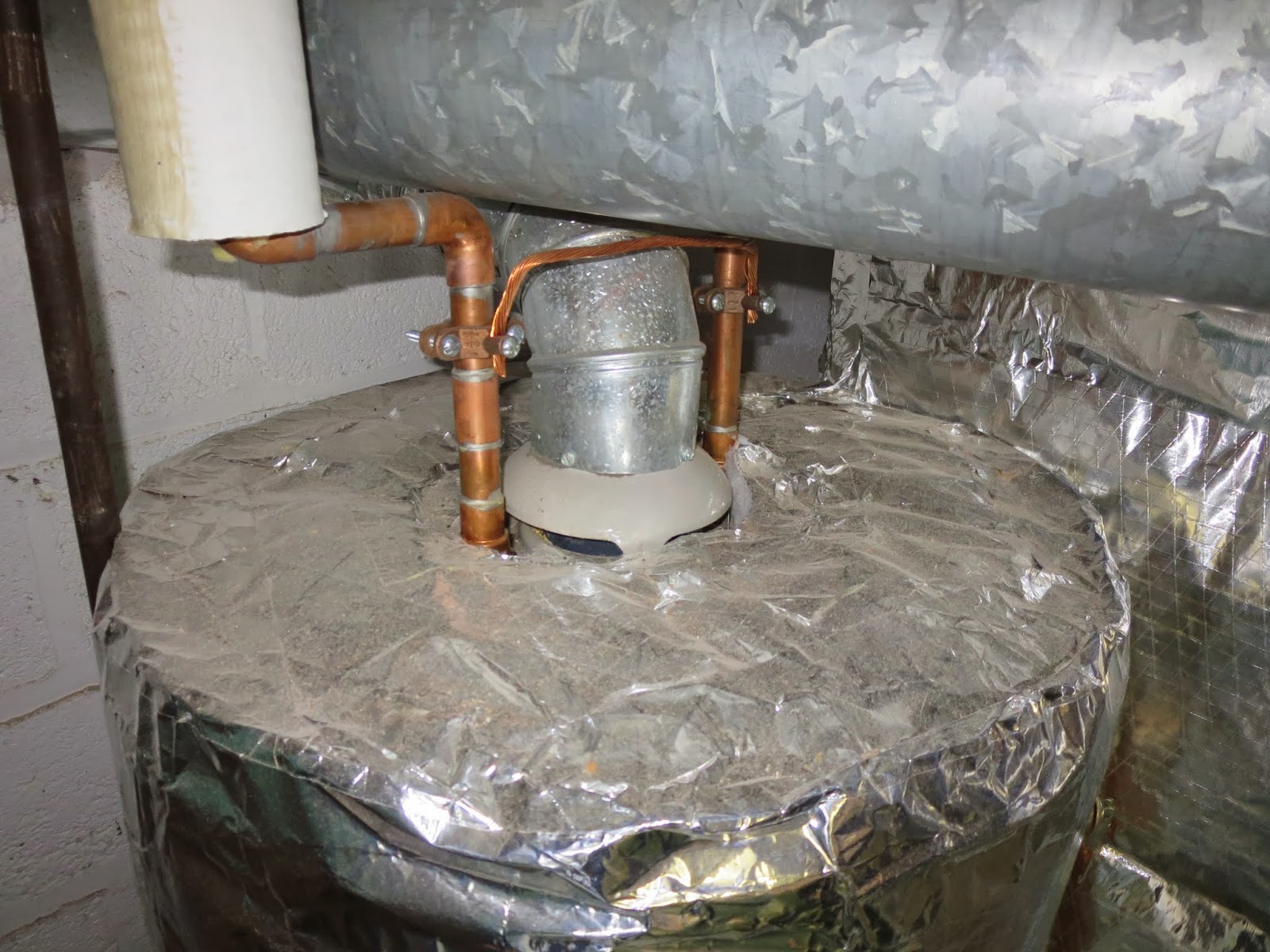
and the water heater carefully insulated as well.


Combined with the clotheslines stretched along the ceiling as a way to avoid using the energy-gulping clothes dryer, this is one very together, money saving, energy saving basement.
Tuesday, January 14, 2014
Composting Leaves in Paris's Luxembourg Gardens

The place? Luxembourg Gardens in Paris. The context? Highly formalized, immaculately maintained grounds. And what do they do with the leaves? Throw them out in the street and haul them out of town? No. They find an out of the way spot in the park, corral the leaves and let them break down into soil.
More on how nature is managed in Paris at this link.
Friday, January 10, 2014
Sump Pump-ageddon

Woe be the world when the sump pumps turn against us. And this, dear readers, I fear has finally come to pass. It was only a matter of time--or, more to the point, an extended period of freezing weather--before the needs of the indoor underworld (people's basements) would begin to wreak havoc on the great suburban out of doors better known as sidewalks and driveways.
It is, once again, that mischievous substance known as water--the only molecule at liberty on this earth to pass with ease from one state to another, from gas to liquid to solid and back again--that is playing tricks.

Rising out of the basement as a liquid, this sump pumpage acts much like a fresh spring, a rivulet, warm enough to begin flowing across the pavement towards Harry's Brook. In above freezing weather, this drainage is benign, flowing away from the house and down into the street, where gravity leads it to a storm drain that connects to the local brook.

But in freezing weather, the water solidifies into a glacier where before there was a driveway.

On Linden Lane, this thick crusting of road salt, along with the traffic cones that were just removed today, may well have been applied to reduce the hazard created by a sump pump that empties into the street and has proved hazardous during cold spells in previous years.
Sump pumps can also cause problems if they drain into the sanitary sewer (the one that carries water from sinks and toilets to the treatment plant), adding unnecessarily to the town's wastewater treatment costs. Some of Princeton's homes still have this faulty connection.

Far better than releasing sump pump water onto a driveway, out into the street, or into a sanitary sewer, is this backyard discharge,

which allows the basement water to flow out into the yard where it can seep into the ground and, during summer dry spells, quench the thirst of gardens, lawns and trees. It helps, of course, to have some slope to carry the water away from the house, which many yards do not.
As it happens, these two houses are built where once there was an actual tributary of Harry's Brook. Though the creek was filled in to build the homes, it still travels underground, seeping into their basements and necessitating a lot of work by their sump pumps. This is a domestic version of what happened with the Spring Street parking garage downtown, and speaks to the perils of trying to ignore or erase the original hydrology.

What water doesn't get absorbed by the uphill neighbors' backyards flows towards my yard beyond the fence, where I've actually recreated a streambed to imitate the original tributary. Conveniently, this frozen stream reveals what is hard to photograph at other times of the year, when the water flow blends into the grass.
Somewhere in Princeton, I'm sure there's some clever homeowner who has channeled sump pump water to make an ice skating rink in the backyard.
These are some ways to tame a sump pump's offerings, to give the mischievous water room to play, and to turn Sump Pump-ageddon into Sump Pump-a-Garden.
Thursday, January 09, 2014
Still No Skating on Carnegie Lake!

Major disappointment here. With temperatures likely to begin rising tomorrow, this seemed like the day that skating on Lake Carnegie and the town's two smaller ponds just might get the green light, which for ice comes in the form of a white flag. But no. The red flag hangeth still, and the recording at the town's skating conditions hotline, 688-2054, said conditions are still not safe today (Jan. 9).

Unlike the lake, the canal still has open water, because it has a stronger current.

But the lake doth beckon, with its vast expanse of smooth ice, made possible by a couple extended cold snaps, a heavy snow that then improbably melted during a one day heat wave, then froze smooth in recent days. With the ice still unsafe, there isn't much to do next to the lake other than make like a beaver and gnaw on some wood, and check the hotline again tomorrow morning.
If not tomorrow, then 2014 could well turn out to be like 2013, but we'll always have 2007 and 2009.
The town webpage for iceskating info is at this link.
Saturday, January 04, 2014
Finding Empowerment in Shutoff Valve Repair

Just beneath the surface in any house lie mysteries that most of us would be happy to remain oblivious to, and yet when something goes wrong, there is little choice but to launch an exploratory expedition under the kitchen sink or into the basement, where pipery and knobbery of baffling complexity awaits to stymie and perplex.
One option is to call a plumber, but a phenomenon known as "Princeton prices" has caused many of us to seek guidance from the collective wisdom of the internet and take wrench in hand.
Take something as seemingly simple as a dripping faucet. Though I have over the years grown more confident in finessing the faucet handle off and replacing the rubber gasket, that operation requires first shutting water off to the faucet. Chances are, the shutoff valve has become encrustified over the years, and will fail to shut the water off. In the worst case, the shutoff valve will itself begin leaking, compounding the original problem in the faucet.
Such a scenario came to pass in our household just before the holidays, prompting a search of the internet for sage advice. Judging from the placement of his youtube tutorial at the top of the heap, Max Lemberger must be the rock star of shutoff valve repair. The tutorial called for first tightening the packing nut, and yet my leaky shutoff valve (lower right in the photo) lacked any nut to tighten. Deeper did I dig into the bowls of cyberspace, plumbing the depths, so to speak, to find at last the key to repairing my aging home's bout of incontinence. Emboldened by a ThisOldHouse video, I took hacksaw in hand and carefully cut the faulty shutoff valve off, then replaced it with a new one (upper left in photo) that requires no soldiering to install. Not only was the problem fixed, but it has remained fixed for one month and counting--a good omen for the new year.
That operation required first shutting off the main shutoff valve for the house, which itself began to drip when in the closed position. Fortunately, it was a slow drip that slowed further and finally stopped soon after I opened the valve up again. Fortunately, not all mysteries need to be solved, but with the help of the internet and the local hardware store, each successful repair adds to a sense that some portion of destiny is, literally, in our hands.
Thursday, January 02, 2014
How Taxicab Drivers Make, or Don't Make, a Living
On a taxicab ride from Princeton Junction to Princeton, the driver gave me the lowdown on the economics of taxi cab driving. There may be other arrangements out there, but this post tells one cab driver's story. What he described sounded about as inefficient as any system for human transport that could be devised. The conversation began with my wondering where he would go after dropping us off. "Back to the Princeton Junction train station," he said, because there's nowhere else to go. So half of his driving provides no service to anyone. And when he gets back to the train station, he has to get in line with as many as 40 other taxi drivers. Because it's cold, he has to keep his car idling, while he waits in line for as long as four hours for the next passenger. If he's unlucky, it will be someone going only a short distance, which puts him back at the end of the line with little money to show for it.
The company he works for provides the car, but he pays for the gas, and can burn through a quarter of a tank just idling at the train station waiting for the next rider. Because he pays for the gas, the company has no incentive to provide a fuel efficient car. He splits the fare with the company 40/60, with the larger portion going to the company. Our ride to Princeton was only his third ride of the day, after nine hours on the job. He gets to keep only $12 of the $30 fare, plus tip. He expected the New Years Eve business that evening to be pretty good, but the next few weeks will be slow. Some drivers avoid this doldrums to some extent by having their own list of clients who will call them directly for a ride.
What this job offers, if precious little money, is hope of getting lucky. Maybe tomorrow will be better than today. But when most everyone in the Princeton area has a car, or a friend to pick them up, there isn't much luck to go around. It's a step up from playing the lottery, in some ways like fishing. Imagine a hundred fishing vessels trawling for the last few fish in an ocean inlet. The economics make little sense not only for the driver but also for the rider, who pays $15 to take the train 50 miles from New York, then $30+ for the last 4 miles to Princeton.
For the planet, it makes even less sense. When not actually transporting riders somewhere, taxis devote themselves completely to their primary role as climate changing devices, their engines pumping fossil carbon into the air. In the U.S., this role is expedited because they tend to be designed to get the worst gas mileage possible. In the older parts of Paris, they are rare because the metro and bike/ped options are so good. In Buenos Aires, which has many buses but not much of a subway system, and the bike share option is just getting going, the taxis are at least small and powered by natural gas, but are so numerous that they flow like a current in the streets.
A taxi's inefficiency is not in complete contrast with public transportation, since empty buses and trains are burning fossil fuels much like idling taxis, all for the sake of being available if anyone comes along who wants a ride.
As a teenager, I briefly worked as a golf caddy, which meant sitting in a dusty yard behind the pro shop waiting for my number to be called. Most golfers preferred golf carts by then, so we caddies had to wait a long time before making a few bucks carrying someone's clubs around the course. Though I wasn't burning fossil fuels while I idled, the golf carts may well have been more ecological, given that, unlike the carts, I had to drive myself out there and back every day.
If taxis are necessary, and they do provide a useful service of custom transport, the ideal compromise would be a vehicle that gets good mileage and has some means other than running the engine to keep the waiting driver comfortable, combined with some system to prevent the needless overabundance of drivers at any one location, much as fisheries are managed to balance the number of fishermen with the number of fish.
The waste--in the drivers' time, in gasoline, and the suburban sprawl that makes people helplessly dependent on cars--is driven to a large extent by the relative cheapness of gasoline--a highly subsidized commodity.
Friday, December 20, 2013
Will Foodwaste Recycling Succeed in Princeton's Public Schools?

Earlier in the fall, some rollout bins labeled for foodwaste showed up behind the Princeton High School. I had heard that foodwaste recycling was going to begin at the public schools, but the bins remained empty. Finally, I emailed superintendent Judy Wilson to ask what was up. A response came from facilities head, Gary Weisman, a week later:
"In response to your recent inquiry regarding food waste recycling at PHS, I wanted you to know that the program is underway and has been for the past few weeks. The bins have been on-site since September, but there were many factors that caused us to delay implementation. All schools are currently on board, but no one should be under the illusion that the ongoing implementaton will be seamless. However, with the support of our administration, custodial staff, aides and students we are hopeful that the program will quickly become part of our normal routine." --Gary Weisman, Dec. 2
Since then, plastic bags (presumably compostable plastic) of foodwaste have begun to show up in the bins. The opportunity here goes beyond saving some money by reducing the amount of trash headed for the landfill. One of the biggest lessons kids can learn is the cumulative power of our individual actions. Each individual's impact seems too minor to be concerned about, but if multiplied by everyone else doing the same thing, the result is game changing.
Though this philosophy is drilled into athletes, it's in everyday life that the game is being played for keeps. The cumulative impact of individual actions--like recycling, voting, and how much carbon we pump into the atmosphere--determines what sort of future we will share. If one student throws non-compostables in the cafeteria compost bin, the custodians are likely to toss the whole contaminated bagful into the trash, sabotaging everyone else's efforts to make the system work. Everyone has to assume responsibility and pitch in. Foodwaste recycling will be toughest at the high school, where students are allowed to eat lunch anywhere in the school. That dispersion and general lack of supervision makes it all the more important that an ethic of recycling be promoted and sustained, lest cynicism grow about whether the high school's recycling program is actually functioning.
What I've heard from conversations with staff fits with my experience back in 2007, while helping get recycling restarted at the public schools. Success is most assured if there's someone at the bin in the schools' cafeterias, ingraining new habits by making sure students throw their scraps and other waste in the right bins. This is essentially the role a coach plays with a sports team. The compost bin needs to be paired with the recycling and trash bins, so students don't have to walk extra steps. Signage has to be clear, both in word and, for those too distracted to notice labels, the "body language" of the containers. There has to be monitoring out back to make sure the after hours custodians aren't just throwing everything in the trash dumpster. To overcome cynicism, there needs to be feedback and updates so students have some assurance that what they are dutifully throwing in the recycling bins is actually getting recycled. Because it's so easy for recycling programs to fall apart over time, someone in each school with passion for recycling needs to be designated to monitor the program over time.
Above all, the administrators have to lead, to send a message repeatedly to staff and students that recycling matters. Otherwise, everyone will take silence to equal indifference. Recycling is not something peripheral to the educational experience, but central to the individual's understanding of his/her place in the world and impact upon it. It's a habit students can learn and carry with them for a lifetime.
In sports, there's a coach, and someone keeping score. Recycling is essentially a sport being played without any ongoing coaching for the individual players, and without a score at the end of the week (e.g. pounds of foodwaste diverted from the trashstream) that people can take pride in or work to improve.
In sports, there's a coach, and someone keeping score. Recycling is essentially a sport being played without any ongoing coaching for the individual players, and without a score at the end of the week (e.g. pounds of foodwaste diverted from the trashstream) that people can take pride in or work to improve.
Sunday, December 15, 2013
Who's Making the Snowmen?

How nice. A snowkangaroo (best guess) in the park.

But wait a minute. Isn't it the kids who are supposed to be building the snowbeings, not the parents? Really kids, you can't expect the parents to house, feed and clothe you, drive you to school, and then go to the park and play for you as well. It's too much!
So come on kids. Time to step up. Put down those cell phones, find some boots and mittens, step outdoors and get busy. If you haven't done it for awhile, don't worry. It's just like riding a bike.
Friday, December 06, 2013
Notes on Meningitis Outbreak at Princeton University
Our pediatrician called the other day to give advice on whether our daughter should get vaccinated for Class B Meningitis at Princeton University. The answer was an emphatic yes. Turned out the pediatrician's son was one of those who contracted the disease this year. It's a serious disease, with a ten percent mortality rate even when treated. It can take weeks or months to recover.
Also from our pediatrician: The vaccination is given in two doses, with one given Dec. 9-12 and the other in February, 2014. There are fewer cases of Class B meningitis in the U.S. (200/year) than elsewhere in the world, which is one reason why the vaccine has been approved in Europe but not yet here. The vaccine has been well tested abroad and is truly not experimental.
An interview on the radio program Here and Now answers many questions relevant for Princeton. The University of California in Santa Barbara has also had an outbreak, with four students getting sick, one of whom had to have both feet amputated. The doctor interviewed said that the campus outbreaks are related to the crowded conditions typical to any campus, and that there is little threat that students will spread the disease outside of the campus environment.
An email from the university to parents of students provides a similar take, saying there are no travel restrictions recommended for students, and that the surrounding community can continue to attend events on campus. Below are some excerpts:
The CDC and state health officials recommend that classes and activities at Princeton University continue as planned, and the surrounding community can continue to attend events on the campus. They do not recommend any travel restrictions for members of the University community. The bacteria are not spread by casual contact or by simply breathing the air where a person with meningitis has been, and there is no evidence to suggest a risk of spreading the bacteria by touching surfaces.
Students, including those who get the vaccine, and other members of the University community should continue to pay increased attention to personal hygienic practices and remember these important points about meningitis:
- Any student with a high fever should go to University Health Services in McCosh Health Center or call (609) 258-3141 during business hours or (609) 258-3139 after hours.
- You may become ill with meningitis even if you have not been in contact with someone who is sick.
- You can help prevent the spread of disease by increasing hygienic practices, and not sharing drinking glasses, eating utensils, smoking materials and other items.
For frequently asked questions about the University vaccine clinics, including specific questions for students, faculty, staff and community members, please visit: http://web.princeton.
For frequently asked questions about the vaccine and bacterial meningitis, please visit the CDC's meningitis information website: http://www.cdc.gov/
Tuesday, December 03, 2013
Dec. 5 Deadline for Short Environmental Film Contest
This from the Princeton Environmental Film Festival:
"Student filmmakers ages 12-24 you may now submit entries to the 2014 Princeton Environmental Film Festival (PEFF) NEW short video contest. Make & send videos that focus on sustainability, its related topics, and life perspectives. Videos can be serious, thoughtful, or comic, and will be judged on their creativity and uniqueness. They should be under three minutes long. Selected videos will be showcased at the PEFF (on Saturday Feb. 8, 2014 ) and one grand prize winner will receive a GoPro Camera."
"Student filmmakers ages 12-24 you may now submit entries to the 2014 Princeton Environmental Film Festival (PEFF) NEW short video contest. Make & send videos that focus on sustainability, its related topics, and life perspectives. Videos can be serious, thoughtful, or comic, and will be judged on their creativity and uniqueness. They should be under three minutes long. Selected videos will be showcased at the PEFF (on Saturday Feb. 8, 2014 ) and one grand prize winner will receive a GoPro Camera."
To enter go to: www.princetonlibrary.org/PEFFshorts
Monday, December 02, 2013
Easy Fix For a Broken Zipper

Another post from our repair empowerment team:
When my daughter needed a new backpack for school, she wanted one similar to her older sister's, but the online store was out of the desired color. The internet had failed us, but the local Kurbside Kmart came through. With uncanny serendipity, a backpack with the same make and desired color appeared on the curb just around the corner from our house. It looked fine, but we soon discovered a problem. One of the zippers wouldn't zip. The teeth didn't close behind the zipper but remained open.
I went to our handy local Sew Vac Center (three blocks away at the Princeton Shopping Center) and bought a zipper and some thread. While searching the web for insights into hand-sewing zippers (a daunting task), I came across a youtube video that showed how to fix the old one. One well-aimed squeeze of the pliers was all it took to make the zipper work like new again. I made this simple fix several weeks ago, and the zipper is still working.
Wednesday, November 27, 2013
Diverse Bicycles and Street Names

A nice sighting on Hodge Road. Watch out for those speedhumps!
Where's Hodge Road? The glut of streetname-worthy personages in Princeton's history has caused many streets to adopt a Zelig-like quality of switching identities every couple blocks. Hodge Road begins its life in the eastern lowlands as Tyson Lane, but quickly grows restless during its slow climb, abandoning that name after only one block in favor of Littlebrook Road, then quickly changing names again, becoming Rollingmead Street. Its passage across the threshold of Snowden Lane seems a fitting time to adopt yet another alias, Hamilton Ave, perhaps to better fit in to a neighorhood populated with Harriet, Hornor, Harrison and Hawthorn. This Hamilton persona continues for a surprisingly long stretch before the street--excuse me ... Avenue--gives in to old impulses and flirts for a brief time with the name Wiggins Street. At Witherspoon, it senses another historical shift and takes the proud name Paul Robeson Place before settling on Hodge Road for its final blocks. Hodge ends at Elm Road, which if you turn right will soon become the Great Road, whose greatness may not be clear in the eye of the beholder.
Some have speculated that the tradition of name changing could have played a key role in confusing the British during the Revolutionary War, and has served to intimidate potential invaders, and benign newcomers, ever since. With the development of GPS by government researchers, New Jersey and Princeton in particular has lost this protective web of confoundment.
While traveling from Tyson to Hodge, you may as a Princetonian of highly advanced discernment wish to point out to fellow travelers the subtle differences in road width, surface texture and overall bearing that distinguish a Lane from a Street and an Avenue from a Place. Also, a tip for those lost and searching for a particular street in Princeton: just keep going straight. You'll probably find it.
Thursday, November 21, 2013
Big Party, Small (Carbon) Footprint Event Tonight
Reducing one's carbon footprint is not usually associated with big fun, but the idea is to uncouple fun from consumption of fossil fuels.
Sustainable Princeton has an event tonight at the Whole Earth Center to help you party without the associated environmental hangover. Check the contact info below if you can't make the event but want info. (It's part of a larger initiative, including a very reasonably priced assessment of one's home energy use and potential savings (at this link).)
Sustainable Princeton has an event tonight at the Whole Earth Center to help you party without the associated environmental hangover. Check the contact info below if you can't make the event but want info. (It's part of a larger initiative, including a very reasonably priced assessment of one's home energy use and potential savings (at this link).)
Big Party, Small (Carbon) Footprint
Green Event Planning for the Holidays & Beyond
November 21 from 7:30-9:00 p.m. at the Whole Earth Center
The holiday season is upon us and with that comes parties, festive packaging, decorations etc.
Ever wonder how to stay green amid all that tinsel?
Join
Sustainable Princeton’s Green CORE (Community Outreach & Resident
Engagement) and share ideas and find out more. The Whole Earth Center is
located at 360 Nassau Street, Princeton, to learn strategies and tips
on how to keep events green without sacrificing style or breaking the
piggy bank.
For more information, please contact Annarie Lyles (rielyles@gmail.com) or Alexandra Bar-Cohen (alexandra.barcohen@gmail.com
Sunday, November 10, 2013
Matchmaker, Matchmaker, Make Me A Rake

One day, a scavenged rake handle--tineless, alone in the world, feeling unloved and useless--met a beautiful red rake that too had lost its mate and then narrowly escaped a one-way ride to the landfill.
They stood shyly next to each other in the garage for what seemed like months, until the handle, transPortered by the rake's perfect symmetry, could not contain itself any longer and burst out singing, "But if baby I'm the bottom, you're the top."

When he got to the part about how she was "the smile on the Mona Lisa", she could resist no longer.

Thousands of leaves danced at their wedding in the sweet autumn afternoon. They've been happily married ever since, and each year look forward to starting a new leaf pile on its way to maturity.
Wednesday, November 06, 2013
Trouble for Princeton's Trees (a crosspost)
This was posted earlier at one of the companions to this blog, PrincetonNatureNotes.org. A recently completed tree inventory suggests that Princeton could end up losing ten street trees for every new one planted in coming years.

To inoculate you for the news carried in this post, I'd like to point out that wishful thinking is not the same as hope. In fact, to the extent that it postpones action, wishful thinking can be thought of as the enemy of hope. Bad news is much more easily accepted if we feel confident in our capacity to work together as a community to respond.
Princeton has a real challenge ahead if it is to keep its protective canopy of trees in coming decades. There are the losses in recent years due to storms like Hurricane Sandy, the ongoing attrition as some pin oaks and red oaks succumb to Bacterial Leaf Scorch, and then there is the gathering storm just to our west of the emerald ash borer. Through a recently completed tree inventory, Princeton can now look at the numbers, and they don't add up--the number of trees likely to be lost dwarfs the number of trees being planted.
Doing the Math
Here are the numbers, rounded off for easier math, as presented by Bob Wells of Morris Arboretum, who directed the inventory and integrated it with an earlier survey of borough trees done by Jim Consolloy. These are only the trees growing in the street right of ways. Trees in parks, preserves, and on private property are not included. Of Princeton's 19,000 street trees, 3000 are in poor condition--unlikely to live beyond the next five years. Another 6000 are in fair condition, with an estimated life expectancy of 5-15 years. Even those trees in good condition are threatened by a growing collection of invading insects and diseases, along with the increasing weather extremes associated with climate change. For instance, some of Princeton's 1400 pin oaks and red oaks will continue to be lost to Bacterial Leaf Scorch.
Compare those numbers with the current replacement rate. Princeton purchases and plants about 60 trees each year along the streets. Its tree crew takes down about 250 trees each year in parks and along streets. The numbers offered up by the tree inventory estimates the annual loss of street trees to be a minimum of 600. By this math, we will be losing ten trees for every one being planted. And this doesn't even take into account the imminent arrival of the Emerald Ash Borer.
Emerald = Less Green
Perhaps most worrisome is the looming threat to Princeton's most common tree, the ash. We can expect to lose most of our 2200 white and green ash trees along the streets in coming years, plus the tens of thousands in our woodlands. The culprit is the emerald ash borer (EAB), an insect that hitch-hiked to southeastern Michigan in wooden packing crates from China, then proliferated to kill 50,000 trees before anyone knew what it was. Since its identification in 2002, EAB has been radiating out across the midwest, killing tens of millions of trees, including a relentless spread eastward through Ohio and Pennsylvania to the border with New Jersey. A map at this link shows New Jersey essentially surrounded by infestations in bordering states.
As chance would have it, the original EAB infestation occurred just north of Ann Arbor, MI, where I used to live. The city of 100,000 had to spend $5.8 million removing 10,000 trees. Interestingly, Ann Arbor's arborist told me that ash continue to sprout in the woodlands there, and can grow to 6 inch diameter, but the chances of their growing to maturity are slim.
Princeton has dealt with threats to trees in the past. A bacterium called Bacillus thuringiensis (BT) has been used to reduce the impact of gypsy moths--also an exotic insect. According to Greg O'Neil, Princeton's arborist, the wooly adelgid's attack on our eastern hemlocks was slowed down by pesticide, after which the pest appears to have "cycled through", allowing many hemlocks to survive.
There is, however, no known control for emerald ash borer other than individually treating each tree, and even then the results are mixed. As an added complication, Imidacloprid, the most frequently mentioned systemic insecticide for protecting ash trees, may be contributing to the decline of honey bees.
What To Do
The sooner we acknowledge the depths of the challenge we face, the more proactive we can be, and the better the prognosis for Princeton's tree canopy. There are a number of actions that can be taken. Treatment for ash trees that are particularly cherished is best undertaken before the emerald ash borer arrives. To better spread the work of removal over a number of years, some of the younger or less healthy ash trees can be taken down and replaced with another species before the invasion hits. The municipality should at least be planning for the extra staff needs and the seven figure expense coming down the pike.
The big question is how to replace so many trees with a limited budget. The more gaps in the street canopy, the more pavement is exposed to the sun, which through the "heat island effect" causes the town to be hotter than it need be in the summer. At $200 each, new trees aren't cheap, and then there's the planting and followup care to insure they survive.
One approach I'm exploring, as a member of the Princeton Shade Tree Commission, is transplanting "volunteer" trees that sprout in people's yards. Some species are more appropriate than others, and determining where to plant them along the street requires some guidance. Perhaps we can come up with a guide, and motivated neighbors could take initiative in their neighborhood to identify gaps and work with willing homeowners to get trees planted in an optimal place and manner along the street. Given the infinite reasons that can be summoned for inaction, such an approach will only work if people see how their own needs can be met by participating in the collective endeavor of shading our streets.

For me, the hope lies in the growth force and the natural affinity people have for trees. It's remarkable how quickly the red oak in this photo, which sprouted on its own in my next door neighbor's yard not that many years ago, has grown large enough to cast much-needed shade on our driveway.
Neighbors a couple doors down have transplanted volunteer trees to key spots in their yard--to shade the house, provide habitat for birds, and provide buffer from the street. After just a few years, they are robust young trees--a white oak, pin oak, American elm and tulip poplar. Another friend is growing a pawpaw and a fig in a sunny spot in their backyard--going for food rather than shade.
Each kind of tree has its strengths and potential drawbacks and vulnerabilities, but after years in which Princeton's landscape was dominated by mature trees, it's refreshing to see young ones coming on the scene, filling the voids, reaching for the sun.

Related to this, the opening reception for an art exhibit entitled "The Fallen and Unfallen: Trees in Peril" is Nov. 1 at the DR Greenway, 5:30 to 7:30. More info here. With paintings and photographs, it celebrates trees while also identifying some of the threats they face, in little snippets of info like this one.
To inoculate you for the news carried in this post, I'd like to point out that wishful thinking is not the same as hope. In fact, to the extent that it postpones action, wishful thinking can be thought of as the enemy of hope. Bad news is much more easily accepted if we feel confident in our capacity to work together as a community to respond.
Princeton has a real challenge ahead if it is to keep its protective canopy of trees in coming decades. There are the losses in recent years due to storms like Hurricane Sandy, the ongoing attrition as some pin oaks and red oaks succumb to Bacterial Leaf Scorch, and then there is the gathering storm just to our west of the emerald ash borer. Through a recently completed tree inventory, Princeton can now look at the numbers, and they don't add up--the number of trees likely to be lost dwarfs the number of trees being planted.
Doing the Math
Here are the numbers, rounded off for easier math, as presented by Bob Wells of Morris Arboretum, who directed the inventory and integrated it with an earlier survey of borough trees done by Jim Consolloy. These are only the trees growing in the street right of ways. Trees in parks, preserves, and on private property are not included. Of Princeton's 19,000 street trees, 3000 are in poor condition--unlikely to live beyond the next five years. Another 6000 are in fair condition, with an estimated life expectancy of 5-15 years. Even those trees in good condition are threatened by a growing collection of invading insects and diseases, along with the increasing weather extremes associated with climate change. For instance, some of Princeton's 1400 pin oaks and red oaks will continue to be lost to Bacterial Leaf Scorch.
Compare those numbers with the current replacement rate. Princeton purchases and plants about 60 trees each year along the streets. Its tree crew takes down about 250 trees each year in parks and along streets. The numbers offered up by the tree inventory estimates the annual loss of street trees to be a minimum of 600. By this math, we will be losing ten trees for every one being planted. And this doesn't even take into account the imminent arrival of the Emerald Ash Borer.
 |
| http://www.tinleypark.org/index.aspx?nid=648 |
Perhaps most worrisome is the looming threat to Princeton's most common tree, the ash. We can expect to lose most of our 2200 white and green ash trees along the streets in coming years, plus the tens of thousands in our woodlands. The culprit is the emerald ash borer (EAB), an insect that hitch-hiked to southeastern Michigan in wooden packing crates from China, then proliferated to kill 50,000 trees before anyone knew what it was. Since its identification in 2002, EAB has been radiating out across the midwest, killing tens of millions of trees, including a relentless spread eastward through Ohio and Pennsylvania to the border with New Jersey. A map at this link shows New Jersey essentially surrounded by infestations in bordering states.
As chance would have it, the original EAB infestation occurred just north of Ann Arbor, MI, where I used to live. The city of 100,000 had to spend $5.8 million removing 10,000 trees. Interestingly, Ann Arbor's arborist told me that ash continue to sprout in the woodlands there, and can grow to 6 inch diameter, but the chances of their growing to maturity are slim.
Princeton has dealt with threats to trees in the past. A bacterium called Bacillus thuringiensis (BT) has been used to reduce the impact of gypsy moths--also an exotic insect. According to Greg O'Neil, Princeton's arborist, the wooly adelgid's attack on our eastern hemlocks was slowed down by pesticide, after which the pest appears to have "cycled through", allowing many hemlocks to survive.
There is, however, no known control for emerald ash borer other than individually treating each tree, and even then the results are mixed. As an added complication, Imidacloprid, the most frequently mentioned systemic insecticide for protecting ash trees, may be contributing to the decline of honey bees.
What To Do
The sooner we acknowledge the depths of the challenge we face, the more proactive we can be, and the better the prognosis for Princeton's tree canopy. There are a number of actions that can be taken. Treatment for ash trees that are particularly cherished is best undertaken before the emerald ash borer arrives. To better spread the work of removal over a number of years, some of the younger or less healthy ash trees can be taken down and replaced with another species before the invasion hits. The municipality should at least be planning for the extra staff needs and the seven figure expense coming down the pike.
The big question is how to replace so many trees with a limited budget. The more gaps in the street canopy, the more pavement is exposed to the sun, which through the "heat island effect" causes the town to be hotter than it need be in the summer. At $200 each, new trees aren't cheap, and then there's the planting and followup care to insure they survive.
One approach I'm exploring, as a member of the Princeton Shade Tree Commission, is transplanting "volunteer" trees that sprout in people's yards. Some species are more appropriate than others, and determining where to plant them along the street requires some guidance. Perhaps we can come up with a guide, and motivated neighbors could take initiative in their neighborhood to identify gaps and work with willing homeowners to get trees planted in an optimal place and manner along the street. Given the infinite reasons that can be summoned for inaction, such an approach will only work if people see how their own needs can be met by participating in the collective endeavor of shading our streets.
For me, the hope lies in the growth force and the natural affinity people have for trees. It's remarkable how quickly the red oak in this photo, which sprouted on its own in my next door neighbor's yard not that many years ago, has grown large enough to cast much-needed shade on our driveway.
Neighbors a couple doors down have transplanted volunteer trees to key spots in their yard--to shade the house, provide habitat for birds, and provide buffer from the street. After just a few years, they are robust young trees--a white oak, pin oak, American elm and tulip poplar. Another friend is growing a pawpaw and a fig in a sunny spot in their backyard--going for food rather than shade.
Each kind of tree has its strengths and potential drawbacks and vulnerabilities, but after years in which Princeton's landscape was dominated by mature trees, it's refreshing to see young ones coming on the scene, filling the voids, reaching for the sun.
Related to this, the opening reception for an art exhibit entitled "The Fallen and Unfallen: Trees in Peril" is Nov. 1 at the DR Greenway, 5:30 to 7:30. More info here. With paintings and photographs, it celebrates trees while also identifying some of the threats they face, in little snippets of info like this one.
Tuesday, November 05, 2013
VOTE!
I'd say "Get thee to a votary!", but it turns out that a votary is defined as a monk or a nun, and they probably aren't working at the polls. October 16 was a good practice run for today's election.
Friday, November 01, 2013
To Pave or Not To Pave

Having watched a few baseball games over the years, I had come to believe that it's over when it's over. This looks over to me. The American Water Company proactively replaced an old water line in our neighborhood, then laid down a nice patch along the middle of the street--a street that looked to otherwise be in good condition. The street, like a dental patient, had received a filling. There seemed no need for an expensive crown.

But no, I was wrong. It's not really over until the fat lady sings, in this case the fat lady that chomps a few inches of asphalt off the street.

The fat lady, being a primadonna, brought her whole weighty entourage,

some of whom looked like they hadn't changed much since World War II.

After a couple days of hefty labor and ponderous groan, they moved on, leaving a gloriously paved street in their wake. Beautifully done, and looking at it from the narrow perspective of a neigborhood, it's pleasing to have it done. American Water says it's all part of replacing the water lines. But taking a larger view, surely there are streets elsewhere, crumbling, plagued with potholes, in greater need of care. If most teeth can function long and well with minor patching, then why not streets? At least on the surface, it seems like a big production for little gain. I know not why the fat lady sings.
Thursday, October 31, 2013
The Haunting Hole Where a House Once Was

No tricks or treats here on Halloween. There was a beautiful house with Frank Lloyd Wrightian lines here, and now it's gone.

The great beasts of demolition are only supposed to devour nondescript houses, not those with style.

Where will they strike next?
Tuesday, October 29, 2013
The Fall and Rise of a House

Most houses pegged for replacement in Princeton suffer a decisive and violent, machine-mediated end. If not a wrecking ball, then a massive claw chomps away at its fabric until all lies in a heap, to be carted away before anyone can notice, or recall what used to be in that sudden void.
So it was surprising to be passing by this long neglected house one day and see several men hammering at its chimney, with a pile of bricks and debris slowly accumulating on the ground. I asked what was up, and the supervisor told me they had decided to take the house apart piece by piece--for the neighbors' sake. They also seemed to think it was cheaper.

After the chimney was taken down, the walls were stripped off. Seeing all that fine wood on display, my hunter-gatherer ancestry kicked in, and the question was posed whether I might obtain some of the lumber for a little project I had cooking. There were in particular 16 or so long 2X6 cross braces in the attic, free of naily bones, that looked like they could be easily trimmed from the carcass like a fish fillet. Not only would the wood be saved from disposal, but it would also likely be of finer quality than what's available these days.
The situation brought back memories of Ann Arbor in 1977, when U. of Michigan's giant Waterman-Barbour gym was pegged for demolition. Built 80 years prior, with separate gyms for men and women, it was, at least in the 70s, the scene of many a pickup basketball game, with what seems now an unlikely diversity of ages and backgrounds, including some Sioux Indians, who were puzzled when I showed up one day without my ponytail, as if they thought I had cut off a piece of my soul. The gym was cavernous, the inner space rising up and up to a long skylight--the sort of building one is more likely to encounter now in dreams that in the waking world.
When we heard the great building was coming down, some artist friends and I asked if we could rescue some of the gym flooring for a dance studio in our third floor downtown loft. We worked quickly, motivated by the wrecking ball that was crashing against a not all that distant corner of the building. There was less worry about liability in those days. The dance floor proved a success, though the loft, too, was later demolished in the real-estate bubble of the 1980s.
But back to the house on Hamilton Ave. The supervisor was at first enthusiastic with the idea of recycling the house, or at least parts thereof, but a week or so later he balked, offering what sounded like a prefabricated excuse.

One can only do so much to shift the throwaway culture. After the about face, there was nothing to be done than to watch the slow motion fall, which in fact just took a few days. In any situation like this, the contractor's goal is to deconstruct as quickly as possible, then have the remains whisked away. Recycling is seen as an unnecessary complication. Without strong incentive to reclaim the wood, it just gets chopped up and stuffed in a dumpster. Presumably, the carbon in the wood will be sequestered in a landfill, for what's that's worth.

The strategy here was to save the basement, foundation and the floor joists, then build a new house on top. Additional basement space was added towards the back, so the new house will be, of course, bigger.

It only takes a day for another floor to be added to the skeletal structure.

Though the recycling dream grew, then burst, the revelation remains that an old, unwanted house can in fact be dismantled by hand, in the process employing many workers and raising at least the possibility of reuse.
Energy Panel Discussion Tonight
Practical ways to save energy and money: 7pm tonight at the Princeton Public Library. Looks like a good lineup.
1. Attend a Panel discussion on Home Energy Savings: OCTOBER 29, 7:00 p.m. at Princeton Public Library in the Community Room titled: "Get EnergySmart: Practical Ways for Princetonians to Save Energy and Money," Speakers include: Edward T. Borer Jr., Energy Plant Manager, Princeton University; Heidi Fichtenbaum, LEED Accredited Architect, Farewell Architects LLC.; Scott Fischer, Founder, Ciel Power LLC; Sandra Torres, Director of Outreach, Tri-State Light and Energy Inc., and Rees Keck, Founder, Potential Energies. This event is free and open to the public.
2. Sign Up for a $49 Home Energy Assessment: Sustainable Princeton negotiated for $49 energy assessments (half price) for local residents. Our goal is to have 100 residents sign up for energy assessments over the next year. Our Energy committee vetted a number of possible energy providers and chose Ciel Power LLC, which has successfuly worked in both Woodbridge and Highland Park to lower energy consumption in those towns. All sorts of energy rebates are available if you choose to make fixes to your home based on the assessment. Go to Cielpower.com to sign up (Princeton residents get a $50 discount from the stated price of $99), or to learn more.
Tuesday, October 15, 2013
Use Those Leaves in the Yard
This fall, rather than dump leaves in the street or stuff them in bags, consider these options.
Mow them back into the lawn
The easiest option by far is to mow the leaves back into the lawn--an approach recommended by county extension offices around the country, and even by company sites like Scotts Miracle Grow. They've studied it, and concluded that the ground up leaves provide valuable fertilizer for the lawn, and do not cause any problem with thatch.

Some kinds of leaves make this method particularly easy. Pine needles and honey locust leaves are so small they don't even need to be chopped up by a mower, or can be raked underneath shrubs to serve as a mulch. Leaves of silver or red maple also tend to "melt" back into the lawn, decomposing quickly.
Grind leaves up with an electric leaf mower/vac
This will take care of leaves the lawnmower can't reach. Electric leaf blowers are quieter than the gas varieties, and some designs can be reversed to vacuum up leaves and grind them. I have not tried this method, but the NPR show You Bet Your Garden had a segment singing the praises of leaves ground up this way as mulch for flower beds. Even if you buy locally, you can check out reviews of various brands here on Amazon, with prices well under $100.
Make Room(s) For Leaves in the Yard
If you choose to collect leaves into piles rather than grind them, the question becomes where to put them if not on the street. One factor that makes people more likely to blow leaves out to the street is that most yards lack "rooms." The typical yard has shrubs pushed against the house and fenceline, defining only one sprawling "room" that extends uninterrupted to the curb, all of which is then required to be ornamental.
Houses have rooms that separate utility and storage from living areas, so why not yards? If you use shrubs or wooden walls to define and screen small utility areas in the yard, it becomes very easy to store leaves while they decompose and slowly return to the soil from which they came. Nature's miraculous trash-free economy is then allowed to function, and we're spared a big mess in the streets and the considerable municipal cost of hauling, grinding and mechanically turning leaves at a distant composting center.

The photo shows one such configuration in a friend's backyard. The wall provides screening between the utility area with compost pile and tools, and the ornamental garden to the left.

Another way to break up space and screen a leaf pile from more ornamental areas is to plant shrubs out a distance from the fence. The leaves can then be piled inbetween the shrubs and the fence. Though a back corner is the most logical location, the one in the photo is next to the street.
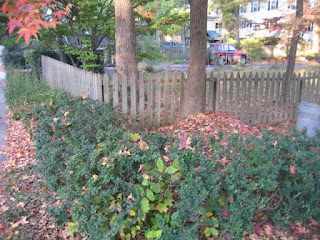
Here's the view from the street. The shrubs are privet, but a native evergreen alternative would be inkberry (Ilex glabra). Other smaller native shrubs--not evergreen but with attractive flowers, would be Itea virginica, Clethra alnifolia or Fothergilla. The main idea is to reconfigure how shrubs of any kind are planted in the yard, so as to create refuges for leaf piles that will quickly be flattened down by the weight of rain and snow and benefit shrubs and trees through the steady process of decomposition. Sectioning off a "room" in the yard also breaks up the monotony of shrubs lining the fenceline and foundation.
Whether ground up or piled in a corner, leaves serve as a natural fertilizer and increase the capacity of the yard to absorb rain. The more organic matter a yard contains, the more moisture it can hold, which helps buffer the yard from extremes of rain and drought. A soil rich in organic matter welcomes the rain, which in turn reduces runoff into the streets and, collectively, the amount of flooding downstream.
Mow them back into the lawn
The easiest option by far is to mow the leaves back into the lawn--an approach recommended by county extension offices around the country, and even by company sites like Scotts Miracle Grow. They've studied it, and concluded that the ground up leaves provide valuable fertilizer for the lawn, and do not cause any problem with thatch.

Some kinds of leaves make this method particularly easy. Pine needles and honey locust leaves are so small they don't even need to be chopped up by a mower, or can be raked underneath shrubs to serve as a mulch. Leaves of silver or red maple also tend to "melt" back into the lawn, decomposing quickly.
Grind leaves up with an electric leaf mower/vac
This will take care of leaves the lawnmower can't reach. Electric leaf blowers are quieter than the gas varieties, and some designs can be reversed to vacuum up leaves and grind them. I have not tried this method, but the NPR show You Bet Your Garden had a segment singing the praises of leaves ground up this way as mulch for flower beds. Even if you buy locally, you can check out reviews of various brands here on Amazon, with prices well under $100.
Make Room(s) For Leaves in the Yard
If you choose to collect leaves into piles rather than grind them, the question becomes where to put them if not on the street. One factor that makes people more likely to blow leaves out to the street is that most yards lack "rooms." The typical yard has shrubs pushed against the house and fenceline, defining only one sprawling "room" that extends uninterrupted to the curb, all of which is then required to be ornamental.
Houses have rooms that separate utility and storage from living areas, so why not yards? If you use shrubs or wooden walls to define and screen small utility areas in the yard, it becomes very easy to store leaves while they decompose and slowly return to the soil from which they came. Nature's miraculous trash-free economy is then allowed to function, and we're spared a big mess in the streets and the considerable municipal cost of hauling, grinding and mechanically turning leaves at a distant composting center.

The photo shows one such configuration in a friend's backyard. The wall provides screening between the utility area with compost pile and tools, and the ornamental garden to the left.

Another way to break up space and screen a leaf pile from more ornamental areas is to plant shrubs out a distance from the fence. The leaves can then be piled inbetween the shrubs and the fence. Though a back corner is the most logical location, the one in the photo is next to the street.

Here's the view from the street. The shrubs are privet, but a native evergreen alternative would be inkberry (Ilex glabra). Other smaller native shrubs--not evergreen but with attractive flowers, would be Itea virginica, Clethra alnifolia or Fothergilla. The main idea is to reconfigure how shrubs of any kind are planted in the yard, so as to create refuges for leaf piles that will quickly be flattened down by the weight of rain and snow and benefit shrubs and trees through the steady process of decomposition. Sectioning off a "room" in the yard also breaks up the monotony of shrubs lining the fenceline and foundation.
Whether ground up or piled in a corner, leaves serve as a natural fertilizer and increase the capacity of the yard to absorb rain. The more organic matter a yard contains, the more moisture it can hold, which helps buffer the yard from extremes of rain and drought. A soil rich in organic matter welcomes the rain, which in turn reduces runoff into the streets and, collectively, the amount of flooding downstream.
Subscribe to:
Posts (Atom)