Showing posts sorted by relevance for query compost. Sort by date Show all posts

Wednesday, September 25, 2019

How to Reduce Princeton's Pollution of Local Waterways


It's been heartening to see Sustainable Princeton alerting residents to the dangers posed to local waterways by the common practice of tossing loose leaves and other organic matter into the streets. Yardwaste often sits for weeks in the street, decomposing and releasing nutrients into stormdrains connected to Carnegie Lake. Three SP mass emails have pointed out how the nutrients in leaves contribute to algae blooms. Nutrient runoff also reduces the dissolved oxygen aquatic life needs to survive.

Many people probably think that by putting leaves on the streets, they are contributing material that will laudably be turned into fine compost at the ecological center. Though it's true that the composting center makes fine compost, there are some environmental downsides. Fossil fuels are burned to collect the leaves, and even the industrial scale composting process is fuel-intensive. Exporting organic matter makes one's soil less absorbent of rainfall, adding to downstream flooding. In addition, the combined collection of leaves and brush from Princeton and Lawrenceville has overwhelmed the 5 acre composting center's capacity.

It's easy for most residents to avoid putting leaves out in the street, by using various methods described on SP's Sustainable Landscaping webpage, yet these "leave the leaves" strategies are unlikely to be widely adopted, for a host of reasons.

While Sustainable Princeton is calling on residents to utilize their leaves on their properties, Princeton's current collection policy has had the unfortunate effect of encouraging unlimited purging of organic matter from private properties. Rules described on the town website, designed to abide by state laws limiting organic pollution in the streets, have proven difficult to enforce. The result is that residents and their landscapers throw leaves and other yard residue out into the streets without regard to complex collection schedules. This highly visible behavior, often in violation of state law and local ordinance, is then emulated by neighbors, until the least environmentally friendly behavior becomes the norm. No amount of education can overcome town practices that lead to unlimited purging.


While investing heavily in loose pickups, the Princeton Public Works Department has shown little interest in offering residents better options for containerizing leaves. The only option currently is to squeeze the leaves into single use yardwaste bags. Leaf piles are mostly air, and a surprising quantity of leaves can be compressed into the paper bags, but they are an imperfect means of containerization. The bags get wet in the rain, are unstable and difficult to drag to the curb.


In addition, the town only collects bagged yardwaste for 17 weeks each year. During the large gap in service during the summer, the streetscape is adorned with the huddled masses of uncollected leaf bags that must wait until October for collection to resume. The bags also hide their contents, which may include forbidden materials like soil and rocks.


There is also a disconnect in people's perceptions, in which residents seem unaware that the pile of yardwaste they place next to or in the street might spoil the curb appeal of an otherwise well-groomed yard. Residents on busy streets often place their loose yardwaste on the extension, which then kills the grass, further marring the Princeton streetscape.

Since Princetonians pay high taxes and yardwaste collection is one of the most visible services provided in return, the only solution I know of is to begin offering residents a better option for containing the yardwaste. For a minimal investment, the town could augment its current bagged leaf collection by providing compost carts of the sort used widely elsewhere in the country. These have large capacity, covers and wheels. Distributed to interested residents, for a onetime fee or for free, compost carts can containerize the majority of leaves and other yardwaste currently being tossed loose in the streets throughout spring and summer. In combination with techniques like mulch mowing that reduce the quantity of leaves that might otherwise be piled in the street, compost carts can play an important role in the fall season as well.

Collection of containerized leaves in compost carts in bags could either be increased to weekly through most of the year, or the 17 current pickups could be made every other week rather than weekly.

With better containerization options, achieved with minimal investment by the town, public works officials will have more reason to expect residents to abide by local and state law, since residents can begin using compost carts to store their yardwaste until pickup day, rather than making illegal piles in the street. Town streets will become more attractive, less hazardous for bicyclists, and less polluting of local waterways. Ultimately, the town may be able to reduce the expensive loose collections as containerization provides more frequent and consistent service to residents.

In addition, compost carts will enhance the capacity of collection crews to enforce regulations. The carts reveal their contents when emptied into the truck, so that any unallowed materials can be seen, and a notice of violation easily placed on the cart. If carts have scannable identification codes, then notices of violation can be sent electronically by email. Currently, if residents put banned materials loose in the street, like grass clippings, the only practical option for enforcement is to leave the banned materials uncollected, to continue rotting and releasing even more nutrients into local waterways.

Past attempts to make compost carts available to residents have been stymied by a tendency of decision-makers to be quickly swayed by objections, whether valid or not. The compost carts are improbably characterized as being both too large for residents to store and too small to hold sufficient amounts of yardwaste. One official questioned the durability of the carts. Though it's useful to vet any new service, there needs to be a sympathetic entity willing to vet the objections as well, keeping in mind the many benefits. Why, we must ask, would compost carts not work in NJ when they are widely used elsewhere in the country?


Most importantly, compost carts will be an educational tool to shift habits. Standing on the curb on collection day, one day a week, a compost cart provides a strong visual cue to neighbors that containerization is the behavior to emulate.

Wednesday, December 02, 2015

The Cost of Free Leaf Bags in Princeton

Here's an idea for freeing up 720 hours of public works staff time, equivalent to $20,000 in the municipal budget every year, while benefitting local businesses and actually improving service.


For years, Princeton has been giving away leaf bags in the spring and fall. It sounds like a good program--a way to encourage homeowners to containerize their leaves rather than pile them in the street where leaves can be an environmental and safety hazard. Each resident can get as many as 40 bags per year at no cost--a nice perk.

But how does this program actually play out? The bags are stored in this shed near Community Park Elementary. Within the shed, eight hours a day, five days a week, 18 weeks a year, sits one or another of our full time public works department employees. At $30/hour, including benefits, that works out to more than $21,000 per year spent to man the shed. A staff member told me that they do no work other than to wait for a resident to come along to take some bags. (Note: Senior staff later stated that staff in the shed also perform other duties, though it's not clear what.) Some days, 25 residents may show up, but on rainy days, nobody comes.

This past year, according to data provided by staff, 13,200 bags were distributed, purchased for $0.40 per bag. The $5280 cost for the bags was paid through a Clean Communities grant, but the staff cost to sit in the shed comes to $1.60 per bag. That means Princeton is spending $2 to buy and distribute each bag. For contrast, leaf bags can be bought at Ace Hardware in the Princeton Shopping Center for $0.50 each.


The "free" leaf bag program, then, turns out to be a costly way of dispensing leaf bags. The 20 bags in this photo provide a much neater way of dealing with leaves than piling them loose in the street, but they also represent a $40 subsidy by the municipality under the current program.

An alternative approach, which would free up those 720 hours in staff time for other work, would be to have a local business stock the bags. The local hardware store, for instance, could serve as the outlet, tracking how many bags it gives out and to whom. The municipality would then reimburse the business, at a quarter of the current per-bag cost. Unlike the town's shed, local businesses are open on weekends, when homeowners are most likely to want the bags. One store manager responded favorably to this idea.

A way to save even more money would be to shift away from subsidies of one-use bags. As the Princeton Environmental Commission has pointed out, paper bags require even more energy to manufacture than plastic bags. The paper mill I studied during an environmental field trip to Savannah, GA in the 1970s polluted the air for miles around, and lowered the water table to dangerous levels that invited saltwater intrusion and left other people's wells dry. Paper is no great gift to the environment.


In addition, the leaf bags are hard to fill, get wet in the rain, can be too heavy for our less muscular residents to haul around the yard, and are unstable if not set very carefully at the curb. This is not an argument for discontinuing the leaf bag collection, but brings into question the investment in a public subsidizing of their use.


Fortunately, there's a better approach used in many other municipalities around the country. This past year, I worked with town staff, a town council member, and members of the Princeton Environmental Commission to develop a proposal to try compost carts for leaf and yardwaste collection in one of Princeton's five "zones". This sort of cart is used in Princeton by cost-conscious and service oriented private companies like Waste Management to collect recyclables downtown and at local schools. A small 32 gallon version of a compost cart is used to collect foodwaste from participating residents.

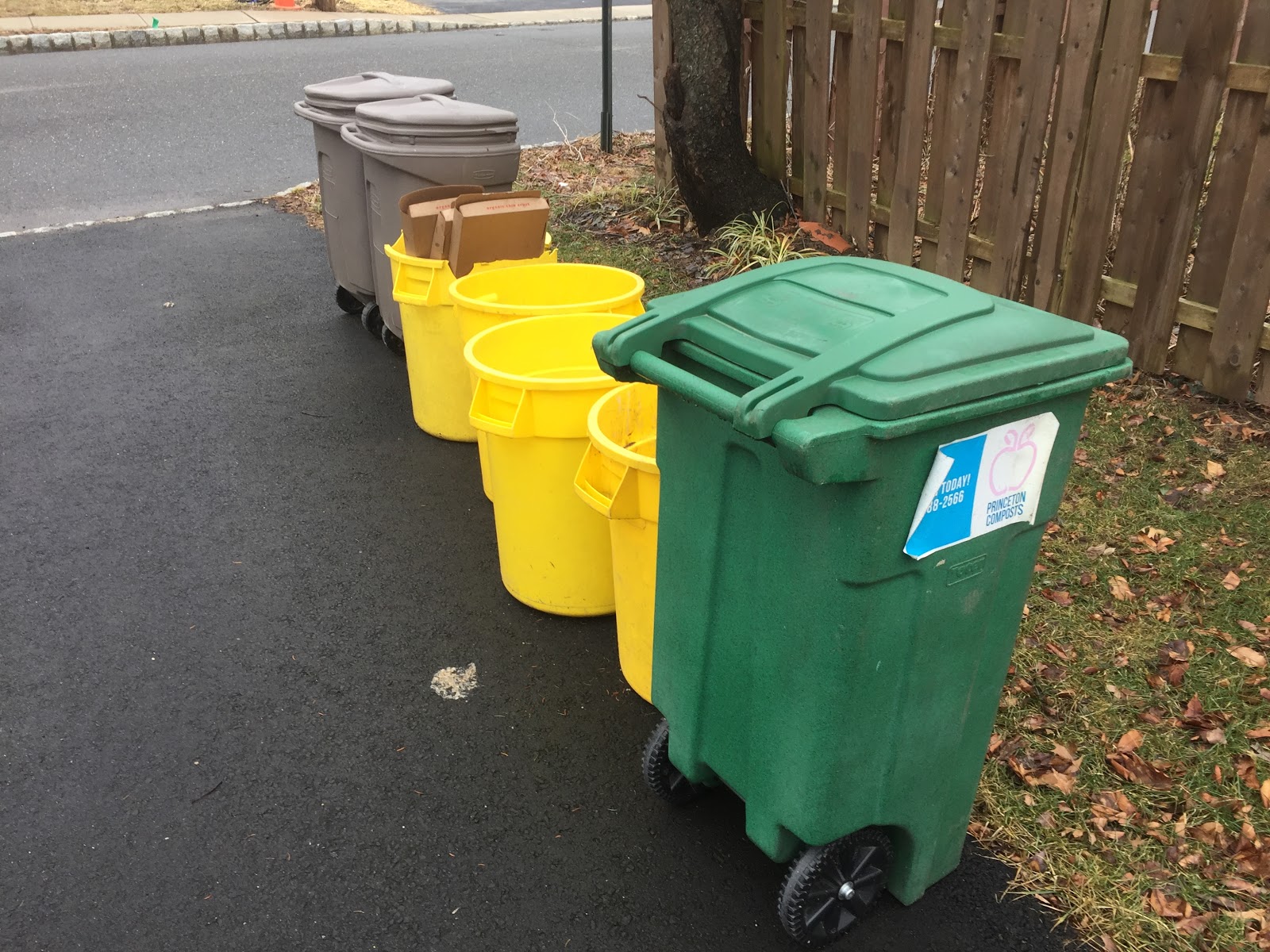
Since a 64 gallon compost cart, such as the one in this photo, would hold the equivalent of three leaf bags (each bag holds 30 gallons, but most people fill them only to 2/3rds full or even less), each filling of a compost cart by a resident is equivalent to a $6 savings in municipal bags. Over the course of a 26 week pickup schedule, the compost cart could handle the equivalent of $150 worth of the town's leaf bags, while costing only $35 to purchase. Over the course of a ten year lifetime, that investment of $35 to buy the compost cart yields $1500 in leaf bag equivalent benefit, for each participating resident. Even if the typical resident wouldn't use a compost cart every week, that's a serious perk for homeowners.

In addition to their potential for providing great benefit at low cost, compost carts are easier to fill, easier to move about the yard, easier for crews to empty. They keep the contents dry and can last for decades, and have been successfully deployed by many municipalities elsewhere in the country. The proposed pilot program that we worked hard to develop would have given residents a chance to try compost carts and discover their benefits. Since the carts would be emptied by the same truck that picks up leaf bags, there would be no extra ongoing cost to using them. Startup costs would be $5000 for a "tipper hook" retrofit on an existing truck, and $3500 for the first 100 compost carts. Though leaf bags and loose leaf pickup would continue, the use of compost carts could expand until residents would find that they can easily deal with their leaves with a combination of carts and backyard composting, steadily reducing the need for the more expensive leaf bag and loose leaf pickups.

Princeton will eventually discover that adding compost cart service is the best way to save money while providing greater convenience and consistency in service, but resistance to trying new approaches is greatly delaying progress, and is keeping Princeton from being a leader in NJ, where so many towns are struggling with the same issue. Even the modest proposal for a pilot program, refined during meetings over the course of a year, was voted down by the solid waste committee, before a case for its adoption could be made at a public meeting.

You can see why so many environmentalists in town are feeling exhausted.

At least the free leaf bag program shows promise of being amended. My presentation to town council on Nov. 23, 2015, and council members' response, can be found at this link, between minutes 18:45 - 22:55.

Monday, August 12, 2019

Princeton Council Decides To Acquire a Food Waste Bio-Digester

Princeton's council members voted 4-1 to acquire a used bio-digester from MetLife. Though the machine is being given to Princeton, the municipality will have to spend about $20-25,000 for transportation and repairs. Princeton will later decide whether to actually use the machine. It would cost an estimated $316,000 annually to collect and compost participating residents' foodwaste. During public comment, some citizens spoke in favor of the acquisition, but interestingly, three of Princeton's most devoted environmentalists questioned the wisdom of acquiring the machine, despite their support for composting in general. In addition, the one dissenting vote came from council's liaison to the Environmental Commission, Eve Niedergang.

Here are my notes from watching a video of the presentation, discussion and vote. (The topic essentially consumes the first hour and a half of the video). As far as I could tell, no examples of successful programs elsewhere in the country utilizing the Brome digester were offered. Though MetLife reportedly used the machine for three years, no details were given on its dependability and the quality of the product. Council members made clear that they were voting only to acquire the machine. The considerable expense of using it will be decided in future votes. Now would seem to be the time to also be closely considering alternative approaches that could prove to be lower tech and lower cost. No mention was made of a backup plan if the machine were to break.

THE BIO-DIGESTER
  • A Brome 1624 model, worth $300,000 new, used for three years as a symbol of MetLife Stadium's sustainability efforts, then discontinued when new management took over. Has been sitting unused for 2 (?) years. An internet search yielded no results for the machine make and model, but exploring this site could prove instructive: https://www.bromecompost.com/en/. Princeton University's digester is a different make.
  • MetLife needs to get the biodigester off of its property soon, and gave Princeton a deadline for deciding whether to accept the gift. 
  • The biodigester will be transported to a MetLife partner, Premier, which will do minor repairs, e.g. rust and dent removal, then the machine will be moved to an as yet unknown location in or around Princeton. In a report by town manager, Marc Dashield, council was told that the cost for transportation, repairs and assembly would not exceed $25,000. The town would then need to decide whether to use the machine or try to sell it. 
  • The machine's capacity can be checked in the video (16 cubic yards?, per month?, expandable to 24 cubic yards with an extension?)
LOCATION FOR THE OPERATION
  • A big problem with Princeton previous foodwaste collection program was that the foodwaste had to be hauled long distances for composting, at sites in Delaware or Pennsylvania. The aim with the biodigester is to locate it either in Princeton or on a nearby farm. The River Road facility is one option.
  • Matt Wasserman, former Princeton Environmental Commission chair and longtime president of Sustainable Princeton, would be the project manager.
CURBSIDE COLLECTION AND HAULING
  • Different options for private or public operation were offered, with estimates of costs. Though the most expensive option would be for the municipality to haul and process the foodwaste, the town has found private operations to be undependable.
  • The total cost per year is estimated to be $316,000 ($14,000 debt service on a $110,000 vehicle, $5000 for fuel and maintenance, $162,000 for two employees, $35,000 for education, $100,000 for processing)
  • $69,000 could potentially be saved in reduced landfill costs
  • Cost would work out to $165 per household per year, with half of that being paid by taxpayers, half by the participant
RISK OF ACCEPTING THE GIFT OF THE BIODIGESTER
  • It was repeatedly stated that the vote to acquire the machine would only cost $20-25,000, some of which could be recouped by selling the machine, if council later decided not to move forward with using it. It was explained that MetLife preferred to take a tax writeoff by donating the machine, rather than try to sell it. If nothing else, it could be sold as scrap.
MARKET FOR COMPOST
  • local farmers buy compost currently for $50-100 per cubic yard from Vermont Compost
COUNCIL COMMENTS ON THE DECISION
  • Dwaine Williamson views the decision in terms of risk and potential reward, and doesn't see much downside.
  • Tim Quinn trusts our professionals to mitigate any potential risk
  • Eve Niedergang said that the more she dug into the details, the more concerned she became. Running the Princeton University digester is a full-time job. It requires a structure, which must be heated in winter, plumbing, etc. Another structure would be needed to house the compost while it cures for 4 weeks. Would runoff be an issue? She is concerned about the municipal staff and council time being devoted to the project with no guarantee of success. She sees many unknowns, and has found the project to be much more complicated than she expected. A digester is not the most ecological way to deal with foodwaste. She sees the potential for a cascade of expenses for an approach that ultimately may not work.
  • Dwaine responded by emphasizing the urgency of the decision, given MetLife's deadline. He assumes we can sell the machine, and sees the vote as very narrowly defined as acquisition only, not actual use.
  • Mayor Liz Lempert said that NJ Dept. of Env. Protection has committed to a 50% reduction in food waste being landfilled in the state, with no plan on how to reach that goal. She said that Princeton U's use of a digester suggests that they decided it's a good idea. She believes the Brome digester doesn't need to be indoors, and thanked Josh Zinder, the local architect who made Princeton aware of the MetLife digester's availability. She pointed to lessons learned in the past, particularly that we need to be in control of the process.
  • Eve pointed out that the numbers presented at the meeting were not available to council members until that afternoon, leaving no time to look at them. She asked why the town is projecting 2000 participants in year 4 when Princeton was only able to find 900 participants for the previous version of the program.
  • Liz defended the need for a curbside collection program by pointing to the strong interest shown (council chambers was filled twice during previous meetings to discuss the subject), and said that surveys show that many residents are not willing to compost in their backyards.
  • Though David Cohen voted to acquire the digester, he said Princeton needs to be ready to cut the program off if it proves unfeasible. We "can't be led down the primrose path." He also mentioned distributed collection centers as potentially useful, regardless, for people who live in apartment buildings and can't participate in curbside collections.
  • Councilmember Fraga said she tends to be an optimist, and so is supporting the acquisition.
PUBLIC COMMENT
  • Bainy Suri: We're not setting the right example. She mentioned Bergen County was making backyard composters available to residents at low cost. It doesn't make sense to replace a pilot program with another pilot program. This program is not scalable, given the limited capacity of the machine.
  • Another longtime environmental advocate in town agreed with councilmember Niedergang's concerns, and said that the information being used to make the decision was not available to the public prior to the meeting. There has not been enough research done. We need to be more sophisticated, and focus more on education and reducing the generation of foodwaste. Are there any examples of a digester working elsewhere?
  • Another local environmentalist said that councilmember Niedergang made good points, called for public/private partnerships and education.
  • Another longtime local environmentalist recommended "centralized composting in open rows," as opposed to the containerized digester. She pointed to stubbornly low participation rates in the previous foodwaste collection program, resistance of residents to being charged extra for composting and less for not, the inconvenience of multiple pickup days between trash and compost. She said that a digester rated low in comparison to other potential actions that could be taken to reduce the amount of foodwaste being landfilled.
  • Joshua Zinder was enthusiastic about his previous experience with curbside foodwaste collection, which he said had reduced his trash by 50%, and sees foodwaste collection as the start of something bigger. "We should be a leader."
  • One resident supportive of the acquisition said that his backyard composter had quickly filled up. (The compost process greatly reduces the mass of material, so it's not clear how his composter could have filled up unless it was undersized and wintertime, when decomposition is slowed.)
  • There was about a 50:50 mix of positive and negative comments by the public.
RELATED POSTS
Related posts on this website can be found by typing "compost" into the search box, or going to this link: https://princetonprimer.blogspot.com/search?q=compost

Designs for a homemade leaf corral and critter-proof foodwaste composter can be found at this link.

Town Topics reported on the meeting at this link.

Sunday, February 24, 2019

A New Use for Princeton's 1000 Green Compost Carts


With the suspension of Princeton's curbside organics collection, about 1000 households now have green compost carts that have gone idle. Residents have been asked to keep the green carts, but the suspension of service could continue indefinitely.

Is there a good use for the carts in the meantime, particularly given that the meantime could last a long time? One excellent and appropriate use is for yardwaste. For fifteen weeks in spring and summer, Princeton has a truck that picks up bags of yardwaste curbside. The green carts are the same size as a full yardwaste bag, so could easily be integrated into the existing program.

Residents could of course, still use the yardwaste bags, but will find the green cart a very useful addition, since it has wheels for easy transport and a top to keep the contents dry. Containerizing yardwaste helps keep streets clean and unobstructed, and prevents the killing of grass when loose yardwaste is placed on the extension next to the curb. Ultimately, containerization could give Princeton beautiful clean streets for most of the year.

Would some residents be confused and, out of habit, mix food scraps in with the yardwaste? The solution is to clearly mark the green carts so that residents know what's allowed and what's not allowed. If and when Princeton resumes its food scrap collection, the yardwaste-only signs on the green carts could easily be covered over. This points to a major advantage of compost carts for containerizing yardwaste. Unlike single use yardwaste bags, the compost carts can be clearly marked as to what contents are allowed, and the crews get to see what's inside when they empty the carts' contents into the truck. Any violations can be spotted, and a warning placed on the emptied cart to set the resident straight.

The curbside programs for collecting yardwaste and recyclables have both been hampered by contamination. Rules are constantly being broken due to lack of enforcement. The recycling program, however, is run by the county, so Princeton cannot enforce the rules. The food scrap "organics" collections were contracted out, again making enforcement difficult. Though the collection of loose leaves and brush is done by town crews, the nature of that process has made enforcement difficult.

Only the collection of containerized yardwaste provides hope for enforcement that will reduce contamination. Collection is done by town crews, who can be trained to give feedback, and most importantly, notes of violation can easily be attached to the container and left at the curb.

With 1000 green compost carts sitting idle, this would seem an ideal time to deploy the compost carts in a useful way, at no expense and with no reduction in any existing service.

Tuesday, April 23, 2013

Curbside Composting and the Extra Work of Going Halfway

The curbside pickup of organic waste has been in the news lately. Actually, the program, designed to keep food scraps, grease-stained pizza boxes, etc. out of the landfill, has been persistently promoted in local papers since its inception two years ago.

According to data supplied by Sustainable Princeton, the program had 460 participants prior to consolidation, and has reached almost 600 now that the annual cost has been reduced to $65.

Those I know who have signed up for the service express surprise and delight at how much they've been able to reduce their trash production by diverting organics into the little rollout bin. Organics dumped in a landfill produce methane, some of which escapes into the atmosphere where it is a powerful agent of global warming.

COMPOSTING IN THE BACKYARD
Though I prefer to compost in my backyard, I can attest to the convenience of putting food scraps into a little compost bucket on the kitchen counter, and the lack of odor. With recycling and composting, we rarely fill a trash can more than once every two or three weeks.

I've never found it necessary to "turn" a compost pile, but instead let it all decompose of its own accord and in its own time, so there's really no work involved beyond a backyard stroll every couple days to empty the bucket. If the squirrels or the chickens (see PrincetonNatureNotes.org for posts on having chickens in Princeton) help themselves from the small heap, no harm's done as far as I can tell. Some white or brown papers, like greasy portions of pizza boxes, or those "compostible plastic" cups that aren't supposed to go in with the recycling, get thrown in as well.

THE EXTRA WORK OF A VOLUNTARY PROGRAM
In some ways, the curbside program is a good example of how a halfway environmental measure is more work than instituting a bigger change. The voluntary program is a good start, and will hopefully lead in the fullness of time to a mandatory program, but the years-long work of encouraging, signing up, and equipping new participants takes a great deal of staff time. To that extra work is added the inefficiency of a truck driving all over Princeton to service the scattered residents participating. There's really no good reason other than habit and custom for people to be mixing organics in with their trash. Recycling is required, and organics recycling should be also.

DESTINATIONS
One possible holdup is that there's no food composting facility nearby. Currently, the foodwaste is hauled 70 miles down to Wilmington. There had been talk of Princeton teaming up with the university on an odorless compost system to be located on River Road, which sounded promising. The university currently sends all of its food waste to a pig farm. Given the high quality of university food, I'd say the pigs are eating high off the hog.

A PARTIAL ANSWER TO THREE RELATED PROBLEMS

Princeton has three related problems: 1) most foodwaste is going to the landfill, 2) yardwaste makes the streets look trashy except for two months in the winter


(It's particularly paradoxical in the springtime, when one can look up and see beautiful flowering trees,

then look down and see lumps of yardwaste dumped at the curb),

and 3) the town is dependent on imported, climate-destabilizing fuels.To move towards solving these problems, anyone choosing not to compost in their backyard would put organics and yardwaste in a rollout bin (larger than the green composting bins) for weekly, year-round collection. That would keep food out of the landfill, and keep the streets much cleaner, with brush pickup and fall leaf season as exceptions.

Ideally, all these mixed organics would head to a nearby center where the solar energy embedded in them would be turned into fuel, and the remains would become fertilizer. This is being done in some cities, mostly in Europe, where the monetary consequence of burning fossil fuel more closely reflects the environmental consequence.

Saturday, May 22, 2021

Another Reason to Containerize Princeton's Leaf and Yardwaste Collection

This blog has long made the case for Princeton to progressively shift towards containerization of leaves, yardwaste, and brush. The aim would be cleaner streets, better compliance with state and local requirements, and substantial reduction in costs for taxpayers. There are many additional reasons why municipalities elsewhere in the country have adopted containerization over collecting loose material tossed in the street. 

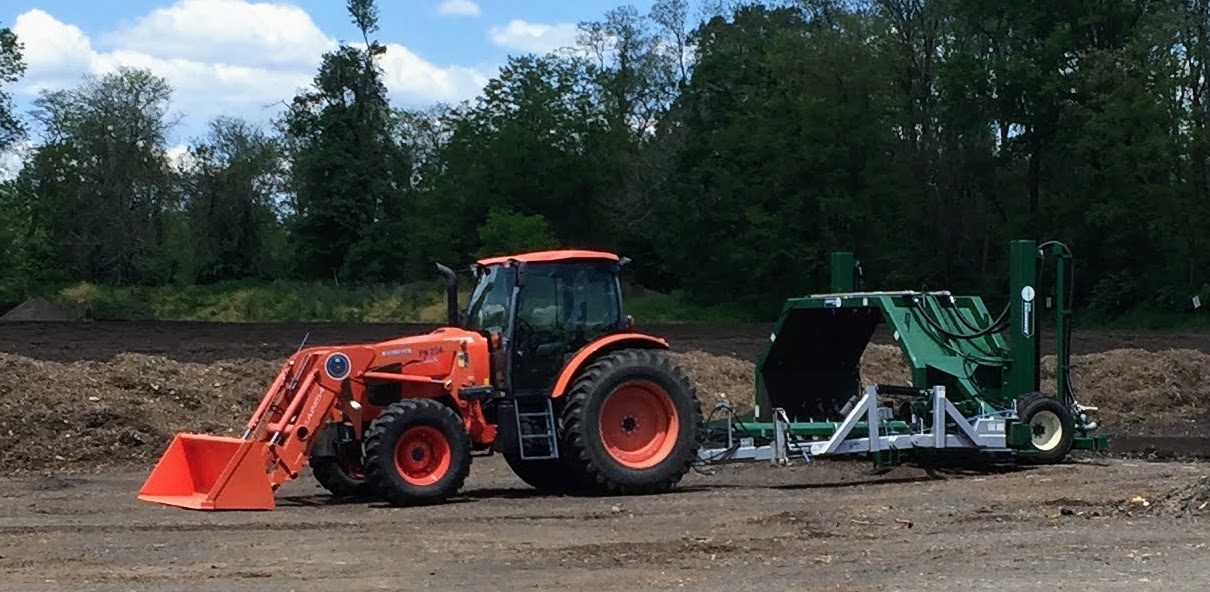
A recent trip to the Lawrenceville Ecological Center offered yet another reason to make the shift. The composting site, out on Princeton Pike, is a wonderful facility, with windrows of compost stretching into the distance. They produce two products, one of which is composted leaves, the other twice ground wood chips. Both of these get piled high and are available for residents of Lawrenceville and Princeton at no cost.

It sounds great, and is great, but they do have a problem. There's more compost and woodchips than they can get rid of. In the first photo is the big pile of compost that has been sitting there for more than a year. And the Lawrenceville public works director told me that the demand for their double ground woodchips has declined since homeowners have come to prefer the darker look of artificially dyed wood chips. 

It's expensive, in fuel and staff time, to compost material that then accumulates unused on-site. 

How would containerization help reduce the excess product, and thereby save Lawrenceville and Princeton significant cost? The limited capacity of a large compost cart would create an incentive for homeowners to utilize some of their leaves in their own yards, by mowing them back into the lawn, leaving them under shrubs as mulch, or piling them in a back corner to return to the soil. It would also reduce the noise of gas-powered leaf blowers, which classically drone on while blowing loose leaves into the streets. 

By providing homeowners with large rollcarts, the town would achieve a much-needed compromise between the current massive loose collection of yardwaste and the "leave the leaves" approach many environmentalists promote. Such a change can be phased in, integrated into existing collections of yardwaste bags, and targeted initially for residents on busy streets where piling loose material in the street is not an option. Like many public policy issues, this one has many layers of complexity, and will require receptivity to change, and a recognition of what has worked elsewhere. 

Friday, August 26, 2022

Princeton Proposes a New Approach to Collecting Trash and Foodwaste

Princeton is trying to deal with rising costs for collecting and disposing of solid waste. According to the consultant Princeton hired, Wayne Defeo, other municipalities have seen increases of 45-150% when they seek bids for new contracts. Scarcity of workers has caused salaries to increase. Injuries, and therefore workmans compensation claims, are common in this line of work. Princeton has its trash hauled to a transfer facility at the Mercer County Improvement Authority, whose costs are the highest in the state. 

Princeton's current contract will end in December, 2022, providing an opportunity to do things differently and potentially minimize the increased cost of a new contract for collection next year. The town describes the options it is considering on its website. Below is a description that includes additional information gleaned from a presentation at town council on August 10.
One strategy the town will use to control rising costs is to automate collection. Instead of having a driver and two crew members collecting trash, an automated truck has only the driver, plus a mechanical arm that grabs a trash cart and empties its contents into the truck. This approach requires a particular kind of cart, sturdy enough to be lifted mechanically, and so Princeton is planning to provide each resident with a new cart that can be lifted by automated garbage trucks. There are different sizes of carts: 32, 64, or 96 gallon. Princeton will likely go with the 64 gallon size, though residents may be able to request a different size. The carts would have barcodes for quick identification, and labels describing what can be put in the cart.

Under this new system, which is typical elsewhere in the country, the trash cans residents currently own would no longer be useful for trash collection. The consultant stated at the August 10 council presentation (11:00 to 1:47:00) that residents' trash cans would be collected and either recycled or reconditioned and made available for reuse elsewhere. 

For bulk waste, that is, trash that a resident can't fit in the new 64 gallon carts, residents would need to make a reservation for free pickup. Bulk pickups would be weekly. Surveys of other towns found that 6-10% of residents put out bulk waste for collection. Each week in Princeton, the collection service would input data on what residents are requesting bulk waste pickup, and figure out the most efficient routes for their trucks to take. An app called recyclecoach was mentioned as one approach to making reservations, though reservations could also be made by phone.

Discussion at the council meeting suggested that bulk pickup is a service most commonly used in lower income neighborhoods, where renters come and go. 

The amount of trash generated by Princeton residents has increased from 5000 to 6000 tons over three years. One way to reduce the amount of trash headed to the Mercer County Improvement Authority and its high "tipping" fees would be to divert foodwaste from the waste stream. Foodwaste makes up 25% of the wastestream. Rather than sending foodwaste to the landfill, it would be collected separately and sent to a nearby composting facility. This could reduce the cost of tipping fees for this portion of the wastestream by 30%. Residents could also put herbaceous (not woody) yardwaste in the carts. 

Thus, Princeton will seek bids to divert foodwaste from the landfill and send it instead to a local composting facility. A foodwaste composting program would only be implemented if the bids prove affordable.

Princeton had a voluntary foodwaste program in the past, but it was terminated in 2019 due to lack of nearby facilities and problems with contamination. A particular problem was that some participants put their foodwaste in non-biodegradable plastic bags that messed up the composting process. Some plastic bags are compostable. Others are not, and will contaminate the composting operation.

Why does Princeton think that foodwaste collection and composting would work now when it did not in the past? Staff offer a number of reasons. New composting facilities have opened up, particularly one in Trenton that uses foodwaste to generate energy and a useful compost. In addition, the municipality has put together a staff that will be better able to monitor the program and educate residents on how to recycle foodwaste correctly. 

Princeton is therefore seeking bids from haulers for weekly collection of foodwaste from all residents. If the bids prove affordable, Princeton would go ahead and begin collecting foodwaste curbside again. For this organics collection, each resident would be given a 64 gallon compost cart. All kinds of food, including meat and bones, could be placed in this cart. Potentially, some compostable types of paper, such as pizza boxes, could be placed in the carts as well. Though all residents would receive a compost cart, participation would be optional, at least at first. Residents would be required to keep the carts whether they participate or not, because separation of foodwaste from trash could become mandatory in the future. The town's new compliance officer would monitor compost carts placed at the curb, and help residents limit contamination. 

The relatively large size of the 64 gallon carts (the green compost carts used for the voluntary foodwaste program were 32 gallon) will make it possible as well to containerize some yard waste that might otherwise end up as little mounds decorating the streets yearround.

There are lots of questions to ask. Could residents get carts that are larger, or smaller, than the 64 gallon size? Will residents be supplied with countertop containers for holding foodwaste in the kitchen? If the separation of foodwaste from the trash is optional, how many residents will actually change their habits and make use of the carts they are given? Will monitoring and education be enough to control the contamination of the foodwaste stream that was a problem in the past?

All of this is a prime example of how complex are the basic municipal services that keep our town functioning. And this proposal does not include a plan for shifting away from expensive loose collection of yardwaste that leaves our streets messy year-round. In any case, change is a'commin'. The carts are standard elsewhere in the country. They have lids to keep the contents dry, and wheels for easy mobility. Sometimes change can be for the better.

Sunday, December 17, 2017

Making Sustainable Practices Visible


Behavior that makes a community more sustainable in the longterm tends to be invisible and inaudible. No one sees you not driving, or using less energy in the home. No one hears you raking leaves. Neighbors don't see a backyard compost pile. Solar panels don't make demands on our awareness the way traffic and airplane noise does. How then to model sustainable practices, given that people tend to copy what they see and hear their neighbors doing?

Have a pollinator garden, solar panels or compost pile hidden somewhere? Don't keep it secret. Tell the world. During a recent visit to Bloomington, IN, I saw a lot of these signs, indicating that the homeowner has some solar panels somewhere on the roof. Given all the reasons people can conjure for not adopting more sustainable practices, signs like these provide some reassurance that others have overcome their inner resistance and perceived impediments and taken action.


Lacking a sign, I decided to use a frontyard demonstration instead. Home composting of yardwaste and kitchen scraps is typically done in the backyard, while the more energy-intensive practice of piling leaves in the street for pickup by heavy machinery is highly visible. This "Wishing the Earth Well" leaf corral serves as a sign of sorts. Since the decorative hubcap was stolen (I guess it's a compliment), a pumpkin has been sitting in as a cap for the inner column where food scraps are tossed.


Gravity works in one's favor with a leaf corral. The leaves continue to settle, leaving room for more when the oaks drop their last leaves.


People often think compost piles need a lot of turning to aid decomposition, but if the leaves are moist and the leaf corral is set on bare ground, the decomposers work up through the pile on their own. This fall, the corral yielded a bucket and a half of high quality compost for the raised beds.

Demonstrations like this are made to show how easy and rewarding sustainable practices can be, if humanity ever chooses to adopt them.

Wednesday, March 14, 2012

Free Compost for Princetonians

Another of Princeton government's stealth services is free compost for residents. Word of mouth has worked pretty well on this one, but it hasn't always been easy to find info online, in part because the name of the composting center is the Lawrenceville Ecological Center or, even more correctly than that the Joseph H. Maher, Jr. Ecological Center.

There are two kinds of compost: composted leaves and thrice-ground woodchips. It's free if you shovel your own, otherwise something like $8/yd3 if they load it in your truck. They take checks, no cash. Drive out Mercer St past the Princeton Battlefield. It turns into Princeton Pike. If you reach I-95, you've gone too far. Address is 3701 Princeton Pike. This link provides more info.  


I used to go out there, but now I just find an arborist taking a tree down in the neighborhood, ask if they want to dump their woodchips in my driveway, and usually end up with a free load of chips. That way, I save myself, and the arborist, a trip out of town, and the chips last much longer as mulch than the already pretty decomposed product they give away at the compost center.

Note: A few caveats with the raw woodchips. They aren't as pretty as the dark, composted mulch, they may borrow some nitrogen from the soil during decomposition, and they may even host an "artillery fungus" that shoots tiny black blobs at your house. But it's still highly convenient and long-lasting stuff to use away from the house, in informal areas. 

Friday, August 23, 2019

Another Summer of Messy Streets and Ordinance Violations Begging for a Solution


We have a little dog named Leo, and though he didn't seem very interested in the solar eclipse two years ago, he does take an enduring interest in walking the streets of Princeton,

which gives me as longtime designated dogwalker the opportunity to update my ongoing report on the state of streets in our fair town.

Frequently, not just in the fall but almost year-round, the streets are lined with piles large and small of yardwaste, detracting from whatever beauty residential neighborhoods might have.

The state of New Jersey long ago made clear a preference for containerized yardwaste. Page 71 of New Jersey's "Model Ordinances" recommendations for municipalities states (emphasis added):
The owner or occupant of any property, or any employee or contractor of such owner or occupant engaged to provide lawn care or landscaping services, shall not sweep, rake, blow or otherwise place yard waste, unless the yard waste is containerized, in the street. If yard waste that is not containerized is placed in the street, the party responsible for placement of yard waste must remove the yard waste from the street or said party shall be deemed in violation of this ordinance.
This makes it sound like Princeton's program of loose yardwaste collection is completely out of step with state guidelines, but then the state provides a bit of latitude. Under Section III: Yardwaste Collection, the state's recommended town ordinance reads:
Sweeping, raking, blowing or otherwise placing yard waste that is not containerized at the curb or along the street is only allowed during the seven (7) days prior to a scheduled and announced collection, and shall not be placed closer than 10 feet from any storm drain inlet. Placement of such yard waste at the curb or along the street at any other time or in any other manner is a violation of this ordinance. 
Given the state's clear preference for keeping streets free of yardwaste, and an ordinance that limits the time any yardwaste can sit on the street to one week, what is Princeton's collection schedule? Regard below the complex schedule for yardwaste pickups that Princetonians are supposed to scrutinize and time their gardening with. Note that there's a 3-6 week gap between pickups in the summer. That means that residents have no way to legally dispose of yardwaste for many weeks. What happens is that residents throw yardwaste in the streets anyway, in violation of state and local law.

Further complicating disposal and collection, residents are asked not to mix leaves and brush at the curb. Brush is used to make woodchip mulch. A good mulch lasts a long time, but if leaves are mixed in with the wood, the ground up mulch breaks down too fast.


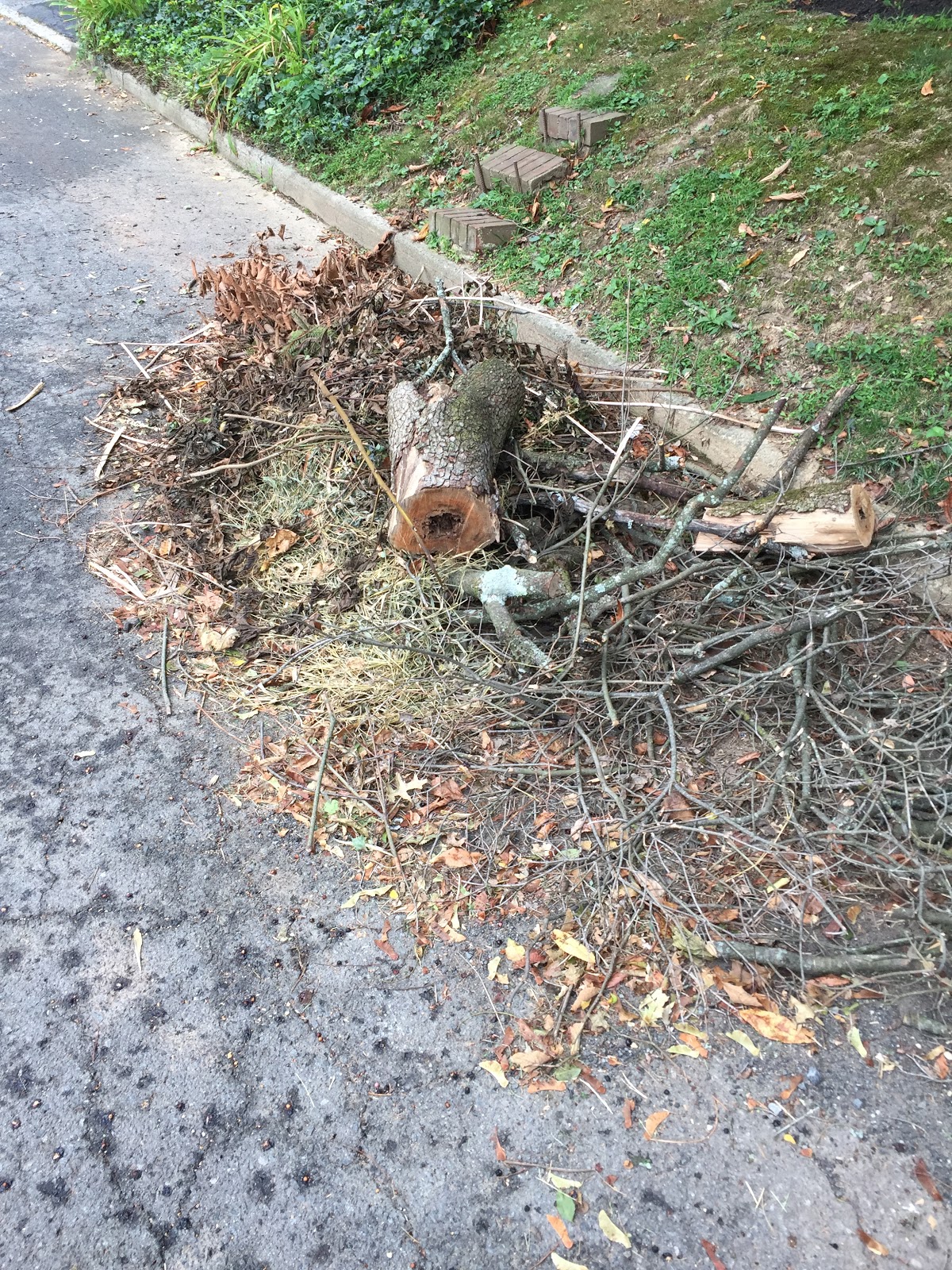
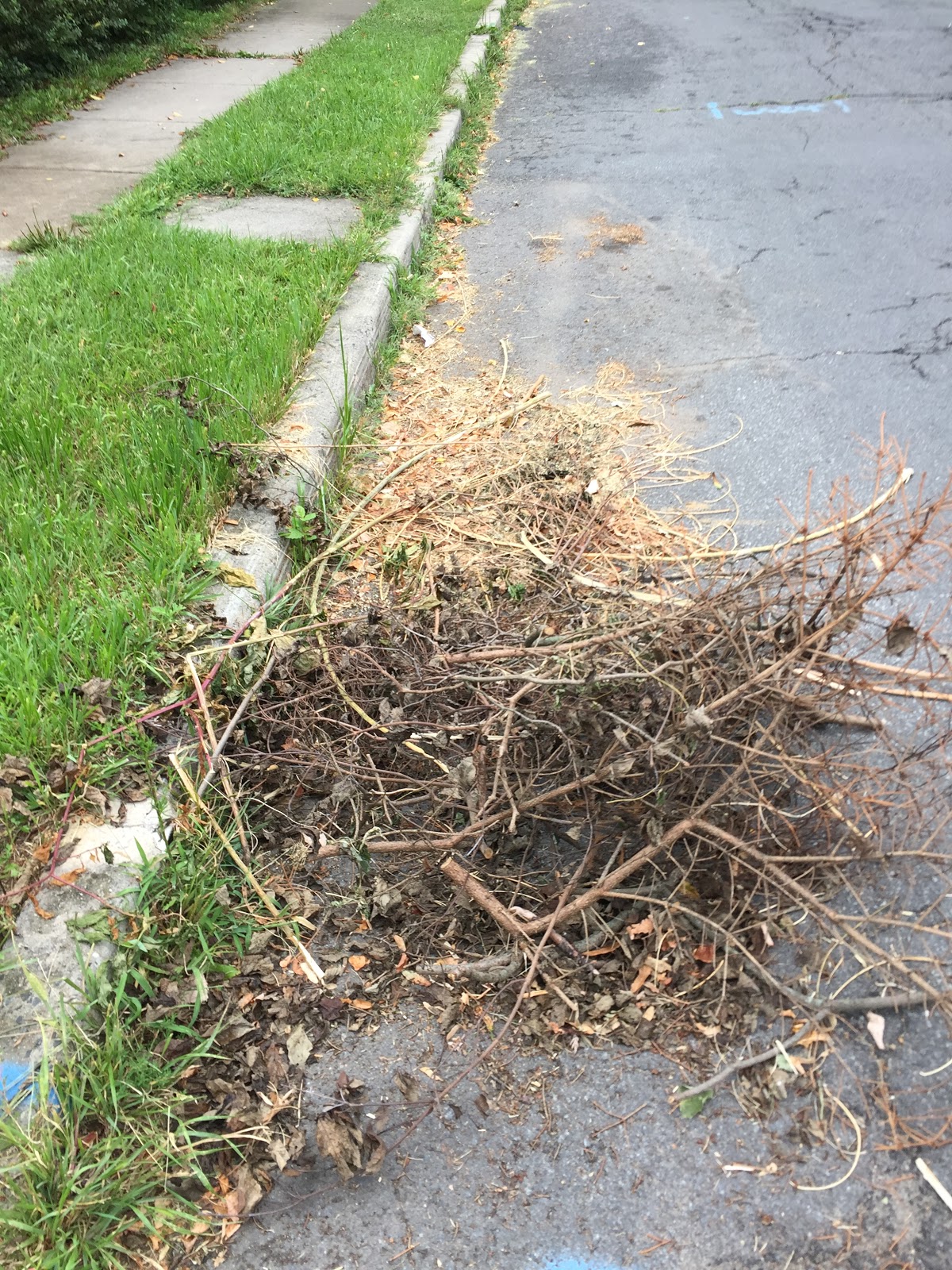
What is a resident supposed to do with non-woody yardwaste (called "leaves" in the schedule) from May through September, when no pickups are scheduled? Below is a collection of photos that provide an answer, taken along a two-block stretch of Linden Lane and Ewing Street. Essentially, the streets become a storage area for leaves and other herbaceous materials from the garden, mixed in with a few sticks.

The infrequent collections mean that state and local laws are regularly being violated, and the yardwaste that finally gets collected is likely contaminating the brush composting process at the Lawrenceville composting center. The town's collection program seems out of sync with resident's gardening habits, and makes it very hard to adhere to state and local law. Princeton is not the only New Jersey town that struggles with this problem, which has only increased over the years.

How many residents along a two block stretch currently lack a good way to legally dispose of yardwaste during the summer? Here's a count:

2nd pile

3rd

4th

5th

6th

7th

8th

9th

10th (Piling leaves/brush loose on the lawn kills the grass)

11th

12th

13th

14th

15th

16th

This appears to be mostly brush, but lots of leaves mixed in.

17th - piled too close to the stormdrain. Containerization would avoid this violation of ordinance.

18th

19th -- This one includes a flower bouquet.

20th

21st -- another violation that could be avoided by containerization

22nd

23rd

24th -- a mix of wood and herbaceous yardwaste.

25th -- containerization of non-woody yardwaste ("leaves") would avoid not only the clogging of the stormdrain but also the unsightly scar in the grass where a pile of yardwaste had sat too long.


One of the piles above later got grass clippings added to it. The town forbids putting grass clippings out for collection, because their high nutrient content could pollute local waterways, but some homeowners do it anyway.


And the fall's first pile of leaves in the street, blocking half the lane, in mid-August. These are probably leaves from a sycamore. Some species of trees, susceptible to this or that disease, tend to drop some leaves in the summer. The town's schedule doesn't have these leaves being picked up until October.

In the past, I've suggested that the town make large compost carts available to residents so that they can containerize much of their yardwaste and put it out on the curb for one of the weekly pickups. Nearly all of the piles shown above would easily fit into a large compost cart, so that they could be stored by the resident out of sight, rather than marring the streetscape for weeks.

These compost carts, widely and effectively used elsewhere in the country, have in Princeton been uncharitably described as either too small to hold sufficient yardwaste to make a difference, or too large for residents to store on their property. Why, when they are widely used elsewhere, would they somehow be both too large and too small for Princetonians?

In the meantime, our streets remain messy much of the year, with numerous violations of state and local ordinances. For gardeners who don't want to have a compost pile or leaf corral, there needs to be a convenient way to store and legally dispose of yardwaste.