Saturday, December 03, 2016
From Farm Silos To Leaf Corrals
How much do our ancestors speak through our lawn care? One of my grandfathers was a farmer/carpenter. The other doubled as an urban chemistry professor and summertime country minister. What a surprise that I bring a country ethic to town living, and am drawn to physical work while preaching a mix of a professor's science and a farmer's common sense.
That yellow aluminum patio chair out next to the curb in the photo? A neighbor left it next to a dumpster, destined for the landfill. What a waste, said the farmer in me, who wishes to see everything reused or recycled. There's some good aluminum in that. And so it ended up on my curb for the next scrap guy who drove by.
And the leaf corral, filled to the brim with leaves, standing proudly in the front yard for the community to see, and maybe even emulate? The satisfaction of filling it goes deeper that adhering to what every farmer and organic gardener knows, that nutrients need to be cycled back into the ground, not wasted out in a noisy, fumey purging onto pavement where the leaves become a hazard and municipal burden. That column, a gathered harvest of sorts, stirs a feeling of rightness as rewarding as a silo filled with corn to feed the cattle through the winter. I see it and remember drives through the farm country of Wisconsin as a kid, the silos standing like exclamation points next to the barns.
After a long rain, the leaves have settled down, leaving room for more. A leaf corral's quick settling accommodates the leisurely pace with which nearby oak trees drop their leaves.
New Jersey seems culturally hardwired to blow/rake leaves out onto the street. Leaves, with such a mindset, are the enemy of tidiness, a curse from above, to be sent out of town like troublesome kids exported to a boarding school. A leaf corral, whether displayed or hidden behind shrubs, offers an alternative to the pavement, and allows not only a tidy yard but a tidy and safe street as well. The leaves in the photo, which had blown against the curb and started to clog the drain, got raked up and put in the leaf corral. Multiply that small gesture 10,000 times across the community and you end up with clean streets, lower taxes, and more nutrients for people's yards. But such win-win-win arguments are like leaves in the wind against the bedrock of NJ custom. No doubt my grandfather ran into similar depths of habit in his Sunday morning ministering.
You can see the different pace of decomposition among different species. Those are oak leaves on the upper left, a Norway maple from across the street on the lower left, and silver maple leaves already crumbling up and transitioning back into earth. If kept reasonably moist, they'll all become compost by next fall in the leaf corral, without any need to stir the contents.
A close look reveals that the center of the leaf corral is a column of critterproof hardware cloth where kitchen scraps go, to decompose odorlessly along with the leaves.
This 3' diameter leaf corral holds enough leaves to disguise and buffer the inner foodscrap composter. A 6' diameter leaf corral holds far more, in fact is sufficient for the entire front yard.
Who knows what my grandfathers, whom I never knew, would think of this front yard contraption. I like to think I'm carrying on their tradition in my own way, in a new place and for a new century.
Thursday, November 24, 2016
Gratitude for Sustainable Non-Acts of Kindness
On this day of thanksgiving, give thanks to all those sustainable non-acts of kindness. Remember when a gap in traffic finally opened up on Route 1 so you could change lanes? That space happened because someone wasn't using their car that day. And that uncluttered look of the curb on trash collection day? That was because someone didn't put the trash can out because it wasn't full yet. And that wonderful silence a few mornings ago when your neighborhood wasn't plagued by the din of leaf blowers? That was the morning a neighbor didn't hire a landscape crew, and raked their leaves instead.
Thanks to those who don't care that everything they do to make the world less annoying is invisible. It doesn't matter that their house looks the same from outside whether their furnace is running constantly or not. They keep the thermostat lower because it's the right thing to do. They don those slim, ultralight down coats and are as comfortable inside as they would be if the furnace were cranked and great gobs of invisible CO2 spewed from the chimney.
In a strange world where helping to save the planet is completely optional, what we value is made more sustainable by the kindness of strangers, or by what we ourselves do. Treasure those non-acts of kindness, the non-doing that makes the world a little quieter, a little roomier, and makes the life we love last a little longer.
Thanks to those who don't care that everything they do to make the world less annoying is invisible. It doesn't matter that their house looks the same from outside whether their furnace is running constantly or not. They keep the thermostat lower because it's the right thing to do. They don those slim, ultralight down coats and are as comfortable inside as they would be if the furnace were cranked and great gobs of invisible CO2 spewed from the chimney.
In a strange world where helping to save the planet is completely optional, what we value is made more sustainable by the kindness of strangers, or by what we ourselves do. Treasure those non-acts of kindness, the non-doing that makes the world a little quieter, a little roomier, and makes the life we love last a little longer.
Tuesday, November 08, 2016
Election Brings Out Crowds, Dogs and Icons to Vote
Please. No accusations of voter fraud. My dog Leo did not vote, although there are times when I think he is the reincarnation of Albert Einstein. Icons, particularly those as thoughtful and wise as Einstein, should be able to come back and vote any time they want.
Another icon, Rosie the Riveter, recently came out of retirement to endorse Hillary Clinton. "Every vote for Hillary is another nail in the coffin of the Trump campaign," she said, rolling up her sleeves. "And that lid needs to be nailed so tight that no one can ever open it up again." She said her decision to return was based on a deepening concern that democracy was coming apart at the seams. "And the only way to hold it together is to vote!" Her steely gaze cut me to the quick.
The vote for Hillary was by far the easiest. As Louis CK said on Conan, "If you vote for Hillary, you're a grownup. If you vote for Trump, you're a sucker. And if you don't vote for anybody, you're an a**#%!e." Being no doubt responsible for making the polling place more crowded than ever before, Trump, with his knack for saying increasingly repulsive things, has clearly been trying to unite the nation, against Trump, whether he's aware of it or not. Tonight we'll find out if he can claim this weird sort of victory through resounding defeat.
Meanwhile, democrats are shoe-ins locally. Leo was at the right height to spot this not so subtle plug for a certain mayoral candidate.
I actually brought Leo along to serve as my advisor on some of the more vexing decisions--the sort that make us hapless citizens wish for a benign dictator, or at least a friend who has the inside story--like who to vote for for schoolboard. And that Public Question #2, about whether the newly added 23 cents per gallon gas tax should be constitutionally required to be spent on roads, bridges and mass transit? My thinking, based on this article, resembles a Gordian Knot. Some of the money will go to mass transit (good, particularly given Christie's decimation of state support for NJ Transit). But roads and bridges are climate change factories, so why support them? But good maintenance will reduce overall expense in the long run. And if we switch to electric cars and boost wind/solar energy, we won't feel like participants in global terrorism while driving down Route 1. And people prefer the independence of car travel, and trains/buses add to climate change, too. But potentially less so. Constitutional amendments reduce flexibility, but how likely is it that lawmakers will use flexibility wisely? The article says people angry about the gas tax increase are voting no, but taxes on carbon are good, so maybe vote yes just to avoid sounding anti-gas tax. But then there's all those robocalls from "Road to Repair" paid for by the Engineers Labor Cooperative, who claim that groups opposed to the gas tax are voting yes on Public Question #2. Confusing, which is why I brought Leo along, hoping his canine intelligence would cut through all of these layers of complexity.
Wait a minute! Who's supposed to be doing the voting around here? Now you just know somebody's going to say the election was rigged after all.
Sunday, November 06, 2016
Upcoming Onstage Community Theater Performances
The community theater group I'm in has a couple public performances coming up. This afternoon, Sunday, Nov. 6, we'll be at the Princeton Public Library Community Room at 3pm, and at Passage Theatre in Trenton at 3pm on Dec. 3.
The group is based at McCarter Theater, and performs monologues and scenes based on stories collected in the community. It's a real slice of life. Afterwards, there will be a free-ranging discussion in which the audience can ask questions about our process, or tell about their own life experiences that the performance brought to mind.
This from the public library writeup:
The ensemble that creates documentary theater performances that explore the stories and issues of our community presents “First Time for Everything.” Members are all over 55 and perform locally, generating delight, insight, and affirmation about senior memories and experiences. A 30-minute “talk back” session will be held after the performance.
Friday, November 04, 2016
Dumpster Full of Denial
This is what happens when leaders, and the people who enable them, deny the urgency of environmental issues. This dumpster outside Princeton High School is filled with the warped remains of a performing arts stage--a stage my daughter's choir was supposed to perform on this past month. What's the stage doing in a dumpster?
The stage, as explained in another post, was warped by flooding caused by a sudden, intense storm in late July that caught the highschool staff unprepared. The flooding, which caused $150,000 of damage to the school basement, plus the expense of replacing the stage and accompanying disruption of school rehearsals and performances, was avoidable. In fact, a flood in 2009 caused the same destruction, and in the intervening years, I had offered a solution to two superintendents, a facilities director, a schoolboard committee, and town engineers, and urged them to act. Nothing was done, and sure enough, history repeated itself, as can be seen in this video.
I've been told that insurance will cover the expense after a $10,000 deductible, but you'd think the school's insurance rates would rise after recurrent claims.
My habit is to see problems coming--flooding, climate change--and offer practical solutions before it's too late. Oftentimes, those solutions include a way to save tax dollars while becoming more environmentally sustainable. Even so, the solutions tend to be resisted. Princetonians generally don't deny that problems like climate change exist, but there is a widespread denial of urgency. Life goes on with little attention paid to the insidious collateral environmental damage our lifestyles cause, day after day--the climate changing gases rising invisibly from our chimneys and exhaust pipes, the discarded plastics that sneak into stormdrains and waterways. We pretend that good people with good intentions couldn't possibly do harm. And besides, what could our little big town possibly contribute to solving environmental problems that are global in scope?
Interestingly, such problems as racism, child abuse, and bullying are also global problems, and yet we don't excuse those behaviors in Princeton on the premise that any progress we make here would have little global impact. Abuse of the planet, in contrast, is legal and unintentional; it's victims are distant in time and space; they lack names and faces. Some forms of environmental pollution are temporary in impact, but the climate change we feed is forever. Unlike racism and other abuses of humanity, our climate legacy will destabilize civilization and the natural world for 1000s of years. How could leaders who surely care deeply about children, their education and futures, deprioritize such a profound and troubling physical legacy? Each year the town council sets priorities and goals, and each year sustainability slips below the threshold.
What's missing is a deep sense of awareness and caring about the physical world that serves as the foundation for our lives. Is the building safe from inundation? Is our shared atmosphere safe from inundation of fossil carbon?
There is a denial, too, that solutions could actually save money. Inaction, as the high school discovered, can be expensive. Solar is free now. Lease some panels and they'll be installed on the roof for free, and your savings on energy begin on day one. And yet parking lots, school roofs, and residential roofs with good orientation and exposure remain empty. People must think it's too good to be true, or that the predicted consequences of continued dependence on fossil fuels must be too bad to be true.
Though I wasn't invited to attend, school and Westminster Choir College officials met with town engineers after the most recent flood to discuss what to do. Will they build a wetland in Westminster's (apparently unbuildable) field to divert future floodwaters safely away from the school?
In the meantime, sustainability in a prosperous, highly regarded town like Princeton is taking the form of sandbags.
Tuesday, October 25, 2016
Save Energy With This LED Retrofit for Recessed Lighting
One way heat escapes from a house in the winter is through recessed lighting that vents to the attic. Oftentimes, the "cans" that hold the light were designed with holes in them so that heat from the bulb wouldn't build up. Those holes allow hot air to escape from the house 24/7, whether the bulb is on or not.
It seems crazy to heat air with fossil fuels, then let it escape through all these holes. Back when I was on the board for Mountain Lakes House, I inventoried the recessed lighting and concluded that the heat loss through them all must be significantly increasing the house's carbon footprint and energy bills.
At the time, the only remedy was to build airtight boxes over each "can" where it vents into the attic--a tedious, expensive process. Just throwing insulation over the cans in the attic wouldn't stop the air loss. I crawled into my own attic and built a box over one, then ran out of patience.
What a surprise, then, to stumble upon the solution years later, in the form of new LED inserts. Take out the old bulb, screw one of these things in, slip it into place,
and you now have a more efficient bulb that no longer leaks conditioned air.
They're called "recessed retrofit downlights", with lots of options for purchase locally or online.
Saturday, October 22, 2016
Magnificent Lindbergh Exhibit at Morven Closes Sunday
Catch it if you can. The exhibit at Morven Museum (Richard Stockton's regal digs next to Municipal Hall) is well worth an eleventh hour visit.
The dramatic images and beautifully written prose speak of a dramatic life of worldwide fame and local tragedy, when the Lindbergh's first child was kidnapped from their Hopewell home.
I loved the patterns and textures in this photo of Lindbergh's welcome home after flying across the Atlantic in the Spirit of St. Louis.
While covering his contributions to American aviation and devotion to good causes, the exhibit doesn't shy away from the more problematic aspects of his life: the multiple families he fathered on various continents, and particularly his fascination with the innovations and efficiencies of the Nazi air force.
A docent explained that multiple institutions have offered to provide a permanent home for the exhibit, but many of the artifacts need to be returned to the Smithsonian. At the least, they should create a digital version of the exhibit for the internet.
Kudos to Morven for this 1st class exhibit.
Monday, October 17, 2016
Dashboards and the Race to Tomorrow
Those ghostly hands floating in the photo are ghosts of travels past, like the invisible clouds of CO2 that rise from my exhaust pipe and mix with countless others in the air to erase all trace of my participation in collective planetary suicide.
Wow, wasn't expecting to write that! Major guilt trip to lay on folks needing "exhausting" machines to get through the day, which is all of us. But that's the box of perpetual guilt that political inaction locally, nationally and globally keeps us in, forcing us into exhausting mental gymnastics of denial and compartmentalization, just to maintain a positive outlook.
But it was the graph in the photo that was to be the subject of this post. On a Prius dashboard, you can see updates every five minutes on how much or how little you're contributing to aforementioned collective planetary suicide as you glide effortlessly forward in peace, comfort and tranquility, insulated from any negative feedback, thanks to the technological elegance of synergy drive. On the left is the first five minutes, when the engine was still cold and guzzling gas, if a Prius can be said to guzzle. Ten minutes in, the engine warm, the 25 mpg guzzles have turned to 60mpg sips, which one deep and persistent stream of thought would say is unamerican. A good American car should be able to drink lustily, take full throated swigs and slam that empty gas tank down on the counter, its weighty fossil carbon contents flown off on the wings of oxygen to hover above us, in airy peace and tranquility, while it effortlessly wreaks havoc for centuries. Carbon liberation! Combust, combust, until we go bust!
All of which was intended to say that those first 5-10 minutes of inefficiency with a cold gas engine feed the dream of electric cars for puddle jumping Princetonians, charged at home with solar panels. But oh how slow the change as we hurl forward towards the climate tyranny of tomorrow, in a nation that cherishes its freedom to pollute.
Tuesday, October 04, 2016
Mr. Sustainable Gets a Twofer
I've had two broken Sharp brand microwaves sitting around the house for awhile. It seemed a shame to throw them away. One just needed a new plate, the other a new doodad that triggers the door to open when you push on the button. The plate online cost not much less than a new microwave, and it seemed too hard to track down an order number for the doodad to open the door. So they sat in the basement, until one day not long ago I made a very promising find about a block away. Someone had thrown out a Sharp microwave. Even though it was a different model, I just had a sense this could be the long awaited solution to one of life's persistent problems.
I tried the plate. Bingo. One microwave fixed. Now it was like a slow motion bowling ball--sent rolling down the lane, hoping for a spare--that had already knocked down one pin and was headed for the other.
Freeze-frame for a few weeks of procrastination, because retrieving the doodad required some dismantling of the old abandoned microwave. A larger task requires a longer inhale of time before the exhale of action. Finally the day arrived when this seemed like the perfect project to do, in order to avoid doing something else.
The extracted doodad was similar to the broken one, as I had suspected, but similar enough? Out came the hack saw to shave off some excess plastic on the scavenged replacement part, and bingo, the piece slipped into place. The figurative second bowling pin went down,
and I was now the proud owner of not one spared microwave but two.
The rest of the donor microwave went out on the curb, hopefully to be taken away by some scrap guy driving by. Within an hour, the motor with its copper coil had been extracted by someone, like an aboriginal hunter plucking the heart from fresh kill.
The satisfaction that comes from making this sort of repair is out of proportion to any actual gain. Megafactories spit microwaves out like popcorn. Spending this time and ingenuity would make sense in Cuba, or some other country with limited access to new stuff. It's strange to have 3rd world instincts while living in a 1st world country, and yet the hard-wired satisfaction suggests a deeper psychological origin, dating back to a time before factories, before extraction from the earth, when nothing came pre-made, when resourcefulness, the capacity to see promise not in human discards but in nature's offerings of wood, sinew and bone could make all the difference between shelter and suffering, feast and hunger. To engage those core faculties of resourcefulness and creativity, even for a prosaic end, is to feel more fully alive.
It's also a great way to avoid attending to less satisfying 1st world obligations.
My rule is never to search intentionally, the better to experience that wonderful thing called serendipity, knowing that, as in this case, chance favors the prepared mind.
Friday, September 23, 2016
The Half Mast Flag
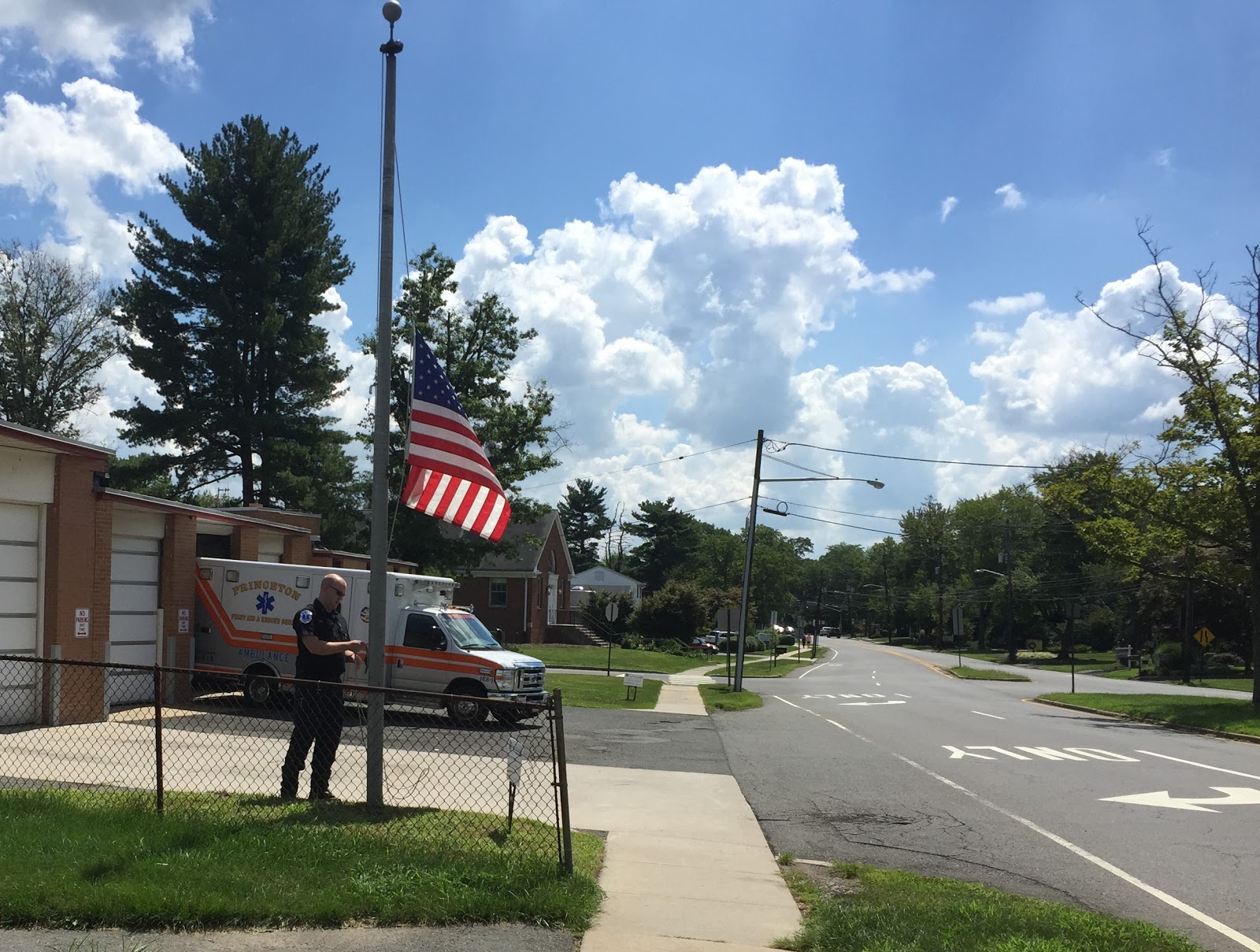
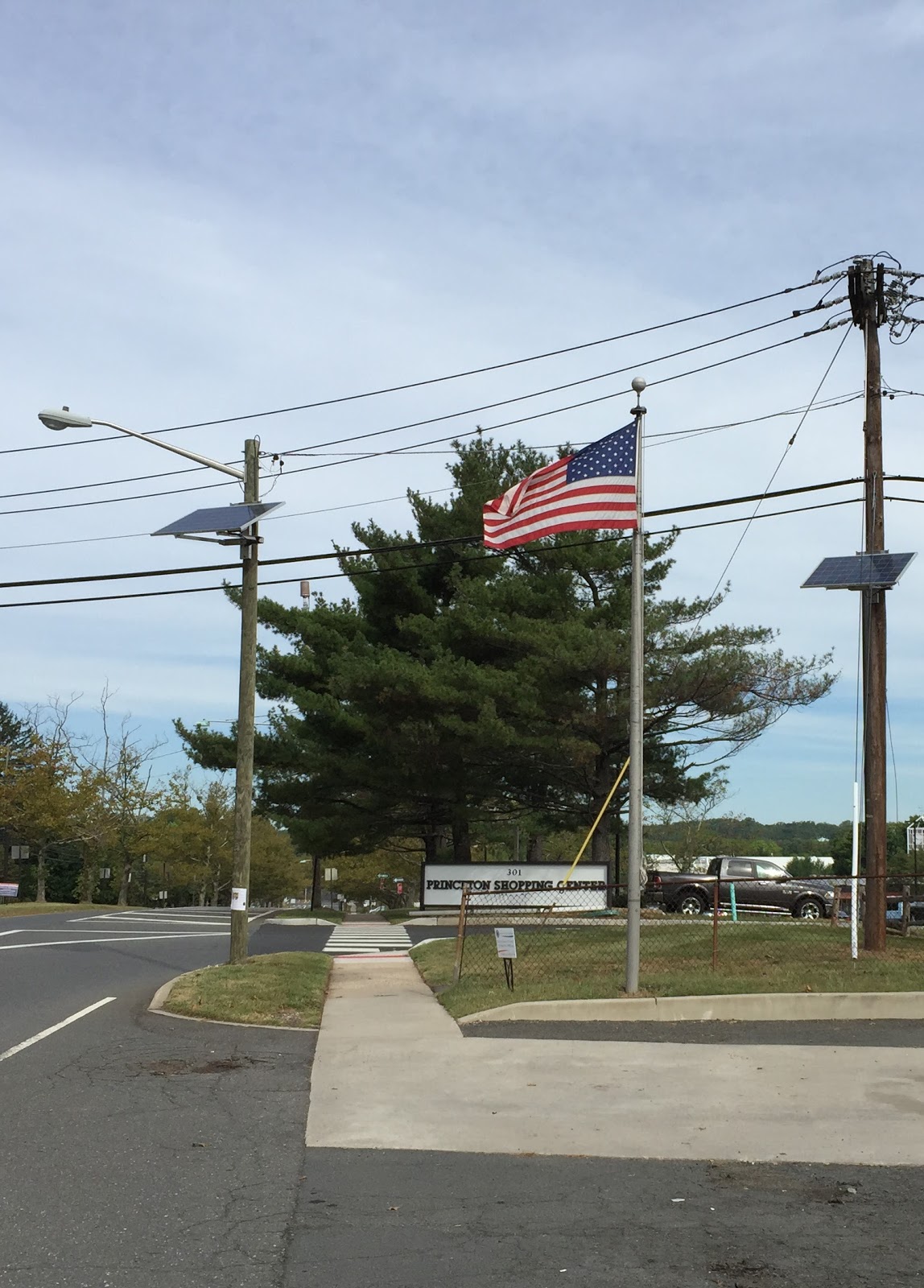
Sometimes, the American flag hoisted in front of the Princeton First Aid and Rescue Squad will fly at half mast. I assume it's to honor the memory of a volunteer who lost his or her life in the line of duty. This happens fairly frequently, though, and since this is the most visible American flag on our side of town, catching the eye as we pull into the Shopping Center, it can give a sense that the nation is repeatedly in mourning. A few weeks ago, the flag was remaining at half mast for a number of days running, and I finally stopped by to ask for some background. Turned out to be in honor of an officer who had lost his life somewhere else in the country.
Though I didn't express any opinion, they raised the flag back up within the hour, as if they'd forgotten how long it had been at half mast.
This raises the question of how to rightly honor those who risk their lives to protect us, without it beginning to seem, particularly in an election year, like a political statement that the nation is on the wrong course.
Might some other flag be flown at half mast for those times of mourning?
A few days later, I stopped by a friend's house and noticed his neighbor was flying the Thin Blue Line, which, according to Wikipedia, "is a symbol used by law enforcement, originating in the United Kingdom but now prevalent in the United States and Canada to commemorate fallen and to show support for the living law enforcement officers and to symbolize the relationship of law enforcement in the community as the protectors of fellow civilians from criminal elements. It is an analogy to the term Thin Red Line."
Flying this flag, or something like it that included rescue squads, either on its own pole or beneath the American flag, would make more clear what and who is being mourned.
As a bit of an aside, I later noticed a flag just down the street, relevant here because it, too, is a variation on a theme. Turns out it's La Senyera Estelada, an unofficial flag generally waved in Barcelona and elsewhere by supporters of Catalonia's independence from Spain. It's modeled after the flags of Puerto Rico and Cuba, which gained independence from Spain in 1898 and 1902 respectively.
Wednesday, September 07, 2016
The Joys of Re-use
I had found this desk next to a dumpster in the neighborhood and knew it would soon be headed for the landfill if Mr. Sustainable didn't come to the rescue. Some careful maneuvering of its significant mass onto the ol' pickup safely transported it to our Kurbside Kmart location one block away on busy Harrison Street, where it sat, curiously unclaimed for several days, despite being in good condition. With people moving in to town, it seemed perfect timing.
As the furniture lingered in our front yard, I had begun to wonder about the aesthetics and practicality of this passion for re-use, when a knock came at the door. A young woman asked, with a tone of disbelief, if I was really giving away that fine desk. I said yes, and her eyes lit up. She and her mother had been passing by on their way home to a distant town, and decided it was perfect for their needs.
The next challenge was to fit it in their little hatchback. Part of the fun of repair and re-use is finding out how things work. Deciding which tools to use, finding all the hidden screws, making all the pieces fit in the car--solving all these physical puzzles has got to be good for the brain. This is basic resourcefulness in the service of saving resources. And serendipity, when it happens to oneself or others, feeds the soul and spares the landfill.
Wednesday, August 31, 2016
Local Trash Cans Overfloweth With Paper
Here's an example of hundreds of seemingly insignificant individual actions leading collectively to a big mess. This is small scale stuff, marring the view outside a cafe, but the same dynamic is at work in sealing the fate of our planet.
This overflow runs counter to other uses of paper in the digital age. Newspapers grow scarce, and we're often reminded not to print things out if we don't need to. There's talk of going paperless in the office. But when it comes to food and drinks, the use of paper is burgeoning. Trash receptacles overflow, in this case spreading over towards the relatively empty receptacle for recyclables. Paper feels ecological. It's from nature, unlike most plastics. It won't drift out to the ocean and work mischief with the food chain. We hear that plastics won't decompose in landfills, but sequestering the plastic's carbon underground can be a good thing. If paper decomposes in a landfill, it produces methane, some of which will escape and feed climate change.
For anyone who reads the fine print on the blue lid of the recycling receptacle here, it includes paper, which means most of the paper in this photo, separated from the food, could actually be stuffed in the recycling rather than the trash. Either people have really bad aim, or they didn't get the memo.
This overflow runs counter to other uses of paper in the digital age. Newspapers grow scarce, and we're often reminded not to print things out if we don't need to. There's talk of going paperless in the office. But when it comes to food and drinks, the use of paper is burgeoning. Trash receptacles overflow, in this case spreading over towards the relatively empty receptacle for recyclables. Paper feels ecological. It's from nature, unlike most plastics. It won't drift out to the ocean and work mischief with the food chain. We hear that plastics won't decompose in landfills, but sequestering the plastic's carbon underground can be a good thing. If paper decomposes in a landfill, it produces methane, some of which will escape and feed climate change.
For anyone who reads the fine print on the blue lid of the recycling receptacle here, it includes paper, which means most of the paper in this photo, separated from the food, could actually be stuffed in the recycling rather than the trash. Either people have really bad aim, or they didn't get the memo.
Friday, August 19, 2016
A Rare Curbside Sighting
A surprisingly rare sight in front of our house is this trash can. Every month or so, if that, and on the small side--32 gallon capacity. Why it's so slow to fill is nothing we've kept track of, but likely has to do with a habit of thought that everything has a place--usually some place other than the trash can. By the time most items have landed in the recycling bin, or the kitchen counter compost bucket, or the plastic bag full of plastic bags to head to McCaffery's, or has been put out on the curb for reuse or scrap, there just isn't much left.
This blog post might more appropriately have a photo not of the trash can but of an empty, clean curb, for it's absence from the curb most weeks is what's most worthy of note. A lot of environmentalism has to do with seeing the significance in what is nowhere to be seen.
Saturday, July 30, 2016
Princeton High School Flooded Again
Why are thousands of gallons of water flowing into the Princeton High School basement?
And more water flowing under the door that leads directly to the wood stage of the high school performing arts center?
The first answer is poor design by the architect, who didn't consider where stormwater would flow during prolonged downpours like the one we had today.
A big storm in 2009 damaged the wooden stage, which then had to be replaced at great expense.
Walnut Street was one foot deep in water after torrential rains this afternoon, and because the performing arts and science wings of the school were built lower than the street, water flowed towards the school rather than away from it, causing massive flooding.
Since 2009, I have raised concern with school superintendents and facilities directors, town engineers and a few council members, on five separate occasions about the potential for a destructive repeat flood. The only response that I'm aware of was that staff would place sandbags against the doors to block the floodwater. It was a bandaid approach, and when Princeton got hit this afternoon with a big downpour, there were no sandbags to be seen.
Here's a 2011 post that explains why the flooding occurs, and offered a solution. A now retired science teacher, Tim Anderson, and I explained the solution to school staff a year or two ago. How frustrating to see what looks like a repeat of 2009's flood, with no action taken in the interim.
Wednesday, July 27, 2016
Green Shade
Shade in a parking lot becomes very popular this time of year. Even better if the shade comes from solar panels, which are vastly better than trees at reducing overall greenhouse gases in the atmosphere. (One estimate suggests an average home array is equivalent to growing 50 trees.)
We chanced by Orchard Hill Elementary in Montgomery Township while taking the scenic route home. What a pleasant oasis! Parking in its dappled shade for a few minutes, it was time to dream of a time when all parking lots might be so elegantly and productively shielded from the sun, and you can return to find your car not burning hot but recharged, ready to take you to your next destination. Then we'll really have it made in the shade, with shade made by energy makers.
This is one of several projects apparently paid for not by the schools but by Somerset County. Check out the site's energy production at this link.
We chanced by Orchard Hill Elementary in Montgomery Township while taking the scenic route home. What a pleasant oasis! Parking in its dappled shade for a few minutes, it was time to dream of a time when all parking lots might be so elegantly and productively shielded from the sun, and you can return to find your car not burning hot but recharged, ready to take you to your next destination. Then we'll really have it made in the shade, with shade made by energy makers.
This is one of several projects apparently paid for not by the schools but by Somerset County. Check out the site's energy production at this link.
Wednesday, July 20, 2016
Happy Scrap
When it comes to recycling, nature puts the human economy to shame. Nature quickly breaks everything down, no matter where it falls, until it can take on new life as part of anything else. We're lucky if even a small percentage of our stuff finds new life. All we can do is try to emulate in some small way nature's genius. Frontage on a busy street can be used to "showcase" stuff that deserves a better fate than the landfill. This week's offerings: a hundred pounds of scrap, a guitar, a couple bed frames.
The guitar was gone within an hour. "Needs work", I told the girl, who couldn't believe her luck. She seemed undeterred by the news. If nothing else, she'll learn about how guitars are put together.
I finally relinquished my prize collection of defunct toasters, which disappeared at 6:30am the following morning with the rest of the scrap.
A neighbor on a side street had put out one of those lightweight carts to carry two recycling buckets. It, too, looked destined for scrap, but needed only a nut and bolt to become serviceable again. Nice when that happens.
The guitar was gone within an hour. "Needs work", I told the girl, who couldn't believe her luck. She seemed undeterred by the news. If nothing else, she'll learn about how guitars are put together.
I finally relinquished my prize collection of defunct toasters, which disappeared at 6:30am the following morning with the rest of the scrap.
A neighbor on a side street had put out one of those lightweight carts to carry two recycling buckets. It, too, looked destined for scrap, but needed only a nut and bolt to become serviceable again. Nice when that happens.
Wednesday, July 13, 2016
Future Road Congestion, EAB-Style
I have seen the future, and it's a New Jersey full of single lane roads. This scene on 206, where crews are removing a dead ash tree, will become commonplace over the next few years, as the Emerald Ash Borer, a.k.a. EAB, lays waste all species of ash, excepting those that homeowners treat with chemical injections. Ash is the most common roadside tree species, and soon gets brittle once it dies, requiring quick removal.
It was easy to tell it was an ash, even from a distance, because it has thick twigs that come off the main stem in pairs.
All of this is happening because the insect was accidentally brought into the country in the wood in wooden packing crates from Asia. Because the insect didn't evolve in America, the native ash here have no resistance to it, and so quickly succumb as it eats the cambium of the trees, essentially choking them.
In the spirit of "get to know your federal government", check out APHIS. Here's a sample page from their website, about EAB.
Sunday, July 10, 2016
Clean Streets, California Style
During a recent trip to California, it was a relief to be able to walk along clean streets. One day a week, three different-colored rollcarts appear in front of each house. The smallest one holds trash, another holds recyclables, and another holds yardwaste and food scraps. By the end of the day, they're all emptied and retrieved by the residents, leaving the streets clean for the rest of the week.
In New Jersey, things are done a little differently. This pile of yardwaste in my neighborhood was on the street for three months. Each time the crews came by to scoop it up, there was a car parked there.
It was eventually hauled away, but by then it had already turned into compost.
Though the fall loose leaf pickup is viewed by many to be necessary, rollcarts could handle the quantities of yardwaste and leaves generated the rest of the year, greatly reducing the ten month long mess in the streets.
As pointed out in previous posts, the preferred behavior, backyard composting, is invisible, while dumping leaves in the street is highly visible, and therefore copied by neighbors. As any parent knows, no amount of education can counteract the power of example. A rollcart for yardwaste provides a much-needed visible, imitatable alternative to loose dumping.
In the meantime, we'll always have California (and North Carolina, and Michigan, and ...)
Friday, July 01, 2016
Why Did the Chicken Not Cross the Road?
Surprise. So rare to have someone knock on the door, but a guy from the local gas company, PSEG, came by yesterday. Long time no see. He said they check the meters every three years, particularly the relief valves. What's a relief valve?
He pointed to the disk-shaped gizmo next to the meter in the basement,
then scrambled behind some shrubbery to find where the gas would be released outdoors if there were some blockage inside. If gas pressure runs amok, the excess gas will be released outside rather than in, the homeowner will smell the gas outside and call the gas company. Since the methane in natural gas doesn't smell, they have to add mercaptan to give it that special leaky gas fragrance. My takeaway was that I need to trim the shrubs away from the house.
The man noticed our free-ranging chickens, which sometimes wander out into our or a neighbor's front yard. I said that thus far they've shown no desire to cross the road. Why would a chicken cross the road, after all, particularly a busy street like Harrison Street, when there's plenty of plants and mulch and good earth to scratch and inspect and gain nourishment from on our side of the car tracks? In this respect, the chickens have thus far displayed a higher intelligence than our otherwise intelligent dog, which would dash out in front of traffic in a second, if left to his own devices. If the cars were instead a herd of cattle stampeding by, would the dog have the same inclination, to head pell mell into a brutal chaos of thundering hooves? I think not, and thus conceived a theory that there's something about wheels that make cars and trucks somehow unreal for a dog.
The gas man and I did not come to a definitive conclusion about this matter, nor the larger matter, which I didn't broach, of human obliviousness towards the global consequences of all those machines rushing by. Are we as blind to danger as dogs, in our own way? He did mention, though, speaking of crossing the road, that a problem with the Prius and other hybrids is that blind pedestrians can't hear them at intersections. There's talk of requiring that electric and hybrid vehicles emit an artificial sound--the equivalent of mercaptan in natural gas.
I was taken back to another streetside conversation I had in the 1960s with a school friend. He said that electric cars are too quiet. Fifty years later, and the same conversation is still being had, with the same din of cars driving by, sending that wonderfully, terribly invisible carbon dioxide skyward. If there's one thing we humans are good at, it's finding reasons to stick with the internal combustion engine. Why would we cross the road to new technologies, sooner rather than later? The answer is up in the air, Junior Birdmen, in a world where our priorities are upside down.
Don't feel too bad if you've never heard of this song, from the 1930s, but here are some new lyrics.
As the gas man headed off to the next house, I braved the ambient traffic noise to offer one more idea, that rather than electric cars being too quiet, it's the engine-driven cars that are too noisy. He took it in a good natured, open minded way, and was gone. Nice to have spontaneous conversations now and then. Will anything be different three years from now, when he knocks again?
He pointed to the disk-shaped gizmo next to the meter in the basement,
then scrambled behind some shrubbery to find where the gas would be released outdoors if there were some blockage inside. If gas pressure runs amok, the excess gas will be released outside rather than in, the homeowner will smell the gas outside and call the gas company. Since the methane in natural gas doesn't smell, they have to add mercaptan to give it that special leaky gas fragrance. My takeaway was that I need to trim the shrubs away from the house.
The man noticed our free-ranging chickens, which sometimes wander out into our or a neighbor's front yard. I said that thus far they've shown no desire to cross the road. Why would a chicken cross the road, after all, particularly a busy street like Harrison Street, when there's plenty of plants and mulch and good earth to scratch and inspect and gain nourishment from on our side of the car tracks? In this respect, the chickens have thus far displayed a higher intelligence than our otherwise intelligent dog, which would dash out in front of traffic in a second, if left to his own devices. If the cars were instead a herd of cattle stampeding by, would the dog have the same inclination, to head pell mell into a brutal chaos of thundering hooves? I think not, and thus conceived a theory that there's something about wheels that make cars and trucks somehow unreal for a dog.
The gas man and I did not come to a definitive conclusion about this matter, nor the larger matter, which I didn't broach, of human obliviousness towards the global consequences of all those machines rushing by. Are we as blind to danger as dogs, in our own way? He did mention, though, speaking of crossing the road, that a problem with the Prius and other hybrids is that blind pedestrians can't hear them at intersections. There's talk of requiring that electric and hybrid vehicles emit an artificial sound--the equivalent of mercaptan in natural gas.
I was taken back to another streetside conversation I had in the 1960s with a school friend. He said that electric cars are too quiet. Fifty years later, and the same conversation is still being had, with the same din of cars driving by, sending that wonderfully, terribly invisible carbon dioxide skyward. If there's one thing we humans are good at, it's finding reasons to stick with the internal combustion engine. Why would we cross the road to new technologies, sooner rather than later? The answer is up in the air, Junior Birdmen, in a world where our priorities are upside down.
Don't feel too bad if you've never heard of this song, from the 1930s, but here are some new lyrics.
Up in the air, Junior Birdman.Maybe they should put the equivalent of mercaptan in gasoline, so that our noses would tell us what our eyes do not, that there's danger all around us--something planet-threatening leaking into the atmosphere from the backs of our cars. And you'd think there'd be someone, somewhere, the equivalent of the gas man, making sure that the planet remains in good working order and all the built-in safety mechanisms are in good condition.
Up in a world that's upside down.
Up in the air, Junior Birdman.
Keep your carbon underground.
As the gas man headed off to the next house, I braved the ambient traffic noise to offer one more idea, that rather than electric cars being too quiet, it's the engine-driven cars that are too noisy. He took it in a good natured, open minded way, and was gone. Nice to have spontaneous conversations now and then. Will anything be different three years from now, when he knocks again?
Tuesday, June 28, 2016
Status of Recycling in Princeton High School
The photo below speaks volumes about recycling, or lack thereof, at Princeton High School. I'm a fan of the school. It's been a good place for my daughters. Most of the teachers are excellent. But there's an opportunity being wasted when it comes to teaching kids basic citizenship skills for living on the planet. There was a time when Princeton's public schools, with the exception of Riverside Elementary, were recycling in name only. Based on my conversations with the truck drivers who pick up recyclables, many schools in NJ were and probably still are in a similar state. Almost ten years ago, I worked with facilities staff, teachers and custodians to develop a protocol to improve recycling in Princeton's public schools. We got the elementary schools recycling again, but JW Middleschool and PHS proved much harder, since students don't spend all day in a single classroom. It seemed to me that the administrators had made recycling a very low priority. There was no signal coming from the top that recycling matters. Recycling only works if everyone--students, teachers, custodians and other staff--do their part. Only if there's a clear and ongoing signal coming from the top will the system work.
My point, which didn't seem to sink in at the time, was that school is the place to develop lifelong habits, and any effort to engrain recycling habits would have lasting benefits. Each student's participation matters, since contamination of recyclables with trash can mean the whole bag ends up in the trash dumpster out back.
This year, a teacher and some students made a visual statement about the state of recycling at PHS. In the cage on the left are all the containers thrown out in an average week. A much smaller portion, on the right, actually get recycled.
The school has decent receptacles--contrasting in shape, color and opening, and paired so that students don't have to walk extra distance to reach the right receptacle. But that's clearly not enough.
One aspect of recycling is that you can tell how a building is doing simply by checking the ratio of recycling and trash dumpsters. In the back of the school, the ratio is 1:3. Not exactly great.
My point, which didn't seem to sink in at the time, was that school is the place to develop lifelong habits, and any effort to engrain recycling habits would have lasting benefits. Each student's participation matters, since contamination of recyclables with trash can mean the whole bag ends up in the trash dumpster out back.
This year, a teacher and some students made a visual statement about the state of recycling at PHS. In the cage on the left are all the containers thrown out in an average week. A much smaller portion, on the right, actually get recycled.
The school has decent receptacles--contrasting in shape, color and opening, and paired so that students don't have to walk extra distance to reach the right receptacle. But that's clearly not enough.
One aspect of recycling is that you can tell how a building is doing simply by checking the ratio of recycling and trash dumpsters. In the back of the school, the ratio is 1:3. Not exactly great.
Thursday, June 23, 2016
Tiny House Takes Princeton By Mini-Storm
What was coming is now here, at least for a few more days. An email from Sustainable Princeton arrived yesterday with news of the Tiny House on Wheels. A movie about these hyper-small structures was shown years back at the Princeton Environmental Film Festival, and there are movies online. The tiny house movement is relevant to Princeton if we wish there to be an affordable way for people of lesser means to live in town. Here's the text from the SP email:
Make sure to check out the "Tiny House on Wheels" before it leavesPrinceton! Grace and Corbett Lunsford specialize in building forensics and are traveling around the country in their tiny house that doubles as a tiny lab to demonstrate home performance. They are here in Princeton this week to educate homeowners how not to waste money on home improvements. Owning and maintaining a home can be an expensive and frustrating experience. However, with a little knowledge about home performance, you can ensure that your hard-earned money is spent on improvements that will get you the comfort, air quality and energy efficiency you expect.
Stop by the parking lot of the Unitarian Universalist Congregation of Princeton on Cherry Hill Rd. between 5 and 6 p.m. until this Friday for a tour. They are also hosting a free Home Performance Crash Course tomorrow from 6-8 p.m. and againon Saturday from 9-11 a.m.
The Tiny House on Wheels' full schedule can be found here.
Tuesday, June 21, 2016
Zika Virus and Princeton's Recycling Containers
The other day, I went to a block party in a part of town where we lived when we first moved to Princeton. With a cool gentle breeze, beer in hand, good food and company, I had this desire to talk of pleasurable things. I've noticed that conversations tend to gravitate towards problem solving, which is understandable, given all the problems in the world, but I think the habit has become too strong. There was a time when people spent their days working at some positive task while being serenaded by the beauty and order of a classical music station. Now, public radio has one talk show after another, analyzing this or that aspect of some societal dysfunction in a never ending quest for solutions. We are problem solvers, after all, though our other role as problem creators seems at times to be even more impressive.
So I was sitting there feeling all this pleasure, wanting to speak of things that would complement that mood, only to hear the words "Zika virus" forming in my brain and slipping out of my mouth. Once they were out, there was no turning back. The conversation raced full gear into problem solving. Turns out my former neighbors have for years suffered unusually high levels of backyard mosquitoes. Why would this be, given their position on high ground, so close to Princeton's backbone, the ridge road called Nassau Street? I pointed out that, in my experience, springs can sometimes be found just a few hundred feet down from a ridge, for reasons unknown. That fit with one neighbor's observation that something is making his sump pump work overtime. It wasn't clear how mosquitoes could breed in wet ground, however, since they need pools of water for that.
I suggested that everyone check their gutters, since roof gutters so easily get blocked by leaves in the fall, or flowers and seeds in the spring. A third possibility, though not at all limited to one neighborhood, is that our green and yellow recycling buckets may be contributing. Many people leave these outside, and since they lack covers, there's nothing stopping the rain from accumulating in cups and jars, where mosquitoes could then breed.
This article in the Princeton Packet says that the virus is spread by Aedes mosquitoes. Turns out there are two kinds in the U.S., both introduced from other continents. The yellow fever mosquito, Aedes aegypti, comes from Africa. The Asian tiger mosquito, Aedes albopictus, was likely introduced to the U.S. in 1985 in a shipment of old tires, and worked its way north to Princeton some years ago. Though it's less likely to transmit the disease than the yellow fever mosquito, it's active during the day, making it a particular nuisance. It also breeds well in small containers, like those found in a recycling bin. A google search found recyclables mentioned as potential breeding sites, e.g. here and here.
One could test this theory, that uncovered recycling bins are increasing mosquito populations, by putting water in some jars and seeing if the mosquitoes use them. Since the mosquitoes prefer dirty water, a gradient from dirty to clean water could be put in the jars to see if that's a factor.
The curbside recycling program is run by Mercer County, not the town of Princeton. The county has a centralized program that towns can buy into if they want. Though the green and yellow buckets have served well, they do have shortcomings regardless of whether they breed mosquitoes. They are small, tip over easily, roll into the streets, and tend to overflow after two weeks of accumulation. The collection crews can't help but spill some as they carry the buckets to the trucks, and the lack of covers can make any paper wet and heavy.
On a windy recycling day, the overflowing contents blow all over the streets. My observations suggest this is the biggest contributor to plastic and paper litter in Princeton, most of which ends up in Carnegie Lake via the storm drains. Any Clean Streets initiative that ignores the accidental litter of recycling day is missing a big piece of the puzzle.
If and when the recycling buckets ever get replaced, it will likely be with large rollcarts with covers and wheels for easy transport to the curb. Some places in Princeton, e.g. Spruce Circle, have already started shifting to rollcarts, though these are small and not of very good quality.
Any contribution recycling buckets make to breeding mosquitoes could sway opinion in a way that all the other deficiencies do not.
Now, to get back to that beer and a gentle breeze...
So I was sitting there feeling all this pleasure, wanting to speak of things that would complement that mood, only to hear the words "Zika virus" forming in my brain and slipping out of my mouth. Once they were out, there was no turning back. The conversation raced full gear into problem solving. Turns out my former neighbors have for years suffered unusually high levels of backyard mosquitoes. Why would this be, given their position on high ground, so close to Princeton's backbone, the ridge road called Nassau Street? I pointed out that, in my experience, springs can sometimes be found just a few hundred feet down from a ridge, for reasons unknown. That fit with one neighbor's observation that something is making his sump pump work overtime. It wasn't clear how mosquitoes could breed in wet ground, however, since they need pools of water for that.
I suggested that everyone check their gutters, since roof gutters so easily get blocked by leaves in the fall, or flowers and seeds in the spring. A third possibility, though not at all limited to one neighborhood, is that our green and yellow recycling buckets may be contributing. Many people leave these outside, and since they lack covers, there's nothing stopping the rain from accumulating in cups and jars, where mosquitoes could then breed.
This article in the Princeton Packet says that the virus is spread by Aedes mosquitoes. Turns out there are two kinds in the U.S., both introduced from other continents. The yellow fever mosquito, Aedes aegypti, comes from Africa. The Asian tiger mosquito, Aedes albopictus, was likely introduced to the U.S. in 1985 in a shipment of old tires, and worked its way north to Princeton some years ago. Though it's less likely to transmit the disease than the yellow fever mosquito, it's active during the day, making it a particular nuisance. It also breeds well in small containers, like those found in a recycling bin. A google search found recyclables mentioned as potential breeding sites, e.g. here and here.
One could test this theory, that uncovered recycling bins are increasing mosquito populations, by putting water in some jars and seeing if the mosquitoes use them. Since the mosquitoes prefer dirty water, a gradient from dirty to clean water could be put in the jars to see if that's a factor.
The curbside recycling program is run by Mercer County, not the town of Princeton. The county has a centralized program that towns can buy into if they want. Though the green and yellow buckets have served well, they do have shortcomings regardless of whether they breed mosquitoes. They are small, tip over easily, roll into the streets, and tend to overflow after two weeks of accumulation. The collection crews can't help but spill some as they carry the buckets to the trucks, and the lack of covers can make any paper wet and heavy.
On a windy recycling day, the overflowing contents blow all over the streets. My observations suggest this is the biggest contributor to plastic and paper litter in Princeton, most of which ends up in Carnegie Lake via the storm drains. Any Clean Streets initiative that ignores the accidental litter of recycling day is missing a big piece of the puzzle.
If and when the recycling buckets ever get replaced, it will likely be with large rollcarts with covers and wheels for easy transport to the curb. Some places in Princeton, e.g. Spruce Circle, have already started shifting to rollcarts, though these are small and not of very good quality.
Any contribution recycling buckets make to breeding mosquitoes could sway opinion in a way that all the other deficiencies do not.
Now, to get back to that beer and a gentle breeze...
Sunday, June 12, 2016
Harry's Brook and the Tale of Two Parking Lots
Though the parking lot at the Princeton Shopping Center will surely look and function much better after its renovation is complete, there was a missed opportunity in terms of reducing how much polluted runoff the parking lot generates. (Update, 8/20/16): Not completely lost. See more recent post.) This is something the aquatic life in Harry's Brook notices, but we don't. We perceive a rain as cleansing. But the brook, one tributary of which begins near the shopping center and flows down to Carnegie Lake, is on the receiving end of that film of pollutants that cars shed wherever they go.
Though reconfigured, the islands of turf and trees at the shopping center will have the same design they had in the past, convex and higher than the surrounding pavement. They will shed water rather than receive it. A more stream-friendly approach is to make the islands concave and lower than the pavement, so they can receive both the quantity and tainted quality of runoff from the pavement. The vegetation and soil can then absorb some of the runoff and filter out some of the pollutants before the stormwater enters the stream. The result is less flashy floods and cooler, cleaner water entering the brook.
One example of this concave shape can be found at Stone Hill Church, up on Bunn Drive. Another is near the shopping center at Westminster Choir College's parking lot. The photo below, taken during construction years back at Westminster, shows the wavy curb where runoff enters on the left, and the drains that take any excess runoff the swale can't handle. The reason Westminster used a more stream-friendly approach? Because their parking lot was an addition, they had to adhere to the latest regulations, which require more sensitivity to the watershed. The shopping center was renovating an existing parking lot, rather than adding additional impervious surface, so the more recent, creek-friendly regulations didn't apply.
The shopping center renovation would have been an opportunity to reduce harmful stormwater impacts on Harry's Brook. That didn't happen, most likely because developers tend to do only what the government requires, and nothing more.
Saturday, June 11, 2016
Artistic Fundraiser for Princeton School Garden Cooperative
Paint your way to a better world at an upcoming fundraiser for the Princeton School Garden Cooperative. More details below, and at this link. It's open to adults and children.
Related, the Princeton Farmers Market, open Thursdays at Hinds Plaza, will be receiving an award at town council's June 13 meeting.
Join us at Pinot's Palette Princeton on Wednesday, June 15th at 7pm, and bloom your own "Kitchen Radishes" with this two hour painting class. Reserve your canvas for $45, and proceeds go directly to the Princeton School Garden Cooperative, which fosters garden-based education in the classroom, cafeteria and community. We will supply some snacks and wine courtesy of our vendors, but feel free to BYOB it up!
Related, the Princeton Farmers Market, open Thursdays at Hinds Plaza, will be receiving an award at town council's June 13 meeting.
Saturday, May 07, 2016
Solar Jam May 14, 11-2p
Check it out at the Princeton High School tennis courts. Maybe the registration deadline is malleable for those who want to participate. My bad for a late posting.
SolarJam 2016, third annual solar car race event for K-8th graders co-sponsored by OASIS (Organizing Action on Sustainability In Schools) and PSEG
Event Basics:
What?
Solar Car race (vehicles made by students according to specifications below) and Photon Fair (tables available to display/demo anything that uses the sun)
All vehicles and projects must be made by the students!
Who?
Two age divisions (K-5 and 6-8)
Each team must have one registered adult chaparone present on site at the event.
Teachers are not required to attend if there is another adult chaparone (such as a parent).
Students may work in teams as part of school or not.
When and where?
May 14 10:30 registration, 11 first race-2pm at Princeton High School tennis courts (May 15: rain date)
Food?
BYO lunch. Water available. This is a no waste event. Please bring a water bottle.
How to register?
For registration contact alloyd@pds.org
When to register?
Required by May 1
How to get more info?
Open the info document attached and/or contact alloyd@pds.org
SolarJam 2016, third annual solar car race event for K-8th graders co-sponsored by OASIS (Organizing Action on Sustainability In Schools) and PSEG
Event Basics:
What?
Solar Car race (vehicles made by students according to specifications below) and Photon Fair (tables available to display/demo anything that uses the sun)
All vehicles and projects must be made by the students!
Who?
Two age divisions (K-5 and 6-8)
Each team must have one registered adult chaparone present on site at the event.
Teachers are not required to attend if there is another adult chaparone (such as a parent).
Students may work in teams as part of school or not.
When and where?
May 14 10:30 registration, 11 first race-2pm at Princeton High School tennis courts (May 15: rain date)
Food?
BYO lunch. Water available. This is a no waste event. Please bring a water bottle.
How to register?
For registration contact alloyd@pds.org
When to register?
Required by May 1
How to get more info?
Open the info document attached and/or contact alloyd@pds.org
Thursday, April 21, 2016
The Water Proof is in the Pants
Bicycling turns one into an optimist. There's the empowerment of all that mechanical assist, the sense of levitation, of "taking a load off" and letting the wheels do the work. Over years of shifting from car to bike, I've changed my view of all that uncertain weather, located between sunshine and thunderstorm, when it looks like it might rain but hasn't yet. That prospect used to send me looking for the car keys, but much less so now. Like a glass half empty or half full, it might rain on me, or it might not, and my experience is that most of the time the rain doesn't manifest, or remains more of a mist that doesn't affect a bike ride into town at all.
Still, there've been a couple times, venturing out on a bike in a light rain, when the rain turned heavy, and my legs got soaked--the thighs being the one horizontal feature while pedaling, and therefore the most exposed to the rain. Amazingly, the pants dry off in an hour--a small and fleeting discomfort. Rain is just water, after all. But when the Blue Ridge outfitters store was going out of business, I finally bought the proof. The water proof. Pants, that is. They slip on before heading out, and one gets this uncanny feeling of being immersed in rain and yet remaining unaffected. It's the closest I might get to being a dolphin, or a duck.
People talk about sustainability. This, for me, is how it happens. Small insights that probably should have been obvious years ago, and yet they come when they come, and accumulate until one's life is considerably changed. Oftentimes, sustainability is experienced not as a closing down or limitation, but as an opening up, of possibility and awareness, a way of looking more to oneself and nature, and less to machines, for answers to the day's questions.
Monday, April 18, 2016
A Week Bursting With Events and Tree Metaphors
Princeton's always bursting with brain food, but coming days are remarkable. Feast, yee who can break minds and schedules free.
Monday, April 18
McCarter Theater, free symposium, The Ground On Which We Stand
Princeton Public Libary, 4pm -- I'm a Good Person, Isn't that enough? Author of Waking Up White
Toni Morrison Lectures, 5:30 -- In Praise--and Dread--of Trees
Tuesday, April 19
Arts Council, 7pm -- Tracy K. Smith, Pulitzer Prize winning poet reads from "Ordinary Light: A Memoir". (She played the role of interlocutor at remarkable, transformative recent events, a performance by Flexn, and a viewing at the Garden Theater of a documentary of poet Robert Bly.)
And on through the week at the library in the evening, with PBS's Warren Zanes Wednesday, the author of "Democracy for Realists: Why Elections Do Not Produce Responsive Government" on Thursday. Friday at 6:30 there's a film on autism produced by Princeton residents Roland and Pam Machold, who also helped bring about a film on Marquand Park, and on Sunday at 2pm, Princeton author and historian Clifford Zink tells the story of "Mercer Magic and the Story of America's First Sports Car".
The film about Marquand Park, shown at the recent Princeton Environmental Film Festival, is said to be on youtube, but all I could find thus far is a preview shot from a drone rising high over the park.
April 26, Labyrinth Bookstore on Nassau Street -- Rootedness, the Ramifications of a Metaphor
Monday, April 18
McCarter Theater, free symposium, The Ground On Which We Stand
Princeton Public Libary, 4pm -- I'm a Good Person, Isn't that enough? Author of Waking Up White
Toni Morrison Lectures, 5:30 -- In Praise--and Dread--of Trees
Tuesday, April 19
Arts Council, 7pm -- Tracy K. Smith, Pulitzer Prize winning poet reads from "Ordinary Light: A Memoir". (She played the role of interlocutor at remarkable, transformative recent events, a performance by Flexn, and a viewing at the Garden Theater of a documentary of poet Robert Bly.)
And on through the week at the library in the evening, with PBS's Warren Zanes Wednesday, the author of "Democracy for Realists: Why Elections Do Not Produce Responsive Government" on Thursday. Friday at 6:30 there's a film on autism produced by Princeton residents Roland and Pam Machold, who also helped bring about a film on Marquand Park, and on Sunday at 2pm, Princeton author and historian Clifford Zink tells the story of "Mercer Magic and the Story of America's First Sports Car".
The film about Marquand Park, shown at the recent Princeton Environmental Film Festival, is said to be on youtube, but all I could find thus far is a preview shot from a drone rising high over the park.
April 26, Labyrinth Bookstore on Nassau Street -- Rootedness, the Ramifications of a Metaphor
Subscribe to:
Posts (Atom)