Thursday, January 29, 2015
How Leaf Blowers Increase Erosion
It's a bleeding of sorts, not of blood but of clay eroding from a yard that was meticulously cleared of leaves in the fall. The ground was left bare and unprotected from the impact of raindrops that loosen soil and then carry it into the street. Leaves not only provide a protective mulch for the soil and fertilizer as they slowly break down, but also provide habitat. Birds, in need of protein to feed their young, can often be seen in the spring flipping leaves over in search of the insects that live underneath.
The homeowner surely thought it was the right thing to do, to blow all the leaves out into the street and have a nice tidy yard. But the result is not so tidy, neither for the street nor for the sidewalk months later. A mulch mowing, rather than a leaf blowing, would have ground the leaves up and deposited them back on the soil, where they could do some good in a tidy enough way.
Wednesday, January 28, 2015
Avalon Bay and "Lightweight" Wood Construction
A friend asked for help tracking down an article on the Edgewater inferno that destroyed 240 units in an Avalon Bay complex. The article mentioned the role lightweight wood construction likely played in the fire's rapid spread. A compilation of past fires and violations at Avalon Bay facilities can be found at this link. Interestingly, Avalon Bay's Edgewater project burned down not once but twice. The first time, in 2000, adjacent homes also were destroyed. So it's not surprising that officials are calling for a review of the Avalon Bay structure to be built in Princeton. Meanwhile, Avalon Bay is finding it much harder than expected to intentionally destroy the old hospital that has occupied the site up to now. There's irony in all the effort being spent to destroy a tough old building, so that a vulnerable new one can be built.
The Edgewater fire brought back memory of an article about how wood used these days, often laminate or made of compressed chips, has a lower flash point and thus allows fire to travel faster through a building. Newer furniture also tends to be made of materials that catch fire at much lower temperatures than solid wood. The idea being that fire in one room will heat the air in the next room, which will suddenly burst into flame once the flashpoint is reached. The lower the flash point, the quicker adjacent rooms ignite.
Thursday, January 22, 2015
Using Parks To Demonstrate Best Practices for Leaf Management
How do we reduce parks maintenance costs, energy consumption and street mess in Princeton? The Princeton Environmental Commission has been recommending for years that people make simple leaf corrals to put leaves into in the fall. These sorts of corrals are used in New York's Central Park, and I've seen them in Paris.
Scarsdale, NY has a helpful video showing another way to effectively process leaves on-site in town parks: mulch mowing.
Princeton could easily and economically be using its parks to demonstrate these methods, rather than, as was seen this past fall at Barbara Sigmund Park, bringing in heavy machinery to gather leaves up and haul them away. All this extra work is being seen at a time when parks maintenance is reportedly understaffed. All the more reason for Princeton's parks to be demonstrating best practices for utilizing leaves on-site.
Scarsdale, NY has a helpful video showing another way to effectively process leaves on-site in town parks: mulch mowing.
Princeton could easily and economically be using its parks to demonstrate these methods, rather than, as was seen this past fall at Barbara Sigmund Park, bringing in heavy machinery to gather leaves up and haul them away. All this extra work is being seen at a time when parks maintenance is reportedly understaffed. All the more reason for Princeton's parks to be demonstrating best practices for utilizing leaves on-site.
Friday, January 16, 2015
65 Things -- When the Library Became a Living Internet
Could a committee have come up with such a great idea? If so, then it's time to rethink our stereotypes about committees. For five hours last Saturday, Jan. 10, during "65 Things @ 65 Witherspoon", the library became a living internet with live tutorials on an outrageously diverse spread of subjects. This was not the internet of annoying pop-up windows or dubious claims, but the internet that has become a channel for human generosity, a massive sharing of know-how and experience. I first became aware of this incredible outpouring of generosity when I wanted to learn to play guitar. Just an internet search away stood thousands of video tutorials showing how to play every tune and finger every note.
At the library's learnathon, each tutorial lasted about a half hour, with subjects constantly changing. Walk in the front door and a magician was explaining how to mount a unicycle. A few steps further in, there was a demonstration of face painting, and then beyond that, a woman providing a tutorial in singing, while all were invited to join a drum circle forming in the library's community room. Already in the archive of memory from earlier in the day were tango lessons, and a how-to on creating picture albums.
My contribution was a demonstration of a Kill-a-Watt meter--a device available for checkout at the library that you can use to measure how much energy this or that item uses in the house. I began with comparing light bulbs. An old-style incandescent used 60 watts, a compact fluorescent used 14, and the latest technology, an LED, provided the same amount of light while using just 9 watts. The LEDs have come way down in price at the big box hardware stores, last for decades, and provide quality light.
Then I plugged a small fan into the Kill a Watt meter, which read 20 watts. Electricity is great for running motors. Our newer frontload washing machine, for instance, if used with detergents formulated to perform best in cold water, uses very little energy. Then I plugged in an air dryer and asked for estimates. 50 watts? 100? The hair dryer uses 1300 watts--the big jump being due to the extreme inefficiency of electricity when it comes to generating radiant heat. Things like toasters and hair dryers fortunately are used only in short bursts. An electric clothesdryer, however, can be on for an hour, while steadily consuming 4000 watts of energy during that time.
To measure a clothesdryer's energy use, it's necessary to have a whole house energy meter, which can cost a couple hundred dollars but is worth considering. Getting immediate feedback on energy use makes much more real the consumption that is otherwise hidden in a monthly bill with lots of small print. It led us to get clothes racks and use the clothesdryer only occasionally.
65 Things vanished as quickly as it appeared. The next day, only the demonstrations of flower arranging remained to hint at what had been.
Thursday, January 15, 2015
Skating Permitted Today (Jan. 15) on Carnegie Lake!
A friend called to tell me the ice is glorious, deep and dark. Weather looks good at least through Saturday, which should allow people time to find their skates. Check Princeton Recreation Dept. hotline, (609) 688-2054, for details.
This photo shows a strange dimpling of the surface. Other photos of the many mysterious patterns locked in the ice can be found at this link.
Tuesday, January 06, 2015
Yardwaste Bags are a Mixed Bag
Among those who are passionate about the need to revise our leaf/brush/yardwaste collection policy, one sent word of another town that doesn't allow loose dumping of leaves on the street, even in the fall. Her description went like this:
"Summit NJ policy has been in effect for a long time. We lived there until 2003 and either landscapers took the leaves or the homeowner composted or the homeowner took the leaves to the drop off center. Remarkably few bagged their leaves."Though the simplified proposal I put together with some help from friends recommends keeping the loose leaf pickup for 2-3 months in the fall, plus providing year-round pickup of leaves/yardwaste containerized in roll carts and yardwaste bags, the programs that ban loose dumping altogether are worth learning from.
What would a year-round ban on loose leaf dumping in the streets mean?
Our streets would finally be clean. There'd be no more piles large and small, year-round.
Necessity being the mother of invention, people would be more apt to rake leaves into a back corner of the property.
These 4-man, three-vehicle, street-scraping caravans would perhaps be needed only for special pickups of brush, or clearing after big storms.
There'd be no more noisy leaf-blower operations running amok in the streets.
But there are many drawbacks to yardwaste bags as the only allowed container. They lack stability.
They are not waterproof, and have to be manually lifted into the trucks, so putting wet, soggy leaves in them is not a good idea.
Unlike roll carts, reliance on yardwaste bags offers no potential to expand service later on by also allowing foodwaste to be put in the rollcart with the yardwaste. With foodwaste comprising a third of our trash, any convenient way to remove it from the wastestream will yield big savingsin landfill tipping fees. This approach has been used to good effect in Ann Arbor, MI, as well as western cities like San Francisco, Seattle and Portland.
Roll Carts Used By Downtown Merchants
When I speak glowingly (you really need to watch this fun 2-minute video to get into the spirit) of roll carts as a vital component of a yardwaste/leaf collection program, some are skeptical. One concern expressed is that the workers would have trouble emptying the carts, which have two to three times the capacity of yardwaste bags. This is easily solved by retrofitting a hydraulic "tipper hook" on the back of existing trucks, at a cost of $5000 per hook. When compared to the roughly one million dollars spent collecting leaves and yardwaste each year, this is a very minor expense that, by eliminating the need for loose leaf pickup ten months per year, could bring several hundred thousand dollars in annual savings.
There've been claims that, if roll carts are to be used for containerizing leaves/yardwaste, the best approach is to spend $250,000 on a brand new truck with an automated hook. This would reduce workers needed to one driver, which could save money over time, but as we can see along Nassau Street, cost-conscious WasteManagement is doing just fine collecting recyclables with two men, plus one of those hydraulic hooks on the back that relieves back stress by doing the lifting. The big advantage of two men in areas of the former borough is that having one worker on the ground makes it much easier to get the carts out from behind parked cars and other obstructions that might be problematic for the expensive new truck with an automated lift on the side.
Here's a close-up of the "tipper hook". It has a low profile, and is safe to use.
How much would the carts cost? I've heard estimates around $50-60 each. Each one has the capacity to eliminate the need for 150 yardwaste bags/year, which means the cart pays for itself in the first year and can continue serving indefinitely.
Roll carts are not only the preferred approach for cost-conscious private haulers like WasteManagement, but also for many yardwaste collection programs around the country. Ann Arbor's program is most relevant because of its similar climate, but also relevant are programs in Seattle, Portland, San Francisco, Durham, NC, and doubtless many other municipalities (Who could forget Enid, Oklahoma, with its rollcart parade video?). The roll carts--with wheels, easier filling, reusability, larger capacity, greater stability, a cover to protect contents from rain, and the potential for large additional savings by adding foodwaste--are a much more plausible alternative to loose dumping than yardwaste bags, which still could be used to supplement the roll cart's capacity. With the carts, council can do away with loose yardwaste pickups for 9-10 months out of the year, and still feel like the town's offering a credible and much more efficient service while stripping away all the negatives associated with loose dumping in the streets.
Sunday, January 04, 2015
Scarsdale, NY Ends Fall Loose Leaf Collection
When several of us this past month presented to Princeton municipal council a proposal to change the way leaves/brush/yardwaste are collected in Princeton, council member Heather Howard said that Scarsdale, NY, has also, like so many towns, been struggling with this issue. Turns out that Scarsdale has made a big change. Beginning in 2015, it will no longer be in the business of picking up loose leaves from the curb. Instead, the town will make weekly pickups of autumn leaves only if they're placed in paper yardwaste bags. Residents and landscapers will be able to drop off leaves at a local site, and the town will truck them from there to a composting center.
While Scarsdale's program is impressive, there are reasons to question its adaptability to Princeton.
The expectations of Princeton residents have been made very high by the year-round pickup of loose leaves/yardwaste/brush traditional in the former borough. Also, Scarsdale's dropoff site may be much more convenient than the Lawrenceville Ecological Center. Though lack of looseleaf pickup would encourage residents to use their leaves in their yards, many residents and landscapers would be apt to take their leaves to the dropoff site. All those little individual trips may not be the most efficient way to deal with leaves.
Still, here is info on the Scarsdale program and why they chose to make a dramatic change.
Drivers of Change
This change is driven in part by economics. The $800,000 annual cost of vacuuming up loose street leaves in a town of 17,000 (Princeton's closer to 30,000) every fall competes with other budget needs. But another driver of this change is that leaves can be utilized in people's yards. In particular, lawn mowers can be easily retrofitted with a "mulching blade and deck plate", so that leaves can be ground up and returned to the lawn as fertilizer.
Retrofitting Lawnmowers for Mulching Leaves In-Place
The Scarsdale website has a very helpful video that shows the sort of mower retrofit residents and landscapers need to convert their mowers for effective mulching of leaves. Residents essentially have to replace their regular blades with mulching blades available at the hardware store. Importantly, Scarsdale staff are using town parks to demonstrate for residents how to use mulching mowers rather than expect leaves to be hauled away. Princeton's policy in recent years has been a mix. For instance, leaves were traditionally mulched in Potts Park when it was in the borough, but were hauled away last year after consolidation, for no clear reason. Like the Princeton Environmental Commission, Scarsdale recommends the Love 'em and Leave 'em website for more information.
While Scarsdale's program is impressive, there are reasons to question its adaptability to Princeton.
The expectations of Princeton residents have been made very high by the year-round pickup of loose leaves/yardwaste/brush traditional in the former borough. Also, Scarsdale's dropoff site may be much more convenient than the Lawrenceville Ecological Center. Though lack of looseleaf pickup would encourage residents to use their leaves in their yards, many residents and landscapers would be apt to take their leaves to the dropoff site. All those little individual trips may not be the most efficient way to deal with leaves.
Still, here is info on the Scarsdale program and why they chose to make a dramatic change.
Drivers of Change
This change is driven in part by economics. The $800,000 annual cost of vacuuming up loose street leaves in a town of 17,000 (Princeton's closer to 30,000) every fall competes with other budget needs. But another driver of this change is that leaves can be utilized in people's yards. In particular, lawn mowers can be easily retrofitted with a "mulching blade and deck plate", so that leaves can be ground up and returned to the lawn as fertilizer.
Retrofitting Lawnmowers for Mulching Leaves In-Place
The Scarsdale website has a very helpful video that shows the sort of mower retrofit residents and landscapers need to convert their mowers for effective mulching of leaves. Residents essentially have to replace their regular blades with mulching blades available at the hardware store. Importantly, Scarsdale staff are using town parks to demonstrate for residents how to use mulching mowers rather than expect leaves to be hauled away. Princeton's policy in recent years has been a mix. For instance, leaves were traditionally mulched in Potts Park when it was in the borough, but were hauled away last year after consolidation, for no clear reason. Like the Princeton Environmental Commission, Scarsdale recommends the Love 'em and Leave 'em website for more information.
Brush Collection
A visit to the town website did not reveal any info about brush collection. They may simply provide a convenient dropoff site.
Tracking Expenses
The Scarsdale sustainability plan suggests using "Fleetmax software" to generate monthly reports of fuel usage for each employee. Princeton has been struggling to track all the expenses associated with loose leaf collection, e.g. vehicle purchase, operation (including fuel costs), maintenance, staff time, extra passes with the streetcleaner, additional cost of contracting out services that employees could otherwise be performing, lost income from parking spaces blocked by leafpiles, etc.
Even if Princeton's "claw" method of picking up leaves is more efficient than Scarsdale's vacuum trucks, Princeton's larger size and essentially year-round loose yardwaste/brush/leaves pickup service likely means an annual price tag of well over $1 million.
Council's Public Comment on Goals/Priorities This Tuesday
Those who want to influence the town's priorities this year should get down to the main council room this Tuesday, Jan. 6. Princeton's council members will meet at 6pm in the main council room on Witherspoon Street to hear from the public about goals and priorities for 2015.
Princeton's 2014 Council Goals and Objectives can be viewed here.
Thursday, January 01, 2015
Another Princeton House Goes Solar
When days are short, it's time to celebrate another home that's using sunlight to feed the grid that powers holiday lights that feed our spirits.
Solar can now be mounted on roofs at no cost to the homeowner. Check it out.
And a happy, sun-filled new year to PrincetonPrimer readers.
Tuesday, December 23, 2014
Energy Efficient House Sprouts on Linden Lane
When last we visited the new house sprouting at the corner of Linden Lane and Hamilton Ave, it was a hole in the ground, knee deep to a cicada, with one side of the basement pressed up close and personal to the buried portion of Harry's Brook that flows from downtown Princeton to Harrison Street. The owner's profession has to do with "aging in place", and her desire was to build a house particularly well suited to that purpose. So-called "passive homes" use passive features like abundant insulation, tight construction, and solar heat to combine great comfort with very low utility bills.
Now that the house is two stories high, framed in and sheltered from the storms, the architect and builder, David Cohen and Baxter Construction, have been hosting tours for all to see its sustainable features.
We started in the basement, which was prefabbed in a factory using custom-sized panels of concrete so dense they didn't need any coating to keep the soil moisture out. The copper tubing wrapped around the sewer pipe transfers heat from the wastewater leaving the house to the city drinking water entering the house. These units, which cost $600 at a bigbox hardware store and can also be installed as a retrofit, raise the temperature of incoming water significantly, reducing the energy needed to make hot water.
This nifty panel distributes water to bathrooms and kitchen. There's a direct line--red for hot, blue for cold--going to each room. The lack of branching shortens the distance the water needs to travel, thereby reducing heat loss between the water heater and the faucet or shower.
The water heater is "on demand", meaning it doesn't have to expend a lot of energy keeping a big tank of water hot. One of the two pipes heading from the water heater to the wall brings in outside air for combustion. Otherwise, the unit would need to use indoor air for combustion, which would mean pulling unconditioned air into the house.
Upstairs, the walls are six inches thick, allowing four inches of sprayed foam insulation, leaving room for wires inside the walls.
This panel of insulation on the outside prevents unwanted heat transfer into or out of the house through the studs.
There's a row of windows facing south that passively harvest solar heat in the winter. An overhang shades the windows in the summer. Standard window glass for houses is treated to reduce the amount of solar heat that can enter. For passive solar, special windows are needed that allow the solar energy through. According to the architect, only one manufacturer in the U.S. supplies this type of window, which speaks to the near complete rejection of this free source of winter energy by the building trade.
The house's passive harvesting of solar energy in the winter is one feature of passive homes. There's a great documentary about the passive house concept called Passive Passion that was shown at the 2013 Princeton Environmental Film Festival. Even in our 1960 house, we can enjoy the boost in solar heating provided by the southwest facing windows in the winter.
Upstairs, the architect explained that they had considered geothermal heating, but due to the high cost decided instead to install a heat pump. It's like an air conditioner that can function as a heater in the winter. Instead of ducts, the one compressor outside drives three separate units mounted on inside walls, one for each bedroom and one for the great room on the first floor. The indoor unit, in the box on the floor in the photo, will be mounted on the wall where the tubing is. Each unit has its own thermostat. Because the house is so well insulated, even rooms that don't have heating/cooling will remain comfortable. The air-tight construction allows ventilation to be controlled, with much of the energy in the exhaust air transferred to the fresh air coming in from outside.
There will be a "green roof" over the porch. Solar panels may be added to the metal portions of the roof in the future, but require a track record of energy use so the system can be properly sized. Metal roofs are more expensive, but last a long, long time and do not emit the volatile organic compounds (VOCs) generated by asphalt shingles.
This is a very thoughtfully designed house, combining affordability with longterm thinking that will yield great comfort and savings for as long as the raingarden grows and Harry's Brook flows. Thanks to architect David Cohen and Baxter Construction for a great tour of this impressive new home.
Saturday, December 20, 2014
Word Game: Five Sentences in One
FIVE PLACES TO END A SENTENCE
or
GETTING TO THE PLACE WHERE CHANGE CAN HAPPEN
How?
How is today?
How is today going?
How is today going to be?
How is today going to be different?
"Let's get to the end so we can reach the beginning."
- lyrics for "Santa Anita", performed by Airto and Fourth World
"Let's get to the end so we can reach the beginning."
- lyrics for "Santa Anita", performed by Airto and Fourth World
Proposal to Simplify, Streamline Collection of Leaves/Brush in Princeton
Below is a PROPOSAL FOR COST-EFFECTIVE COLLECTION OF LEAVES, YARDWASTE AND BRUSH IN PRINCETON, NJ.
I submitted this proposal to Princeton council Dec. 15, 2014, with input and support from other town residents who have repeatedly expressed concerns about the existing policies over the years. Thanks to Daniel Harris, Grace Sinden, Bainy Suri, and Pam Machold for their help. The Princeton Environmental Commission (PEC) has also been working very hard on this issue, and submitted a memorandum to town council October 3rd. Our proposal and the PEC's memorandum can be seen as complementary, with the memorandum giving an excellent summary of all the drawbacks of the current system, and our proposal offering a detailed alternative.
Princetonians and town staff have strong opinions about yardwaste collection. It is human to immediately seek out flaw in any proposed change to the way we do things. Hopefully, this proposal will be received in the positive, exploratory spirit of "This approach has worked elsewhere. How might we make it work in Princeton?".
For readers in a hurry, here is a summary of the proposal: 2-3 months of loose leaf collection in the fall, year-round weekly pickup of containerized yardwaste utilizing 64 or 96 gallon roll carts and yardwaste bags, and 2-3 free special pickups of bulky brush per resident each year. The investment in the new program should get paid back through savings in a year or two, and save hundreds of thousands of dollars yearly from thereon.
This proposal seeks to anticipate all concerns, mixing idealism with pragmatism. It is based on long observation and research of how other municipalities handle the issue. Phone calls to nearby public works departments make clear that Princeton is not alone in its search for a solution. West Windsor, Hopewell, Lawrenceville—all are struggling, just as we are, with dumpings of yardwaste, leaves and brush on the streets that are year-round and fail to adhere to ordinances.
SUMMARY
This proposal recommends practices that have been successful in many other municipalities around the country. It provides answers for all the various forms of organics--leaves, yardwaste, brush, and even potentially foodwaste. While gaining the many fiscal, ecological, safety, and aesthetic advantages of containerized collection, the proposal adds a new weekly collection service that will be cleaner, safer, more consistent and more fair.
I submitted this proposal to Princeton council Dec. 15, 2014, with input and support from other town residents who have repeatedly expressed concerns about the existing policies over the years. Thanks to Daniel Harris, Grace Sinden, Bainy Suri, and Pam Machold for their help. The Princeton Environmental Commission (PEC) has also been working very hard on this issue, and submitted a memorandum to town council October 3rd. Our proposal and the PEC's memorandum can be seen as complementary, with the memorandum giving an excellent summary of all the drawbacks of the current system, and our proposal offering a detailed alternative.
Princetonians and town staff have strong opinions about yardwaste collection. It is human to immediately seek out flaw in any proposed change to the way we do things. Hopefully, this proposal will be received in the positive, exploratory spirit of "This approach has worked elsewhere. How might we make it work in Princeton?".
For readers in a hurry, here is a summary of the proposal: 2-3 months of loose leaf collection in the fall, year-round weekly pickup of containerized yardwaste utilizing 64 or 96 gallon roll carts and yardwaste bags, and 2-3 free special pickups of bulky brush per resident each year. The investment in the new program should get paid back through savings in a year or two, and save hundreds of thousands of dollars yearly from thereon.
Any proposal must
satisfy the practical needs of residents and the political needs of town
council. The goals of the proposal are dramatically reduced cost, improved
street safety, adequate service to residents, more utilization of
leaves/yardwaste onsite in people's yards, dramatically improved streetscape appearance, reduced
water pollution, and improved compliance with state regulations. More efficient collection will allow a shift to other priorities for some employees now constantly chasing after yardwaste.
A careful reading
of the PEC memorandum will show that it does an excellent job of describing the
problem, and encouraging people to use leaves on site, but doesn't address
brush as a distinct issue from leaves/yardwaste, and doesn't give a clear sense
of how we will shift away from loose leaf pickups. It also doesn't provide
council with a way of covering its apparent promise not to reduce overall service.
DIRECT AND INDIRECT SAVINGS
- Reduced staff needs for yardwaste collection means freed up staff can perform other functions currently neglected or contracted out. These include better business district maintenance, storm sewer cleaning, better park maintenance, and 60% reduction in road repair costs when done in-house.
- Reduced wear and tear on equipment, reduced fuel costs.
- Reduced street-sweeping costs due to less dirt and debris in streets for monthly street-sweeps to deal with.
- Reduced tipping fees and composting costs as new approach helps residents discover how easy and beneficial it is to compost leaves/yardwaste onsite.
- Potential for eventually adding foodwaste to the containerized yardwaste collection. (see below)
POTENTIAL FOR INTEGRATED FOODWASTE/YARDWASTE COLLECTION AND COMPOSTING
Containerized yardwaste collection can bring big savings and stability to Princeton's foodwaste collection. Other municipalities (e.g. Ann Arbor, San Francisco, Seattle, Portland) allow residents to add foodwaste to the large yardwaste rollcart, and co-compost the foodwaste/yardwaste. It's conceivable that, with permitting, the Ecological Center could be used for this sort of composting, greatly reducing fuel and collection costs compared to the current foodwaste collection program. Only through the use of roll carts for yardwaste will this future savings be made possible.
PROPOSAL
This proposal seeks to anticipate all concerns, mixing idealism with pragmatism. It is based on long observation and research of how other municipalities handle the issue. Phone calls to nearby public works departments make clear that Princeton is not alone in its search for a solution. West Windsor, Hopewell, Lawrenceville—all are struggling, just as we are, with dumpings of yardwaste, leaves and brush on the streets that are year-round and fail to adhere to ordinances.
This is the only
proposal I've seen that takes into account not only leaves/yardwaste but also
brush. Also key, while reducing overall cost and limiting some services, this
proposal adds a service so that council can claim it is keeping its promise not
to reduce overall service. A former high level public works employee estimated
the annual current cost of collection to be $800,000, half of which
he believed could be saved by changes to the program. Costs likely exceed $1
million when composting costs and all direct and indirect costs are factored in. We are still
waiting on better numbers. The inefficiency of the current system is such that
an alternative approach would likely save $400,000.
The proposed
service is so simple it can be described in one sentence: 2-3 months of loose
leaf collection in the fall, year-round weekly pickup of containerized yardwaste
utilizing 64 or 96 gallon roll carts and yardwaste bags, and 2-3 free special
brush pickups per resident each year. The investment in the new program should
get paid back through savings in a year or two.
Services to be provided:
· Loose leaf collection during 2-3 months in the fall. Residents can still put loose leaves on the street during
that period, but fines will be issued if the leaves are too close to
stormdrains or block traffic. The other 9-10 months of the year, loose
dumping of leaves/yardwaste is not allowed. For homeowners with large wooded lots, there is no reason to be piling fall leaves next to the street. Some means of strongly encouraging onsite composting should be considered.
· Each resident can call in 2-3 times/year for free special
pickups of brush. Additional curbside pickups of
brush will require payment of a fee. Small amounts of brush can be placed in the roll carts or bundled next to the curb for weekly pickup with yardwaste.
· Town-wide pickups of loose leaves and brush after big
storms, if needed.
· Containerized leaves/yardwaste will be collected 10-12 months/year, once per week on a given day for each neighborhood. (could
possibly exclude Jan/Feb) Currently, bagged leaves are picked up 26 times per
year. This proposal would nearly double that service, and make it consistently on a
particular day. As with trash and recycling, containerized yardwaste/leaves would
only be put on the curb the night before the collection. Though yardwaste bags
can be used, a roll cart will be the primary container, as has been used in
many cities. Unlike yardwaste bags, the roll cart--like our 32 gallon green
foodwaste carts but larger--is easily rolled around the yard, holds 2-3 bags
worth of material, is easier to fill, and keeps contents dry. It can also be
emptied into the truck using a hydraulic “tipper” hook that can be retrofitted
onto existing trucks for $5000/hook. The cost of roll carts for 7000 dwellings
is about $400,000, to be paid either by the town or shared with participating
residents. This one-time town cost would be paid back through savings within a
year or two. Residents desiring additional carts could purchase them at cost.
· Enforcement of the policy, combined with education as described
by the PEC memorandum, will encourage people to "leave the leaves", to utilize them on the property through mulch-mowing, leaf
corrals, and raking/blowing leaves into wooded areas on larger lots. Since fencing for leaf corrals is generally sold in long lengths, the town could provide the fencing and stakes to interested homeowners, who would then be expected to email back a "selfie" of them with their installed leaf corral.
UNDERLYING LOGIC OF
THE PROPOSAL
In addition to
allowing council to claim it is maintaining service, a successful program must
take advantage of the following:
- Residents/landscapers want simplicity and consistency: Princeton's current approach has complex schedules. Homeowners and landscapers frequently ignore these schedules and instead impose their own, simple policy, which is to dump leaves/brush year-round at any time. A simplified, consistent collection approach would imitate the successful approach we use for garbage and recycling.
- Residents imitate their neighbors: If one neighbor puts leaves out on the wrong week, others will do the same. Since backyard composting is invisible from the street, this beneficial practice cannot be spread by imitation. The town's green rollout bins (e.g. roll carts) for foodwaste are highly visible--a quality that the town has taken advantage of to encourage more people to sign up. A larger rollout bin for yardwaste would have the same advantage.
- Working with nature makes life easier: The roll carts, along with education and promotions like free leaf corrals, will motivate residents to discover the advantages of mulching mowers and/or piling leaves in corrals or wooded portion of their property. The PEC memorandum, which references a very helpful website, Love 'em and Leave 'em, does a good job of encouraging and informing this approach.
- Making the case for cost savings: Neither the loose leaf pickup nor the bagged leaf approach is efficient. The former requires a large caravan of machines; the latter means awkward stuffing for the homeowner, and cruising of town by crews to pick up widely scattered bags along the curb. Once data is available, we can give the public a sense of potential savings.
- The combination of education, enforcement, and the habits formed by utilizing weekly containerized pickup, will cause residents and landscapers to shift towards utilizing leaves/yardwaste onsite in the yard, and thereby further reduce the cost of composting and collection.
This proposal recommends practices that have been successful in many other municipalities around the country. It provides answers for all the various forms of organics--leaves, yardwaste, brush, and even potentially foodwaste. While gaining the many fiscal, ecological, safety, and aesthetic advantages of containerized collection, the proposal adds a new weekly collection service that will be cleaner, safer, more consistent and more fair.
Thursday, December 18, 2014
Do Municipalities Lack Info on Best Practices?
Let's say you're a town in NJ that wants advice on how best to deliver services in a cost-effective way. You'd think there's an umbrella organization out there working to provide towns with information on how best to do this. It would compile information on best practices, and make that information easily available, so that each town doesn't have to spend staff time doing its own research. If your dog is barking for no clear reason, it may be picking up on the high-pitched sound of 565 municipalities in New Jersey all trying to reinvent the wheel.
One potential provider of useful information is the NJ League of Municipalities, which just had its annual conference. Since the public works directors I've spoken to in the Princeton area all express exasperation over the struggle to collect loose leaves, yardwaste and brush, I called the League to ask for information on best practices for this service. How do other towns do it? Has anyone come up with a better system?
Surprisingly, the man I was directed to for an answer was completely unaware that towns are struggling with the leaf/yardwaste/brush issue. He didn't remember any articles in their monthly magazine on the subject. They have no best practices for various municipal functions, but if I wished I could look at their monthly magazines for articles. The magazines are not online, however, and the only way to search them is to go to the library and look at each year's December issue for a list of articles, then find that month's magazine in the library's stacks.
Pretty retro. Surely there's some more accessible source of information that just googling with a few key words.
One potential provider of useful information is the NJ League of Municipalities, which just had its annual conference. Since the public works directors I've spoken to in the Princeton area all express exasperation over the struggle to collect loose leaves, yardwaste and brush, I called the League to ask for information on best practices for this service. How do other towns do it? Has anyone come up with a better system?
Surprisingly, the man I was directed to for an answer was completely unaware that towns are struggling with the leaf/yardwaste/brush issue. He didn't remember any articles in their monthly magazine on the subject. They have no best practices for various municipal functions, but if I wished I could look at their monthly magazines for articles. The magazines are not online, however, and the only way to search them is to go to the library and look at each year's December issue for a list of articles, then find that month's magazine in the library's stacks.
Pretty retro. Surely there's some more accessible source of information that just googling with a few key words.
Rogue Pin Oak Ignores Leaf Collection Schedule
Here in Section 1 (Princeton's divided into five sections for leaf collection), a rogue pin oak is ignoring the collection schedule. A thorough walk around the block suggests it has accomplices scattered throughout town. The schedule says the last loose leaf pickup was a month ago, and the last bagged leaf pickup was Dec. 15. But this pin oak (upper left) has held onto its leaves and is dropping them in a clearly passive aggressive, "time release" fashion that may continue into January. Since trees have rings, we can only assume that this tree is the ring leader who has prompted residents in turn to rake the leaves into the street in defiance of municipal collection schedules. The consequence for all this rogue behavior? The town will surely ignore its own collection schedule and come by once again with The Claw and its heavy-metal entourage.
Wind has blown the leafie-come-lately pin oak's leaves into neighbors' yards, making the disconnect between town collection schedules and the tree's behavior a problem for multiple homeowners.
What's the solution? If each neighbor had a roll cart and weekly year-round collections, these neighbors could keep up with the slow drip of leaves from this and other oak trees, rolling the cart out to the curb just one day a week rather than leaving piles of leaves out on the streets for what could be weeks.
Any extra beyond the cart's capacity could be put in yardwaste bags or piled in a leaf corral tucked into a corner of the yard. A large, 96 gallon roll cart would hold all the leaves in these five partially filled bags, which are now stranded at the curb because they were put out too late for the season's last pickup.
The recurrent message from residents is that they need a curbside service with no stops and starts. A consistent, weekly pickup will also relieve staff of having to fashion and then revise complicated stop-and-start collection schedules.
Wednesday, December 17, 2014
Why Roll Carts for Yardwaste Collection
Because many people in Princeton are having trouble understanding the concept of using roll carts as part of the solution for collection of leaves and yardwaste, I offer some Q and A below, and have searched the web for videos that will demonstrate how they work. That search suggests that "roll carts" is a more common name than the term I was using in previous posts, "rollout bins". They're also called "polycarts".
Just to get you in the mood, here is a mind-opening, entertaining, two minute video that captures the spirit, portraying the roll cart in heroic terms, complete with marching band. Come on, Princeton! If Enid, Oklahoma can switch to roll carts for yard waste, we can do it, too. I called Enid, and was told that the video is an accurate portrayal of the roll carts' popularity among residents.
Current use of roll carts in Princeton
Roll carts of varying sizes are used in towns and cities across the country to hold trash, recyclables and yardwaste, and are becoming increasingly common in Princeton. Most residents in the former township used them prior to consolidation because each resident had to contract with a private hauler for trash collection, and private services find roll carts to be the most convenient and cost-effective container. Downtown merchants roll their big, 95 gallon roll carts full of recyclables out to the curb on Nassau Street each week. Food waste is collected in small, green 35 gallon roll carts. And less durable versions of roll carts are increasingly dominating the selection for homeowners at the local hardware stores.
The increasing size of roll carts available at the hardware store also increases the potential for back injury among trash collectors expected to lift them. And that's where the hydraulic hook, called a "tipper", comes into play, particularly when considering using large roll carts for containerizing yardwaste year-round. The hydraulic hooks that mechanically empty the contents into the truck are mounted on the back, and operated with a lever by the crew member. Those hooks work only with the sturdier carts purchased directly by municipalities or private haulers (see photo at bottom of post).
Some of the concerns expressed about roll carts are:
Some municipalities using roll carts for yardwaste include San Francisco, Portland, OR, Seattle, Ann Arbor, MI, and of course Enid, Oklahoma (Don't tell me you didn't watch their awesome video!).
Potential future steps to increase savings even more:
Integrating foodwaste and yardwaste collection
In all the cities/towns mentioned above except Enid, they've taken the extra step of allowing foodwaste to be added to the yardwaste cart. In Ann Arbor, this mixture is composted in windrows outside of town just like normal yardwaste. This potential future step for Princeton, which would mean big savings in landfill tipping fees, is only possible if we start using roll carts for yardwaste.
Possible future shift to completely containerized pickup
There have been some calls to end looseleaf collection altogether, even in the fall. I think the perception of leaves as something to purge from the yard is too widespread and deeply engrained for Princeton to adopt such a policy. A case can also be made that the planting of trees along public right of ways obligates the municipality to provide some collection service to deal with the resulting leaves. For those interested in ending loose leaf pickup in the future, however, it's interesting how weekly collection of containerized yardwaste in rollcarts (+ yardwaste bags if desired) has made such a policy shift possible in Ann Arbor, MI, providing increased safety, predictability and fairness, as explained on their website.
Montgomery, just to the north, offers no curbside pickup--neither containerized nor loose--of leaves/yardwaste. Whether that means homeowners keep leaves on their property, or have landscape services haul them away is not clear. Some of those leaves are reportedly brought to Princeton by landscape firms to dump on our streets.
Just to get you in the mood, here is a mind-opening, entertaining, two minute video that captures the spirit, portraying the roll cart in heroic terms, complete with marching band. Come on, Princeton! If Enid, Oklahoma can switch to roll carts for yard waste, we can do it, too. I called Enid, and was told that the video is an accurate portrayal of the roll carts' popularity among residents.
Current use of roll carts in Princeton
Roll carts of varying sizes are used in towns and cities across the country to hold trash, recyclables and yardwaste, and are becoming increasingly common in Princeton. Most residents in the former township used them prior to consolidation because each resident had to contract with a private hauler for trash collection, and private services find roll carts to be the most convenient and cost-effective container. Downtown merchants roll their big, 95 gallon roll carts full of recyclables out to the curb on Nassau Street each week. Food waste is collected in small, green 35 gallon roll carts. And less durable versions of roll carts are increasingly dominating the selection for homeowners at the local hardware stores.
The increasing size of roll carts available at the hardware store also increases the potential for back injury among trash collectors expected to lift them. And that's where the hydraulic hook, called a "tipper", comes into play, particularly when considering using large roll carts for containerizing yardwaste year-round. The hydraulic hooks that mechanically empty the contents into the truck are mounted on the back, and operated with a lever by the crew member. Those hooks work only with the sturdier carts purchased directly by municipalities or private haulers (see photo at bottom of post).
- How could a roll cart possibly hold all of my leaves? In the fall, it can't, which is why I'm suggesting continuing the fall loose leaf pickup. Optimally, we'd shift to mulch mowing, leaf corrals, and blowing/raking leaves into wooded areas on larger lots, but that would require a paradigm shift in many people's thinking. The other ten months of the year, however, nearly all piles of yardwaste put out on the street could instead be neatly containerized in a roll cart and put out on the curb only on the weekly pickup day. Even in the fall, roll carts will be useful for containerizing leaves that fall gradually from trees, with a new pickup each week. Leaves are mostly fluff, so a lot can be packed into a cart. Roll carts will greatly reduce the amount of loose leaves put out on the street, and may help shift people towards seeking ways to use leaves in their yards, where they can provide great benefit to the soil, plants and wildlife.
- Where to stow the roll carts? Some towns offer residents different sizes of roll carts--35, 65, or 95 gallon. Even though the largest size holds the equivalent of three yardwaste bags, it isn't that big. It can be stowed in the garage, or around the side of the house, or behind a shrub. People can stick with yardwaste bags if they want, but once they find out how much more convenient carts are than yardwaste bags, they will suddenly find they have room for them after all.
- Won't they be too heavy for crews to empty into the truck? Princeton's existing trucks can be retrofitted with a rear load "tipper"--essentially a small hydraulic hook that will lift the cart up and dump its contents into the truck in one quick motion. My phone calls to multiple suppliers suggest a cost of about $5000 per hook. Here's the shortest video I could find, running thirty seconds, demonstrating the "tipper". In fact, it's the yardwaste bags that pose a hazard to crews, since wet leaves can make yardwaste bags very heavy, and they must be dragged to the curb by the resident, then lifted by the crew without hydraulic assist.
- What if I can't get all of my yardwaste into the cart? Yardwaste bags can still be used for extra leaves/yardwaste. Or, you can stow some yardwaste in a temporary pile behind some shrubs until the next week, or make a small corral for extra leaves in some out of the way spot in the yard. The consistency of weekly pickups will provide homeowners with certainty, so they can adjust their yardwork to best take advantage of the service.
- Won't the carts be too expensive? There are two routes to go. One involves buying a fancy truck that requires only one crew member, and automatically grabs and empties the cart. These are expensive, and would seem to be impractical in the former borough, with its parked cars blocking a truck's access to the curb. And these automated trucks would preclude any use of yardwaste bags. The other approach involves a $5000 retrofit for existing trucks, and about $420,000 to buy the carts for 7000 households (at $50 each). The town could provide the carts for free, or share the cost with those households who want the service. Even if the town distributes carts for free, this one time investment would pay for itself in a year or two. Residents could purchase extra carts at cost if desired.
- Roll carts are plastic. Don't we want to avoid buying additional plastic? Our containers for trash and recycling are also plastic. Some roll carts are made of recycled plastic. A large roll cart filled and emptied fifty times per year avoids the consumption of 150 single use yardwaste bags. That's a lot of paper saved over the lifetime of a roll cart.
- How about brush? Residents would be given 2-3 free special pickups of brush each year. Small sticks/branches that occasionally fall in the yard could be cut to size and put in the roll cart for the next weekly pickup.
Some municipalities using roll carts for yardwaste include San Francisco, Portland, OR, Seattle, Ann Arbor, MI, and of course Enid, Oklahoma (Don't tell me you didn't watch their awesome video!).
Potential future steps to increase savings even more:
Integrating foodwaste and yardwaste collection
In all the cities/towns mentioned above except Enid, they've taken the extra step of allowing foodwaste to be added to the yardwaste cart. In Ann Arbor, this mixture is composted in windrows outside of town just like normal yardwaste. This potential future step for Princeton, which would mean big savings in landfill tipping fees, is only possible if we start using roll carts for yardwaste.
Possible future shift to completely containerized pickup
There have been some calls to end looseleaf collection altogether, even in the fall. I think the perception of leaves as something to purge from the yard is too widespread and deeply engrained for Princeton to adopt such a policy. A case can also be made that the planting of trees along public right of ways obligates the municipality to provide some collection service to deal with the resulting leaves. For those interested in ending loose leaf pickup in the future, however, it's interesting how weekly collection of containerized yardwaste in rollcarts (+ yardwaste bags if desired) has made such a policy shift possible in Ann Arbor, MI, providing increased safety, predictability and fairness, as explained on their website.
Montgomery, just to the north, offers no curbside pickup--neither containerized nor loose--of leaves/yardwaste. Whether that means homeowners keep leaves on their property, or have landscape services haul them away is not clear. Some of those leaves are reportedly brought to Princeton by landscape firms to dump on our streets.
Friday, December 12, 2014
Princeton Profile Debuts This Saturday
This Saturday, Dec. 13, Princeton Future will offer preliminary results of its effort to compile a community database called Princeton Profile 2014, at the Princeton Public Library, starting at 9:30am. Having gotten a good numerical feel for Princeton in the morning, you can then take your numerical and spiritual value any number of directions, such as the 2pm march in New York. Wherever we go, we each have the considerable numerical power of one, with spirit either augmenting or subtracting from that. The database's alliterative title, in the tradition of Planet Princeton, Princeton Packet, our own Princeton Primer, and the more-alliterative-than-thou Princeton Printers, should help Princeton Profile survive to become an annual event.
I was involved in an early effort to quantify various aspects of Princeton's environment, including the built environment, when the Princeton Environmental Commission worked with a consultant to update the Princeton Environmental Resource Inventory (ERI) in 2010. It has all sorts of maps and tables and descriptions that offer a portrait of Princeton. But that's essentially a static document. An annual Princeton Profile could take the ERI as a starting point and build on it, build awareness and maintain relevance.
An example of the need for good data:
I emailed Princeton Future to ask them to include numbers on Princeton's Sisyphean struggle to prevent streets from disappearing under the masses of leaves, yardwaste and brush continually heaped upon them. Numbers, such as annual expense, will inform and motivate a change in policy, and there's no other change in policy that offers the same potential for both saving money and improving service and town appearance. One estimate I got from a now-departed public works employee was that collection and composting costs $800,000/yr, half of which he said could be saved with a more efficient policy. My guess is that the cost is $1-2 million when all the direct and indirect costs are factored in.
Let's say we adopt a new approach to collection, with rollout bins as the core, year-round service. Weekly pickups would be augmented by two months of fall looseleaf pickup and two or three special pickups of brush that each resident could call in to request. And let's say that Princeton has about 7000 houses and duplexes (page 113 of the ERI). That means the use of rollout bins for yardwaste, with weekly pickups like we do for trash, could provide the same service as 16-24,000 yardwaste bags per year. Those numbers might help people see that the one-time purchase of durable containers made of recycled plastic would not only reduce the need for the gas-guzzling, crew-intensive Claw caravans but also greatly reduce consumption of paper.
How to pay for new rollout bins for homeowners? Well, Princeton provides free rollout bins for participants in the foodwaste collections. I've heard quotes of $50-60 for the larger sized bin needed for yardwaste. With some 7000 homes, that comes out to about $400,000--a one-time expense that could be borne by the town or shared with the participating homeowners. We'd likely save that much money in the first year. Adding a small hydraulic hook on the backs of existing trucks would cost another $5000/truck. When combined with education encouraging homeowners with wooded lots to put their leaves in the woods rather than on the streets, the new program will also reduce costs at the composting facilities.
Decisions are only as good as the numbers they're based on, and all too often people use inaccurate numbers to discredit good ideas. We'll see if Princeton Future's effort, refined over time, can help inform local decision-making.
I was involved in an early effort to quantify various aspects of Princeton's environment, including the built environment, when the Princeton Environmental Commission worked with a consultant to update the Princeton Environmental Resource Inventory (ERI) in 2010. It has all sorts of maps and tables and descriptions that offer a portrait of Princeton. But that's essentially a static document. An annual Princeton Profile could take the ERI as a starting point and build on it, build awareness and maintain relevance.
An example of the need for good data:
I emailed Princeton Future to ask them to include numbers on Princeton's Sisyphean struggle to prevent streets from disappearing under the masses of leaves, yardwaste and brush continually heaped upon them. Numbers, such as annual expense, will inform and motivate a change in policy, and there's no other change in policy that offers the same potential for both saving money and improving service and town appearance. One estimate I got from a now-departed public works employee was that collection and composting costs $800,000/yr, half of which he said could be saved with a more efficient policy. My guess is that the cost is $1-2 million when all the direct and indirect costs are factored in.
Let's say we adopt a new approach to collection, with rollout bins as the core, year-round service. Weekly pickups would be augmented by two months of fall looseleaf pickup and two or three special pickups of brush that each resident could call in to request. And let's say that Princeton has about 7000 houses and duplexes (page 113 of the ERI). That means the use of rollout bins for yardwaste, with weekly pickups like we do for trash, could provide the same service as 16-24,000 yardwaste bags per year. Those numbers might help people see that the one-time purchase of durable containers made of recycled plastic would not only reduce the need for the gas-guzzling, crew-intensive Claw caravans but also greatly reduce consumption of paper.
How to pay for new rollout bins for homeowners? Well, Princeton provides free rollout bins for participants in the foodwaste collections. I've heard quotes of $50-60 for the larger sized bin needed for yardwaste. With some 7000 homes, that comes out to about $400,000--a one-time expense that could be borne by the town or shared with the participating homeowners. We'd likely save that much money in the first year. Adding a small hydraulic hook on the backs of existing trucks would cost another $5000/truck. When combined with education encouraging homeowners with wooded lots to put their leaves in the woods rather than on the streets, the new program will also reduce costs at the composting facilities.
Decisions are only as good as the numbers they're based on, and all too often people use inaccurate numbers to discredit good ideas. We'll see if Princeton Future's effort, refined over time, can help inform local decision-making.
Wednesday, December 10, 2014
Autumn's Last Leaves--Yet Another Reason for Yardwaste Bins
Though we're still waiting on numbers, it's likely that Princeton spends over a million dollars per year cleaning up and composting the vegetation people throw in the streets. The problem has increased since consolidation, as the traditionally intense collection of loose leaves, yardwaste and brush in the borough has spread to the township. As more and more public works staff are sent chasing after these endless dumpings, more of the town's work either gets neglected or contracted out at additional expense.
90% of these loose dumpings throughout the year could easily and conveniently be containerized, with great benefits for efficiency, safety, convenience, and cleanliness. Late fall, when trees such as pin oaks are dropping their last leaves, is an excellent example. The three leaf piles extending along this side of the block in this photo
could each fit easily in a large yardwaste bin (like the green foodwaste bins but larger). If each participating resident had a yardwaste bin, this street would be clean, with bins rolled out to the curb just one day a week for collection. The street would also be clean during spring and summer months when people could be containerizing their small amounts of yardwaste rather than putting them loose on the street. We containerize our trash, our recyclables, and our sewage. And we can easily containerize the great majority of yardwaste generated year-round.
Here's another example--busy Wiggins Street, leaves sopping wet, the cars spreading the leaves a block in either direction on their tires. A big, soggy mess, bleeding nutrients into local streams, speeding the eutrophication of Carnegie Lake. And very little room on the narrow street for any piling of leaves. Far better for these leaves to have been stuffed in a yardwaste bin that could be rolled out to the curb once a week for pickup.
Another example, on Stanley. Most or all of these leaves could have been ground up by a mulching mower and either left on the lawn or used as mulch. Any extra could be put in the yardwaste bin, so we don't need to look at or drive around this illegally large pile for two weeks.
Tremendous increases in efficiency will be gained when this caravan of four vehicles (two garbage trucks, the "Claw", and the pickup truck way in the back that accompanies them for safety on busy streets) is reduced to one vehicle with two personnel--one to drive, and one to roll the yardwaste bins to a lifting hook fitted on the back of the truck. It's been done to good effect in other cities, and our streets and budget are begging for a similar fix in Princeton.
Tuesday, December 02, 2014
Jimmy Carter with Barbara Sigmund
Digging through old Princeton newspapers (online) for info about Oswald Veblen, I found this from October 7, 1976. Thirty eight years and an extra 67 ppm of CO2 later, Jimmy Carter will speak at 2pm tomorrow, Wednesday, Dec. 3, at the Princeton University Chapel.
Barbara Boggs Sigmund was, among other things, mayor of Princeton from 1983-1990. Her sister, Cokie Roberts, is officially Mary Martha Corinne Morrison Claiborne Roberts (née Boggs), which suggests that Barbara had some more names in there.
While we're at it, I'll mention that the Barbara Sigmund memorial garden is located at Chestnut and Hamilton Ave, and is in need of a knowledgeable caretaker.
Broken Glass and Recycling's Status Quo
People tend to accept the status quo without thinking much about how things could be better. Broken glass in the sidewalk? Nine out of ten people would step around it and be on their way. Maybe ninety nine out of a hundred. I've seen this phenomenon when a fallen branch blocks a sidewalk near an elementary school. Rather than simply pick the branch up and move it out of the way, parents and kids would walk around it, day after day. The thought somehow doesn't enter the mind that a thirty second intervention would benefit everyone who follows.
When entering a building, however, people feel good about holding the door open for the person coming behind, but that instinct doesn't translate to town streets and sidewalks, where the public space is somebody else's problem.
Even nudging the broken glass out of the way doesn't get to the underlying dilemma. Though a town cannot act singlehandedly to change the ubiquity of single-use containers, it could at least acknowledge that the recycling bins are too small. (The overfilling makes it more likely that hurried crews will spill this or that bit of plastic in the street while carrying the recyclables to the truck. Rain then sweeps that litter into the storm drain system, which connects to waterways, and Princeton becomes a contributor to plastics pollution in the ocean.)
They also tip over easily in the wind, scattering their contents on the street and rolling out into traffic. And they lack wheels. Here, someone who doesn't savor lugging the containers out to the curb has made a little cart. Cute, and functional enough, but the amazing thing is that, beyond the borders of our one-town planet,
recycling bins have evolved. They have wheels! And lids to keep the papers from getting soggy! And just one holds more recyclables than two of the 35 gallon plastic buckets we currently use. (This photo's from a town in the midwest, where they have a rollout bin for trash, one for recyclables, and one for yardwaste, and the streets are clean.)
But actually, Princeton uses the county recycling program, so any change would involve either pulling out of the county program, or getting the county to update their approach. Meanwhile, as we carry today into an indefinite string of tomorrows, our psyches are well-armed to tolerate small, repetitive annoyances, and our shoes will protect us from broken glass.
Friday, November 28, 2014
Leaf Pickup--The Fairness Issue
This website has long argued for a better approach to Princeton's collection of compostables--yardwaste, leaves, brush and foodwaste. The aim should be clean streets for nine months of the year, less expense, less distraction of staff from other important tasks, and consistent service.
This fall's looseleaf collection has, in my neighborhood, appeared to go pretty well. But this photo shows a neighborhood after its last looseleaf pickup in the fall. The streets should be clean, but they're not. In fact, there is scarcely a week of the year when the streets are clean with the current system.
This post focuses on just one of the many strong arguments for a revision of service: the fairness issue, which manifests itself at the end of the year. With the town divided up into four zones, the last pickup will vary by several weeks, depending on the zone. In the less fortunate zones, the last looseleaf pickup in the fall may come before all the leaves have fallen from the trees.
That's what happened for this neighbor, whose pin oak still has leaves, one week after the last pickup. The unfairness would be greatly reduced if each participating homeowner had a rollout bin. A fuller, succinct description of this approach is provided in this letter, but the upshot is that these small piles of leaves, and similar ones of yardwaste that are currently dumped loose on the streets year-round, could easily fit into a rollout bin. The larger versions of rollout bins hold the equivalent of three yardwaste bags. Though yardwaste bags could still be used to complement the bins, rollout bins are superior in that they are sturdy, waterproof, mobile, and easily filled.
Rollout bins are also perfect for stowing these pumpkins, and the little blob of leaves just beyond it. The bin would be rolled out to the curb for weekly pickups, leaving the streetscape uncluttered the other six.
Princeton can do better, and there is reason to believe that making the rollout bin the core of compostables collection would increase convenience, consistency, fairness, and street cleanliness--all at a reduced cost.
Monday, November 24, 2014
Seeking a Foodwaste Composting Site In NJ
There was a surprise announcement a couple months ago at a Princeton municipal council meeting. The plant in Wilmington, DE where Princeton's foodwaste was being trucked to has closed. A September 26 article in Delaware Public Media suggests it is unlikely to reopen. I've heard that Princeton is now trucking its foodwaste to a pig farmer in south Jersey, but the pigs and the farmer aren't happy with all the paper and yardwaste mixed in.
What to do? There are a number of options in the works.
AgriArk
As described to me by Tom Tjanick, AgriArk is in Trenton and uses
Trenton Biogas
This company got approval to convert a never-used sludge plant into a facility than can convert foodwaste into energy. Informative writeup here.
Gloucester City Organic Conversion
Fifty miles south of Princeton, construction is beginning on another plant to convert foodwaste, yardwaste and brush into energy and compost. A 2012 article with a drawing of the facility is here.
Co-composting with yardwaste/leaves
If Princeton shifts towards containerization of yardwaste by providing rollout bins to residents, as has been done successfully in other municipalities, it's possible that foodwaste could eventually be put in the rollout bins as well and co-composted in windrows with the yardwaste. This would require a permit from the DEP, which a DEP official made sound not too terribly onerous to acquire. The result should bring a significant savings from reduced landfill tipping fees and a merging and streamlining of the town's foodwaste and yardwaste collections.
With interest rates low, it's a good time for governments local and regional to be investing in these solutions, rather than continuing indefinitely with the bandaid approach.
What to do? There are a number of options in the works.
AgriArk
As described to me by Tom Tjanick, AgriArk is in Trenton and uses
"a proprietary biological microbe to break down food waste/ organics in an anaerobic environment that produces a soil amendment that acts as a replacement for chemical fertilizers. Our process actually sequesters large volumes of CO2 back to the soil."There's an informative writeup on the company at this link. Sounds like they're ready to go if sufficient funding comes along.
Trenton Biogas
This company got approval to convert a never-used sludge plant into a facility than can convert foodwaste into energy. Informative writeup here.
Gloucester City Organic Conversion
Fifty miles south of Princeton, construction is beginning on another plant to convert foodwaste, yardwaste and brush into energy and compost. A 2012 article with a drawing of the facility is here.
Co-composting with yardwaste/leaves
If Princeton shifts towards containerization of yardwaste by providing rollout bins to residents, as has been done successfully in other municipalities, it's possible that foodwaste could eventually be put in the rollout bins as well and co-composted in windrows with the yardwaste. This would require a permit from the DEP, which a DEP official made sound not too terribly onerous to acquire. The result should bring a significant savings from reduced landfill tipping fees and a merging and streamlining of the town's foodwaste and yardwaste collections.
With interest rates low, it's a good time for governments local and regional to be investing in these solutions, rather than continuing indefinitely with the bandaid approach.
Saturday, November 22, 2014
The New Dinky Station--Sun and Shadow
This coffee-centric still-life of the new Dinky station seeks to show that there is life after death. After long mourning over the moving of the station, a morning comes when sunlight plays upon gleaming glass, metal and stone. People can see sun or shadow as they please, and seek to drown lingering sorrows in the Wawa's grand-opening weekend's free coffee.
Looking north from the new station, some may see a highly symbolic giant gash in the ground, spanning the grieved and grievous 460 feet from old station to new. It's as if the ground finally collapsed under the weight of connotation that distance acquired. But others will see the old station buildings still intact--a cafe and restaurant to come--and underpinnings being set in place for a new arts campus to rise.
The new platform's canopy is an inversion of the old, with "v" pointing down rather than up, and combines with the Lot 7 parking structure across the tracks to give a strong metallic feel.
The waiting room echoes the canopy's "V" shape in its ceiling, and the progression of pillars in its southern wall. As one of the far too few buildings in town purposefully oriented for passive solar heating, it's more welcoming to people on a chill fall day because it welcomes the sun as well.
The wooden benches were designed by George Nakashima of New Hope.
Usually, a passive solar building will have a broad overhang on the south side, to shade the windows in the summer. Instead, the university planted a grove of 6' caliper honey locust trees tall enough to shade the station when they sprout leaves this coming spring.
Botanical aside: Honey locust trees are a popular choice for plazas. Their shade is open and airy, and their tiny leaves disperse unobtrusively in the fall. These are thornless varieties, as the wild honey locust has giant spines that once protected it from now extinct megafauna. Out in the parking and turnaround area are some Kentucky coffee trees, another native that is particularly well suited for making the most of solar heating in spring and fall. (Its seeds have the look but not the taste of coffee beans.) The tree drops its leaves very early in the fall, and leafs out very late in the spring. Interestingly, the seeds of both the honey locust and the Kentucky coffee tree were once eaten and spread by megafauna--those lumbering wooly mammoths, et al, that disappeared from North America just 13,000 years ago. Just as the wooly mammoth, in furriness and size, was adapted to very cold weather, the Kentucky coffee tree's short growing season seems tailored to much shorter summers and longer winters than we currently have. With no megafauna to spread their seed, these two tree species "don't get around much anymore", and depend on human fauna for the chance to pop up in plazas and next to parking lots.
Perhaps the trees will have dreams of megafauna past each time their roots sense the vibrations spread by the Dinky's arrival.
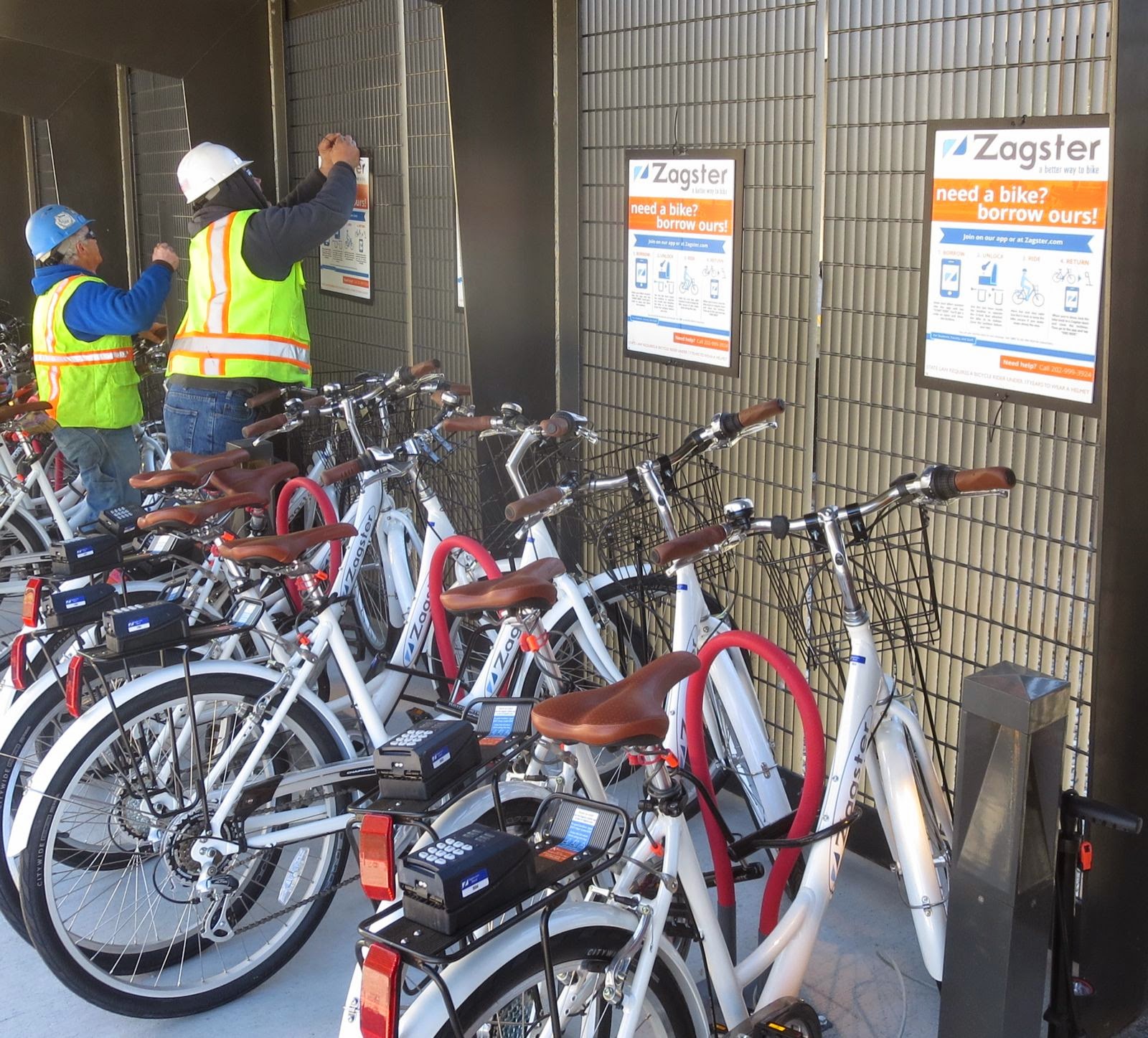
The shelter for bicycles runs parallel in placement and size to the train it's meant to complement.
The bikes seem to say "Don't leave me behind. Let me take a ride, too."
Workmen were putting the finishing touches on the bike borrowing self-service.
Interesting concept.
Another coffee-centric photo, of the inside of the Wawa on its first day open, just a few steps across the plaza from the train. This may be the first Wawa ever to have a big skylight over the cashier area,
and several slivery ones in the bathrooms that cast ethereal light on the proceedings. That may be why the woman collecting donations at the front door for a church's humanitarian efforts recommended the bathrooms so highly.
The bathrooms also have an Airblade hand dryer whose "420 mph sheets of air scrape water from hands, drying them quickly and hygienically", along with faucets that automatically turn on and off, and a waterless urinal (no photo, sorry). The forced air approach to hand drying avoids the waste of paper towels and the energy-intensive hot air of traditional hand dryers.
From the top of the parking structure next door, you can see the "green" roof of the Wawa, with circular skylight. The roof actually looks like a small hill, and should green up with plants come spring. Not your typical Wawa roof.
Seen from above, the arrival of the Dinky brought back a sweet memory of the train set I had as a kid--a mass transportation mecca laid out on a 4x8 piece of plywood in the basement.
Though there is lamentably no photo of my childhood train set, here's what it might have looked like if my big brother had come along, torn up some track, and inserted a center for the performing arts. How long would it have taken, after such an intrusion, before I could emerge from the shadows and walk in the sun once more? The Dinky offers its own answer, with an early morning "toot!" that yet and still begins each new day in Princeton.
(Previous writings on Big Bro's, a.k.a. Ma U's, relocation of the Dinky can be found here.)
Subscribe to:
Posts (Atom)