Showing posts with label Princeton University. Show all posts

Sunday, September 29, 2019

Funkiest Recycling Containers Ever at Princeton University Football Stadium


People celebrate Princeton for many things. Computers had some of their beginnings here, as did football apparently, which is now celebrating its 150th anniversary at the Princeton University stadium.

I wish that, for this grand occasion, they might have sprung for some new recycling containers to adorn the stadium's fine interior. Instead, the stainless steel containers that were dysfunctional ten years ago are even moreso now. It's more accurate to call them anti-recycling containers.


Back when I was trying to improve recycling, I devoted a whole blog to critiquing public recycling containers, so few of which are well designed. Walk down the stadium's interior corridors--a nice sort of indoor/outdoor experience--and you'll see some of the most confusing labeling imaginable.


This one says "recycling", but the "bottles-cans" label is crossed out.

Two of this one's labels suggest recycling, but the third label says "trash." Does one go with the majority?

There are two basic rules for successful recycling: Pair up the trash and recyclables containers, because people won't take the time to go searching for the right container. And create a clear visual distinction between the two containers. Otherwise, people throw stuff wherever.

Here's a particularly helpful post from more than ten years ago that describes the recycling situation at Jadwin Gym, and how it could be easily and inexpensively improved. It was written back when I was contacting Princeton University's athletic department, wanting to help them improve their stadium recycling. We made some progress, but in the end, the lack of motivation for maintenance staff ultimately undoes any improvements initiated from above.


A better design for a recycling container is this one, in the minority at the stadium, shaped like the bottles you're supposed to put in it.

Another good design has been used in Princeton's parks for many years. It won't win awards for beauty, but actually works. The trash and recycling receptacles are paired and of contrasting appearance. It isn't expensive, and it really isn't hard.

Sunday, October 01, 2017

The Quandary and Legacy of Overamplification

Every now and then, I have a bone to pick with Princeton University. These aren't the usual bones, e.g. University expansionism, it's impact on property taxes, or moving the Dinky station. These are smaller bones, like the stadium lights that used to be left on for long hours while the stadium was empty (which also turned out to be one of former university president Tilghman's pet peeves), or the ineffective recycling at Jadwin Gym (they improved it for awhile after my input, then reverted). All of these bones play against a background of overall gratitude. My wife is a professor there, my older daughter had a good experience as an undergrad, and I've attended many lectures open to the public. The bones are often not specific to the University, but are symptomatic of a culturally pervasive problem. The bone du post has to do with toxic sound levels.

In a world of speed limits, seat belts and emission standards, where toys, play equipment and nearly everything else we buy and consume are carefully regulated for safety, the exceptions to this safety-first mentality stand out. The most grievous is carbon emissions, upon which no constraint has been placed. The future remains unprotected and has already suffered what is now playing out as tremendous damage.


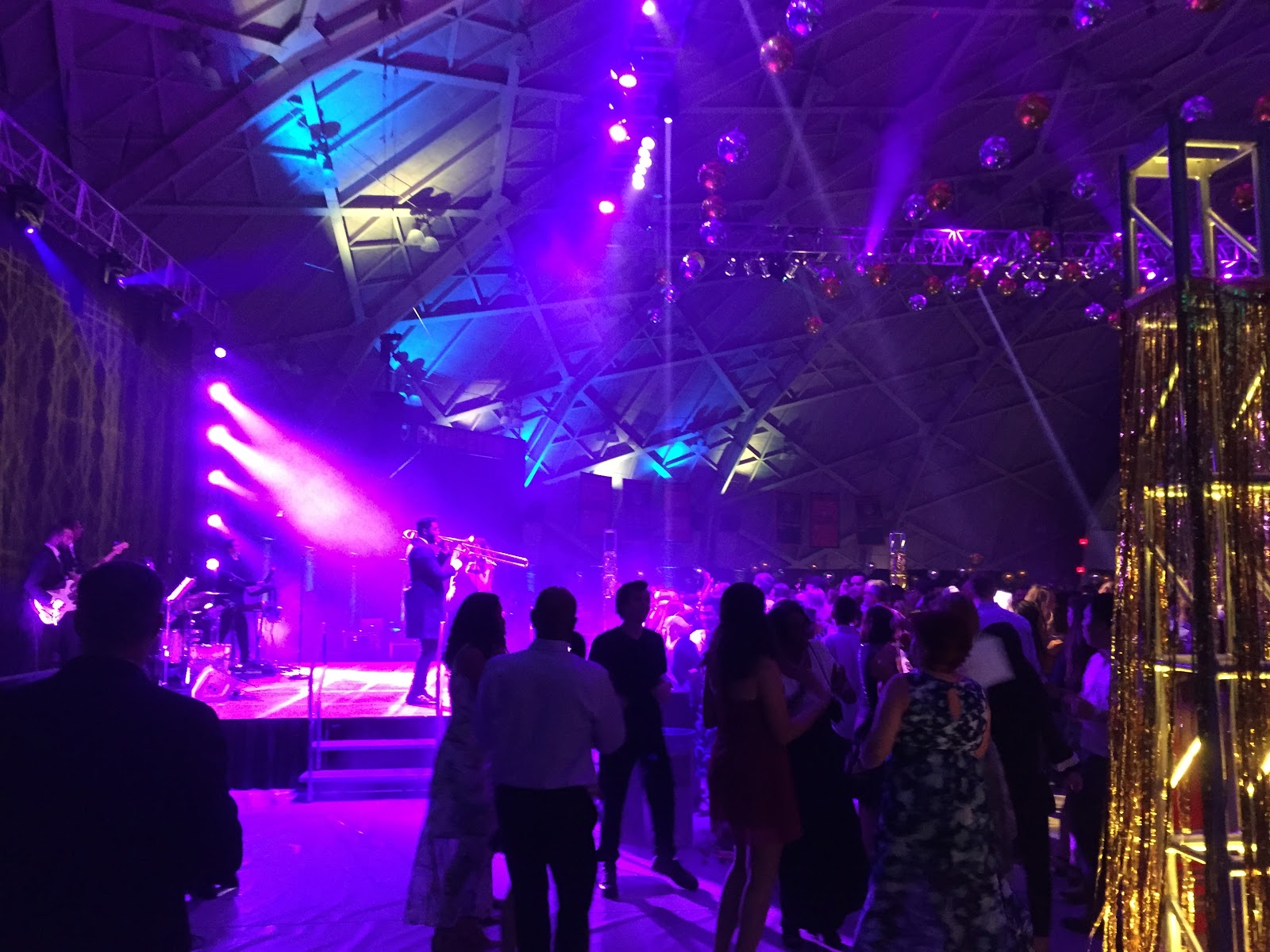
Another is decibels, whose impact on the ears, as with climate change, is unintended and often long delayed. That impact became apparent at an event this past spring (this post lingered in the draft folder): the big Princeton University graduation party known as the Senior Prom at Jadwin Gym. My daughter was part of the 2017 graduation--a meticulously planned 3 day affair that involves mass transport and accommodation of far-flung families, and a tightly scheduled series of events, all of which seems to have come off without a hitch.

Why, then, would a University that watches closely over its students not pay attention to the sound levels at the big party to which we were all invited? The cavernous gym was packed with people young and old, dancing and seated. The food was a healthy mix of humus, vegetables and fruit, but the air was toxic with thunderous sound. About one hour in, my daughter's ears "popped". Traumatized, she fled to the building's entryway, texting me with worries that her hearing had been damaged.

As someone who has played in wedding bands, I know that people who complain about loud music can be pegged as fuddy duddies trying to ruin the party. That's probably why I wore earplugs but didn't try to convince others in the family to do the same.

Regulation is often viewed negatively, but it can often lead to better products. Regulation of the producer can protect and simplify life for countless consumers. The deafening volumes in Jadwin Gym not only stymied any conversation at the tables, but by overwhelming the ears, paradoxically, the music was harder to hear with any clarity. The philosophy seems to be that people are so inhibited, so awkward at parties, that they must be pummeled by loud music in order to break down inhibitions, while providing an excuse to avoid conversation. In nightclubs, loud music is intentionally used to encourage people to drink more and talk less. But the University has no profit motive at a graduation party.

It's true that tolerance for loud sounds varies, and spectacles like a big party or a sports event are expected to be loud. But it's possible to achieve the desired intensity, sense of spectacle and celebration without destructive sound levels. In the 1980s and 90s, I struggled with this while playing in loud bands, and concluded that human nature conspires with technology, leading to volume creep. Soundmen, subjected repeatedly to loud music as part of their job, are not the best arbiters of volume. A band's volume can creep upward out of youthful exuberance. It's easier for a musician to turn up than to risk resentment and bruised egos by asking others to turn down.

These factors pushing volume upwards have no countervailing force. Audience members are very reluctant to give feedback. I remember a deafening Maynard Ferguson concert--my first but one of his last before he died--where people sat like trapped animals in their seats. A few walked out, but I was the only one to appeal to the soundman, clearly a veteran and victim of nightly decibelian overdose. He shrugged, perhaps unable to hear what I was saying. We searched for a quieter place in the auditorium, but finally had to leave.

At the least, at events where sound levels could be extreme, big bowls of foam earplugs should be displayed in the lobby. Soundmen should be required to conform to decibel limits. And any noisy establishment should be protecting its workers and customers from hearing damage. Workers in particular, such as the waiters at the Senior Prom, with longer exposure and no option to leave, are particularly at risk. Once requirements and procedures are in place, good habits are reinforced and our lives become simplified and safer. Otherwise, everyone pays. Hearing aids ain't cheap.

As with climate change, it's the delayed damage done unintentionally that slips through society's otherwise elaborate safety net.


Thursday, June 08, 2017

Pomp and Political Circumstance


It was a misty and misty-eyed day on the green in front of Nassau Hall as the class of '17 was formally anointed with degrees. There is so much quality stuffed into the bounded space of Princeton University, in the architecture, the brain power. A week is devoted to celebrating it all, first with an infusion of alumni, then with three days devoted to the graduating class. This year, I was invited in, as a proud parent, to bathe in orange and black, which happen to have been my school colors growing up in a small Wisconsin town. Our mascot was a bulldog, from which I may have gained some degree of persistence in life, though as a beast it lacks the lithe charisma of a tiger. My day of birth mixed with the graduating class's year--a prime coincidence given some additional gravitas by F. Scott Fitzgerald's graduation a century prior.


Among those receiving honorary degrees was Kareem Abdul-Jabbar, basketball star from my youth, jazz aficionado, and doer of good in the world, still head and shoulders above as he walked through the gates.

There was another familiar name from my youth being honored along with Kareem--Jeremiah Ostriker, an astrophysicist who had been a student at Yerkes Observatory in that small Wisconsin town when I was growing up. He went on to be one of the discoverers of dark matter in the universe.


Stirring music wafted across the crowded green, and stirring words bounced off the surrounding buildings as the rain held off. It was a good feeling to witness my daughter walking through the gates to a gallant melody from Gustav Holtz's The Planets. Later, when the band was viewed from closer up, the body language of the conductor and musicians suggested a less than inspired feeling behind the music, but they were professionals doing what they do very well.

The class victorian, in her speech, focused praise on the un-degreed--the people who day after day provide food for the students, clean the bathrooms, and offer a chance for any student who takes the time to discover magic and authenticity in plain-spoken lives. I, too, having grown up in an academic family, was attracted to that plain-speech that came not from books but from everyday experience.

In retrospect, it seemed a call for reclaiming a connection with the working class, much of which has drifted into a self-destructive allegiance with faux-populist, authoritarian-leaning politicians.

President Eisgruber's speech, too, was in part a response to the forces that are working from without and within to erode and eviscerate institutions that once seemed so secure.
"Overcoming the fractious politics and bitter disagreements of our day will require empathy; it will require friendship and love; it will require an ability to connect and collaborate together. It will also demand that we find a way to restore and rebuild faith in the institutions, of government and of society, that allow us to take on projects together. That is no easy task, for we live at a time when confidence in our shared institutions is ebbing. People are losing faith not only in government, but also in business, journalism, and non-profit organizations."
What he must know and cannot say is that words like "empathy" and "us" and "together" are anathema for those who gain power by pilloring the despised "Other" and who thrive on division. How, it must be asked, can there be so much intelligence in the world, so much analytical power, so many wise words finely crafted over centuries and easily accessed, and yet power accrues to the incurious, the callous, the arrogant and the petty?

Within the comforting embrace of campus walls and elegant gates, as good deeds were praised and the graduating class was called upon to serve the nation, I watched swallows patrolling for insects above the verdant canopy of beneficent trees. Other birds, in twos or threes, passed through, barely noting our presence as they hurried on to some distant destination. Then the birds and their vibrant energy and skill were gone, and a lost balloon rose higher and higher towards the clouds. I imbued it with meaning, at odds with the occasion, as it slipped further away. The balloon became our prospects, given political sabotage, for stopping runaway global warming. Powerless to retrieve it, I watched as it faded to a speck and then disappeared into the gray mist of low-hanging clouds.

But no, we are buoyant, each imbued with spiritual helium. Dark matter cannot draw us down. The clouds may threaten rain but cannot deter. The faces of the regally clad and newly anointed, passing through the gates at long last, were full of joy, relief and expectation. Kareem still stands tall, unbowed by age and the nation's political trajectory. Gustav Holtz still stirs the noble bedrock at our core.

President Eisgruber quoted one of his predecessors, Bill Bowan: “Institutions exist to allow us to band together in support of larger purposes; they permit a continuity otherwise impossible to achieve; and they allow a magnification of individual efforts. Learning to make the accommodations that institutional affiliation requires is not always easy,” especially for people like our students, who have been encouraged to cultivate “critical habits of thought and a fierce independence. But there is a need to cooperate and collaborate, as well as to strike out on one’s own, if important societal ends are to be served.”

Those words were spoken to Eisgruber and others in his graduating class of 1986, as Ronald Reagan's administration was spreading pessimism about government and collective effort in general, promoting instead the individual as the all and end all. That pessimism has grown, deepened, hardened into an ideology impervious to evidence or urgency, and now leaves us helpless and paralyzed, as we collectively create problems but are denied the chance to collectively solve them.

Still, hope awaits in the wings, of vibrant birds overhead, of graduates dispersing to pursue their dreams, and the spirit that flies in timeless melodies.