Wednesday, July 12, 2017

Free World Music in Princeton, July 14, 15 and 22

Blue Curtain and the Princeton Rec Department host two concerts this summer in the beautiful setting of Pettoranello Gardens. Park in the Community Park North parking lot off of Mountain Ave and walk down into Pettoranello Gardens. Or ride you bike. This year, Jamaican and latin jazz.

Meanwhile, this Thursday, July 13, African banjo player Cheick Hamala Diabate performs, 6-8 at the Princeton Shopping Center, sponsored by the Arts Council of Princeton.


dd />

Alert: Two shifts from public to private--Attacks on Internet Neutrality, and Selling Off of Public Airwaves

Defending the Internet's Net Neutrality: A broad coalition is encouraging people to defend the internet's "net neutrality" against the current administration's revisionary zeal. Here's an easy way to express your opinion by the July 17 deadline:
https://www.battleforthenet.com/netroots/?utm_source=greenpeace


Wireless Microphones: The government is also selling off additional frequencies to wireless providers, creating problems for performers who use wireless microphones. Depending on which frequency the microphones use, they could start picking up cellphone conversations in the middle of a performance. As with selling off public lands, the government gets temporary income but the loss of "common wealth" is forever. http://www.geartechs.com/index.php/News/fcc-auction-more-news-on-wireless-microphones-of-the-future.html

Thursday, June 08, 2017

Pomp and Political Circumstance


It was a misty and misty-eyed day on the green in front of Nassau Hall as the class of '17 was formally anointed with degrees. There is so much quality stuffed into the bounded space of Princeton University, in the architecture, the brain power. A week is devoted to celebrating it all, first with an infusion of alumni, then with three days devoted to the graduating class. This year, I was invited in, as a proud parent, to bathe in orange and black, which happen to have been my school colors growing up in a small Wisconsin town. Our mascot was a bulldog, from which I may have gained some degree of persistence in life, though as a beast it lacks the lithe charisma of a tiger. My day of birth mixed with the graduating class's year--a prime coincidence given some additional gravitas by F. Scott Fitzgerald's graduation a century prior.


Among those receiving honorary degrees was Kareem Abdul-Jabbar, basketball star from my youth, jazz aficionado, and doer of good in the world, still head and shoulders above as he walked through the gates.

There was another familiar name from my youth being honored along with Kareem--Jeremiah Ostriker, an astrophysicist who had been a student at Yerkes Observatory in that small Wisconsin town when I was growing up. He went on to be one of the discoverers of dark matter in the universe.


Stirring music wafted across the crowded green, and stirring words bounced off the surrounding buildings as the rain held off. It was a good feeling to witness my daughter walking through the gates to a gallant melody from Gustav Holtz's The Planets. Later, when the band was viewed from closer up, the body language of the conductor and musicians suggested a less than inspired feeling behind the music, but they were professionals doing what they do very well.

The class victorian, in her speech, focused praise on the un-degreed--the people who day after day provide food for the students, clean the bathrooms, and offer a chance for any student who takes the time to discover magic and authenticity in plain-spoken lives. I, too, having grown up in an academic family, was attracted to that plain-speech that came not from books but from everyday experience.

In retrospect, it seemed a call for reclaiming a connection with the working class, much of which has drifted into a self-destructive allegiance with faux-populist, authoritarian-leaning politicians.

President Eisgruber's speech, too, was in part a response to the forces that are working from without and within to erode and eviscerate institutions that once seemed so secure.
"Overcoming the fractious politics and bitter disagreements of our day will require empathy; it will require friendship and love; it will require an ability to connect and collaborate together. It will also demand that we find a way to restore and rebuild faith in the institutions, of government and of society, that allow us to take on projects together. That is no easy task, for we live at a time when confidence in our shared institutions is ebbing. People are losing faith not only in government, but also in business, journalism, and non-profit organizations."
What he must know and cannot say is that words like "empathy" and "us" and "together" are anathema for those who gain power by pilloring the despised "Other" and who thrive on division. How, it must be asked, can there be so much intelligence in the world, so much analytical power, so many wise words finely crafted over centuries and easily accessed, and yet power accrues to the incurious, the callous, the arrogant and the petty?

Within the comforting embrace of campus walls and elegant gates, as good deeds were praised and the graduating class was called upon to serve the nation, I watched swallows patrolling for insects above the verdant canopy of beneficent trees. Other birds, in twos or threes, passed through, barely noting our presence as they hurried on to some distant destination. Then the birds and their vibrant energy and skill were gone, and a lost balloon rose higher and higher towards the clouds. I imbued it with meaning, at odds with the occasion, as it slipped further away. The balloon became our prospects, given political sabotage, for stopping runaway global warming. Powerless to retrieve it, I watched as it faded to a speck and then disappeared into the gray mist of low-hanging clouds.

But no, we are buoyant, each imbued with spiritual helium. Dark matter cannot draw us down. The clouds may threaten rain but cannot deter. The faces of the regally clad and newly anointed, passing through the gates at long last, were full of joy, relief and expectation. Kareem still stands tall, unbowed by age and the nation's political trajectory. Gustav Holtz still stirs the noble bedrock at our core.

President Eisgruber quoted one of his predecessors, Bill Bowan: “Institutions exist to allow us to band together in support of larger purposes; they permit a continuity otherwise impossible to achieve; and they allow a magnification of individual efforts. Learning to make the accommodations that institutional affiliation requires is not always easy,” especially for people like our students, who have been encouraged to cultivate “critical habits of thought and a fierce independence. But there is a need to cooperate and collaborate, as well as to strike out on one’s own, if important societal ends are to be served.”

Those words were spoken to Eisgruber and others in his graduating class of 1986, as Ronald Reagan's administration was spreading pessimism about government and collective effort in general, promoting instead the individual as the all and end all. That pessimism has grown, deepened, hardened into an ideology impervious to evidence or urgency, and now leaves us helpless and paralyzed, as we collectively create problems but are denied the chance to collectively solve them.

Still, hope awaits in the wings, of vibrant birds overhead, of graduates dispersing to pursue their dreams, and the spirit that flies in timeless melodies.

Monday, May 29, 2017

Scrapping Our Role as Climate Saboteurs


There was a time, during WWII, when patriotism meant contributing scrap metal to the war effort. Movie stars like Rita Hayworth lent their glamour to the cause. Soldiers were fighting on the front lines, and citizens were backing them up by contributing what they could and making do with less.

Memorial Day still honors those who have died while serving in the armed forces, but we seem to have lost an awareness of the continuum of service and sacrifice, of how our own civilian lives connect to keeping the country secure.

We know now that our biggest enemy cannot be beaten by an army. Bullets cannot hold back a rising sea, stop a deluge or end a drought. American soil is most vulnerable not to foreign invasion but to the catastrophic melting of ice caps. Despite all the positive ways we spend our days, each one of us has been recruited as an unwitting soldier in a war upon our shared estate. As civilians, our struggle every day is to limit our roles as unintentional climate saboteurs.

There are political elements that strive to slow progress, and keep us armed with tailpipes and chimneys gushing global warming gases for as long as possible. The tide is turning, though. Renewable energy and the batteries to store it are dropping rapidly in cost. One of our neighbors recently bought an electric car that runs 230 miles on a charge. In time, and let's hope it's soon enough, scrap will be doubly patriotic because it will include the star-crossed machines of combustion. Gas stations will be obsolete. We'll scrap the war on our land, our climate and our future, in a global disarmament as our machines are silenced of their engine groans and fossil carbon sighs. Our cars and homes will run on the sun and the wind. At last, our civilian lifestyles will be supporting our troops' mission to protect American terra firma, rather than working against it.


This year's Memorial Day parade was brought to us by gasoline. There's no question about the grip it holds on our lives, our hearts, our memories. I made models of souped up cars like this one when I was a kid. Can still smell the plastic and the paint. But gasoline's grip will loosen. Maybe Memorial Day will still be a day to smell the bite of exhaust in the flag-filled air. But the other 364 days of the year, we'll have moved on, despite ourselves. May the future be welcoming despite our long delay.

Monday, May 22, 2017

A Scavenger Cleans the Scene


The town doesn't pick up leaves bagged in plastic. Some landscape crew hadn't gotten the memo, however, so these plastic bags full of leaves sat in front of a rental on Linden Lane, creating an eyesore for weeks. Maybe it was months. They sat there so long the UV radiation started degrading the plastic. What to do?

Time for Mr. Sustainable to swoop in with his greenmobile--able to jump puddles in a single bound around the block--to turn a lose-lose into a winsome win-win. "Sure," he thought, "I could use the leaves. Leaves are always useful, for keeping moisture in the soil, contributing nutrients, and smothering weeds. The chickens will scratch under them for bugs. Happiness will prevail. The more leaves the merrier."

This is the sort of service scavenging species provide in nature every day. We think of them as no better than beggars, freeloaders, opportunists. A vulture exploits others' misfortune, and yet they too serve by picking clean what is foul. They find utility in others' messes, and leave the world a cleaner place. We should rank them, and their willingness to view trash as a resource, more highly in our estimation.

Saturday, May 06, 2017

Recycling Plastic Flower Pots

Have plastic pots you don't want to throw away? A local resident called up nurseries, asking if they take used pots. Finally, he found out that Lowes has a recycling program for pots. Below is text from their website. I'd encourage people not to make a special trip, but integrate it into other Route 1 errands, lest the gas burned do more harm than the good of recycling the pots.

Lowe's is committed to exploring new opportunities to reduce waste and help consumers do the same. We launched a nationwide Garden Center recycling program in February to help keep rising mounds of plastic plant containers out of landfills. 
Lowe's recycled 230,000 pounds of plastic in just three months during a pilot test in which 22 stores collected plastic pots, trays and tags that are used with live nursery items. Following that success, Lowe's expanded the program to all stores in the continental United States, more than 1,700 locations.
Generally, curbside recycling programs are unable to accept plastic plant containers, such as pots and hanging baskets. This new program gives consumers a responsible recycling option and makes it easy for them. We provide a cart for stores and customers to return plastic plant trays, pots and tags, regardless of condition. No matter where consumers purchase the plant, they are encouraged to return the materials to a Lowe's Garden Center to be recycled.

Monday, April 24, 2017

Free Energy at the Princeton Shopping Center


Symbolism teams up with utility as an electric car recharging station and Nomad Pizza occupy what once was a gas station. Shop or dine at the Princeton Shopping Center and treat your electric car to a 24/7 All You Can Drink special. Get a full charge for no extra charge.

Two reports thus far from friends who are leasing electric cars: One said the station charges up his car further than he can charge it at home. The other reported that both parking spaces next to the charging station were occupied by non-electric cars. Move over, gas guzzlers!

There are some very happy electric car owners out there. A Chevy Volt owner (50-60 mile range on batteries, plus gas engine backup) said she only paid $8 for gas in the past year, and charging the car at home didn't noticeably increase her electric bill. She mentioned some additive one can use to keep the gas fresh, since it sits in the tank for a long time.

The Chevy Bolt has a range of nearly 250 miles on battery power. I had been wondering when the future would arrive, to rescue the future from a persistent, resistant present.

The logic behind leasing an electric car rather than buying new outright is that the battery technology will advance quickly in coming years. Since many people lease, that means there are good deals on 3 year old electric cars, if one wants to buy used.

Next step: Build a solar array over the Princeton Shopping Center parking lot, like they've done at some of the Montgomery schools.


Wednesday, March 15, 2017

Streetside Stackable Art On Recycling Day


I tend to emphasize the downside of our recycling buckets, but check out their stackability. Looks like an artist just joined the recycling crew, as all over town the buckets were left neatly and creatively stacked. We'll see if this becomes the new normal.

Reminds me of when I was horticulturist at the Michigan Union in Ann Arbor, and hired a fellow jazz musician as an assistant. He approached lawn mowing like a sculptor, leaving behind a different pattern each time.

Friday, February 24, 2017

Yardsale Desk To Star in University Play

For years, this desk, bought for a pittance at a yardsale, lived a quiet life in my daughter's bedroom, covered with all manner of things, seldom actually used as a desk. Even when it was no longer of unuse in the bedroom and relegated to a garage filled with all manner of things and seldom used as a garage, it didn't give up hope. "Life is so strange", it said to its richly grained self. "Maybe it's preparing me to star in a dark comedy." There were days, though, as the dust grew thicker upon it, that it felt like it was fated only to take up space. It sent its photo to a used furniture store in town, but they weren´t interested. A pingpong table nearby told the desk, ¨Look, I only need slight repairs, and I´ve been in here two years. Sure, I was glad to be saved from the landfill, but when´s my second life going to start? I think we´re in here until they sell the house.¨

No one paid the desk´s wild dreams any mind, but desk dreams really do come true, for one day a young woman showed up to take the desk to Princeton University campus, where it now stands proudly on the Hamilton Murray Theater stage, ready to play a role as, surprise, a desk, in a student production of Speech and Debate. Other actors will get all the lines, but the desk will get more stage time.


I was glad to see the desk get the break it so richly deserves. As the desk's agent, I tried to stipulate that the desk have a spotlight pointed at it at all times, but the stage manager, my daughter, refused to compromise artistic integrity to serve a stage prop's ego. We're hoping this could boost the desk's flagging career. Otherwise, it's back to the garage.

Speech and Debate, at Princeton University´s Hamilton Murray Theater:

Three misfit high-schoolers form a Speech and Debate club in an attempt to reveal a sex scandal, unveiling their own vulnerabilities--at once hilarious and heartbreaking--along the way. Pulitzer-prize-finalist and Tony-award-winning playwright Stephen Karam presents a dark comedy with music about coming to terms with ourselves, others, and the terrifying hypocrisy of the adult world.

By Stephen Karam
Directed by Kyle Berlin '18

February 24 @ 8 PM
February 25 @ 8 PM
February 26 @ 2 PM
March 2 @ 8 PM
March 3 @ 8 PM
March 4 @ 2PM
March 4 @ 8 PM

$8 for students
$10 for faculty/seniors
$12 general public
Student Events Eligible

Thursday, February 23, 2017

Free Heat, Free Money


Walking in front of a rental house two doors down, I suddenly felt a blast of radiant heat on my right cheek. I looked around, wondering where it was coming from. Ten feet away was a window, reflecting the afternoon sun. Either the window pane or the white shades inside were reflecting back intense solar energy. Multiply that by however many times larger the window is than my face, and you get a sense of how much free heat is being reflected away from that house. While free heat is being rejected, the gas furnace is laboring to keep the house warm, and more fossil carbon is slipping up and out of the chimney. Discontent with nature's subtle power and inconsistency, we turned long ago to the now discomfiting comforts of machines.

How deceptive it all is. The climate changing pollution seeping out of Princeton's chimneys and exhaust pipes is silent, invisible, odorless, unintended, and the winter sun, hunkered down low in the sky, seems an improbable source of heat for a home.


What's being lost is as covert as a $5 bill slipping from a pocket, noticed only by someone out and about, open to serendipity, who happens by the right spot at the right time.

Thursday, February 16, 2017

A Small Victory: Reaching Out To Companies About Their Products

This is a time to be thankful for small victories, and also to reach out to those beyond our bubble.

But first, a joke, heard yesterday, about a couple who collect cars. The husband tells his wife, "Honey, I'd like something shiny and black that goes from zero to 250 in two seconds." "Sure", said the wife, who then went out and bought him a bathroom scale.

We had an Escali bathroom scale stop working after about ten years, and because we liked it so much I reached out to the company. It turned out to be a great lesson for the kids. A company representative responded immediately to my email, offering to replace it for free if I filled out a form. There seemed to be a catch, because the form required a receipt, which of course we are not organized enough to have kept. Initially discouraged, I later emailed back, explaining that the receipt was long gone. To my surprise and delight, the rep responded that that was not a problem. Just send a photo of the model number on the back.

Within a week, the new scale showed up on our doorstep. The kids were impressed, and so was I.


The only downside is that the old scale needs to be thrown out, or perhaps recycled as electronics. Knowing this, I had given the old scale ample time to repair itself before reaching out to the company--a month or two sitting on the shelf in the family room. This was not completely irrational. Self-repair had worked in the past, with a garbage disposal and some other items.

Thanks to "The Escali Team" for standing by their product.


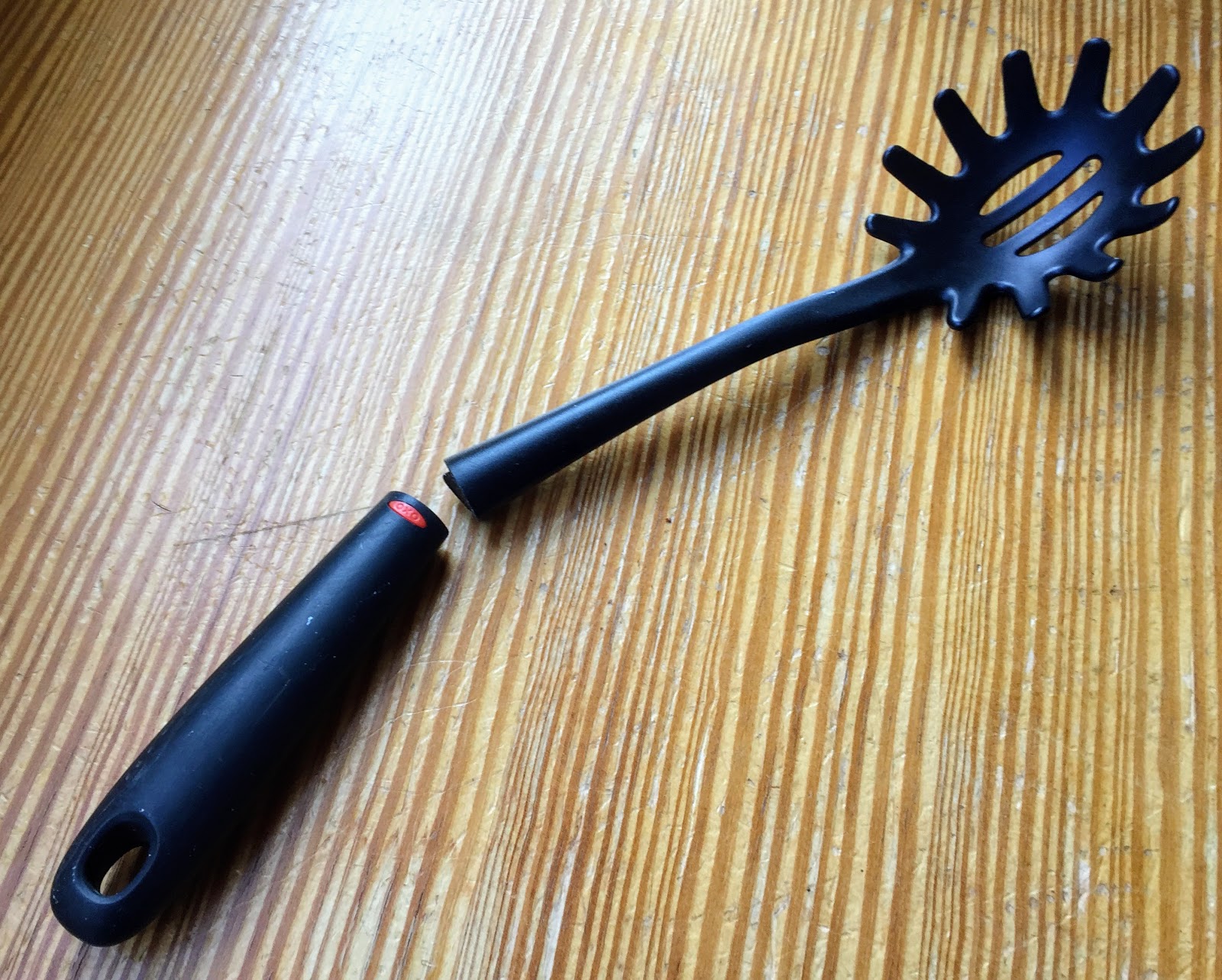
Next up, that Oxo brand spaghetti server, though at $6.95 it's more a matter of principal and curiosity.

Friday, February 03, 2017

Rain Barrels are a Drop in the Bucket

One oft-mentioned way to "go green" is to buy a rainbarrel to collect water from your roof. There are a few things you should know. I write this as an advocate for capturing and utilizing the runoff from roofs, driveways and uphill neighbors' yards. There's a role for rainbarrels, but it's often overstated.

First, a bit of calculation shows that a 2000 square foot roof captures 1250 gallons of water from a 1 inch rain. Divide that by four downspouts, and you have about 300 gallons coming into the rainbarrel in a modest rain. If an average rainbarrel holds 50-75 gallons, most of the water will not be captured. The percentage caught will be even lower if the rainbarrel still has water from the previous rain--likely, given that people tend to forget to use the rainbarrel water in their gardens.

So the question becomes, is the rainbarrel really making a difference, or is it just adding to the amount of "stuff" in the world? I have a rainbarrel--rescued from a dumpster and retrofitted with a screen to filter the incoming water and keep out mosquitoes--but the water doesn't get used much, so I just leave it on slow drip, to let the water empty out before the next rain. Attaching a soaker hose is another way to slowly release the water into the garden.

Unless you're really going to use the water, it can be more aesthetic and consequential to direct the roof water into swales or concave raingardens that can accommodate the hundreds of gallons generated. Or, if you're serious about catching and using water, check out this system at the West Windsor Municipal Center. It looks like it holds a couple thousand gallons.


The giant rainbarrel (you can get these at farm supply stores) is raised up to add pressure to the gravity feed over to what looks like a community garden.

It's fun to see a 1970s counter-cultural dream come to life on municipal land in the 21st century. The central concept was easy living by working with nature. We'd store the rain from the sky, capture nitrogen from the air by planting legumes, use mulch to discourage the weeds; and interplant to make full use of the sun's gift of energy; then sit back and watch the garden grow.

Implementation was not always perfect. In Durham, NC in the 1990s, realizing that one small rainbarrel wasn't catching much runoff, I picked up a dozen 50 gallon drums from the local Coca Cola plant, washed out the dregs of syrup, then drilled holes to connect them in series. They weren't very aesthetic, and the 220 gallon plastic cisterns I bought at a farm supply store to replace them with didn't exactly blend into the landscape either.

These experiences led to dreams of bladder-like rainbarrels that would deflate when empty--far more efficient to transport from factory to home. After a big rain, they'd bloat like a Michelin Man in a tire commercial, but would shrink down behind the shrubbery at the base of the house's foundation inbetween rains. That was the dream, and it's nice to see that these now exist, under the name "rain bladder". Though they are pricey, that could change if they became standard installations on homes.


Another alternative to the standard rainbarrel is what I call a "fillable, spillable minipond", basically a black tub placed under a downspout, which in turn overflows into the yard. It provides open water that's nice to dip your hands into while working in the garden, and a blank canvas for nature's crystalline creativity in the winter. The tippable aspect proves handy if mosquito wigglers appear.

After all the experimentation, the cheapest and most aesthetic approach to capturing and slowing down runoff from our home and driveway turned out to be the yard itself. Some downspouts send water flowing across the lawn, or into a shrub boarder, or into concave raingardens that accumulate a few inches of rain that then seeps into the ground over a day or two. (We have miniponds, too, dug deeper for extra capacity, but the attractive open water requires special attention to discourage mosquitoes.) With the help of some low berms and hollowing out here and there, the yard itself becomes the bladder, and the ground, rather than the rainbarrel, becomes the reservoir that deep-rooted plants and trees can draw on during droughts.

The little rainbarrels can still play a role, but compared to all the water a roof generates, and the potential holding capacity of a yard, they really are a drop in the bucket.

Friday, January 27, 2017

Plastic's Ticket To Travel: Wind, Rain and a Stormdrain

Along Franklin Ave, eight pieces of trash, mostly plastic, sit poised to head down the storm drain and into Harry's Brook. A stormdrain may not look like a promising gateway to the world, but this plastic could be poised for a journey of thousands of miles. Harry's Brook empties into Carnegie Lake, which in turn empties into the Millstone River, whose water joins the Raritan River where our drinking water comes from, and from there drains into the Atlantic Ocean. If you type "Sargasso Sea plastic pollution" into a google search, and then click on "images", you may see what's at this link--images of plastic strewn across the sea. Multiply eight pieces of trash by the millions of storm drains in New Jersey, add all the other states and nations with rivers flowing into the Atlantic, and those ghastly images seem less surprising.

As with so many other threats to a habitable planet's future, don't look for malice or even carelessness in this local/global litter. Now and then, strong winds blow on Princeton's recycling day. Overflowing green and yellow recycling buckets spill their contents onto the streets, and water and gravity do the rest.


Princeton participates in Mercer County's recycling service, which may well be cost-effective, but the small round buckets are not ideal, as they lack capacity and stability, and can roll into traffic when left on their side. Most lack lids and, if stored outside, allow rain in and mosquitoes to breed in the summer. When filled with heavy paper or glass, they are onerous for many residents to carry to the street. Still, one senses that the yellow and green recycling buckets will, like the rest of the world's imperfections, endure.

Below are some posts about plastics and recycling filled with fun, edification and exasperation from previous years:

Troubled Beverage Containers on the Brink

The Great Recyclables Escape

House Made of Bottles

Where Princeton's Recyclables Go

Poem of the Puzzled Bottle Top Recycler

Wednesday, January 25, 2017

Accidents Caused by Leaves Piled in the Streets

At tonight's Princeton Environmental Commission meeting in Municipal Hall, we'll be discussing ways to reduce the amount of leaves and yardwaste being piled in the streets. One approach is detailed on a page accessed via the tabs at the top of this blog. Click on "Improving Yardwaste Collection", or click on this link. It lists seven downsides of loose dumping, and offers a way to shift towards containerization and thereby clean up our streets and waterways.


How dangerous are leaf piles in the streets? I've heard of near misses, particularly at night, when drivers didn't see pedestrians forced to walk in the car lane to avoid leaf piles, and I've seen kids playing in street leaf piles--a natural inclination--until their distracted parents noticed the danger. Snopes.com documents two deaths in other towns when children playing in street leaves were run over. The photo below shows how wet leaves near intersections can cause cars to skid.

But have leaves in Princeton's streets actually caused accidents? An OPRA request to the Princeton Police Department yielded a couple reports of accidents caused by leaf piles. Here's one description:
"Driver 1 stated he was traveling northbound on Arreton Road when he swerved left to avoid a large pile of leaves which were situated along the northbound road edge. As a result, Driver 1 stated, he lost control of his vehicle and drove off of the left side of the roadway before crashing into a row of bushes in front of 165 Arreton Road and continuing northbound onto the property at 155 Arreton Road. There, Driver 1 stated, he crashed into and drove over two trees and a large boulder before his vehicle came to rest in the driveway at 155 Arreton Road."
What we have, then, in Princeton is a couple car accidents that showed up on a keyword search over the past five years, stories of close calls, and tragic deaths documented elsewhere in the country. We know that it's difficult for the municipality to enforce its ordinance restricting how far piles intrude into the street, and that most piles violate the ordinance. There's an ongoing calculation that street leaf piles are safe enough, but they're also an accident waiting to happen.

Monday, January 23, 2017

A Small Victory of the Commons--Clearing Obstructed Sidewalks

The sidewalks along our street can be a test of pedestrians' initiative. This sidewalk has been constricted since last fall, and though it doesn't affect most of us, it could make things tricky for the occasional person in an electric wheel chair heading up to the shopping center. For months, I'd think of that each time I walked this sidewalk, and each time I'd do nothing about it. I know the owner who is supposed to keep this sidewalk clear. It's usually better to knock on the door and point out the problem, which homeowners often don't notice as they come and go in their cars. But he's busy with a young kid or two, and after all, it took me a few years living up the street before it dawned on me that my portion of sidewalk was partially obstructed by shrubs. Finally, I went ahead and shoveled the leaves off the sidewalk. Fifteen minutes of exercise is not to be regretted, and this newly cleared stretch has now gained positive associations to replace those pesky concerns--a victory for self and community.


Here's another recurrent obstruction, across the street. Most of the bamboo stems returned to vertical after the storm, but one stem remained hanging over the sidewalk for days. Rather than intervene, I made it into an experiment, a test of citizenship and community spirit, to see whether any pedestrian would actually take the initiative and break the stem off, to solve this annoying problem in a small corner of Princeton's commons. Several days passed, with each pedestrian walking around it, before one finally took a few seconds of extra time to pin it back where it wouldn't obstruct those that followed.

For virtual nature walks identifying the diverse intrusive foliage along blocked Princeton sidewalks, see A Portrait of Sidewalk Neglect and a Weedful, Needful Sidewalk.


Wednesday, January 18, 2017

Circular Economy Event at Library, Jan. 19, 7pm


Here's a Sustainable Princeton event coming up tomorrow. One of the speakers is with TerraCycle. I'm going to take my burgeoning bag of mylar coffee bags to see if they will put them to reuse.

From Sustainable Princeton:
Join us tomorrow evening at 7:00 p.m. at the Princeton Public Library Community Room for our panel of local circular economy experts moderated by Dylan Siegler, Sustainability Coordinator at NRG Energy, Inc. Panelists Charlene Wall-Warren, Director Sustainability at BASF; Michael Waas, Global VP of Brand Partnerships at TerraCycle and Matt Wasserman, VP New Product Development & Sustainability, Sabert Corp. will discuss how companies are rethinking the linear "take, make, dispose" economy and moving towards a system that seeks to reduce pollution and the amount of waste we produce.

New Jersey Certified Recycling Professionals can earn 1.5 CRP classroom credit for attendance.

Light snacks and refreshments provided by Jammin' Crêpes. This zero-waste event is free and open to the public. Many thanks to our longtime event partner, The Princeton Public Library and our series sponsor, NRG Energy, Inc.

Friday, January 13, 2017

Bicycling on Vandeventer

The other day, riding my bike southward on Vandeventer at a goodly rate and in the approved manner, I heard a honk, and glanced back to see a car following close behind. With parked cars on the right, I had no room to move out of his way, and so proceeded apace. To my astonishment, he pulled closer, within two feet of my bike, in an effort to intimidate. I didn't know what to do. Finally, he veered out into the opposite lane and passed in a huff. All this haste came to nothing, as moments later he was forced to stop and wait like everyone else for the traffic light at Nassau Street. Noting his captive presence in the line, I approached and tippy tapped ever so discreetly upon his window and inquired in the politest, most diplomatic tone I could summon--my memory is a bit unclear as to the exact language used--something to the effect of, "Whatever do you think you are doing?" I continued in a similar manner until fully vented, doing my best at all times to maintain a gentlemanly demeanor, though word choice and intensity may have been influenced by an awareness of having just been bullied. Then, gaining no response other than an averted eye, I went on my way, confident that my thoughtful, nuanced feedback would steer him towards deep reflection and a changed behavior going forward.

Wednesday, January 11, 2017

Civic Action Series at Labyrinth Begins Jan. 19, 6pm

In the first in a series of civic action workshops at Labyrinth Books, Cymie Payne will be teaching anyone who wants to learn how to write and submit what are called "letters of comment" when objectionable policy changes (the focus here is on the environment) are looming.


-----------------------------------------------------------------------------
Speak to Your Government Effectively
A Workshop with Environmental Law Professor Cymie Payne
Open to All
Thursday, January 19th @ 6PM
------------------------------------------------------------------------------
With the advent of a new administration in Washington, thoughts turn to the nature of democracy. Do you feel like your government isn’t listening to you? Do you want your opinion to be heard? Do you have expertise that would improve public policy? The legitimacy of democracy rests on transparency and public participation. We have the right to know what our government is doing and frequently the law provides means for us to speak directly on policy and regulation in a process known as “commenting”. Federal agencies are obligated to acknowledge these public comments. Come participate in a practical introduction to a simple process for commenting on regulations, policies and decisions. No prior knowledge required.

Cymie Payne is an Associate Professor in the Department of Human Ecology at Rutgers University and the School of Law. She is known for her work on global governance of the environment and natural resources and the consequent evolution of international law, with a focus on climate change, ocean resources and protection of the environment in relation to armed conflict. She also is affiliated with the Bloustein School of Planning and Public Policy and writes frequently on international courts and tribunals.

Free and open to the public.

Labyrinth Books
122 Nassau Street
Princeton NJ, 08540

Tuesday, January 03, 2017

Leaves: How Nature's Gift Becomes a Menace


Many homeowners find it convenient to rake or blow their leaves to the curb each fall. The leaves are then scraped off the pavement and hauled out of town to be composted. There may be some logic to this approach, but there's also considerable illogic at work. The illogic plays out in many ways: expense, the hazards of blocked traffic and bike lanes, global warming gases from all the scraping, hauling and industrial composting, nutrient runoff into streams, impoverished and hardened urban soils, bias against homeowners on busy or narrow streets, and a scarred streetscape. Here are photos that illustrate some of the downsides.

Leaf piles in the streets push bicyclists and pedestrians (on streets with no sidewalks) out into traffic lanes. I've heard of near misses, particularly at night.

Cars, too, must swerve to avoid leaf piles. Here's a common situation. Police records show at least two auto accidents precipitated by leafpiles.

Removal of the above leaf pile left a dirty street and scarred ground. Rains will sweep nutrients from the remaining decomposing leaves and bare dirt into the local waterway, adding to nutrient pollution.


The irony is that regulations require that silt fencing be installed at construction sites to prevent the washing of sediment into our streams, and yet uncontainerized leaf collection exposes dirt and coats long stretches of streets with leaf residue that can then wash into those same streams.


Loose leaf collection discriminates against homeowners on busy streets, where they must pile their leaves on the grass rather than the pavement. Covered by leaves, the grass quickly dies, leaving bare dirt far into the next summer.

Grass also gets killed on narrow side streets like Chestnut. One exasperated resident of very narrow Bank Street told me of the racket caused by a landscape crew that blew leaves from the backyard into the street, where they interfered with traffic for many days.

It's ironic to see this fertilizer sign on a lawn facing Hamilton Ave, while at the same time the lawn service is killing the grass with piles of leaves. You could ask "What are people thinking?", but I doubt much thinking is going on. Rather, there's a blind adherence to two customs: fertilizing lawns and blowing leaves towards the street.

Princeton main thoroughfare, Nassau St, should be a pride and joy, but the decorative flags and hanging flower baskets during the summer contrast with the lingering scars left behind by fall leaf pickup.

Here's another stretch of Nassau Street left bare and muddy after the grass-killing leaf piles have been removed.

And then there's the actual scars on the pavement, left behind by the "claw" that picks up the leaves.

It's hard to photograph the annual expense, which may be up around $1 million, or the hardened, leaf-cheated urban soil that sheds rain and adds to flooding, or the fossil carbon rising from all the public works department's machines to speed climate change.

Some people think that the answer lies in education and better enforcement of the town's leaf ordinance. I used to think the same. But past education efforts, of which I was a part, had negligible impact. Enforcement was tried, proved time consuming and was abandoned. Robo calls with schedule reminders have helped some, but it's doubtful that landscape crews, with rapid employee turnover and language barriers, will ever coordinate their work to conform to the town's five zone leaf pickup.

Blowing leaves into the street is much like being allowed to send underground carbon up into the air as CO2 from our exhaust pipes. The legacy of all that private convenience is a shared public burden. Deprived of the convenience of doing environmental harm, we would respond, as humans do, by being resourceful and inventive. In the case of leaves, we'd mow some of the leaves back into the lawn and blow others into a back corner of the yard to kill the weeds. We'd devote a tiny portion of our (largely unused) yards to leaf corrals that return nutrients to the soil, and if need be we'd stuff any leaves left over into yardwaste bags and rollcarts for efficient pickup. We'd take as our inspiration nature itself, which never hauls valuable nutrients away, but keeps them close by, to return to the soil from which they came. And we'd take pride in clean and verdant streetscapes.

Princeton doesn't need to be spending $1 million for a brand of leaf management that forces us to navigate through a scarred mess much of the year. We're better than this.

Saturday, December 31, 2016

The Curtain Falls on Dickens (and Obama)


The last curtain falls this afternoon, Dec. 31, on A Christmas Carol at McCarter Theater. It's a great new production, which makes me happy in general, but also for McCarter and the director Adam Immerwahr. Adam was the director of our Onstage community theater group for four years.

The production features a more diverse cast, and a large contingent of community members who mingle with the crowd before the show in period costumes, then appear in group scenes on stage. Ebenezer and the ghosts speak in less grand, echoey tones of voice than in the previous production, more everyday, bringing them closer to people we may know in our own lives.

How profound the contrast this year, between Ebenezer's transformation and the transformation about to occur in Washington, where kindness, generosity of spirit, and empathy are about to be sent packing. In the arts, we're so regularly exposed to happy endings, where good wins out, that we take for granted that the world will work that way, too. How hard the world is working to prove otherwise.


Meanwhile, I ran into the one and only original manuscript of A Christmas Carol on display at the Morgan Library and Museum in NY.


Dickens wrote the story quickly, but wasn't afraid to revise and hone the language.

Friday, December 23, 2016

FIGuring Out A Use for Old Carpets


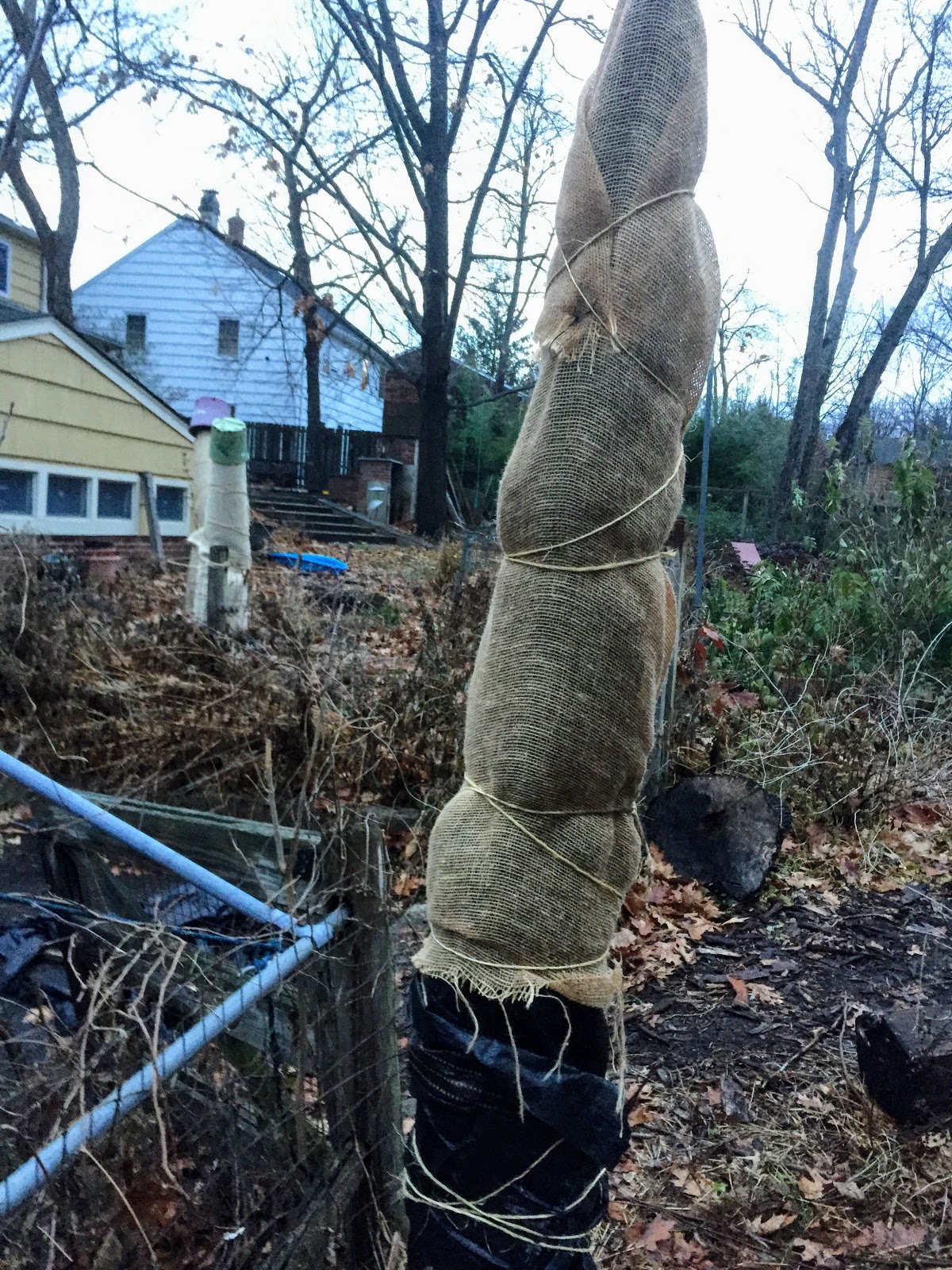
When fig tree stems stand naked against the arctic air, the buds burn and the stems die back to the ground. Though new stems sprout in the spring, no fruit is borne. Three years in a row this has happened, for lack of protection. Finally, in the waning light one recent afternoon, with a 15 degree night approaching, Mr. Sustainable was finally moved to action. There was a new roll of burlap to wrap around them, but it wasn't long enough. What to do?

The internet called for wrapping them in old carpets, but where to get one?

What a coincidence that the Kurbside Kmart just across the street was having a holiday sale on discarded carpet.


It was hard for Mr. Sustainable to cut a decent looking carpet in two, even one that had been lying on the curb for three weeks. But cut he did, and the result was these two characters, or shall we call them FIGures, each wrapped around a fig tree.


But there was a third fig tree and no more carpet. What to do? Fortunately, Mr. Sustainable had retrieved discarded silt fencing from another Kurbside Kmart elsewhere in the neighborhood. It just looked useful, somehow. Little did he know how prescient that bit of scavenging would prove to be.

Silt fencing is that tough, element-proof fabric they install on building sites to catch dirt before it erodes into the street. One of the paradoxes of government is that we have elaborate controls on runoff from construction sites, while allowing spraying of fertilizer, etc. on lawns and dumping of leaves in the street, which create far more nutrient-rich runoff than erosion from these scattered building sites ever would.

But we were talking about figs.


The black silt fencing made a fine wrap for the third fig tree. The remaining burlap was wrapped on the outside, to better deflect the sunlight and avoid roasting the fig tree on sunny winter days.


Mr. Sustainable scored his third win-win a few days later when, needing some thick plastic bags, he thought of buying new bags at the hardware store, then remembered seeing a pile of bagged leaves down the street. The town doesn't pick up leaves bagged in plastic, and the bags might remain there for weeks before the owner caught on. A truckload of those gave Mr. Sustainable all the bags he needed, plus some leaves to pile on the last remnants of invasive english ivy along the fenceline.

There were imaginary high fives all around, with hopes for a fig or two come summer.

Sunday, December 11, 2016

Straddling Two Worlds at the Gas Station


Compartmentalization was a trick of the mind that pundits would attribute to Bill Clinton, when he was having to attend to his presidential duties while fending off the endless attacks launched by the Republican Congress.

But it's something we all do to sustain our view of ourselves as basically good people while we contribute daily to the unraveling of planetary functions. We still have little practical choice as individuals but to unintentionally hasten civilization and the planet towards apocalypse. For that ethical bind, we can point to those cowardly, reckless and opportunistic politicians who deny the existence of and solutions for climate change. Through their failure to act, through their refusal to acknowledge that freedom must be accompanied by responsibility, we still have little choice but to harm our children's future by continuing to seed the atmosphere with CO2 just to get through the day.

Pause now to consider, with a sense of awe, how adept we are at compartmentalization. Even though most people acknowledge the grave risk posed by a radically altered climate, sanity requires an insulatory mechanism that keeps thoughts of climate change at a distance, much like the unconscious effort we constantly expend to shut out background noise, which as it happens is mostly generated by those same climate changing machines.

If you've ever been somewhere outdoors away from the machine sounds of cars and planes, you may have noticed your body and mind relaxing in a new way. That is how it feels to me when my mind no longer has to work at blocking out background noise. You don't even realize what a mental burden you've been under until that burden is removed. Imagine the feeling of freedom and relief we would feel, a deep inner release of tension, if we were no longer trapped in the role of hastening climate change as we drive our cars and heat our homes.

I began driving before warnings were sounded about climate change, and even though I think daily about the dangers of using carbon energy from underground, I can still pull into a gas station without giving a thought to the greater meaning of the transaction at hand.


Filling the tank seems like just one more thing to do, along with buying groceries. Unlike cigarette packaging, there's no warning on the gas pump. In New Jersey, we sit passively in our cars while the gas is pumped for us. The experience is completely sanitized. Then, on the highway, we're insulated from the noise of the engine. The exhaust pipe is hidden behind us, and the CO2 is invisible. We look ahead as we drive, intent on where we need to go, but where we're headed collectively is being determined by what's pouring out of the back of the car. And it's all perfectly legal. In a safety obsessed culture, it is (im)perfectly legal to contribute to future apocalypse. In fact, this behavior is our most visible public activity, a massive ethical lapse on full display for our children to wonder at, although they too will become expert over time at insulating their awareness.

Growing up with gasoline--the almost pleasant sting of its smell, the play of light as it flowed into the tank of the lawnmower--I remember feeling reassured that the main products of its combustion are carbon dioxide and water. Harmless, I thought, and how I wish now it were so, that the world's good and bad hadn't turned upside down. How I wish that my most lasting daily legacy, what the earth will still remember of me centuries and millennia from now, would be something other than the sequestered carbon I knowingly summoned from the pump and scattered to the winds, so that I could live a normal life in this abnormal age.